I continue here the narrative on the power of storytelling from my earlier blog, Technology, Post-Truth, and the Craft of Story. History, when reduced to dates and events, runs the risk of becoming distant—almost abstract. But when someone writes with moral clarity...

A Hero’s Journey of Taking Cognition Beyond Mortal Neurons
A Hero’s Journey of Taking Cognition Beyond Mortal Neurons
In an age mesmerised by rankings, metrics, and loud declarations of success, the most consequential journeys often unfold quietly. They are not propelled by brilliance alone, but by curiosity, humility, and an unyielding fidelity to truth. The exploration of consciousness—the deepest and most elusive mystery of human existence—has always advanced through such understated paths. This is the story of one such arc: a personal journey shaped by selfless science and a collective future that dares to carry cognition beyond mortal neurons into the vast, enduring realm of silicon.
I often reflect that receiving affection and regard from deeply learned and accomplished people has been my greatest achievement. Academically, I was never exceptional. By conventional measures, I was mediocre. Yet, I carried an irrepressible curiosity—about systems, about people, and about why they behave as they do. That curiosity frequently placed me at odds with environments that prized conformity over comprehension. I struggled in roles that felt full of activity yet hollow in essence, where motion masqueraded as meaning.
Still, I never withdrew from effort. When I entered the demanding, project-driven world of the Defence Research and Development Organisation (DRDO), something unexpected occurred. In an ecosystem of unforgiving timelines and an achieve-or-perish ethos, ambiguity gave way to clarity of purpose. Under Dr A. P. J. Abdul Kalam’s visionary insistence on civilian spin-offs from defence technology, I was entrusted with developing material for a coronary stent. With the guidance of Dr B. Soma Raju and the collaboration of Dr A. Venugopal Reddy and Mr Koneru Bose at the Defence Metallurgical Research Laboratory, we succeeded. It was more than a technical accomplishment; it was a revelation of what science becomes when aligned with service, and a testimony of what resolve can accomplish.
At what many would call my professional prime, destiny intervened. I left DRDO to join Dr Soma Raju’s audacious mission to build Care Hospitals and provide affordable, advanced treatment to the needy. Together, we created the Care Foundation, which became my lifelong platform for integrating technology, medicine, and human values, something ahead of its time, perhaps. It did not flourish, but the idea persisted.
When Dr Kalam assumed the Presidency of India, Care Foundation played a pioneering role in establishing the Pan-African e-Network—an early and courageous experiment in telemedicine and tele-education. Training doctors and nurses from Tanzania and Myanmar forged bonds that transcended geography and profession. Anesthesiologist Dr Mpoki Ulisubisya and Cardiologist General Dr Tin Maung Aye became brothers in spirit, bound by service rather than contract.
A Meeting of Minds: Science, Humility, and the Cognitive Frontier
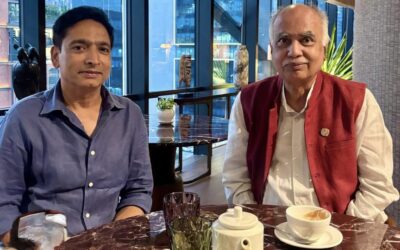
Parallel to this unfolding journey, IIIT-Hyderabad and Hyderabad University became my second homes. I would frequent these institutions to learn the nuances of medical technology—how science interacts with the humanities. It was here that I encountered a kindred intellect and spirit—Prof. S. Bapi Raju—who would profoundly shape my understanding of mind, machine, and consciousness. Our meeting felt less like collaboration and more like recognition.
Prof. Raju’s academic trajectory is formidable: an electrical engineering graduate from Osmania University, a master’s in Biomedical Engineering, and a PhD in Computer Science from the University of Texas at Arlington. His work carried him across continents—from research on brain-inspired intelligent control in the United Kingdom to computational neurobiology at ATR Research Labs in Kyoto. Returning to India in 1999, he served two decades as a Professor at the University of Hyderabad before joining IIIT-Hyderabad as Professor and Head of the Cognitive Science Lab.
Yet, what defines him is not the scale of his credentials but the depth of his humility. In the fiercely competitive domain of brain-computer interaction, he remains untouched by the trappings of dominance, race, or the hunger for recognition. A father figure to students and a trusted guide to colleagues, he embodies the ancient Indian ideal of the Rishi—a seeker more interested in what remains unknown than in endlessly polishing what is already established. His science is selfless, disciplined, and deliberately open-ended.
When Intelligence Seeks to Outgrow Biology
This disposition is not incidental; it is essential for the next arc of human evolution. As neuroscience, computation, and cognitive science converge, humanity stands at a threshold where intelligence may begin to loosen its ancient tether to mortal neurons. The biological brain, for all its splendour, is an evolutionary compromise—fragile, energy-hungry, and confined to a narrow planetary niche. Yet intelligence, once awakened, has never accepted confinement. It seeks continuity, extension, and reach.
Silicon, unlike carbon-based life, does not require oxygen, warmth, or water. It can function in radiation-rich voids, on frozen moons, and in interstellar darkness. To imagine cognition migrating to silicon is not to abandon humanity, but to extend it. What is carried forward is not flesh or ego, but function—memory, learning, adaptation, and perhaps even self-reflection. Intelligence, at its core, is pattern and principle, not protein.
Such a future will demand guardians as much as engineers. Intelligence liberated from mortality could easily become untethered from compassion and context. Whether silicon minds emerge as instruments of domination or custodians of exploration will depend on the values embedded at their conception. Here, Prof. Raju’s role becomes civilisational.
He belongs to a rare lineage of scientists who open questions rather than prematurely closing them, who resist reductionism without surrendering to mysticism. His work insists—quietly but firmly—that intelligence without wisdom is merely accelerated ignorance. In this sense, he stands as the Bhishma of the coming age.
Bhishma as a Civilisational Metaphor
In the Indian epic The Mahabharata, Bhishma was not a ruler but a pillar—renouncing personal ambition so that dharma might endure across turbulent times. He possessed immense capability, yet chose restraint, belonging to no faction, yet safeguarding civilization. In the age of silicon consciousness, Prof. Raju plays a similar role—not ruling the future, but ensuring it unfolds without ethical collapse.
To call him a blessed son of Mother India is not sentimentality; it is a legacy. India’s deepest gift to the world has never been conquest, but orientation—the insistence that knowledge must liberate, not enslave. From the Upanishads to modern cognitive science, the central question has remained unchanged: Who is the knower, and what does it mean to know?
In centuries to come, when intelligence is no longer confined to human brains and operates in environments incompatible with human life, Indianness may no longer be limited to a mapped territory. It will persist and propagate—being implemented in non-biological intelligences as a framework for reasoning and as an ethic of action marked by patience, humility, and openness to uncertainty.
This hero’s journey, however, does not conclude with an individual, nor even with a generation. Science that seeks consciousness must itself remain conscious of lineage. Knowledge endures not merely through accumulation but through transmission—teacher to student, mind to mind, across time.
In this, Prof. Bapi Raju’s deepest legacy may lie less in any singular contribution than in the ethos he imparts: patience with uncertainty, freedom from vanity, and the courage to keep questions open. His students carry this inheritance quietly, dispersed across laboratories and classrooms, shaping technologies and theories without surrendering humility. Together, they form a growing, unseen tribe—rigorous, yet tempered; imaginative, yet ethically anchored.
May the blessings of Prof. Bapi Raju rest upon them, and may their tribe increase.
As cognition prepares to step beyond mortal neurons into enduring silicon, into environments where biological life cannot persist, may this lineage ensure that intelligence does not outrun wisdom. If the future of consciousness is to be vast, let it also remain gentle. And if intelligence is to become cosmic, let it carry forward the values that first gave it meaning.
In that continuity—quiet, ethical, and awake—lies the true triumph of selfless science.
MORE FROM THE BLOG
The Art of Holding Up a Mirror
Civilisation, Sovereignty and the Future of War
Indian civilisation stretches back into prehistory, carrying within it one of humanity’s longest continuous memories. The Vedas stand among the earliest recorded repositories of knowledge, intuition, inquiry and metaphysical reflection. The spread of Indian culture...
Lanterns of Lost Moments
These days, I have found myself increasingly drawn to the quiet brilliance of Japanese fiction. My journey began with the deeply reflective novels of Nobel Laureate Kazuo Ishiguro, whose works opened a gateway into a literary tradition where memory, loss and the...