
O Mississippi
Rivers shape civilisations, nourish their fields, connect their settlements, and enter their collective memory. The Sindhu, Ganga and Kaveri helped shape the civilisation of the Indian subcontinent– a rich tapestry of kingdoms and cultures; the Nile sustained ancient Egypt and the kingdoms of Nubia in what is now Sudan. The Yellow River was one of the cradles of Chinese civilisation, while the Irrawaddy remains Myanmar’s great river artery, formerly Burma. In the Americas, the Mississippi flows through the heart of the United States, and the Amazon through the vast equatorial landscapes of South America.
I have visited one of the Nile’s headwater sources in Rwanda, sailed a few kilometres along the Irrawaddy, and visited Shanghai, the great Chinese city on the Huangpu River near the Yangtze estuary. I have also seen the Mississippi at three places along its approximately 2,340-mile course: Minneapolis, St. Louis and Memphis. In Memphis, I stood on its eastern bank. These encounters made rivers more than lines on a map for me; they became living connections between geography, history and human endeavour.
My tryst with the Mississippi came through three friendships.
In the early 2000s, I met Madhusudan Reddy, who came from near Tirupati in Andhra Pradesh. He had migrated to the United States in the 1980s and founded US Electronics in Minneapolis, specialising in medical displays and related imaging technology. Through him, we attempted to develop indigenous digital X-ray systems at Electronics Corporation of India Limited (ECIL). The project also brought me into contact with James Lupino, who worked with US Electronics. Although our effort did not culminate in a working system, it gave me something enduring: a friendship with James.
In 2008, when I accompanied Dr A.P.J. Abdul Kalam on his visit to the United States, James came to San Francisco to meet us. We then travelled together to Los Angeles. After Dr Kalam returned to India, James took me on a long flight to Minneapolis via Phoenix.
I stayed in Minneapolis for a few days, enjoying the cool weather and the quiet, unhurried atmosphere. Minneapolis and St. Paul, together known as the Twin Cities, both lie in Minnesota, with the Mississippi winding through them. Farther downstream, the river forms part of the boundary between Minnesota to the west and Wisconsin to the east.
Even now, when my imagination wanders, it sometimes returns to those riverbanks. I find myself wishing that I might live there—if not in this life, perhaps in another. My belief in reincarnation leaves room for such a quiet hope. A river disappears around a bend without ending its journey; perhaps life, too, continues beyond memory. And perhaps, in some future birth, I shall find myself beside the Mississippi, feeling at home without knowing why.
I visited St. Louis with Hamish Shahani, son of Chandru Shahani and Managing Director and CEO of Klenzaids Contamination Controls Pvt. Ltd. The enterprise his father founded in Mumbai began in the early 1970s, producing its first HEPA filter in 1971. From that modest beginning, Klenzaids helped build India’s cleanroom technology and biological containment capabilities. Its work included laboratories where carefully controlled airflow and filtration help prevent potentially harmful microorganisms from escaping into the surrounding environment. As India’s pharmaceutical and biotechnology industries expanded, such indigenous expertise helped reduce dependence on imported equipment and facilities, conserving valuable foreign exchange.
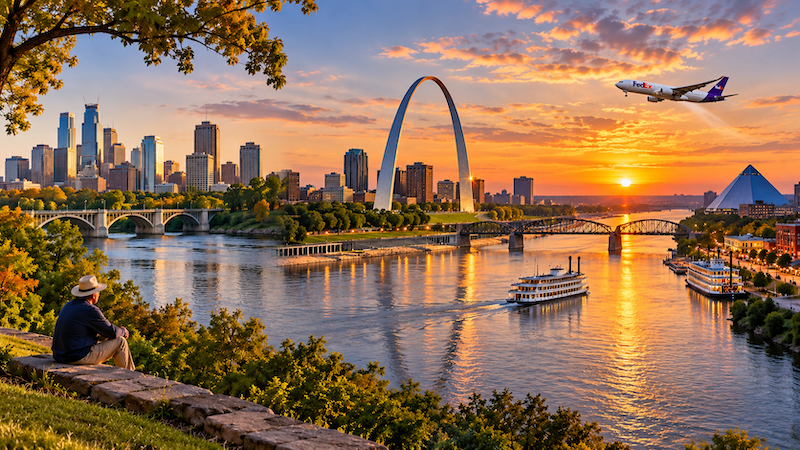
What astonished me most in St. Louis was the Gateway Arch, rising 630 feet above the western bank of the Mississippi. Its gleaming stainless-steel exterior gives this immense structure an almost weightless grace—a single, assured curve drawn against the sky. Within its legs, a specially designed tram carries visitors to the observation deck at the summit. Its reinforced-concrete foundations extend 60 feet underground. The Arch was built between 1963 and 1965, although the larger memorial project began three decades earlier. To an engineer, it is a remarkable marriage of structural discipline and artistic imagination: every hidden calculation serves the simplicity of the visible form. Nearby, the historic Eads Bridge, completed in 1874, spans the Mississippi with three graceful steel arches—an earlier expression of the engineering imagination that would later create the Arch.
In the underground theatre, we watched a beautifully made film about America’s westward expansion. The historical turning point in 1803 was the Louisiana Purchase, which doubled the country’s territory; the Lewis and Clark expedition followed in 1804. St. Louis became celebrated as the “Gateway to the West,” and the Arch gives that name a monumental form. Beside the Mississippi, I felt how a river could be both a geographical boundary and an invitation to cross it—carrying people towards possibilities they could scarcely foresee.
My visit to Memphis, in the southern state of Tennessee, gave me an opportunity to visit Professor Ramareddy Guntaka, whom I had known well before the journey through his Hyderabad connections. An eminent molecular biologist, he had made important contributions to research on collagen gene regulation and fibrosis. His work also extended to cloning and genetically characterising Indian strains of the hepatitis C virus. My friend, radiologist Dr Naiyer Imam, hosted me on that trip and accompanied me to see him.
Dr Imam drove from his home in Roanoke, Virginia, to Charlotte, North Carolina, where he left his car at the airport before we flew to Memphis. What may seem commonplace today struck me then as a small cultural revelation: a long drive, an airport parking space and an onward flight fitted together with remarkable ease. Distances that appeared formidable on a map had become ordinary arrangements in everyday life.
At Memphis airport, the rows of FedEx aircraft were an astonishing sight. I was told that every night there were some 400–500 aircraft arrivals and departures. I had understood global commerce through companies, contracts and markets; here, its physical scale stood before me. Memphis houses the FedEx World Hub, where shipments converge, are sorted and depart again through a vast network of connecting flights. Behind each aircraft lay an intricate coordination of people, machines, information and time. Some things must be seen before their meaning can be fully grasped. That airport gave the phrase “global business” a tangible form.
Memphis also brought me back to the Mississippi, this time on its eastern bank. The river had long made the city a centre of transport and trade; the aircraft were a newer expression of that enduring role. The connection fascinated me. Barges followed the river’s course, while aircraft crossed the sky, both carrying goods across distances and linking one community’s needs with another’s work. The ancient waterway and the modern air network belonged to different ages, yet served the same impulse to connect.
America’s ‘Father of Waters’ carries more than its own stream. Through its many tributaries, the Mississippi gathers water from a vast drainage basin encompassing all or parts of thirty-one American states and two Canadian provinces. As it flows, distant landscapes become part of a common journey. Standing beside it, I could understand why this river has been one of the great forces shaping the United States. Its waters have nourished fields, sustained settlements and carried trade, drawing the life of an immense interior towards the sea.
After Minneapolis and St. Louis, Memphis revealed another face of the Mississippi to me. The visit brought together the warmth of an old acquaintance, the hospitality of a friend and a glimpse of the vast machinery of world commerce. Amid it all, the river continued its unhurried passage. Modern business measured its promises in hours; the Mississippi seemed to keep a longer account of human endeavour.
I shall not be going to the United States again, and these journeys now seem almost like dreams. Yet each encounter played its quiet part in expanding my inner frontiers, leaving me with more than I had taken there. James, Professor Guntaka, Dr Imam and Hamish all live within me, their presence still glowing with warmth. The journeys are over, but something of their life continues in mine.
MORE FROM THE BLOG
The Right to an Ordinary Life
In the unhurried days of retirement, with travel now limited, I return to scenes from my earlier life through books. After graduation, as a teaching associate at G. B. Pant University, I once painted a crude copy of Van Gogh’s sunflowers to brighten the bare wall of...
One Milk, Many Marvels
For a middle-class Indian of my generation, cheese was hardly an everyday food. My first memorable encounter came late in life, in February 2006, when I travelled with President A.P.J. Abdul Kalam on his state visits to Singapore, the Philippines and South Korea. On...
Molecules, Mirrors and the Meaning of Life
When the 2026 Nobel Prize in Chemistry was announced on 7 October, I immediately thought of a scientist I have known and admired for many years—Dr. Srivari Chandrasekhar, formerly Director of the CSIR–Indian Institute of Chemical Technology, Hyderabad. The Nobel Prize...

Arunji, an interesting read. While you suggest that these journeys are over, it seems they continue to live very much within you. And perhaps that is the beauty of travel—it is a wonderful amalgamation of the places we see, the people we meet and the memories we carry home. It was also fascinating to learn about the profound impact the Mississippi has had on American life and its history.
The article is beautifully crafted, with a rare mix of geography, scenic beauty, and the association with good friends who contributed to the journey. Very educational, too.
The Mississippi River has contributed so much to American history, geography, the economy, and more. I visited New Orleans last month, mainly to sail up the Mississippi. Crossing this river from East to West by the so-called Pilgrims also brought misery to the natives.
Dear Sir, Greetings! A beautifully written and deeply reflective article, Sir. What fascinated me most is how you have transformed the Mississippi from a geographical landmark into a living metaphor for friendship, human connection, technological progress, and the passage of time.
Your experiences across Minneapolis, St. Louis, and Memphis beautifully illustrate how different generations of engineering and innovation—from bridges and monumental architecture to medical technology and global logistics—have helped humanity overcome distances. Yet, despite all these remarkable achievements, the river continues its timeless journey, reminding us that nature operates on a scale far greater than our technological ambitions.
I was particularly touched by your reflection that “A river disappears around a bend without ending its journey; perhaps life, too, continues beyond memory.” What a profound way to connect a river’s physical journey with the philosophical journey of human existence.
To me, the most meaningful message of this article is that “the true value of travel lies not in the places we visit, but in the people we meet, the perspectives we gain, and the memories that become part of who we are.” Just as the Mississippi gathers countless tributaries along its course, our lives are enriched by the people and experiences that join our journey.
Your concluding thought that these journeys have expanded your inner frontiers is especially moving. Perhaps journeys never truly end; they simply continue flowing within us as memories, wisdom, and gratitude. Thank you, Sir, for another wonderful reflection that connects geography, science, engineering, friendship, and the philosophy of life so beautifully. Warm Regards.
What a reflection…..
The narrative brings together rivers, engineering, scientific endeavour and personal relationships without losing the warmth of individual memories. The Mississippi seems to emerge as a geographical landmark, but along with that as a witness to changing eras of human enterprise and enduring friendships. The closing reflection is especially touching…. some journeys may end, but the people and experiences that become part of our lives continue to accompany us.
Oh! Wonderful. Among the long series of your memoirs, this piece stands out as a truly exceptional creation, offering a deeply engaging read. The effortless depth and grace with which you weave the milestones of your life’s journey is both astonishing and inspiring. After all, it is the rivers of time and experience that have forever nurtured and sustained civilization and consciousness.
Professor Arun Tiwari’s reflection reminds us that rivers are not merely waterways flowing across continents; they are silent carriers of memory, friendship, aspiration and grace.
His gentle contemplation of reincarnation evokes an ancient truth recognised in many traditions: that existence, like a river disappearing beyond a bend, is not extinguished but transformed.
The people who touch our lives, the places that awaken our hearts, and the ideals that inspire our work do not vanish with time; they become part of our inner landscape. Perhaps life’s deepest purpose lies not in reaching a destination but in letting every encounter widen the banks of our compassion, gratitude, and understanding, until we recognise ourselves as participants in one vast, continuous flow of human and divine connectedness.
Thank you, sir, for reminding us what matters and what is worth remembering.
Thank you, Prof. Tiwari, for this beautiful reflection on the Mississippi and the friendships that accompanied your journeys across America. I was deeply touched to see my name among those cherished memories. Your description of rivers as enduring connections felt especially meaningful, as our friendship too has continued to flow across continents and over the years.
I fondly remember our times together in 2008 and afterwards – the conversations, travels, and experiences we shared in Minnesota, Texas, California and Hyderabad. While projects and professional pursuits may come and go, genuine friendships remain among life’s greatest gifts. I have always cherished our friendship and feel grateful for the wisdom, warmth, and inspiration you have brought into my life over the years. May the river of friendship continue its journey for many years to come.
A wonderful read. I loved how you connected your travels, deep friendships and the great Mississippi River. Thank you for this thoughtful piece.
Arun ji, Thank you for sharing. Very educative. I appreciate your humility in expressing gratitude to relevant people.
Arunji, A nice blend of travel, friendship, scientific progress and personal philosophy. The Mississippi becomes more than a river here; it becomes a thread connecting cherished memories and enduring relationships. The thought of finding a familiar sense of belonging in another lifetime is especially poignant and poetic.
Prof, I hope you return to the Mississippi River in your next life! In the next phase of life, anything is possible!
Thank you for visiting the source of the River Nile in Rwanda. Indeed, the source lies in the biggest natural rainforest in Eastern and Central Africa-the Nyungwe forests.
Best wishes!
The encounters of people we meet and by extension places we visit shapes us now and influences us in ways more than one……Imagine life without such encounters? we would still think the world revolves around us. Our decisions, aspirations, things to look forward to, our future, are a cumulation of these experiences….