
Molecules, Mirrors and the Meaning of Life
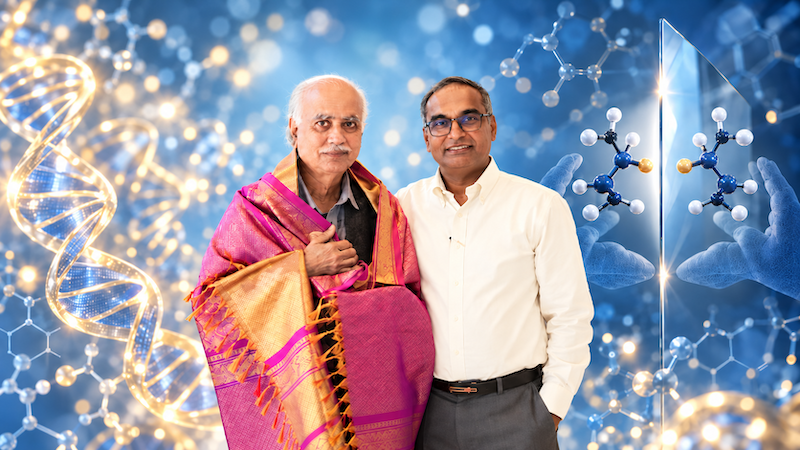
When the 2026 Nobel Prize in Chemistry was announced on 7 October, I immediately thought of a scientist I have known and admired for many years—Dr. Srivari Chandrasekhar, formerly Director of the CSIR–Indian Institute of Chemical Technology, Hyderabad. The Nobel Prize went to Henri B. Kagan and Kenso Soai for their pioneering discoveries concerning how chemical reactions can favour and amplify one of two mirror-image forms of a molecule. Their work addresses one of chemistry’s most intriguing mysteries: why does life favour one of two molecular forms that are mirror images of each other, much like our left and right hands?
In February this year, I wrote an ode titled A Scientist and a Gentleman, describing my personal bond with Dr. Chandrasekhar. I recalled how, during my first visit to his director’s office, he personally fetched a bottle of water from a small refrigerator instead of summoning an assistant. That simple gesture revealed a humility I have always associated with genuinely great scientists. I also wrote about his formidable achievements in organic synthesis, particularly his work on complex natural products and pharmaceutical compounds, as well as his contributions to developing more environmentally sustainable chemical processes.
Dr. Chandrasekhar is a leading Indian exponent of chiral chemistry and asymmetric synthesis. His work includes methods for constructing the precisely arranged molecular fragments required for complex medicines such as eribulin, an anticancer drug.
I take particular pride in having known a scientist whose work belongs to the same broad field of molecular science that this year’s Nobel Prize has brought into the global spotlight. You don’t need to land on the moon to enjoy the moonlight!
The word chirality comes from the Greek word cheir, meaning hand. To understand it, hold up your two hands with the palms facing you. Now bring them together in a Namaste, and they match perfectly. Yet, if you place one hand directly over the other, with both palms facing the same direction, they cannot be made to coincide exactly. They are mirror images but not identical objects. In the same way, two chiral molecules can have the same atoms and bonds but differ in the three-dimensional arrangement of those atoms. These two forms are called enantiomers. But why should the orientation of a few atoms matter so much?
The answer lies in the exquisite selectivity of biological systems. Enzymes, receptors, transport proteins and many other biological structures are themselves chiral. A molecule must often fit into them with the precision of a key entering a lock. A right-handed molecular key may fit beautifully; its left-handed counterpart may fit poorly, fail to work, or engage a different biological target.
Thus, the same molecular formula can conceal two very different biological identities.
This is also how chirality can create ‘impurity’. During ordinary chemical synthesis, a reaction may produce equal amounts of both mirror-image molecules, known as a racemic mixture. If only one form provides the desired therapeutic effect, the other may be regarded as an unwanted stereochemical component. Sometimes it is relatively inactive; sometimes it has a different useful effect; and occasionally it introduces serious risks.
The pharmaceutical industry has learned this lesson through costly experience. Modern drug development increasingly depends on determining which molecular form produces the desired effect and whether the other introduces undesirable consequences. Regulatory authorities accordingly require attention to stereochemical identity, purity and biological behaviour.
This year’s Nobel Prize celebrates a deeper achievement of asymmetric synthesis: chemists need not always create both forms and painstakingly separate them afterwards. They can use appropriately designed catalysts and reaction conditions to favour the desired form from the outset. Kagan’s work demonstrated how a small initial imbalance could produce a disproportionately large preference in the final product. Soai explored an even more fascinating possibility: a reaction in which the chiral product helps generate more of its own handed form, amplifying an initially tiny asymmetry.
This brings me to a question. We know that ordinary glucose is predominantly D-glucose, one particular stereochemical form. Its mirror image, L-glucose, has the same molecular formula, C₆H₁₂O₆, and can taste sweet. But the human body’s glucose transport and metabolic systems have evolved mainly to handle D-glucose. Could L-glucose therefore offer sweetness without substantially increasing blood glucose?
In principle, this is a scientifically interesting possibility. Because ordinary human metabolism does not use L-glucose in the same way as D-glucose, it has attracted interest as a potential low-calorie sweetening compound. But reduced metabolic utilisation does not automatically establish safety. Its intestinal absorption, tolerance, effects on the digestive system, manufacturing cost and long-term consequences would all require careful evaluation. No wonder L-glucose is not an established replacement for ordinary sugar for people managing diabetes.
Edible oils present a more interesting case. Oils are complex mixtures of triglycerides, molecules in which fatty acids are attached to a glycerol backbone. Some triglycerides are chiral, and the position of specific fatty acids on the glycerol backbone can influence digestion, absorption and physical properties. Digestive enzymes do not necessarily treat every molecular arrangement identically. Indeed, research into structured lipids has explored how modifying these arrangements might influence nutritional and technological behaviour.
But it would be misleading to conclude that simply increasing the proportion of right-handed or left-handed molecules would make any edible oil safer. There is no universal healthy handedness. The health effects of oils depend on many factors, including their fatty-acid composition, degree of processing, oxidation, cooking conditions and quantity consumed. Chirality and stereospecific positioning provide additional possibilities for research, not a simple shortcut to healthier food.
Asymmetric synthesis helps chemists build complex molecules with the precise three-dimensional architecture needed for biological activity. In a potent anticancer compound, an incorrectly oriented group may compromise activity or introduce an unwanted interaction. Creating the desired stereochemistry is therefore not a decorative refinement but part of constructing the intended medicine itself.
Dr. Chandrasekhar’s achievements acquire special significance in this context. His group’s research on synthesising biologically active natural products and pharmaceutical intermediates required exceptional control over molecular structure. His work on the chiral building blocks of eribulin illustrates the painstaking ingenuity involved in translating complex molecular architecture into practical chemistry.
I have spent much of my professional life observing how advances in one field make transformative applications possible in another. In defence engineering, materials that were originally developed for demanding aerospace applications found new uses in medical devices. In chemistry, the mastery of molecular handedness can similarly move from an abstract scientific problem to the construction of medicines, specialised materials and perhaps future nutritional innovations.
The field also has a philosophical dimension that fascinates me. Living organisms display a remarkable preference for molecular handedness. Proteins are built almost entirely from L-amino acids, while the sugars essential to energy metabolism and the structure of DNA and RNA predominantly belong to the D-series. The letters L and D, derived from the Latin words laevus (left) and dexter (right), distinguish two different three-dimensional arrangements of atoms, like mirror-image forms of the same molecule. This remarkable preference for one molecular form over the other is among the defining chemical characteristics of life.
It is tempting to extend the metaphor to human life. Two individuals may have similar qualifications, opportunities and intelligence, yet their character may lead them in opposite directions. Knowledge can become an instrument of vanity or an expression of service. Authority can demand submission or encourage independence. The outward structures may look similar, but their consequences can be profoundly different.
That was precisely what impressed me about Dr. Chandrasekhar. His intellectual achievements were accompanied by a disposition towards humility and usefulness. In his office, the simple act of offering a visitor water revealed something that no citation index or scientific award could measure.
The Nobel Prize celebrates a magnificent scientific achievement. For me, it also renews my appreciation for the chemists who devote their lives to mastering matter’s hidden architecture. I feel privileged to know Dr. Srivari Chandrasekhar, a scientist whose command of complex molecular synthesis belongs to this remarkable intellectual tradition.
Chirality teaches us that two molecules can be mirror images of one another and yet behave very differently in life. The same is true of human achievement. Scientific brilliance earns admiration, but when joined with humility and compassion, it becomes something greater. That is why, long before this Nobel announcement, I had come to regard Dr. Chandrasekhar as both a scientist and a gentleman. To me, he has always been a Nobel laureate in his own right, with or without the prize.
MORE FROM THE BLOG

The Right to an Ordinary Life
In the unhurried days of retirement, with travel now limited, I return to scenes from my earlier life through books. After graduation, as a teaching associate at G. B. Pant University, I once painted a crude copy of Van Gogh’s sunflowers to brighten the bare wall of...

One Milk, Many Marvels
For a middle-class Indian of my generation, cheese was hardly an everyday food. My first memorable encounter came late in life, in February 2006, when I travelled with President A.P.J. Abdul Kalam on his state visits to Singapore, the Philippines and South Korea. On...

O Mississippi
Rivers shape civilisations, nourish their fields, connect their settlements, and enter their collective memory. The Sindhu, Ganga and Kaveri helped shape the civilisation of the Indian subcontinent– a rich tapestry of kingdoms and cultures; the Nile sustained ancient...

Arunji, this was a nice read. The way you explained molecular chirality through something as simple as our two hands coming together in Namaste made a complex scientific concept so accessible. And even more beautiful was how you connected this scientific idea to human character and the choices we make in life.
Your recollection of Dr. Chandrasekhar personally fetching a glass of water is particularly touching. It is such a simple gesture, yet perhaps says more about a person’s character than many professional achievements or accolades.
You really make a great point – knowledge may earn recognition, but it is how we use it and how we touch other lives that defines our real legacy. A wonderful tribute to a scientist and, more importantly, a gentleman.
The article on molecules and their behaviour is excellent. So is the personality behind it.
Thanks for the education. For a person like me, from the electromagnetic and microwave background, chiral materials have a huge number of uses – as polarisation rotators, reduction of the radar cross-section of aircraft so that they become less detectable by the enemy’s radar and so on. The same phenomenon that ‘separates’ the L and D glucose is used here,
Sir , Firstly your principle of Chirality applied to Human achievement is just. It’s a powerful way to show that sameness on the surface says little about how well something truly fits. As a biomedical engineer, I found the D-glucose and L-glucose discussion especially thought-provoking. It shows that a molecule’s usefulness to the body depends on more than its chemical formula: what matters is whether it fits the transporters, enzymes and metabolic pathways involved. The implications reach into pharmaceuticals, nutritional science and precision medicine. Rearranging fatty acids on a triglyceride backbone may change how fat is digested and metabolised, but chirality alone doesn’t determine nutritional value. For me, the wider lesson for biomedical innovation is that biological compatibility has to be shown through experiments, not assumed because of molecular elegance
Modern scientific institutions evaluate researchers through citations, publications, patents, grants and awards. Such measures capture important forms of achievement, but they reveal relatively little about consideration for others.
A distinguished scientist may be technically exceptional yet personally arrogant. Another may combine intellectual distinction with generosity and modesty. Your essay offers a human corrective to the culture of rankings and awards.
There is also a necessary qualification: one gracious gesture cannot conclusively establish an individual’s entire character. What gives your account strength is that you present the incident within a longstanding personal acquaintance.
The essential ethical proposition is that professional excellence and moral excellence are distinct achievements, and their combination is particularly admirable.
This very interesting article acquires particular relevance in the age of artificial intelligence. AI systems can increasingly perform tasks once associated with exceptional human expertise. They can discover molecular structures, analyse biological information and support the design of medicines. Yet the distinction between capability and responsible conduct remains fundamental.
An AI system may produce an accurate molecular prediction without recognising whether its application is socially desirable. A pharmaceutical company may possess sophisticated scientific capabilities while pursuing commercial objectives that do not sufficiently serve patients. The central question therefore changes from What can science accomplish? to What should humanity choose to accomplish with science?
This makes Dr. Chandrasekhar’s example especially relevant: knowledge must remain connected to responsibility.
Respected Sir, Your remarkable ability to connect the science of molecular chirality with the deeper meaning of human existence is extraordinary. The anecdote about Dr Srivari Chandrasekhar beautifully reminds us that true greatness lies in humility and service, not merely in knowledge. Your writing and observation are truly unparalleled—you make science speak to the soul.
Matter becomes useful through the right arrangement. Knowledge becomes valuable through the right application. Human achievement becomes meaningful through the right intention.
There is an Indian philosophical expression that resonates with this conclusion:
विद्या ददाति विनयं।
Knowledge gives humility.
The traditional saying is an ethical ideal, not an automatic law: knowledge does not invariably produce humility. Rather, humility is one mark of knowledge that has matured into wisdom.
Your portrait of Dr. Chandrasekhar gives that ideal a human face.
Nice to see the ever-energetic and inspiring Dr S. Chandrasekhar. Life is not simply a collection of molecules. It is a matter arranged in particular ways, participating in organised processes. The same chemical ingredients can produce very different outcomes depending on their relationships. This extends beyond chemistry to biology, systems engineering and even human institutions.
Dear Sir, great picture and great idea of the transition from molecular handedness to human character. Two mirror-image molecules are structurally related but may produce very different biological effects. Likewise, two scientists may be equally accomplished, yet one seeks recognition while another puts knowledge at the service of others.
In chemistry, left-handedness and right-handedness are physical properties without intrinsic moral value. Neither is universally superior. In human life, humility and compassion are ethical qualities that we deliberately value. Why not say that nature teaches us that arrangement determines function? Human experience teaches us that intention and conduct determine the moral worth of achievement.
The Nobel-winning work of Kagan and Soai has implications beyond molecular synthesis. In nonlinear systems, small initial differences can sometimes become greatly amplified. Soai’s autocatalytic reactions demonstrate this phenomenon particularly vividly.
One minor decision may establish a precedent. The precedent becomes a habit. The habit becomes organisational culture. Eventually, what began as a small choice can influence an entire institution.
The underlying systems insight is powerful: Initial differences matter, but feedback mechanisms determine whether they disappear, persist or become amplified. This may be a promising extension into management and leadership.
What makes this piece particularly meaningful is the way a scientific idea becomes a reflection on the person behind the science. I especially liked the recollection of the small gesture of offering water…. such moments often reveal a person’s character more clearly than any list of accomplishments. The explanation of chirality is wonderfully accessible…..making a rather intricate subject interesting even to a reader without a chemistry background. And the analogy between molecular handedness and the different ways in which people use their knowledge and influence is a lovely thought. It is evident that your admiration for Dr. Chandrasekhar comes from personal experience and deep respect, which gives the closing tribute a warmth that goes well beyond the Nobel Prize itself.
You have raised lot of points that can be actually useful for health in coming years. Hopefully AI and smart scientists can use their individual talent to make health actually better
Arun ji, Thank you for sharing. I like your closing comment that “Chirality teaches us that two molecules can be mirror images of one another and yet behave very differently in life. The same is true of humans.” . I come from a place called Chirala in AP. A Telugu poem says that Salt and Camphor look alike, but they are different in all ways.
Arunji, tjis is a beautiful reflection connecting the fascinating science of chirality with the humility and brilliance of Dr. Srivari Chandrasekhar.
True greatness lies not only in scientific achievements but also in the simplicity and grace with which a scientist touches lives. And indeed, one need not land on the moon to appreciate its moonlight.