The Quiet Force of Purpose

The Quiet Force of Purpose

The Quiet Force of Purpose

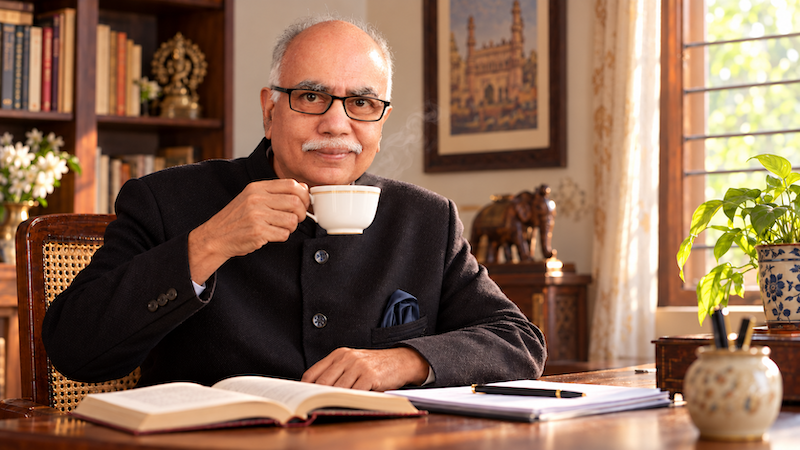
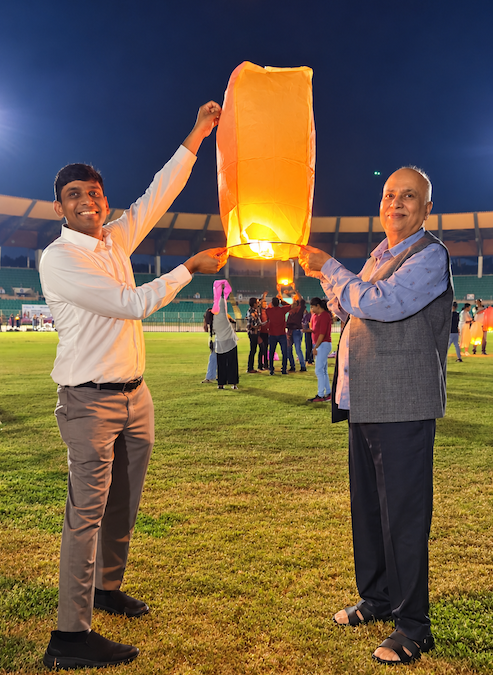
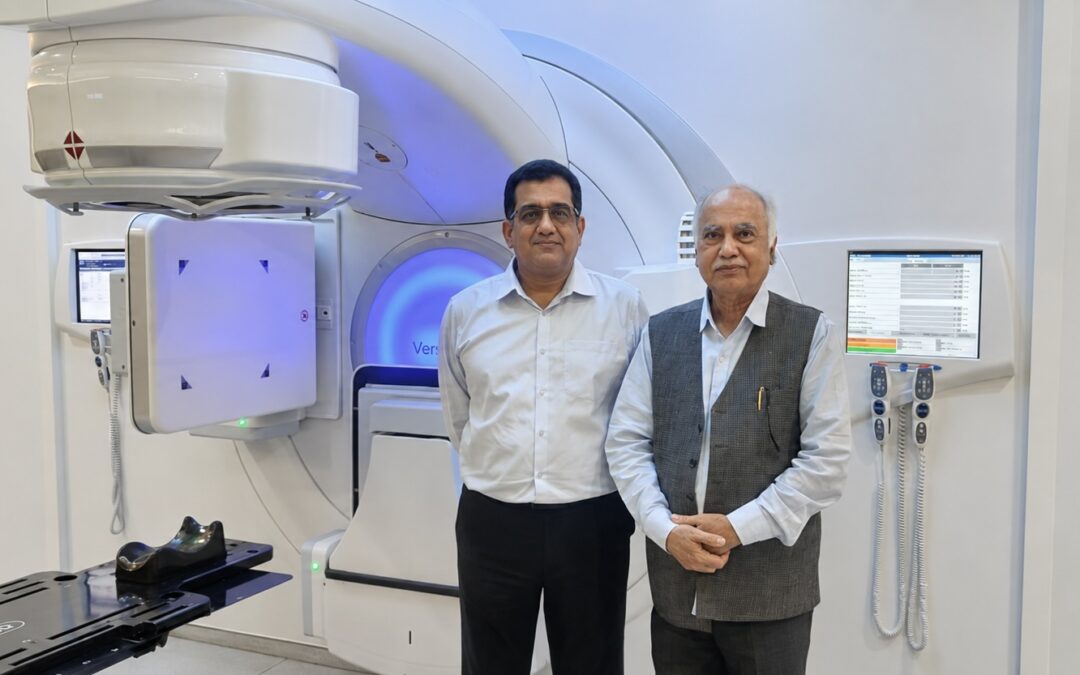
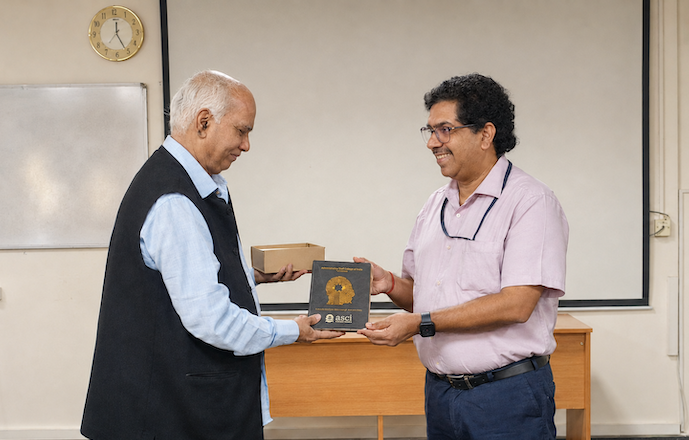
There are meetings that remain as events, and there are meetings that quietly become reflections. My recent interaction with Pavan Pidugu, graciously hosted by Dr. Chinnababu Sunkavalli at his home, belongs to the latter category. It was not a formal gathering of titles and achievements, though both were present in abundance—it was a meeting of journeys, of intent, and of that rare human quality which one recognises instinctively but struggles to name.

Pavan stood before me in a simple cotton shirt—unassuming, grounded. Yet here was a man who, since February 2025, has served as the Chief Digital & Information Officer at the U.S. Department of Transportation, reporting directly to Secretary Sean Duffy. In that moment, as he held my hand with warmth and respect, there was no hierarchy—only a quiet dignity that comes from being aligned with something larger than oneself. We sat on a sofa and spoke for an hour, and he also shuffled, talking to other guests.

Pavan’s story begins not in a metropolis, but in a village nestled in the foothills of the sacred Tirumala Hills in Tirupati. It is here that one begins to understand the first layer of his personality—the synthesis of tradition and aspiration.

His formative years were shaped within the Maharishi Mahesh Yogi Education System, an educational philosophy that integrates consciousness-based learning with modern knowledge systems. It is a system that does not merely aim to produce professionals, but individuals anchored in awareness, discipline and inner balance. In hindsight, one sees how such an education does not loudly announce itself but quietly informs every decision that follows.

Like thousands of Indian engineers of the late 1990s, Pavan arrived in the United States in 2002, carried forward by the rising tide of the global software revolution. But what distinguishes him is not the migration—it is the evolution.

He worked for Walmart at its headquarters, nestled in Bentonville, Arkansas—a place that blends the character of a Southern town, the intimacy of a small community, the dynamism of a global business centre, and the expanding energy of the Northwest Arkansas metropolitan region. Pavan entered a world where scale is not an abstract concept but a daily operational reality. Walmart is not merely a retail giant; it is a complex network where supply chains, customer behaviour and digital systems intersect on a planetary scale. Here, Pavan did not just participate—he transformed.

He led the evolution of Walmart’s global digital customer and omnichannel experience, redefining how millions of people interact with retail ecosystems. More importantly, he introduced a shift in ways of working—embedding design thinking and product management principles into the organisation’s technological backbone.

One of his defining contributions was taking charge of Walmart’s global point-of-sale systems through a rigorously fact-based decision-making framework. In a world often driven by intuition and urgency, he brought clarity, data discipline and architectural foresight. Recognition followed, as did material success—but these, one senses, were by-products rather than objectives.

Even at the height of his corporate journey, Pavan remained a student. He pursued a master’s in operations management from the University of Arkansas, and later another from Columbia University—one of the most storied institutions in the Ivy League.

He also briefly stepped into academia as an Adjunct Professor at the Rochester Institute of Technology. This movement—from industry to classroom—reveals an important trait: the desire not just to accumulate knowledge, but to share it.

Then came what Pavan himself describes as a ‘calling’.

In a decision that might appear ‘worldly-unwise’, he chose to leave a successful corporate trajectory and join the U.S. federal government, moving to Washington, D.C. It is here that the narrative deepens.

Governments around the world share certain characteristics—they are large, complex, often slow, and bound by layers of processes. Compensation rarely matches the corporate sector. Yet, they embody something that no private enterprise can fully claim: a mandate to serve.

At the Federal Motor Carrier Safety Administration (FMCSA), Pavan served as Chief Technology Officer and later rose to his current position. His work focused on transforming how technology is conceived, built and delivered within a federal institution—serving carriers, commercial vehicle drivers, and law enforcement agencies.

This is not merely about software. It is about safety, efficiency and trust across a vast national network. His recognition as one of the ‘World 100 Technology Leaders 2024’ stands as an affirmation—not just of competence, but of conviction.

My conversation with Pavan opened a deeper window into how transportation is conceptualised in the United States. In India, transport is often equated with trucks—the visible carriers of goods on highways. It is a perspective shaped by immediacy and familiarity.

But in the United States, transportation is far more expensive. It encompasses everything that moves—by road, rail, air, sea and inland waterways. It is an integrated network where logistics, infrastructure, policy and digital intelligence converge.

The U.S. Department of Transportation oversees this vast ecosystem—ensuring not just mobility, but safety, sustainability and interoperability. Agencies such as FMCSA are but one part of this larger architecture, focused on commercial motor vehicle safety, yet intricately woven into larger systems beyond themselves. This holistic approach transforms transportation from a sector into a living framework of national functionality. It is not merely about movement; it is about enabling life at scale.

India, in its rapid development, stands at an interesting juncture. The physical infrastructure is expanding impressively, but the conceptual framework—seeing transport as an integrated, multimodal system—still has room to evolve. The future will demand not just more roads, but smarter, interconnected mobility ecosystems.

Yet, beyond systems and strategies, what remains with me is the person. In Pavan, I see what Friedrich Nietzsche once described as the ‘Übermensch’—not in the misunderstood sense of dominance, but as an individual who transcends conventional limitations by aligning deeply with purpose; a person who acts not out of compulsion, but out of clarity.

And yet, Pavan remains grounded—rooted in family, in simple habits, in a life that does not seek spectacle. Such an equilibrium is uncommon. Ascending is one thing; to ascend while remaining anchored to one’s centre is another altogether. As I left that evening, I found myself thinking not just about Pavan, but about the ecosystem that produced him. 

Indian civilisation, at its best, does not merely impart knowledge—it shapes character. When this foundation is paired with quality education, global exposure, and relentless hard work, it produces individuals who can navigate complexity without losing their inner coherence. Pavan Pidugu is one such individual.

He is not an exception to celebrate, but a possibility to recognise. A reminder that in a world increasingly driven by speed and scale, it is still possible to move with purpose—and to remain human while doing so. And perhaps, that is the quiet message he embodies: true greatness does not announce itself. It can be lived simply, steadily and with a sense of responsibility that extends far beyond oneself. In Pavan lives the ideal of a life divine—a son of Mother India who neither submits to nor blindly rejects systems, but elevates them from within with mindful intelligence and a compassionate heart. May his path remain guided by clarity and grace, may his work continue to serve with quiet strength, and may his journey inspire many more to rise with purpose, wisdom and compassion.

MORE FROM THE BLOG

The Quiet Force of Purpose

The Quiet Force of Purpose

There are meetings that remain as events, and there are meetings that quietly become reflections. My recent interaction with Pavan Pidugu, graciously hosted by Dr. Chinnababu Sunkavalli at his home, belongs to the latter category. It was not a formal gathering of...

The Man Shaping Real-World AI

The Man Shaping Real-World AI

I stopped wondering about the world a long time ago. Even this waking life feels no different from a dream—strange, layered, quietly unfolding—especially if one watches carefully. Of late, I have neither been travelling a lot nor pursuing any agenda that would make me...

Technology, Post-Truth, and the Art of Storytelling

Technology, Post-Truth, and the Art of Storytelling

I count it among the quiet privileges of my life that I live in Cyberabad, that curious frontier of Hyderabad where glass and code rise together, and where the pulse of the contemporary world beats with an almost inaudible insistence. Yet, even here, amid the measured...

The Man Shaping Real-World AI

The Man Shaping Real-World AI

The Man Shaping Real-World AI

I stopped wondering about the world a long time ago. Even this waking life feels no different from a dream—strange, layered, quietly unfolding—especially if one watches carefully. Of late, I have neither been travelling a lot nor pursuing any agenda that would make me particularly relevant to the world. And yet, life continues to bring remarkable people into my orbit—many from distant continents, many who carry the unmistakable weight of achievement with an effortless grace. Meeting Srinivas Attili was one such moment.

Srini Attili, as he is called, is the Executive Vice President of the Civilian Business Group at Science Applications International Corporation (SAIC), a major American technology enterprise headquartered in Reston, Virginia. SAIC operates across multiple sectors, supporting federal agencies and state and local governments. Its portfolio is vast, its reach significant.

But what struck me about Srinivas Attili was not abstraction; it was clarity. In a world that often confuses innovation with progress, he speaks in terms of execution, trade-offs and outcomes. The approach is deceptively simple—build enterprise and mission IT capabilities that are reusable, replicable and resilient. Layer onto this the intelligent application of AI—not as a buzzword, but as a tool to enhance productivity and bend the cost curve.

Attili’s worldview is striking in its simplicity. “There are no mysteries,” he says. “What we call problems often arise because we are investing our time, money and effort in the wrong things.” Optimising the wrong thing, he suggests, is perhaps the most seductive trap of all.

His journey began far from the corridors of global technology leadership—in Narsipatnam in Anakapalle district, Andhra Pradesh. It was a landscape of quiet abundance and silent struggle. Frugality was not a choice but a way of being, practised even amidst nature’s bounty, where every resource was respected and nothing taken for granted, because abundance came only through relentless labour.

In such places, aspiration does not announce itself loudly; it germinates quietly, often waiting for a moment of ignition. For him, that moment arrived when a government-sponsored technology camp was conducted in his town. He enrolled. That single spark was enough. What followed was a trajectory shaped by curiosity and discipline: a bachelor’s degree in computer technology from Nagpur, a master’s in computer science, and an MBA in the United States. He went on to build a career across institutions such as PwC, IBM, Deloitte and McKinsey & Company—before stepping into leadership at SAIC. 

Yet, for all this global exposure, his philosophy remains grounded.

“Understand the problem before fitting a solution,” he says. “That is how you earn trust, stay relevant and deliver outcomes that endure.” He follows the startup and venture ecosystem closely, but his interest lies less in the novelty of technology and more in its translation—how ideas move from promise to operational reality. This is where many innovations falter. Execution, not imagination, is the true differentiator.

For Attili, long-term impact is not measured in quarters or headlines, but in systems that endure. One such example dates back to 2003–2004, when he helped build a portal for the U.S. Army. It allowed deployed soldiers to access education from over 100 universities through a single interface—a simple yet profound act of enabling individuals to use a benefit they had earned.

Over the years, he has witnessed waves of technological change—eBusiness, on-demand services, microservices, APIs, blockchain, cloud computing, and cybersecurity. Some trends faded; others became foundational. His lens, however, remains consistent: Does it solve a real problem? And does it endure?

On artificial intelligence, he is equally clear-eyed. AI, in his view, is not about automating workflows solely for efficiency. At SAIC, they refer to ‘mission threads’—use cases that must function reliably at scale, over time. AI must not merely execute; it must learn, adapt and improve. It must become a living system.

But Attili’s sense of mission extends beyond the corporate sphere. His association with nonprofits like Global Grace Health—focused on cancer screening and outreach to the poor in their communities—reflects a deeper commitment to human well-being. It was this shared thread that led to our meeting.

He is also mentioned as a quiet force in Dr. Chinnababu Sunkavalli’s book, Live for a Legacy, which I had the privilege to co-author. His visit to Hyderabad, and the time we spent together at Dr. Chinnababu’s home, felt less like a formal meeting and more like a conversation that lingered—like a cup of tea whose warmth stays long after it is finished.

When I asked him for advice for Indian technology entrepreneurs, he articulated a framework of elegant simplicity—the ’three E’s’: Experience of the mission; Expertise in technology; and Ecosystem orchestration. This, he explained, is about integration—connecting partners, aligning platforms, and helping institutions extract value from what they already possess. “Blessed are the mission integrators”, he said. Those words stayed with me.

Integration, in his view, is not merely technical. It is deeply human. Imagination, compassion, interpretation, articulation—these are not soft skills; they are the very forces that enable integration. Without them, excellence remains elusive. Whether one is a homemaker preparing a meal, a farmer tending crops, a teacher shaping young minds, or a nurse caring for the ill, the difference lies in seeing the act not as an isolated task, but as service to a larger cause. In that shift, peace emerges.

AI, then, is not an end. It is an enabler. A compass. A vehicle. Used wisely, it sharpens our ability to serve. Used blindly, it amplifies our confusion.

There is, perhaps, a larger intelligence at play—a quiet evolutionary force that nudges reality towards purpose. We may not fully comprehend it, but we sense its direction. And in that unfolding, human beings remain uniquely placed—not as masters, but as participants.

As I listened to Srini speak of integration—of mission threads, ecosystems and enduring systems—I could not help but reflect on our own landscape in India. Ours is, in many ways, a fragmented system. Each Ministry often beats its own trumpet. Departments tend to become domains, and domains quietly harden into fiefdoms. For a vast nation of extraordinary capability, there is still no institutional equivalent of Science Applications International Corporation—an entity that exists to integrate, to harmonise, to make the whole greater than the sum of its parts.

In far too many places, “our way is the highway” remains the unspoken doctrine. And so, despite undeniable progress—new flyovers arching across cities, skyscrapers rising with confidence, shopping malls redefining consumption—the deeper questions persist. The poor are not only poor; they are often underserved, even unserved. Primary education struggles for attention. Primary healthcare access is uneven. People like farmers, agricultural labourers, fishermen, etc.—the invisible backbone of the nation—continue to live their own fate, as spectators to a narrative of development that unfolds around them but not always for them.

They watch speeches. They watch cricket matches. They witness the symbols of growth. But beneath their feet, the water table recedes. Yet even as they remain on the margins, global supply chains quietly enter their modest kitchens—bringing both opportunity and disruption. It is not intent that fails; it is, more often, the failure to integrate.

What we need today are not merely technologies—or policies drafted in isolation—but integrators: individuals and institutions with the capacity to see across silos, align incentives, connect disparate systems, and carry outcomes through time. Most organisations rarely fail because they lack ideas. They falter because they scale what should never have grown, sustain revenue that adds little value, and defer the hard choices that clear thinking compels. In the end, success does not belong to those who know more—it belongs to those who connect, choose and act in time.

We need Srinis. Not as exceptions, but as a growing tribe. Men and women who understand that true progress lies not in isolated excellence, but in orchestrated harmony; who recognise that the real power of AI—or any technology—emerges only when it is embedded within systems that serve a coherent purpose. Progress is not about building more systems. It is about making systems work together. That is the work that lies before us. May many more like him rise.

MORE FROM THE BLOG

The Quiet Force of Purpose

The Quiet Force of Purpose

There are meetings that remain as events, and there are meetings that quietly become reflections. My recent interaction with Pavan Pidugu, graciously hosted by Dr. Chinnababu Sunkavalli at his home, belongs to the latter category. It was not a formal gathering of...

The Man Shaping Real-World AI

The Man Shaping Real-World AI

I stopped wondering about the world a long time ago. Even this waking life feels no different from a dream—strange, layered, quietly unfolding—especially if one watches carefully. Of late, I have neither been travelling a lot nor pursuing any agenda that would make me...

Technology, Post-Truth, and the Art of Storytelling

Technology, Post-Truth, and the Art of Storytelling

I count it among the quiet privileges of my life that I live in Cyberabad, that curious frontier of Hyderabad where glass and code rise together, and where the pulse of the contemporary world beats with an almost inaudible insistence. Yet, even here, amid the measured...

Technology, Post-Truth, and the Art of Storytelling

Technology, Post-Truth, and the Art of Storytelling

Technology, Post-Truth, and the Art of Storytelling

I count it among the quiet privileges of my life that I live in Cyberabad, that curious frontier of Hyderabad where glass and code rise together, and where the pulse of the contemporary world beats with an almost inaudible insistence. Yet, even here, amid the measured rhythm of machines and meetings, there comes a moment when the mind turns restless in its own enclosure—when the walls of one’s study, however familiar, begin to feel like a narrowing horizon.

It is then that I step out, not so much in search of diversion as in search of renewal, and find myself drawn, almost instinctively, to institutions—those living spaces where thought gathers, where ideas are not merely spoken but shaped, contested, and, in their quieter moments, allowed to become the future. These visits unfold as small, inward journeys—intellectual pilgrimages, if one may call them so—where the act of arriving is itself a kind of reflection.  

Of all such places, the International Institute of Information Technology Hyderabad has, over time, become a point of gentle return. There is, upon entering its campus, a peculiar stillness—not an absence of activity, but a presence of thought. The corridors seem to hold a subdued resonance, as though they remember conversations not yet concluded, and discoveries not yet made. One walks through them with a certain attentiveness, sensing that beneath the visible order of classrooms and laboratories there moves an undercurrent of inquiry, of possibility, of futures quietly assembling themselves out of the discipline of the present.

During a recent visit, I found myself lingering through an entire forenoon with Vineet Gandhi, who leads the Centre for Visual Information Technology. Conversations with researchers have a cadence of their own—they seldom declare their destination at the outset. The meeting, arranged at the behest of Deepti Gaddam, Managing Director of Ozone Hospitals and a successful technology curator, began almost ceremonially with introductions. Then, as if yielding to a deeper current, it unfolded through stories of journeys and ideas. What is termed incubation in computer science revealed itself, in that room, as something more intimate—a quiet humanisation of technology.  

Vineet’s own journey seems to trace the quiet arc of a new generation of global Indian scientists. Born in Pipar City (पीपाड़), a small town in Jodhpur district, and schooled in Ajmer, he carries within him that early geography of modest beginnings, which so often widens, rather than limits, one’s horizon. From there, he moved to the Indian Institute of Information Technology, Design and Manufacturing, Jabalpur, graduating in 2009, and soon after, as if answering a larger summons, left for Europe on the prestigious Erasmus Mundus programme. 

Within the CIMET consortium—Colour in Informatics and Media Technology—Vineet’s education unfolded across intellectual and geographical landscapes, weaving together disciplines and cultures into a single, evolving inquiry. His master’s programme unfolded as a passage across borders—one semester in Spain, another in Norway—each landscape offering not merely a change of place but a shift in intellectual temperament. By the time he arrived at the National Institute for Research in Digital Science and Technology in France to complete his thesis, the journey had already begun to assume the quality of a quiet synthesis. It was there that he remained to pursue his doctoral work in applied mathematics and computer science under Rémi Ronfard, a pioneer in the intriguing field of Computer Theatre—where storytelling does not merely borrow from computation, but is reshaped by it, finding new grammars of expression at their intersection.

 In 2015, Vineet returned to India, as though completing a wide arc, and joined the International Institute of Information Technology – Hyderabad as a Senior Research Scientist. Over the years, he has grown into a steady and thoughtful presence within its research community, and today, as an Associate Professor, he contributes to its vibrant ecosystem in visual computing and artificial intelligence. Alongside his academic work, he serves as Chief Scientific Advisor at Animaker Inc., where his insights flow outwards—translating the abstractions of computer vision into tools creators across the world use, often without pausing to consider the science that enables them.

This dual inhabitation—one foot anchored in the reflective quiet of academia, the other stepping into the restless terrain of real-world innovation—suggests a new form of scholarship. The researcher is no longer confined to the slow, solitary afterlife of published papers; knowledge now seeks embodiment, moving outwards into platforms and products that subtly reshape how the world sees, tells, and remembers its stories.  

Listening to Vineet in person, whom I had previously knownonly through the media, I became aware—almost with a certain humility—of how little I truly understand of media technology. My relationship with cinema has largely been that of a spectator, one who receives images as they appear, without perceiving the intricate and invisible machinery that gives them form. And yet, in that moment, it seemed that behind every frame there lay not only technique, but an entire architecture of thought—patient, precise, and quietly transformative.

For me, digital media long remained a distant, almost mythical realm beyond engineering. Steve Jobs changed that perception—building Pixar into a pioneer of digital storytelling, and later reshaping not only music, but also how it was produced, distributed, and valued through the iPod and iTunes. In doing so, he showed how computation, creativity and narrative could converge to redefine entire creative industries.

 Today, as we watch television or scroll through digital media, certainty itself seems to waver: is what we see real or fabricated, truth or simulation, human-made or machine-generated? These questions have stayed with me as I work on The Mirror and the Maze, my new book about a post-truth world—an environment in which objective facts recede, and perception is shaped more by emotion, belief and repeated narratives than by verifiable reality. Technology has given us the power to simulate reality—but with it comes a deeper philosophical unease about what reality now means.

Yet this uncertainty did not arrive overnight. The modern world has already lived through a quiet cognitive revolution—brought about not by books, but by cinema. While books, for centuries, remained the preserve of the literate and even within that, a reflective minority, films crossed those boundaries with ease. They spoke in images, emotions, and archetypes, reaching millions simultaneously, imprinting ideas with a force that text alone rarely achieves. Cinema did not merely entertain; it reshaped perception itself, training societies to see, feel and believe through narrative.

At the heart of every memorable film lies a story—an emotional thread that binds image to meaning and moment to memory. Films like Mayabazar and Mother India have shaped a civilisation’s sense of heroism and duty, while The Godfather and The Wolf of Wall Street expose the darker undercurrents of power. Even the recent Dhurandhar reflects the anxieties of nationhood, where visible narratives meet unseen forces.

And yet, beneath these varied expressions, something remains unchanged. Technology may refine the instruments of storytelling, but the human hunger for stories is insatiable, for we continue to seek the meaning of our own existence. What gives a film its life is not the apparatus, but the story it carries—a quiet bridge between what we see and what we feel. A great film is one in which the audience finds something of themselves.

My conversation with Vineet Gandhi unfolded in his modest chamber, suffused with the unmistakable stillness of a scholar’s workspace. On one wall stood a large, old-fashioned green board rather than the whiteboards in vogue today. He uses dust-free chalk sticks imported from Japan. “A couple of sticks last an entire semester”, he said, almost as an aside, with a gentle smile.

Before I left, he placed a few of those chalk sticks in my hand as a parting gift, thanking me for coming—small objects, yet curiously weighty in their suggestion. They seemed to remind me that, for all the sophistication of artificial intelligence and digital media, learning still begins in simplicity: a teacher, a board, and an idea slowly taking shape through the movement of a hand.

MORE FROM THE BLOG

The Quiet Force of Purpose

The Quiet Force of Purpose

There are meetings that remain as events, and there are meetings that quietly become reflections. My recent interaction with Pavan Pidugu, graciously hosted by Dr. Chinnababu Sunkavalli at his home, belongs to the latter category. It was not a formal gathering of...

The Man Shaping Real-World AI

The Man Shaping Real-World AI

I stopped wondering about the world a long time ago. Even this waking life feels no different from a dream—strange, layered, quietly unfolding—especially if one watches carefully. Of late, I have neither been travelling a lot nor pursuing any agenda that would make me...

Technology, Post-Truth, and the Art of Storytelling

Technology, Post-Truth, and the Art of Storytelling

I count it among the quiet privileges of my life that I live in Cyberabad, that curious frontier of Hyderabad where glass and code rise together, and where the pulse of the contemporary world beats with an almost inaudible insistence. Yet, even here, amid the measured...

Awakening the Atom: India’s Quiet Energy Revolution

Awakening the Atom: India’s Quiet Energy Revolution

Awakening the Atom: India’s Quiet Energy Revolution

It is one of history’s great ironies that nuclear energy—arguably among humanity’s most profound technological achievements—remains burdened with the shadow of destruction. The association is not without reason; it was forged in the searing memory of the Hiroshima bombing on 6 August 1945, during the final stages of World War II, when the atom first revealed its terrifying power. And yet, in the decades since, that same force has quietly transformed into one of the cleanest and most sustainable sources of electricity we know. When India’s Fast Breeder Reactor at Kalpakkam recently went critical, it stirred in me a cascade of memories—most vividly, my visit in 2007 to the reactor ‘Bhavani’ as part of President A. P. J. Abdul Kalam’s entourage.

I remember standing before a structure of such immense scale and complexity—its vast volumes of reinforced concrete and steel descending deep underground, layers engineered, cooled and shielded to contain a force that, once critical, cannot simply be switched off—that it redefined my sense of what human endeavour can achieve. Today, when public celebrations often gather around bridges and skyscrapers, I am struck by how little we recognise these deeper infrastructures that sustain civilisation. We have grown accustomed to admiring the visible and the ornate, while remaining largely unaware of the invisible forces—and the monumental systems, buried beneath our feet—that quietly hold our world together.

At the foundation of this journey stands Homi J. Bhabha—a visionary who not only imagined India’s atomic future but also built the institutions to realise it. With the support of the Tata Trusts and the visionary backing of J. R. D. Tata, he established the Tata Institute of Fundamental Research in 1945, laying the foundation for India’s advanced scientific research ecosystem. In 1954, he articulated the three-stage nuclear programme, a uniquely Indian strategy designed to convert limited uranium and abundant thorium into long-term energy security. His untimely death on 24 January 1966, in the crash of Air India Flight 101, bound for London and lost over Mont Blanc in the Alps, did not extinguish this vision. It endured—quietly, persistently—through generations of scientists, and through a political leadership that grasped the long arc of national interest. That the first stage now stands effectively realised in April 2026 is not merely a technical milestone; it is a civilisational marker of patience, continuity and resolve. 

The elegance of Homi J. Bhabha’s vision lies in its alignment with India’s natural endowment. With modest uranium reserves but vast thorium deposits, the programme unfolds in three deliberate stages: heavy-water reactors using natural uranium; fast breeder reactors that multiply fissile material, a material that can split and release energy to sustain a nuclear chain reaction; and, finally, thorium-based systems capable of sustaining energy production for centuries. For a country of over a billion people, the demand for energy at scale is not a choice but a necessity—one that cannot be met without harnessing the power of the atom. This is not just an energy strategy; it is a blueprint for sovereignty—transforming scarcity into abundance through science.

Yet, within this design lies a deeper strategic insight. The world remains fundamentally dependent on uranium—a resource India possesses only in limited measure—while thorium, abundant along India’s coasts, remains largely untapped globally. Bhabha’s pathway recognised that thorium cannot release energy on its own; it must first be ‘awakened’. During the fast breeder stage, plutonium is produced, which in turn serves as the trigger, converting thorium into uranium-233—a fissile material capable of sustaining a nuclear chain reaction. In this elegant act of scientific alchemy, India turns its constraint into strength: using what is scarce to unlock what is abundant, and thereby securing an energy future that is not only self-reliant but potentially inexhaustible.

Yet such a vision was never destined for haste. The programme’s long gestation arises from its very architecture. Each stage depends on the successful completion of the one before it; the second cannot proceed without the first, nor the third without the second. The technologies involved are among the most complex humanity has attempted. Fast breeder reactors operate under high neutron flux and demanding engineering conditions, while thorium must first be converted into uranium-233 through a multi-step fuel cycle before it becomes usable as nuclear fuel. Every step demands precision, validation and time. 

To this intrinsic difficulty was added the weight of history. After the Smiling Buddha, India faced decades of technological isolation under regimes such as the Nuclear Suppliers Group. What many nations could access through global collaboration, India had to build painstakingly from first principles. This constraint undoubtedly slowed progress, but it also forged a rare kind of resilience. The programme that emerged is not derivative; it is deeply indigenous—shaped by necessity, refined through persistence, and strengthened by self-reliance. If anywhere in the world there exists a nuclear programme that can truly claim to be homegrown in spirit and substance, it is India’s.

History reminds us that science has often advanced through the movement of minds across borders. Albert Einstein, an immigrant to the United States, reshaped modern physics; Enrico Fermi, Leo Szilard and Edward Teller were among those who carried Europe’s intellectual legacy into America’s nuclear enterprise. India’s journey, by contrast, unfolded largely without such external inflows—its strength arising from within. In that sense, its achievement is not only technological but civilisational: a demonstration that sustained vision, even under constraint, can build capabilities as profound as any assembled through the advantages of global mobility.

Hereafter, the future moves forward with quiet certainty. With the breeder stage going critical at Kalpakkam, India begins to multiply its fissile resources, preparing the ground for the thorium era. In the coming decades, thorium-based reactor technologies are expected to progress from experimental stages to potential deployment, positioning India among the leading nations in industrialising this fuel cycle. In parallel, nuclear energy is likely to integrate with renewables, helping anchor a stable, clean energy grid. Beyond its borders, India may emerge as a provider of nuclear technologies and frameworks for the Global South—offering not just systems, but a philosophy of building under constraint. 

In reflecting on the journey so far, I consider myself deeply fortunate to have met R. Chidambaram and Anil Kakodkar on several occasions and to have experienced their warmth and affection. As a mechanical engineer, I was struck when Kakodkar Sahib shared that he, too, came from the same discipline. Verghese Kurien, himself a mechanical engineer, embodied the same truth—that excellence is not confined by formal training. Perhaps that is the quiet law of great endeavour: those who surrender to the work before them often transcend their own boundaries, as if carried forward by a larger current of energy.

I have also been privileged to share a long-standing association with Sudhakar Potluri, who devoted a lifetime to atomic energy and later served as Chairman of the Electronics Corporation of India Limited. From him, I gained an appreciation of the extraordinary electronic engineering that underlies nuclear power—the seamless conversion of heat into steam, the precise running of turbines, and the generation of electricity in systems where ‘never a fault’ is not merely an ideal but an uncompromising necessity. As for me, my journey has been modest; I remain a small fry in the presence of such towering individuals, grateful simply to have been a fellow traveller in a boat steered by Dr. Kalam—much like an isotope held in careful balance.

MORE FROM THE BLOG

The Quiet Force of Purpose

The Quiet Force of Purpose

There are meetings that remain as events, and there are meetings that quietly become reflections. My recent interaction with Pavan Pidugu, graciously hosted by Dr. Chinnababu Sunkavalli at his home, belongs to the latter category. It was not a formal gathering of...

The Man Shaping Real-World AI

The Man Shaping Real-World AI

I stopped wondering about the world a long time ago. Even this waking life feels no different from a dream—strange, layered, quietly unfolding—especially if one watches carefully. Of late, I have neither been travelling a lot nor pursuing any agenda that would make me...

Technology, Post-Truth, and the Art of Storytelling

Technology, Post-Truth, and the Art of Storytelling

I count it among the quiet privileges of my life that I live in Cyberabad, that curious frontier of Hyderabad where glass and code rise together, and where the pulse of the contemporary world beats with an almost inaudible insistence. Yet, even here, amid the measured...

Water, Wisdom and the Fortitude of the Indian Farmer

Water, Wisdom and the Fortitude of the Indian Farmer

Water, Wisdom and the Fortitude of the Indian Farmer

There are days that begin as routine engagements and quietly unfold into moments of reflection—days that leave behind not just memories, but also a gentle reordering of one’s thoughts. My visit to the ICAR – Central Research Institute for Dryland Agriculture (CRIDA) in Hyderabad on the occasion of World Water Day, celebrated every year on March 22 under the aegis of the United Nations, was one such experience. What began as a social commitment turned into an encounter with science, governance, and, most importantly, the enduring fortitude of the Indian farmer. 

My journey to this moment has been, in many ways, a continuum of seemingly disparate paths. From my early days in defence research, working under the visionary leadership of Dr. A. P. J. Abdul Kalam on civilian spinoffs of defence technologies, to later stepping into healthcare and contributing to the development of affordable coronary stents, I have often found myself moving across domains. Telemedicine drew me further into global collaborations, connecting institutions across continents, and eventually, these experiences led me—almost organically—into agriculture and rural development. 

Perhaps that is why, when Dr. Vinod Kumar Singh invited me to participate in the Water Day celebrations at CRIDA, I accepted without hesitation. Dr. Singh is an alumnus of G. B. Pant University, my alma mater, and he worked for 18 years in Meerut, my native place. Also, there was a sense of returning to a set of questions that lie at the heart of our civilisation: how we use water, how we grow food, and how we sustain life itself. 

The morning unfolded in three distinct yet interconnected encounters. I reached the institute early, thanks to the quiet Sunday traffic, and spent some time with Dr. B. M. K. Raju, Head of Statistics. What he shared was both simple and profound. In a field study conducted within the same region, with identical seeds, soil and water conditions, maize yields ranged from 3 to 15 quintals per acre. Such variability, he explained, is not accidental. It reflects a complex interplay of management practices, timing, micro-climatic variations and subtle human decisions. 

In that moment, his observation crystallised into a striking insight: artificial intelligence, at its core, is nothing but real-time statistics. Behind the sophistication of algorithms lies the same fundamental principle—recognising patterns, understanding variability, and making decisions under uncertainty. What we often perceive as a technological leap is, in essence, a more refined way of seeing what has always existed within the fabric of reality.

The second encounter brought me face-to-face with the benevolent side of governance. I met Sri M. Kodanda Reddy, a seasoned political leader whose presence carried both experience and quiet conviction. As we spoke, he affectionately embraced me and said that I carried the aura of Dr. Kalam—a remark that moved me deeply, for it reflected not just personal warmth, but the enduring imprint of a great soul on those he touched. He then recalled his time as an MLA, when President Kalam addressed the Andhra Pradesh Assembly, and how that moment had left a lasting impression on him.  It served as a reminder of how ideas, when supported by committed individuals, can travel across institutions and geographies, leaving a lasting impact.

Our conversation turned to the role of elected representatives in translating ideas into action. A dedicated MLA or MP, he said, does more than allocate funds; he or she creates visibility, aligns administrative attention and brings the weight of the system behind meaningful initiatives. Publicity, often dismissed as superficial, can become a powerful catalyst when aligned with purpose. It ensures that good work is not only accomplished but also seen, replicated and scaled.

Yet, the most enduring part of the day lay not in discussions of data or governance, but in my interaction with the farmers who had gathered for the event. These were individuals of modest means, invited to be recognised for their work in water conservation. Their presence carried a quiet dignity—yet beneath it lay something stronger: fortitude shaped by uncertainty, climate variability and systemic inequities. 

There was a language barrier between us, but it seemed almost irrelevant. Many came forward, shook my hand and communicated through their eyes—a silent exchange of warmth and respect. There was something deeply moving in that unspoken connection, as though we were acknowledging, without words, a shared understanding of effort, endurance and purpose. 

When I addressed them, I spoke in Hindi, reflecting on their role in sustaining life itself. It is easy to overlook the sheer scale of what they do: producing just one kilogram of paddy requires nearly 3,000 litres of water. Yet, the economic structures surrounding agriculture seldom recognise this hidden cost. Farmers bear the burden of production, while much of the value is appropriated by intermediaries. The system, in many ways, remains deeply misaligned—both economically inefficient and ecologically unsustainable. One is compelled to ask: by what logic must India produce water-intensive Basmati rice for export—and for whose benefit? Is our water, after all, without value?

We speak of scarcity, yet continue to design systems that encourage waste; we celebrate productivity, yet rarely reward stewardship. What emerges is a deep paradox—one that technology alone cannot resolve. It calls instead for a fundamental rethinking of our incentives, our policies and, above all, our values. Water has never been seen as a commodity.

Rivers, in our civilisational consciousness, are not mere channels of water—they are mothers; and rain is seen as a benediction from the heavens. When I spoke of the Godavari and Krishna as mothers, the entire audience responded with spontaneous applause—an instinctive affirmation of a truth they have lived with, not merely learned. In that moment, it became evident that this is not symbolism alone, but a deeply internalised way of relating to nature. This cultural memory carries profound ecological wisdom. It reminds us that sustainability is not a modern construct to be engineered, but an ancient practice to be remembered—one that we have gradually drifted away from, even as its relevance has only grown stronger.

On a lighter note, I shared a simple thought with the farmers: that amidst all the discussions of water scarcity, each of us should at least ensure we drink three to four litres of water a day—the most basic foundation of health. It drew laughter and applause, but it also carried a subtle message—that even in complexity, there is space for simplicity. 

As the event concluded, I was presented with a Kondapalli bullock cart—a handcrafted toy that carries a history of over 400 years. Made from softwood sourced from nearby hills, these artefacts represent not just craftsmanship, but a way of life rooted in patience, precision and continuity. They are reminders that tradition, when preserved with care, becomes a living bridge between the past and the present. 

As I drove back home, I found myself reflecting on the quiet coherence of the day. Science, governance and culture—often treated as separate domains—had come together in a single narrative. And at the centre of it all stood the farmer: resilient, adaptive and quietly steadfast.

In a world increasingly defined by complexity, speed and abstraction, there is something profoundly reassuring about this grounded strength. It reminds us that beneath layers of systems and structures lies a core that continues to sustain us—a core built on effort, trust and a deep, almost instinctive connection to the land.

Perhaps that is the quiet lesson this day offers. That progress is not merely about adding new layers of technology or policy, but about rediscovering and strengthening what already exists. The future of water, agriculture and sustainability may not lie solely in grand solutions, but in the careful alignment of knowledge, intent and human values.

And above all, that amidst all our discussions of scarcity and crisis, there remains a quiet, enduring abundance—in the fortitude of our farmers, in the wisdom of our traditions, and in the possibility of doing things differently, if only we choose to see clearly.

MORE FROM THE BLOG

The Quiet Force of Purpose

The Quiet Force of Purpose

There are meetings that remain as events, and there are meetings that quietly become reflections. My recent interaction with Pavan Pidugu, graciously hosted by Dr. Chinnababu Sunkavalli at his home, belongs to the latter category. It was not a formal gathering of...

The Man Shaping Real-World AI

The Man Shaping Real-World AI

I stopped wondering about the world a long time ago. Even this waking life feels no different from a dream—strange, layered, quietly unfolding—especially if one watches carefully. Of late, I have neither been travelling a lot nor pursuing any agenda that would make me...

Technology, Post-Truth, and the Art of Storytelling

Technology, Post-Truth, and the Art of Storytelling

I count it among the quiet privileges of my life that I live in Cyberabad, that curious frontier of Hyderabad where glass and code rise together, and where the pulse of the contemporary world beats with an almost inaudible insistence. Yet, even here, amid the measured...