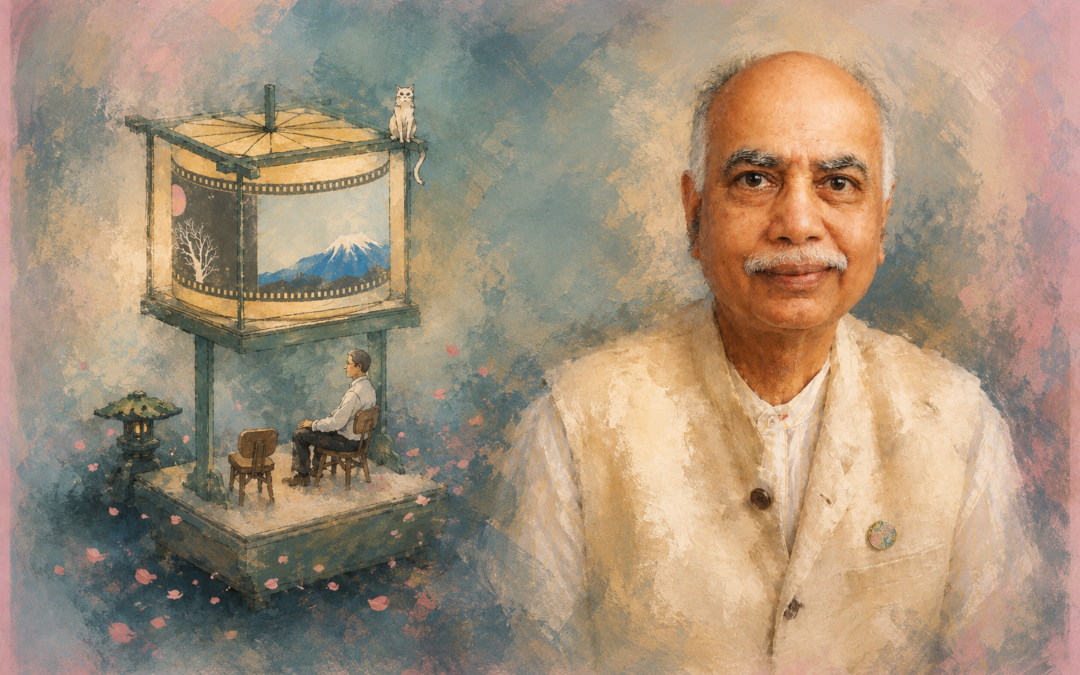
Yoga Vasishtha Walks into Nolan’s Dream

Yoga Vasishtha Walks into Nolan’s Dream

Yoga Vasishtha Walks into Nolan’s Dream

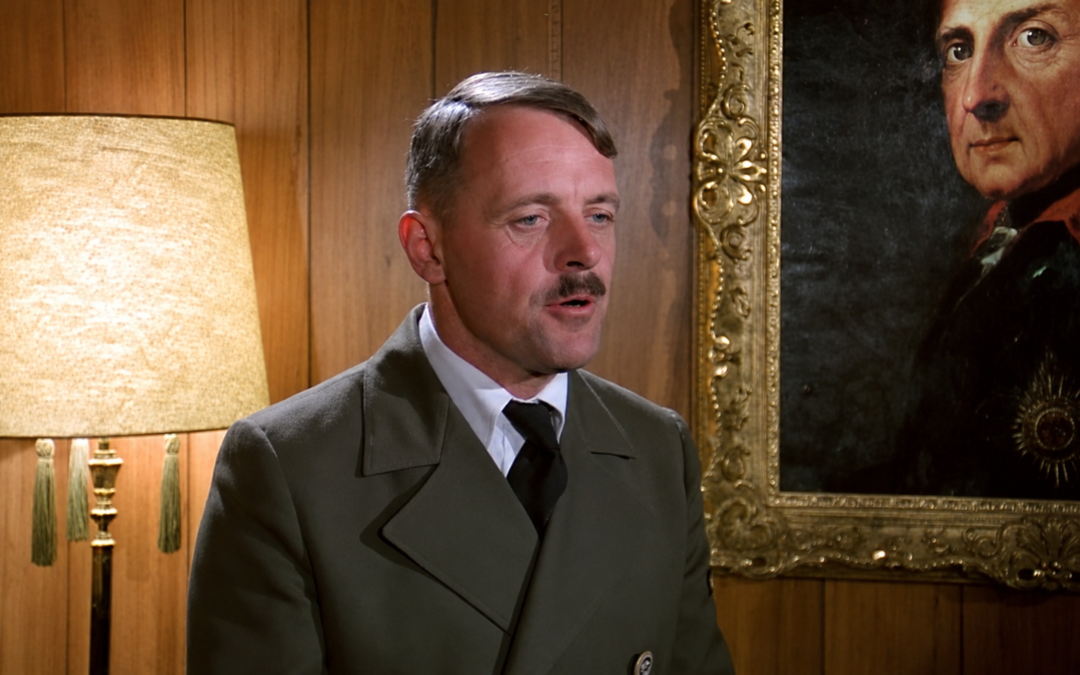
I watched Christopher Nolan’s Inception when it was released in 2010, back when going to the theatre still felt like an event. The film is centred around the idea of entering and manipulating dreams, slipping into layers of the mind as easily as walking through doors. In that world, the only reliable test for what is real is a small spinning top: it falls in reality, but in a dream, it spins endlessly. When the film ended, I stayed in my seat as the credits faded and the screen turned dark. I didn’t fully understand what I had just seen, yet it held me completely. It felt as if I, too, was left hanging between two worlds, just like the final top that wobbles but never reveals the truth.

It was in such a moment—breath held between realities—that I heard a whisper. Not the soft murmur of Hollywood, but the calm voice of Vasishtha Muni, guiding the young prince Rama in a world just as uncertain, though untouched by our screens and cities.

Two worlds, separated by time, touched in that hush after the credits. What Nolan filmed with architecture and mirrors, Vasishtha painted with words and silence. Both asked us the question we fear the most—What if everything we call real is but a dream of the mind? And suddenly, cinema dissolves, and the scripture breathes.

Imagine a thin sheet of light hanging in the air. Then another settles over it, and then another, until hundreds of soft, see-through layers glow gently on top of each other. Try, if you can, to tell which veil came first, and which followed; which is the original and which is only a reflection. Impossible? That is how the world feels in Inception—layers folding into layers, dreams rippling beneath deeper dreams, and reality slipping like silk between the fingers.

We, too, grew up in such dreams. Our childhood longings mingle with another’s yearnings; together, they weave a new fabric of shared hopes, fears and compromises. Two adults marry, harbouring their individual dreams. When children arrive, they bring their own embryonic worlds to manifest. As they grow, love, and choose partners, more dreams enter the tapestry—strange, beautiful, conflicting. Soon, the house is full of overlapping universes: ambitions brushing against disappointments, laughter spilling over silence, tenderness meeting fatigue.

And somewhere in that swirl, you pause, bewildered. You watch people adjust, resist, laugh, quarrel, surrender, and rise again—actors in a play they did not write, yet feel compelled to perform. You begin to doubt what is real. Was that happiness or habit? Anger or exhaustion? Was that a promise or simply a line rehearsed too often to question?

Veil after veil. Dream upon dream. And at the heart of it all, a quiet whisper: What is the waking world, and when did I fall asleep? And is this not what Vasishtha Muni said to young prince Rama?

“This world is as real as the dream you see every night.” (Yoga Vasishtha 7.168.20).

A gentle sentence, terrifying in its simplicity. The words sound so true when I, now 70 years old, sit on the ledge of memory, unable to tell whether I stand on solid ground or the edge of a subconscious abyss.

In the film Inception, we see cities rise and collapse, time stretch, and staircases loop — the mind building worlds as effortlessly as a child breathes. Valmiki captured this much earlier in the Yoga Vasishtha, which he wrote after the Ramayana: “Every thought shapes a universe” (4.4.15). Queen Chudala becomes a young monk boy, Kumbha, to test her husband, Shikhidkwaja; Lila meets another Lila from a future life. King Gadhi turns into a Chandala. Four clones of Vipaschit spring up, each living differently and transmigrating into different loops. Every emotion seeds a reality. It is not merely a filmic trick; it is metaphysics with a pulse.

But before you call it a puppet show, there is no puppeteer here. Like Cobb in the film, we are followed not by policemen but by our past—our guilt crystallised into the exquisite and dangerous form of Mal, Cobb’s wife. She enters every dream, slicing the fabric of illusion, not to set him free, but to drown him deeper in his own remorse. We all live the scripts we ourselves write, but wonder when they roll out as our fate. How brilliantly the Yoga Vasishtha created the scene in the palace of Ayodhya: a teenage Rama, back from a pilgrimage, haunted by the question: What is the point of this world? Why do we suffer, love, lose, wage war, dream, and despair?

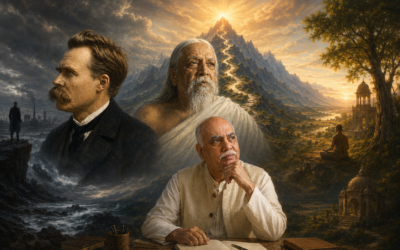
Memory binds the human mind. A prince and a thief, a royal and a fugitive, a billionaire and a pauper—all sit captive in the chambers of their own minds. Vasishtha Muni murmurs, like a wind through leaves, “The impure and confused mind, haunted by the ghost of multiplicity, creates a world of duality and illusion” (6.23.21). And so, Nolan shows us a man sinking in his subconscious oceans; Vasishtha shows us a world sunk in illusion’s tide. Both speak not merely to kings and dream-thieves, but to each of us whose heart has tripped over a memory and never recovered its footing.

In Inception, Ariadne, a collaborator of Cobb, draws bridges, buildings and labyrinths. In the Yoga Vasishtha, the architect is the mind itself. Not a team of designers, but a single pulse of consciousness shapes mountains, raises civilisations, and sets galaxies turning like a dancer’s lehnga. None is more real than the appearance and dispersion of ripples in a pond right before one’s eyes. Both works teach us—softly, dangerously—that we are builders, and weavers of our own dreams.

Cobb carries his totem—a tiny spinning top, trembling with truth. If it falls, he is awake—safe. If it spins forever, he is living in a dream. But what of us, who carry no such delicate instrument? What totem do we place on our tables when the morning news feels theatrical and our own thoughts echo louder than the world outside?

Vasishtha Muni offers not a spinning object, but a still awareness. The witness. That which sees both waking and dream, and remains untouched. One looks outward—a top trembling on wood. The other looks inward—consciousness watching itself. In the end, even Cobb’s totem betrays him, as all external anchors must. But the witness never falters, because it is not in the scene. It is the silent observer behind it.

Long before modern psychology sketched the first map of the psyche, before Freud named the unconscious or William James classified the flow of thought, an ancient Indian text sat in quiet majesty, speaking of the mind with a precision and daring unmatched even today. In the Yoga Vasishtha, thought is not merely a function of brain matter; it is the sovereign architect of reality. Consciousness is not a by-product—it is the field in which worlds rise and fall like ripples in a boundless lake.

Centuries before science coined terms like cognitive bias, mental conditioning, neuroplasticity and simulation, the sages of India had already walked those inner corridors. They observed, not with instruments, but with piercing stillness and disciplined awareness. They asked: What is perception? How does desire distort cognition? How does memory fabricate identity? What is the root of suffering? What is the nature of reality when the mind ceases? And they answered not in riddles, but with astonishing psychological clarity.

“The mind is nothing but a field of feelings.” (Yoga Vasishtha 3.96.1)

The next time you dream, pause and wonder: what if a dream is not a casual pastime gifted by sleep? Seek a faint glimmer of awareness inside the dream. What if the dream is not something you watch, but something that watches you? What if it is showing you a mirror, asking you to notice how your own actions and habits shape the flow of your mind, turning small vibrations into situations, emotions, and even destiny?

This was my intention in writing Yoga Vasishtha: The Original Thesis on Mind — to free this timeless science from the confines of Sanskrit verse and place it gently, yet urgently, in the hands of young minds searching for clarity in our bewildering age.

When I say there are no colours in reality—only electromagnetic frequencies your brain translates into colour—it can feel unsettling. We are enchanted by this vivid palette, yet it is a construct, a sensory illusion. So too with the world and the cosmos: they exist only in the seeing and in the sensing. When the eyes finally close, that private universe dissolves. The credits roll; the screen goes blank; and the theatre empties. At that point, what does it matter how brilliant or terrible the film once seemed?

MORE FROM THE BLOG

Science, Service, and the Long Goodbye to Leprosy

Science, Service, and the Long Goodbye to Leprosy

It was already evening when they arrived, and I sensed a good feeling. The light had softened, retreating gently from the edges of objects, as though the day itself wished to listen to what came next. Dr. Gangadhar Sunkara came with Dr. Chinnababu Sunkavalli—both...

Empire Without Flags

Empire Without Flags

Still in her twenties, Rebecca F. Kuang has emerged as one of the most incisive literary voices examining empire’s afterlives. Born in China, raised in the United States, and educated at Cambridge and Oxford, she broke through with The Poppy War, a novel rooted in...

A Child and a Name in the Lila of Becoming

A Child and a Name in the Lila of Becoming

 My younger brother Salil Tiwari’s son, Sudhanshu, and his wife, Stuti, have been blessed with a son. They live in Meerut, my hometown, and visited me recently. Like all visits involving a newborn, it carried a quiet gravity—soft footsteps, hushed voices, time slowing...

When Glass Begins to Think

When Glass Begins to Think

When Glass Begins to Think

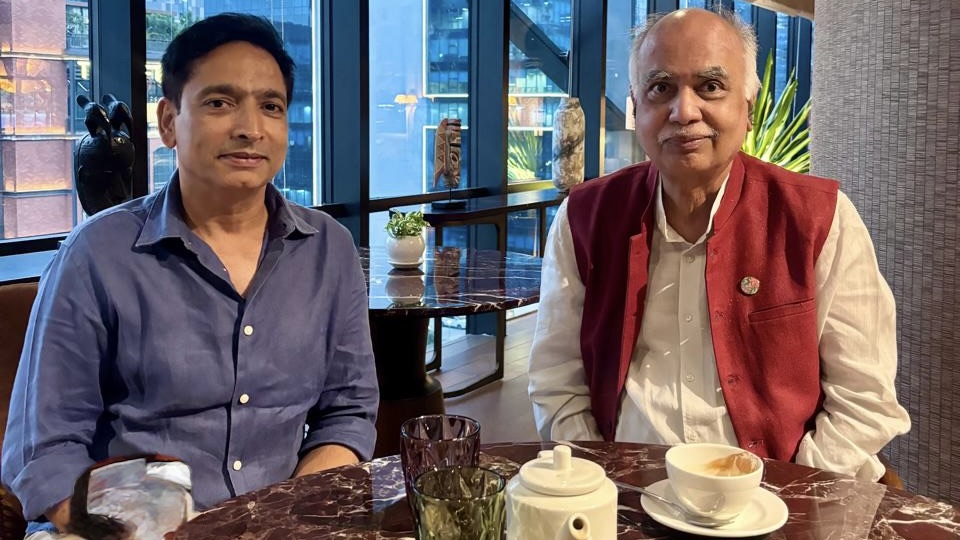
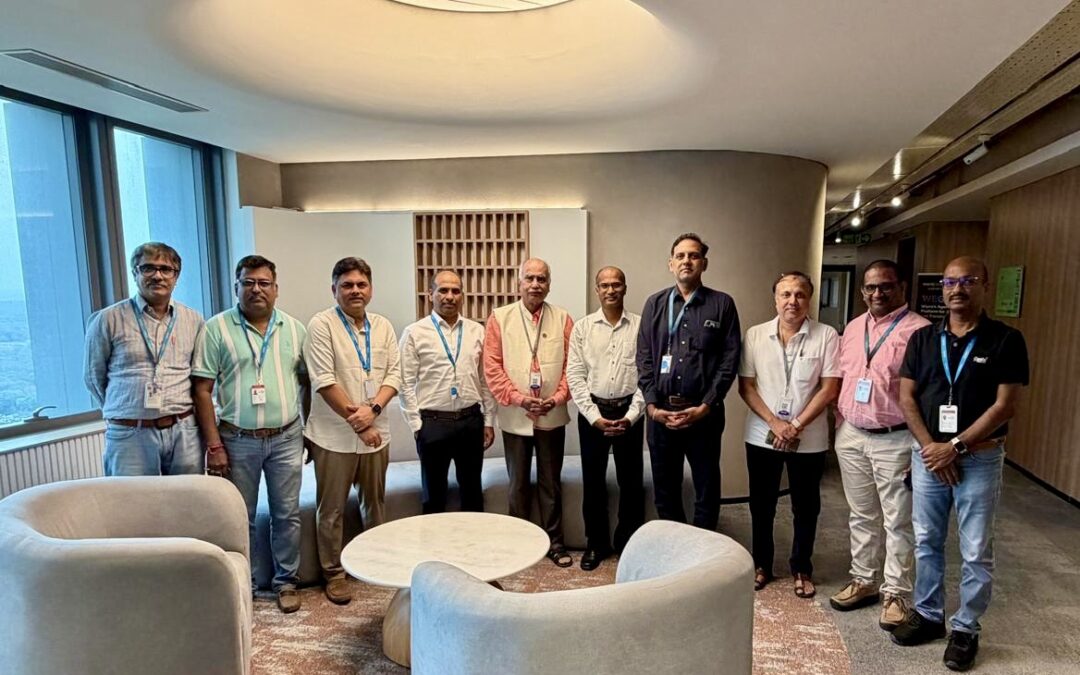
When Hari Atkuri visited me with his niece, Krishna, I felt an immediate shift in the air—as if a gentle breeze had entered the room carrying the fragrance of an unseen, far-off garden. Warm, curious, and quietly luminous, their presence brought a rare ease, the kind that arrives only when good intent and pure purpose walk in together. Hari, who is based in Minneapolis, USA, leads ZeGlass as its CEO and is the visionary Founder of SmartGlass Labs. I met him through my long-time friend James Lupino—another bridge across continents woven by trust and shared aspirations.

It did not take long before we started talking about glass, which is everywhere and as old as the industry itself. There is something poetic about glass — a material born from sand and fire, clear as thought and as fragile as a breath on a winter pane. For centuries, it has stood quietly at the edges of human life—framing mornings, filtering sunlight, watching the world without speaking back. Houses, towers, hospitals, schools—all with window-eyes wide open, holding the world in silent reflection.

Yet now, a new intelligence stirs behind the silent transparency. Something gentle, almost shy, but enormously powerful. We are entering a time when glass will not merely let the light through, but also understand it, sense it, shape it and also block it, if needed. And in doing so, shape us—our comfort, our energy, our lives. This is the dawning age of intelligent glasses —the popular term for “augmented reality (AR) smart glasses,” “AI glasses,” or “head-mounted displays (HMDs)” —where windows become thinking membranes, and buildings begin to breathe, feel, and act. The wide eyes of Krishna, pursuing a degree in AI, testified to this industry-wide revolution in glass called Fenestration, which shapes the future of windows and openings.

Imagine your room on a hot afternoon. Today, the sun climbs and pours heat into your walls without hesitation. Curtains are dragged across, air-conditioners hum and whine, and electricity flows like water down a drain. But tomorrow, the glass will notice the rising heat. It will darken itself softly, like a thoughtful eyelid half-closing against glare. Light will be filtered, heat softened, and your room will remain cool without raising a finger—or a degree.

In a world racing toward energy hunger, this means life. For glass occupies much of our buildings; it is the skin of our modern cities. If this skin begins to think—begins to regulate heat, trap light, and even convert solar energy into electricity, like a quiet battery—then the city becomes not a consumer, but a producer. A living organism rather than a steel skeleton.

Why Glass? Why Now?

Sand—the simplest of things—is being reimagined. Glass is renewable, recyclable, modest and abundant. It does not need to be manufactured into complexity; it already surrounds us. All it requires is intelligence—a whisper of chemistry, a thread of nanotechnology, a breath of AI—and it transforms.

Soon, our windows will not only let us watch the world; they will also help preserve it. They will know when to cool, when to brighten, when to save power and when to release it.

Glass will become a climate shield, reducing the burden on air conditioning that today consumes global electricity. It will become a gentle battery, storing sunlight in invisible layers. It will become a mindful companion, modulating spaces so we feel calmer, sleep better and work with clarity. This is not mysticism; it is material science meeting imagination.

A PhD in Physics from the Liquid Crystal Institute at Kent State University and a die-hard innovator, Hari told me that the future of glass is not arriving with a rattle—it is gathering softly, like dew: electrochromic windows that tint themselves like moods, adjusting to light; thermochromic glass that responds to heat like skin sensing warmth; perovskite solar windows, almost transparent, that capture sunlight and convert it into power; quantum-dot films that draw energy even from cloudy skies and indoor light; all-glass batteries, storing energy inside the very surface meant only to shine; transparent displays, where windows turn into gentle screens when needed; sensor-woven panes, reading the air, the presence of people and the rhythm of the day. What was once a dull surface becomes a sensory organ of architecture—like a tree’s leaves tuned to the seasons.

Walk into a room, not as a stranger but as someone expected. The glass notices you. It adjusts the light, the tint, the warmth—softly. It senses that the sunlight is strong, so it protects. It knows evening is approaching, so it shifts toward warmer tones to relax the mind and prepare you for rest. The building is no longer an object. It is a companion—quiet, alert, caring. The harshness of machines gives way to a gentler intelligence. Light is no longer an intruder but a conversation. And somewhere, behind it all, a simple truth emerges—nature always knew how to balance light. We are merely learning to listen.

Listening to Hari, I could sense the ushering in of a new philosophy of space—the evolution of smart glass technology suggests a significant shift in spatial design. Walls that once only separated now connect. Every window becomes a subtle participant in life—harvesting energy, sensing moods, protecting comfort and weaving daylight like fine silk through space.

In India, where the heat weighs heavily in the afternoons, this evolution carries profound economic significance. Every smart sheet of glass becomes a climate worker, reducing energy loads, softening the heat, making cities habitable without punishing the Earth. The workplace brightens the mind; the hospital calms healing hearts; the school shields young eyes; the home becomes a tender partner in well-being.

I asked Hari whether he thought the Silicon Age was morphing into the Silica Age. He said, in an indomitable spirit, “We may one day look back and say: silicon made us think, but glass made us feel.” Silicon, born from sand, powered the digital revolution. Now silica, also born from sand, will power the intelligent Earth revolution. Not through dominance, but through harmony. Not through force, but through light.

Standing before my French-style full window this morning, feeling the first rays of the sun, I thought of how simple this material has been—quiet, unassuming, endlessly transparent. Now imagine that same glass thinking with you. Guarding you. Producing energy as you sip tea. Filtering light so your eyes soften, your breath slows, your mind sharpens. In that moment, the boundary between inside and outside fades. Technology stops being a device and becomes an environment.

The next industrial revolution may not roar; it may shimmer. It may arrive not as a factory, but as a windowpane. Quiet, humble, filled with possibility. Glass, once the silent witness to human life, is ready to become its quiet guardian. And as dawn spreads tomorrow, take a moment to look at your window—not as glass, but as a doorway to the intelligent light that is coming. A future that is not just visible but luminous, alive, and aware.

The future, then, is not steel or silicon or algorithms shouting under fluorescent lights, but sunlight meeting intelligence on a clear surface—glass that thinks, matter woven with meaning. It is a window that does not merely open to the world but opens the world anew. In this spirit, I asked Hari whether he would return to India one day to lead a Silica Revolution here, helping a land of sages, silicon, and sunlight become the capital of intelligent materials. He did not answer at once; the question hung in the air, like a seed waiting for the right season. But his niece’s eyes lit up, bright with wonder and quiet certainty. In that young gaze was a promise stronger than any spoken reply. Young Indians are rising—curious, confident, rooted yet restless. They will not only inherit the New India; they will build it.

MORE FROM THE BLOG

Science, Service, and the Long Goodbye to Leprosy

Science, Service, and the Long Goodbye to Leprosy

It was already evening when they arrived, and I sensed a good feeling. The light had softened, retreating gently from the edges of objects, as though the day itself wished to listen to what came next. Dr. Gangadhar Sunkara came with Dr. Chinnababu Sunkavalli—both...

Empire Without Flags

Empire Without Flags

Still in her twenties, Rebecca F. Kuang has emerged as one of the most incisive literary voices examining empire’s afterlives. Born in China, raised in the United States, and educated at Cambridge and Oxford, she broke through with The Poppy War, a novel rooted in...

A Child and a Name in the Lila of Becoming

A Child and a Name in the Lila of Becoming

 My younger brother Salil Tiwari’s son, Sudhanshu, and his wife, Stuti, have been blessed with a son. They live in Meerut, my hometown, and visited me recently. Like all visits involving a newborn, it carried a quiet gravity—soft footsteps, hushed voices, time slowing...

A Book Between Generations

A Book Between Generations

A Book Between Generations

It was a mild noon, neither summer nor winter, when Venkat Kumar Tangirala came to see me. The sun, hidden behind clouds that held back its heat, allowed only a soft light, as if words were holding their breath between two thoughts, unsure whether to be expressed or remain silent. He arrived with his twenty-one-year-old son, Medhansh Tangirala, taller than his tall father, a young man with that familiar mixture of curiosity and hesitation which youth wears when stepping into a room of ideas.

Kumar Tangirala, of Brahminical ancestry, always the steady one, had in his eyes the mild exhaustion of someone who has travelled long, not just across distances but across the years. Medhansh, however, carried that unspent restlessness of beginnings—the kind that believes time is infinite and the world still pliant enough to bend to one’s will. As I greeted them, something stirred within me: a memory perhaps, or the faint echo of what it feels like to be twenty-one and sure that understanding lies just one book away.

We settled into conversation as easily as one slips into an old armchair. Kumar spoke of work and the state of things—his windmills, the confusion of tariff times, the noise—business became a relentless chase for something undefined. Medhansh listened, occasionally nodding, but I could sense his mind was elsewhere, moving through the invisible labyrinth of screens and opinions that define his generation’s consciousness.

And then, I placed a copy of my new book, Yoga Vasishtha: The Original Thesis on Mind, before them. Its orange-yellow cover caught the light for a moment, like an idea surfacing from deep meditation. I said nothing for a while. The silence seemed to belong to the book itself, as though the centuries between Sage Vasishtha and us had folded into this one quiet moment in my living room.

Medhansh turned it in his hands. “Is it Rama sitting here? Is this philosophy or psychology?” he asked in a sincere, disoriented tone of one trying to map the borders of meaning. “It is both,” I replied. “And neither. It is a mirror. When you look into it, it shows not the world—but the mind that sees the world.”

He looked at me, perhaps expecting elaboration, but I smiled instead. There are moments when explanation kills the wonder it seeks to awaken. And Yoga Vasishtha—that vast, contemplative ocean of inquiry—demands wonder more than comprehension. It begins where the world ends and the mind begins to ask, What is real?

Kumar spoke then of how his son’s generation had been overwhelmed by the post-truth chaos—the endless tide of news, trends, and digital drama. “Medhansh says everyone has an opinion, but no one seems to know anything,” Kumar sighed. “I told him, maybe you should read something old enough to be new again.”

The sentence hung in the air, like incense. I felt its truth deeply. In a time when truth itself is fractured, the ancient voice of Vasishtha resonates with radical clarity once more. He doesn’t promise peace or salvation. He offers understanding—the quiet kind that dismantles illusion, not through belief, but through awareness.

I told the young man, “Look, Medhansh, this book is not to be read as one reads the news or a novel. It is to be entered into, like a forest. The more you wander, the more you lose the map—and in losing it, you begin to see differently.” Medhansh smiled faintly, half in politeness, half in intrigue. “But what is it about?” he asked. “It is about the mind,” I said. “The one thing we carry everywhere but rarely meet.”

As we spoke, I saw in him what I often see in young faces today—a subtle fatigue. The fatigue is not of labour but of attention. Attention that is stretched thin, pulled apart by devices, deadlines, and desires. In the post-truth world, where even silence is commodified, the mind rarely rests long enough to see itself. Yoga Vasishtha begins precisely there—at the threshold between restlessness and reflection.

Kumar looked at his son, perhaps remembering his own youth when questions still weighed and silence was still a language. “I think this will appeal to you,” he said. “It’s about the art of thinking, not about conclusions.

Medhansh nodded, holding the book as though it were a fragile relic from another time. I watched him and thought of Rama—the young prince in the scripture—disillusioned with the world, asking his teacher why life felt meaningless despite all its pleasures. That was the beginning of Yoga Vasishtha: a conversation between despair and wisdom. How fitting, I thought, that it should begin again here, between a father and his son.

Outside, the evening had deepened. The light was turning golden, spilling gently through the window, and for a moment it seemed that time itself had paused to listen. We spoke then of the relevance of ancient thought in modern times. I told them that philosophy, when lived, is not an escape but an awakening. It teaches discernment—the rarest virtue in an age where information masquerades as knowledge. The Vasishtha way is not to retreat to caves, but to live in the world with the stillness of one who knows that the waves and the ocean are not different.

Kumar asked softly, “Do you think young people can understand such depth?” I looked at his son, who was now tracing the Sanskrit title on the cover with his fingers. “They feel it,” I said. “Only the words haven’t come to them yet.”

Perhaps that is what Yoga Vasishtha offers—language for the inarticulate knowing that every young soul feels when it looks at the world and wonders, Is this all? The book tells us that the world we see is but the projection of the mind—shifting, shimmering, impermanent. It doesn’t condemn the illusion; it teaches us to see through it. In that seeing, freedom begins.

The conversation drifted, as all good ones do, into silences and digressions. Kumar spoke of his worries for the future, his son, and his confusion about what to believe. And I, quietly, thought of Vasishtha’s own words: “The mind is the cause of bondage and the mind is the cause of liberation.” It is that simple—and that difficult.

As they rose to leave, I felt a certain serenity. The book had found its next reader, or perhaps, its next questioner. I signed it with a few words: “May this not give you answers, but the courage to question rightly.”

Kumar clasped my hand warmly. “You always make even confusion sound noble,” he laughed in his trademark crackling manner. Medhansh smiled too, and I noticed that his eyes had softened, as if some veil had thinned, ever so slightly.

When they left, the house grew quiet again. I thought of the generations—how they come with their noise and their brilliance, their disbelief and their yearning. Each must find its own bridge between science and spirit, intellect and intuition. The mind remains the battlefield, as it was in Rama’s time, as it is now in the age of algorithms.

And so, the scene lingered in my mind long after the door closed: the father, the son, and the book between them. A trinity of time—the past, the future, and the eternal present—bound by a single question: What is real?

That is where Yoga Vasishtha: The Original Thesis on Mind begins—and where, perhaps, all modern minds must return.

MORE FROM THE BLOG

Science, Service, and the Long Goodbye to Leprosy

Science, Service, and the Long Goodbye to Leprosy

It was already evening when they arrived, and I sensed a good feeling. The light had softened, retreating gently from the edges of objects, as though the day itself wished to listen to what came next. Dr. Gangadhar Sunkara came with Dr. Chinnababu Sunkavalli—both...

Empire Without Flags

Empire Without Flags

Still in her twenties, Rebecca F. Kuang has emerged as one of the most incisive literary voices examining empire’s afterlives. Born in China, raised in the United States, and educated at Cambridge and Oxford, she broke through with The Poppy War, a novel rooted in...

A Child and a Name in the Lila of Becoming

A Child and a Name in the Lila of Becoming

 My younger brother Salil Tiwari’s son, Sudhanshu, and his wife, Stuti, have been blessed with a son. They live in Meerut, my hometown, and visited me recently. Like all visits involving a newborn, it carried a quiet gravity—soft footsteps, hushed voices, time slowing...

A Small Republic of Trust

A Small Republic of Trust

A Small Republic of Trust

It was a quiet forenoon when they arrived — father and son, two physicians bound by a lineage of service and an unspoken continuity between action and thought. The air outside was still, save for the occasional chirping of birds on my 14th-floor east-facing balcony. By noon, the sun had moved overhead, leaving the balcony in shade and pleasantly cool.

Dr Venkata Ratnam Vakkalanka sat opposite me, unhurried, his eyes clear, his presence light yet steady. There was no theatricality about him, no performance of virtue. Sagacious, with his white hair and beard, he spoke in simple sentences that carried the ring of lived truth — a rhythm as steady as his pulse.

He is about my age, and yet I felt, as we talked, that he had lived a life more centred, more certain of its course. He had chosen his orbit early and had remained within it — like a planet loyal to its sun. As he spoke, memories came flooding back — of Kakinada, that quiet coastal town I had been to ‘once upon a time’. A paradise of tranquil order, I had called it then — a place where life seemed to move with purpose yet without haste. It was easy to imagine him there, tending to his patients not merely as cases of sugar and blood pressure but as whole lives, luminous and complicated, each seeking equilibrium.

In a world where most young doctors fled toward neon cities and richer destinies, he had stayed behind. Not out of inertia, but out of faith — faith that one need not go far to serve greatly. His wife, Smt. Padmaja provided anchoring. His clinic, modest by city standards, had become a sanctuary for those who sought not miracles but understanding. He had turned medicine into dialogue, and dialogue into healing.

He spoke of diabetes — not with the mechanical certainty of textbooks but with the tenderness of a philosopher. “Diabetes,” he said, “is a rhythm gone astray. The human body is a system of balances — intake and expenditure, rest and effort, indulgence and restraint. When the rhythm is lost, disease enters. My task is not to overpower it with drugs but to guide the rhythm back.”

Remembering his guru, legendary diabetologist Dr M. Viswanathan in Chennai, he said, smiling gently, “I often tell my patients — Metformin is not a miracle, it is a foundation. It gives us a base to rebuild upon. But without discipline, without the steady pulse of daily practice, even the best medicine becomes futile.” Healing is never a technical fix but a repairing act — a restoration of harmony between man and his body, between desire and discipline. He believed that the truest medicine was awareness.

His son, Dr Sujit Vakkalanka, sat beside him — younger, thoughtful, with the stillness of one who has seen the world and carries both its promise and fatigue. Trained in the United States, he now stood poised at the threshold of a new frontier — that of using artificial intelligence to treat diabetes. He spoke softly, almost diffidently, of algorithms piggybacking on the mobile phone that could monitor energy intake and expenditure in real time, whisper gentle reminders when indulgence crept in, and make health a living dialogue between man and machine.

“The body always tells us everything,” he said. “We just don’t listen. AI could help us listen better.” It was a beautiful image — not of machines replacing wisdom but extending it. The father saw in his son’s vision the evolution of his own lifelong practice: what he had done through intuition, the son hoped to do through data. Between them stood not a generational divide but a bridge — one built of the same compassion, expressed in different tongues.

I asked Dr Vakkalanka whether he had ever regretted not leaving Kakinada for a larger city, such as Hyderabad. He shook his head slowly. “No,” he said. “A doctor’s work is not measured by where he practices but by how deeply he listens. My patients are my teachers. Many of them have gone elsewhere, yet they still come for consultation. I never felt the need to go elsewhere.” The sentence lingered between us like a benediction.

In that moment, I understood something rare: that staying is also a form of courage. In an age where ambition is defined by departure, to remain rooted is almost radical. Dr Vakkalanka had not chased success; he had cultivated meaning. In the quiet streets of Kakinada, he had built a small republic of trust. I remembered again that town — its symmetry, its discipline, the rhythm of its tides — and saw how his life mirrored its geography. The man and the place seemed woven from the same calm cloth.

We spoke of food, of sleep, of the unseen mathematics of metabolism. He believed that modern life’s tragedy was excess — not just of calories, but of noise, anxiety, distraction. “We live,” he said, “as though energy were infinite. But it is not. Whether physical or emotional, every indulgence must be balanced by stillness. The healthiest people are not those who do the most, but those who do enough.”

His words were less prescriptive than philosophical. I thought then how his son’s vision — AI monitoring our daily rhythm — was, at heart, an echo of the father’s teaching. The old wisdom clothed in new syntax. Awareness translated into code. Perhaps that is how knowledge evolves — one generation feels, the next measures. One listens to the pulse, the other to the data. Yet both, in the end, seek the same harmony. When they rose to leave, the air around me seemed lighter and the sunshine brighter.

In the night, in the brief spell before sleep takes over, the images of Kakinada returned — of its still waters and soft light. Dr Vakkalanka had embodied Kakinada: its tranquillity, its balance, its quiet assurance that service is richer than ambition. And through his son, that same spirit was finding its way into the circuitry of the future. Perhaps this is what it means to heal — to make the hidden rhythm visible again, whether in the bloodstream or in the algorithm, whether in a small town by the sea or on the luminous screen of a machine.

And perhaps, when the world grows too hurried, too indulgent, it will need more men like Dr Vakkalanka — those who stay, serve, and remind us that the healthiest system, human or digital, is the one that remembers to live in rhythm. Life, after all, is like the deep ocean: stillness rules its depths, holding treasures for those with the courage to dive deep. The world of families, communities, livelihoods, media, and other vanity fairs is like waves on the ocean surface: roaring, glittering, crashing, and vanishing — a fleeting display of entropy! But like there is always the enduring calm below, there is eternal immortality residing within all of us, witnessing the drama of our lives.

MORE FROM THE BLOG

Science, Service, and the Long Goodbye to Leprosy

Science, Service, and the Long Goodbye to Leprosy

It was already evening when they arrived, and I sensed a good feeling. The light had softened, retreating gently from the edges of objects, as though the day itself wished to listen to what came next. Dr. Gangadhar Sunkara came with Dr. Chinnababu Sunkavalli—both...

Empire Without Flags

Empire Without Flags

Still in her twenties, Rebecca F. Kuang has emerged as one of the most incisive literary voices examining empire’s afterlives. Born in China, raised in the United States, and educated at Cambridge and Oxford, she broke through with The Poppy War, a novel rooted in...

A Child and a Name in the Lila of Becoming

A Child and a Name in the Lila of Becoming

 My younger brother Salil Tiwari’s son, Sudhanshu, and his wife, Stuti, have been blessed with a son. They live in Meerut, my hometown, and visited me recently. Like all visits involving a newborn, it carried a quiet gravity—soft footsteps, hushed voices, time slowing...

From Wings to Light

From Wings to Light

From Wings to Light

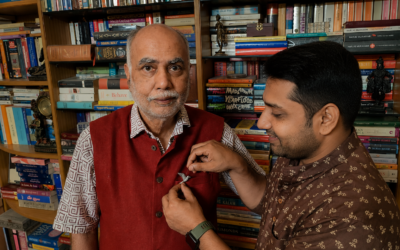
My name found its place in the world through Wings of Fire, the autobiography of Dr A.P.J. Abdul Kalam, who invited me to walk beside him as co-author. When it was first published in December 1999 by Universities Press, the book did not immediately take flight. I still remember those early months—more than a year, in fact—when it lingered quietly before gradually finding its readers. But once it did, the journey was unstoppable. For twenty-five years now, the book has endured, carried by the affection of people who saw in Dr Kalam’s story a reflection of their own hopes.

Not long ago, the publishers asked me to prepare a Silver Jubilee edition. I approached it with reverence. The original sixteen chapters remain exactly as they were; to me, every word and punctuation mark is sacred. To these, I added six new chapters, written in my own voice, reflecting on Dr Kalam’s life as I had witnessed it. These chapters speak of his role in India’s nuclear tests, the day he received the Bharat Ratna, his election as President, and the way he spent his final years speaking to young people about purpose and possibility.

The new edition is now available. My hope is simple—that it touches hearts as profoundly as the first edition did, and that Dr Kalam’s light continues to guide those who read it.

Two questions arise before me as I stand witness to this event, grateful for the opportunity despite my frail health: What is the purpose of a life, and how best can one live it? These are not easy questions, yet unless they are faced, there can be no true peace of mind or serenity of heart. I have seen it in myself—whether lying awake, travelling in search of new horizons, or seeking relief through distractions—no matter how the “chemistry of pleasure” persists, the restlessness remains until these questions are addressed.

I have learnt that no one else can answer them on my behalf. A guru may speak, a scripture may guide, but unless I make the truth my own, it remains hollow, like a counterfeit note that cannot buy anything of value. In my own journey, I have seen how easy it is to borrow beliefs and call them convictions, but life has a way of testing what is genuine.

For me, God—however one names or imagines Him—has never accepted intermediaries. It is always a direct, unmediated encounter, intimate and personal. Methods, yes, they help just as a car or a plane can carry me faster to a destination; prayer, meditation, or discipline can bring me nearer to clarity. But what I find when I arrive—that is mine alone, and no one else can share in it or claim credit for it.

I have also discovered that mythology, states of meditation, and even the trance of devotion are only shifts of consciousness. They may soothe, they may uplift, but they are not the truth itself. The truth is something starker, simpler, and deeply personal. It comes only when one dares to live the questions as one’s own. And in those rare moments when it appears, it feels less like an achievement and more like a homecoming.

We all enter this world without choice, and in our growing years, too, so much unfolds beyond our control. Education, for instance, is often decided not by aptitude or desire, but by the accident of birth—by the financial standing of one’s parents and the geography of one’s home. Those born into low-income families, especially in remote villages far from urban centres, face a clear disadvantage.

This is why Dr Kalam stands out as a beacon for countless reasons, but most profoundly for one: his unyielding determination to rise above educational deprivation. Had he surrendered there, no later success—scientific or social—would have been possible. His life reminds us that the foundation of all achievement lies in refusing to be defined by early limits.

Then comes another test—the enticement of the world around us: the circle of friends, the distractions of pastimes, the easy slide into gossip or indulgence in pursuits that drain energy yet yield nothing. Here again, Dr Kalam offers a lesson. His life was marked by an unswerving focus on the task before him—first as a student absorbed in learning, later as an adult committed to his work. A simple, frugal lifestyle reinforced this focus. To many, it may sound like a small detail, but in truth, it is pivotal.

How many students today can genuinely say they are giving their studies the attention they deserve? How many employees can claim genuine loyalty to their livelihoods? And frugality—once a virtue—seems to have been cast aside. Instead, we see people living for the moment, beyond their means, buying on credit, acquiring that which is neither necessary nor nourishing. Dr Kalam’s example is a quiet counterpoint to this—a reminder that simplicity sharpens focus, which in turn, paves the way to greatness.

It has been ten years since Dr Kalam walked out of this world, and yet he remains with me—every single day, not as nostalgia or sentiment, but as my witness. In his unseen presence, I ask myself the same questions he asked himself: Am I living with purpose? What does a purposeful life mean when one has retired, when the body has grown frail? The answers are no longer uncertain.

I have come to see that the meaning of a human life is to let one’s narrow consciousness—the embodied soul—expand into the vastness of universal consciousness. It is not hidden; it does not require elaborate rites or intermediaries. The truth is in plain sight. Look up at the sky on a starry night, and you will sense it. Watch a plant turn sunlight into matter, breathe in carbon from the air, and quietly fulfil its purpose—you will know it. Education, too, is like this. Knowing how to swim is one thing; swimming across a river is another. Knowledge that serves only livelihood is incomplete. The real test is whether you shared it, whether you offered it beyond yourself.

This was Dr Kalam’s gift to us. After Rashtrapati Bhavan, he became a pilgrim to classrooms. From campus to campus, he carried the flame, speaking to students—of dreams, of courage, of purpose. And it was before them, in the midst of that message, that he laid down his body and gave his final lesson—that a life lived in service ends in service.

And so, I write. I write blogs, I write books—sometimes about myself, often about the quiet, good work of others. Each dawn I take as an extension, another chance to do what little I can. Every night I close with the satisfaction of having read a noble voice, borrowed a spark, and try to kindle it into words that might steady or inspire a fellow traveller.

The Silver Jubilee edition of Wings of Fire carries this torch onward. And now, it rests with you. The next time someone says, “This cannot be done,” remember Dr Kalam, and this truth: life itself is the miracle of what has never happened before. We are here to add to that miracle. That was his gift, his legacy. I have tried to carry it faithfully. And now, dear reader, it is yours to keep alive.

MORE FROM THE BLOG

Science, Service, and the Long Goodbye to Leprosy

Science, Service, and the Long Goodbye to Leprosy

It was already evening when they arrived, and I sensed a good feeling. The light had softened, retreating gently from the edges of objects, as though the day itself wished to listen to what came next. Dr. Gangadhar Sunkara came with Dr. Chinnababu Sunkavalli—both...

Empire Without Flags

Empire Without Flags

Still in her twenties, Rebecca F. Kuang has emerged as one of the most incisive literary voices examining empire’s afterlives. Born in China, raised in the United States, and educated at Cambridge and Oxford, she broke through with The Poppy War, a novel rooted in...

A Child and a Name in the Lila of Becoming

A Child and a Name in the Lila of Becoming

 My younger brother Salil Tiwari’s son, Sudhanshu, and his wife, Stuti, have been blessed with a son. They live in Meerut, my hometown, and visited me recently. Like all visits involving a newborn, it carried a quiet gravity—soft footsteps, hushed voices, time slowing...