
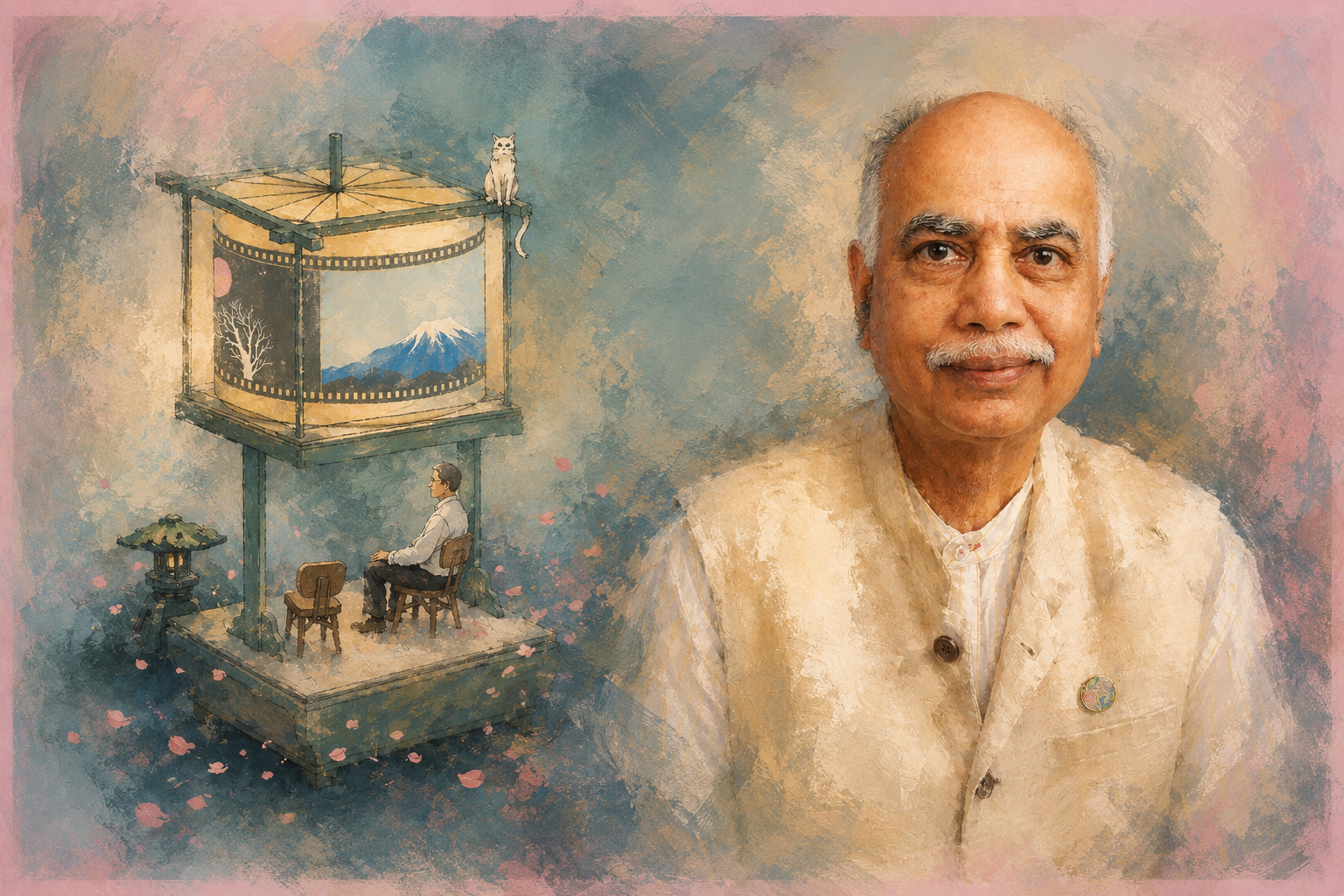
Lanterns of Lost Moments
These days, I have found myself increasingly drawn to the quiet brilliance of Japanese fiction. My journey began with the deeply reflective novels of Nobel Laureate Kazuo Ishiguro, whose works opened a gateway into a literary tradition where memory, loss and the unseen emotional architecture of life are rendered with extraordinary subtlety. From there, I immersed myself in the surreal yet profoundly human worlds of Haruki Murakami, reading nearly all his major works. Most recently, I turned to The Lantern of Lost Memories by Sanaka Hiiragi, born in 1974, a writer whose delicate craftsmanship continues this remarkable Japanese literary sensibility.
Across these writers, one notices a common artistic thread: the ability to magnify seemingly ordinary moments into luminous meditations on existence. Small gestures, forgotten memories, fleeting encounters and personal griefs are transformed into profound philosophical reflections. Reading these works in English translation is a pleasure, but one cannot help imagining the exquisite linguistic precision and emotional cadence of the original Japanese prose.
The Lantern of Lost Memories unfolds through three distinct yet intricately interconnected stories, all centred around an ethereal photo studio perched upon a serene hill between life and the afterlife. This liminal place is managed by Hirasaka, a mysterious figure who receives a box of photographs every day from a courier named Yama. Each set of photographs, one from every day lived from birth to death, corresponds to the life of a person who will die that day and arrive at the studio soon.
Upon arrival, each deceased visitor is granted an extraordinary final gift: the opportunity to choose a single photograph from each year of their life to make a revolving lantern. More than that, Hirasaka possesses the unique ability to invisibly accompany them back to a chosen day from that year, allowing them to relive it and photograph it anew. Hirasaka then arranges these photographs in a slow, revolving lantern—an emotional illumination meant to gently guide souls into the afterlife.
Yet Hirasaka himself remains the novel’s most haunting enigma. He possesses no memory of his own human life, save for one solitary photograph of himself standing alone in a park—an image that serves as both anchor and void. Very subtly, but powerfully, we are told that even those entrusted with guiding others through memory and meaning may themselves remain lost in search of their own. The quest for identity, purpose and self-understanding is universal, extending even to those who illuminate the path for others—as seen in the lives of many gurus, philosophers and writers who ended their days in misery.
The first story introduces Hatsue, a 92-year-old woman who chooses to revisit her youth at age 23, when she worked as a nursery school teacher for the impoverished children of industrial labourers. Her return reveals not grand achievements, but the quiet dignity of compassion and service. Through Hatsue, the novel emphasises that a meaningful life is often built not through power or acclaim, but through tenderness, sacrifice and unnoticed goodness.
The second story shifts dramatically in tone, following a 47-year-old gangster-like, hefty man who arrives at the studio after being murdered. Initially appearing hardened and morally compromised, his journey backwards reveals hidden layers of kindness, particularly his role in protecting a vulnerable Vietnamese immigrant child from the cruelty of local bullies at school. In doing so, Hiiragi masterfully reveals humanity even in hardened souls.
The final and most emotionally resonant story centres on Mitsuru, a young girl who has suffered abuse. She is only temporarily dead but would return to the living world. During her visit, Hirasaka breaks the sacred code of non-interference by teaching her how to start a fire with focused sunlight and dried leaves—a small act of practical wisdom that ultimately saves her life later. This act of compassion comes at a great cost: as punishment, Hirasaka’s memories are permanently erased, leaving behind only a single photograph Mitsuru took of him, as mentioned earlier.
This climax elevates the novel from a meditation on memory into a profound reflection on selfless love and sacrifice. Hirasaka’s choice suggests that true meaning may not lie in preserving oneself, but in becoming a source of light for another’s continued life.
The novel concludes with Mitsuru growing into adolescence while Hirasaka and Yama quietly hope that she will not return to the studio until the farthest possible future—an understated but deeply moving blessing that she may live a long, full life.
Ultimately, The Lantern of Lost Memories offers readers a deeply humane and spiritually resonant message: life’s true significance lies not in grand accomplishments, but in the moments of kindness, courage and connection that leave an enduring imprint on human lives. Memory, in this novel, is not merely recollection—it is illumination. Our lives become lanterns, glowing through the love we gave, the wounds we healed, and the small acts of grace we offered. In that sense, every human life has the potential to become its own lantern—guiding others long after we are gone.
As I read, I could not help but ask myself: If I were to arrive at Hirasaka’s studio, which memory would I choose to relive? Without hesitation, I know my answer.
I would ask to return to a day in 1977, when I went with my siblings—my sister Seema and my brothers Varun and Salil—and my father to watch the film Hum Kisise Kum Naheen in Meerut. It was an evening show at Menka Cinema theatre. I had brought my first little salary home. During the film’s interval, I stepped out to buy a paan for my father—a first-of-its-kind gesture. It was a simple act by a son for the father who always provided whatever was needed, often without my asking and before the need had even risen.
Memory often preserves such moments with sacred precision. My father passed away soon after. And with his passing, something far larger than a life came to an end: we siblings never again sat together in a cinema hall as one complete family. My sister got married, and my brothers grew into adults with lives of their own. That ordinary evening became, without our knowing it, the closing frame of an entire era of our formative years.
If Hirasaka were to guide me back, I would not seek grand revelations or dramatic turning points. I would simply wish to stand again in that theatre lobby, holding that paan, seeing my father alive, hearing my siblings’ laughter, and experiencing again the unconscious security of a world still whole. Unfortunately, no photograph exists of all five of us, and I would love to take one with Hirasaka’s help.
Perhaps the deepest tragedy of life is that we seldom recognise its most precious moments while we are living them. In the end, The Lantern of Lost Memories leaves us with a haunting yet consoling truth: life is not measured solely by milestones, victories, or public achievements, but by those fragile, irreplaceable moments whose true value becomes visible only after time has taken them away. Perhaps that is why memory hurts. And perhaps that is also why it glows.
After finishing this blog, pause for a moment and imagine your own journey through time—capturing, in a single impossible photograph, one beautiful moment from your life that memory alone could never fully preserve.
MORE FROM THE BLOG
Tea, Coffee, or Me?
Though I have been a tea person all my life, coffee has always intrigued me. During my travels in the United States, it seemed to be everywhere: at breakfast tables, in offices, beside hotel reception desks and in paper cups carried through the streets. In Ethiopia, I...
The Agony and the Ecstasy of Life
Since I met Dr Chinnababu Sunkavalli, the robotic surgical oncologist, in 2022 through an introduction by the Tangirala brothers, Venkat and Ravi, he has become part of my life. His enthusiasm, his commitment to connecting with people, and his extraordinary zeal to...
The Resilient Doctor
Dr. Prithvi Raj Jampana is a distinguished radiation oncologist with extensive experience in radiotherapy and systemic treatments for a wide range of cancers. He trained in clinical oncology at Oxford University Hospitals and worked in the UK for over two decades...
Fascinating reflections on memory as a living force, Prof Tiwariji! Your message on moments that stay illuminated long after everything fades quietly reminds us what truly matters!!
Respected Sir, Memory isn’t a hard drive. It’s like those ‘lanterns of lost moments’ we talked about—selective, flickering, a little unreliable. Emotion is the bond; we remember what we felt, not what happened. That’s why breakups and childhood birthdays have different impacts.
Sir, you have beautifully articulated Hiragi’s central insight, that the unnoticed acts of kindness and compassion often become the true architecture of human meaning. Your reflection reveals that the novel is not merely about death or remembrance, but about the hidden moral weight carried by seemingly ordinary lives and fleeting human moments.
Dear Sir, Greetings. An extraordinarily moving and reflective piece, Sir. Your narration beautifully captures the Japanese literary sensitivity towards memory, loss, and human connection. What touched me most was your personal recollection at the end—it transformed the blog from a literary review into a deeply emotional meditation on family, love, and the fleeting nature of life’s precious moments. Truly, this blog glows like the lanterns it describes. Warm Regards.
The article is very interesting. It’s interesting how each moment of our lives can be put together, and at the end, one would be surprised to find how these moments have paved our lives. Trivial happenings during moments of togetherness while at work had illumined our thoughts and actions later in our lives. Trivial, it seemed then – but it is definitely of great help now and forever.
Arunji, this is a well-narrated reflective piece. Japanese literature has a rare ability to illuminate the quiet corners of human existence with such tenderness and depth. The idea that even those who guide others may themselves remain in search of meaning is profoundly moving. Your narration captures that emotional subtlety wonderfully.
Hello, this is a beautiful reminder that life, lived meaningfully and purposefully, is found in the small, humane acts toward others. Thank you for sharing your insights, Prof. As I read your post, it reminded me of a good movie, “Mr. Church”. It is worth watching. It is available on Netflix.
So true this idea of lanterns! Much of what we call personality emerges from this invisible layer. A scent suddenly evokes grief. A tone of voice generates trust or discomfort. A childhood humiliation silently shapes adult ambition. We often believe we are making rational decisions in the present, while in reality, the unconscious is retrieving ancient emotional codes from its hidden storage chambers.
Unlike conscious memory, however, the unconscious is not neatly indexed. It is associative, symbolic, and emotional. It surfaces through dreams, slips of the tongue, irrational fears, recurring attractions, artistic impulses, and inexplicable moods. Forgotten events do not vanish; they are cached beneath awareness, waiting for resonance, trauma, love, music, or solitude to reactivate them.
The opening establishes a quiet, contemplative mood very effectively. Your comparison between Japanese fiction and the emotional architecture of ordinary life is apt, and the transition into the novel feels natural. The personal memory near the end gives the piece emotional gravity and makes the reflection feel earned rather than abstract.
The central insight is strong: memory is not just recollection, but a form of illumination. That idea is reinforced well by the structure of the novel summary, especially the contrast between Hirasaka’s role as guide and his own inner loss. Your father-and-cinema memory is especially powerful because it is specific, tender, and quietly devastating.
This beautifully written blog captures with remarkable sensitivity that forgotten childhood moments are rarely lost. They survive like hidden lanterns within the inner architecture of the self, illuminating our moods, guiding our reactions, and sometimes explaining longings we ourselves cannot fully name. Modern neuroscience increasingly confirms what literature has always intuited—that memory is not an archive stored outside life, but an active operating system running continuously beneath consciousness.
The unconscious may be understood as the mind’s deepest cache memory — a hidden repository where impressions, emotions, fears, desires, and unfinished experiences remain stored long after conscious awareness has moved on. In computing, a cache silently preserves frequently used data so that the system can respond rapidly without repeatedly accessing the central archive. The human unconscious functions in a remarkably similar way. It retains compressed fragments of lived experience and continuously feeds them back into thought, behaviour, instinct, attraction, anxiety, and imagination. Lovely writing!
Lanterns of Lost Moments beautifully reminds us that memory is not merely nostalgia; it is the invisible software embedded within human consciousness. Long before we learn language or logic, our minds begin recording sensations, voices, fears, warmth, tenderness, and silence. These early impressions do not disappear with time. They remain deeply coded within us, quietly shaping our instincts, emotions, relationships, choices, and even how we interpret the world.
In an age obsessed with external technology and artificial intelligence, this story gently redirects attention toward the oldest intelligence we carry: the emotional memory embedded in the human soul. This is therefore not only a moving narrative, but also a meditation on identity, continuity, and the quiet persistence of childhood within adulthood.
How quietly it shows that the most important parts of a life are often the smallest moments…things we don’t even notice at the time. The idea of choosing one memory to relive is simple, but it makes you pause. Not because it’s dramatic, but because it feels so real. And the ending, with your own memory, is what truly lingers. It gently reminds us that we only understand the value of certain moments much later…when they’ve already passed.
A very beautiful and heartfelt piece. It gently reminds us how small moments from the past may fade away with time, but their memories continue to light up our lives quietly. Simple, emotional and deeply touching.
Lanterns of Lost Moments is a beautiful reminder that childhood is never truly behind us—it glows quietly within, like hidden lanterns illuminating the unseen corridors of our inner world. The earliest moments we imagine forgotten are often the very foundations of our emotions, instincts, and choices. They shape our joys, fears, longings, and even the subtle directions our lives take. To remain in touch with these buried fragments is not an exercise in nostalgia alone, but a profound act of self-understanding. In reconnecting with the forgotten landscapes of early memory, we recover pieces of ourselves that continue to guide us, often silently, through adulthood. This story powerfully evokes the truth that our past is not lost—it lives within us, whispering through mood, imagination, and decision, asking only that we pause long enough to listen.
Professor Arun Tiwari ji, this is one of the most beautiful and quietly devastating pieces I have read in a long time. The way you weave Japanese literary sensibility with your own memories creates a tenderness that is both scholarly and deeply human. Your reflections carry the precision of a thinker and the vulnerability of someone who has lived, loved and lost—and that combination makes the writing glow from within.
What moved me most is how effortlessly you turn personal memory into universal emotion. The moment with your father, your siblings, the paan in your hand—these are described with such simplicity that they become luminous. They remind us that the most precious parts of our lives are often small, unguarded moments we never realised were final. Reading this made my eyes wet; it is impossible not to see one’s own lost moments in your words.
Thank you for offering a piece that is at once literature, philosophy and a quiet ache of the heart. It stays with the reader long after the last line.
Excellent piece, Sir! This is a beautiful and deeply moving reflection that touches the very core of the human experience. The way you weave into your own profound, personal memories of family in Meerut is pure poetic artistry. This serves as a powerful reminder that our lives are shaped not by grand milestones but by the quiet acts of grace we leave behind. Thank you for sharing such a magnificent piece of writing—it is an absolute joy and an honour to read.