
The Board, the Bot and the Mathematician
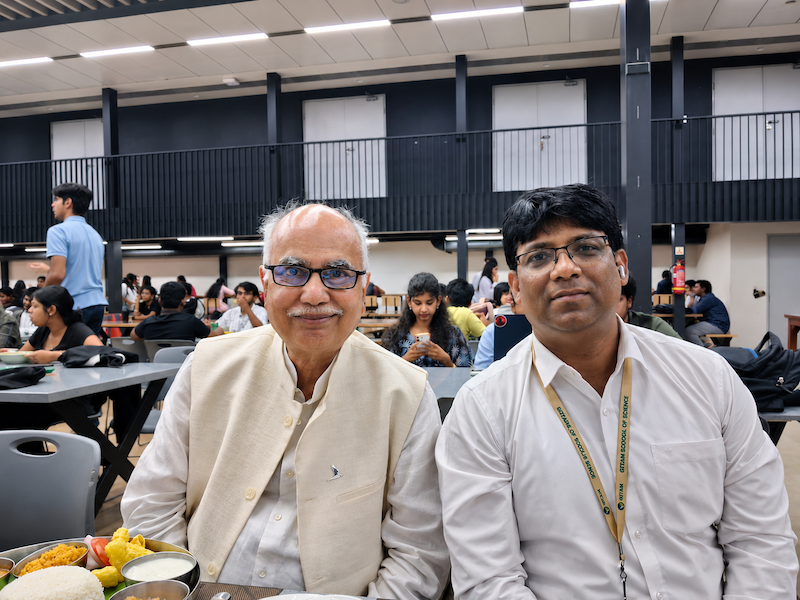
I was invited to address nearly 500 students during their first week at GITAM University in Hyderabad. I was hosted by Dr. Motahar Reza, Director of the GITAM School of Science. A native of Murshidabad in West Bengal, Dr. Reza trained at IIT Kharagpur, worked across computational fluid mechanics, machine learning and data science, and joined GITAM in 2020. His journey from fluid dynamics to artificial intelligence made him an ideal host for a conversation about how learning itself is changing.
GITAM began in Visakhapatnam in 1980 as the Gandhi Institute of Technology and Management. The acronym has since become an educational brand, with campuses in Visakhapatnam, Hyderabad and Bengaluru. This year, the university is home to 28,000 full-time students—young, energetic, curious and ambitious. Yet scale alone does not define a university. What struck me was its carefully curated environment: orderly without being oppressive, ambitious without appearing anxious, and imbued with the Tagorean aspiration, ‘Where the mind is without fear, and the head is held high.’
I chose ‘The Three Habits in the AI Era’ as the subject of my address. My message was simple: do not fear artificial intelligence; form habits that help it amplify your intelligence. The three habits were: Ask, Speak and Write.
Ask AI one meaningful question every day. Once a week, select one idea that arises from those questions and speak about it for three minutes. Let AI transcribe the recording and polish the language. Then study the polished version: What became clearer? Did the machine improve the grammar, or alter the thought? Finally, write the improved version by hand in a dated notebook.
Asking cultivates curiosity; speaking reveals gaps in thought; writing consolidates learning and strengthens memory. The student also learns to inspect rather than passively accept an AI output. Sustained through four years, the notebook can become a personal intellectual autobiography—perhaps a 200-page book authored before graduation.
The students received the idea warmly. Afterwards, Dr. Reza hosted lunch with faculty colleagues and Dr. S. Chandrasekhar, one of the finest green chemists of our time and a former Secretary of the Government of India’s Department of Science and Technology. Despite his eminence, he possesses the warmth and humility of a true scholar. A university is revealed as much by conversations around a table as by lectures in an auditorium.
During lunch, my thoughts returned to mathematics. Mathematics has always fascinated me, although I could never claim mastery of it. During my master’s programme at G. B. Pant University, I chose Tensor Methods in Continuum Mechanics as an elective and only just secured a B grade. Yet the course gave me a sufficient grounding in matrix algebra to prove invaluable later in operational research and mechanical vibrations. During discussions at DRDL on six-degree-of-freedom modelling—the three translational and three rotational motions of a missile—I found myself unexpectedly confident and vocal.
This experience taught me that mathematical education cannot be judged only by marks secured at the moment of instruction. A concept imperfectly grasped today may become the instrument through which one understands a real-life system years later. Education deposits structures in the mind; application activates them.
I therefore asked Dr. Reza, “How do young students see mathematics today, and how is AI affecting its teaching and learning? Mathematics has always required a heady combination of rigour and intuition. Does AI strengthen that combination—or quietly undermine it?”
The answer lies not in the intelligence of the machine, but in the wisdom with which we choose to wield it.
Mathematics contains four interacting layers. The conceptual layer concerns meaning: What is a derivative, a vector or an eigenvalue? The procedural layer concerns operations such as differentiation and integration. The representational layer connects equations with graphs, tables, simulations and physical phenomena. The metacognitive layer concerns thinking about one’s own thinking. It asks: Why did I choose this method? Where could it fail? Is the answer logically, dimensionally and physically plausible?
Traditional classrooms often overemphasise procedure because it is easiest to demonstrate and examine. AI can perform many procedures rapidly. That does not make mathematics obsolete; it reveals that procedure was never the whole of mathematics. Done till here
A large language model is most useful at the conceptual and linguistic interface. It can explain an idea through an analogy, a graph, a physical example or simpler language. It can help students whose English is functional rather than fluent, generate graded examples, compare alternative methods, and ask Socratic questions. A computer algebra system manipulates symbols; a numerical solver approximates solutions that resist closed-form expression; a visualisation engine reveals parameter sensitivity; and a proof assistant verifies that deductions follow from stated axioms. Mathematical literacy now includes knowing which technology to trust for which task.
This is a neuro-symbolic partnership. Neural models excel at pattern recognition, language and analogy; symbolic systems are stronger at exact manipulation and formal verification. The human must still choose the assumptions, formulate the model, interpret the results and decide whether the answer is relevant.
The distinction matters because a language model generates plausible sequences, while mathematics demands valid relationships. A convincing explanation is not a mathematical proof. A confident derivation may contain a sign error, an unstated assumption or an invalid cancellation. One recent evaluation found that although 90 per cent of AI tutoring dialogues appeared instructionally strong, only just over half were mathematically correct throughout. OECD analyses likewise warn that generative AI may improve task performance without producing genuine learning when students outsource the intellectual work.
The pedagogical principle should therefore be:
AI may assist the struggle, but it must not abolish productive struggle.
A sound mathematics lesson in the AI era might follow five stages: Conjecture – Attempt – Dialogue – Verification – Reconstruction.
First, the student predicts what should happen. Second, the student attempts the problem unaided. Third, AI offers a hint, questions an assumption, presents an alternative representation or constructs a counterexample—without immediately supplying the answer. Fourth, the result is checked through substitution, limiting cases, dimensional analysis, numerical testing or formal proof. Fifth, the student reconstructs the argument in their own words and, where appropriate, by hand.
This is an AI sandwich: human effort before AI, critical interaction with AI, and human synthesis afterwards.
Teachers therefore cease to be mere transmitters of worked examples. They become designers of mathematical encounters, diagnosticians of misconceptions and guardians of epistemic standards. Instead of asking only whether the student obtained the answer, they ask whether the student can explain the method, identify the weakest step, test a boundary case, distinguish an exact result from an approximation, and justify the conclusion.
Assessment should evolve accordingly. Students can critique an AI-generated solution, locate a deliberately inserted error, compare methods, defend their assumptions orally, annotate a proof or maintain a handwritten reasoning journal. The trace of thought becomes more important than the final answer.
My three habits fit mathematics particularly well. Ask becomes the habit of forming a precise mathematical question. Speak becomes the ability to articulate a chain of reasoning and hear where it breaks. Write becomes the disciplined conversion of intuition into symbols, definitions and proof. AI can accompany all three, but it cannot assume responsibility for any of them.
The real danger is not that AI will make students weak at mathematics. It is that institutions will continue teaching mathematics as the production of answers when machines have become excellent answer-producing partners. The opportunity is to restore mathematics to its deeper purpose: modelling reality, detecting structure, reasoning under uncertainty and learning to recognise when one is wrong.
The classroom board will not disappear. Nor will the notebook. They will stand beside the bot. The university’s task is to ensure that the machine supplies speed and range while the human being retains curiosity, judgement and the courage to ask:
“Is this merely a convincing answer—or is it mathematically true?”
That question stayed with me as I made my way home. In my mind’s eye, Dr. Reza’s infectious smile returned, seeming to carry the simplest possible reply:
“It can be both.”
MORE FROM THE BLOG
Tea, Coffee, or Me?
Though I have been a tea person all my life, coffee has always intrigued me. During my travels in the United States, it seemed to be everywhere: at breakfast tables, in offices, beside hotel reception desks and in paper cups carried through the streets. In Ethiopia, I...

The Agony and the Ecstasy of Life
Since I met Dr Chinnababu Sunkavalli, the robotic surgical oncologist, in 2022 through an introduction by the Tangirala brothers, Venkat and Ravi, he has become part of my life. His enthusiasm, his commitment to connecting with people, and his extraordinary zeal to...
The Resilient Doctor
Dr. Prithvi Raj Jampana is a distinguished radiation oncologist with extensive experience in radiotherapy and systemic treatments for a wide range of cancers. He trained in clinical oncology at Oxford University Hospitals and worked in the UK for over two decades...
Arunji, enjoyed this one too. What I admire most is your unique ability to bridge the worlds of machines, technology, mathematics, and the human spirit so effortlessly. You remind us that while AI can compute, predict, and optimize, qualities like curiosity, wisdom, and the ability to ask meaningful questions remain uniquely human.
Your blogs consistently demonstrate that technology and humanity are not opposing forces—they are at their best when they enrich one another. Thank you for another thought-provoking read.
This piece doesn’t just inform…it quietly unsettles and then steadies the reader. It made me pause and reflect on how easily we are beginning to accept answers without truly earning them. Your words gently bring back the value of effort, of doubt, of staying with a question until it begins to reveal itself. There is something deeply moving in your faith that learning is still a human act…fragile, imperfect, but profoundly meaningful. The way you speak of thinking, questioning, and reconstructing feels almost like a reminder of something we are in danger of forgetting. It left me with a sense of both humility and hope…that even in an age of powerful machines, the quiet discipline of the mind still matters.
Having worked in the United States and now returned to India as a mid-career engineer, I find this reflection especially relevant to the way information technology is evolving. In the IT industry, we often celebrate speed, scale, automation and rapid deployment, but beneath every reliable digital system lies mathematics—logic, probability, optimisation, statistics, graph theory, linear algebra and computational complexity.
AI can produce code, recommendations and apparently persuasive answers almost instantly. Yet an engineer must still ask whether the output is logically sound, statistically valid, computationally efficient and robust under real-world conditions. A system may work during a demonstration and still fail when exposed to unusual data, changing environments or human complexity.
My experience in the United States showed me the value of disciplined validation, while working in India has shown me the extraordinary power of applying technology at scale. To combine these strengths, our engineers must move beyond merely using tools and recover the mathematical foundations of computing. The enduring question is therefore exactly the right one: is the answer only convincing, or is it mathematically true?
The future will belong not to those who use AI the fastest, but to those who can examine its assumptions, verify its reasoning and apply it responsibly.
Dear Sir, as a young academician and a supporter of liberal education, I found this essay deeply relevant to the future of teaching. The board, the bot and the mathematician represent more than three tools; they represent three essential habits of the mind—explanation, exploration and verification.
In an age when AI can produce fluent answers instantly, education must resist the temptation to equate speed with understanding. Mathematics is especially important because it trains the mind to move beyond persuasion towards proof, structure and logical consistency. Yet mathematics alone is not enough. The liberal disciplines teach us to ask what a technology means, whose interests it serves, what assumptions it carries and how it may affect human life.
The real purpose of education is therefore not merely to prepare students to use intelligent machines, but to develop independent judgement. The bot may assist learning, but the teacher must still cultivate curiosity, doubt, ethical reflection and the courage to question an impressive answer.
The most important classroom of the future will be one in which computation and culture, mathematics and philosophy, technology and humanity are brought into conversation. That is where education can remain truly liberal—and genuinely intelligent.
As a young computer engineer, I found the idea of the “AI sandwich”—human effort before AI, critical interaction with it, and human synthesis afterwards—both practical and powerful. In programming, an AI tool can generate code within seconds, but it cannot relieve us of the responsibility to understand the logic, test boundary cases, detect hidden assumptions and examine the consequences of failure.
The question, “Is this merely a convincing answer—or is it mathematically true?” applies equally well to every piece of AI-generated code. Does it merely look correct, or is it secure, efficient and dependable under real-world conditions?
AI is undoubtedly making engineering faster, but speed without understanding can create fragile systems. The habits of asking, speaking and writing can help young engineers become not merely users of intelligent tools, but thoughtful designers who retain ownership of their reasoning. The board, notebook and bot must indeed coexist, because the most important intelligence in the loop must remain human.
Dear Arun Tiwari Sir, it was a great honour to host you at GITAM School of Science, Hyderabad, for the induction address to our first-year Liberal Education students. Your talk on “The Three Habits in the AI Era” — Ask, Speak, Write — struck exactly the right note for young minds stepping into a world being reshaped by AI, and I could see it resonate with the students long after you left the podium.
Reading this blog is an even greater honour. To have our conversation over lunch — on mathematics, on the conceptual, procedural, representational and metacognitive layers, on the “AI sandwich” of human effort, critical dialogue and human synthesis — captured with such clarity and depth is humbling. You’ve articulated something I feel deeply in my own work: that AI must sharpen productive struggle, not replace it.
Since much of my own work involves designing deep learning architectures and developing AI algorithms — spanning computer vision and language models, with several publications in top IEEE journals — as well as my earlier grounding in computational fluid dynamics, your framing of the neuro-symbolic partnership resonated deeply: neural systems for pattern and language, symbolic systems for exact manipulation and verification, and the human retaining judgment over assumptions and interpretation. This is precisely the balance I now navigate in my current work on AI-based, data-driven solutions for the mathematics of fluid flow in microchannels, with implications for lab-on-chip and microelectronic device design. The question you leave us with, “Is this merely a convincing answer — or is it mathematically true?”, is one I will now carry into every model I build and every classroom conversation I have.
Thank you for your time, your generosity, and for putting into words an experience I will treasure. It was a privilege to have you at GITAM Hyderabad, and I hope this is the start of many more conversations between the board, the bot, and the mathematician. With warm regards.
Prof Tiwari, AI is a blessing and should be accepted as such; human speed has just been accentuated, but the classroom board will not disappear. Nor will the notebook. They will stand beside the bot. The university’s task is to ensure that the machine supplies speed and range while the human being retains curiosity, judgement and the courage to ask’ in all disciplines
A profound framing, Arun Sir..!! The “AI sandwich”—human effort before, critical interaction during, human synthesis after—may be the wisest pedagogical principle I’ve encountered for this moment. Your distinction between plausible sequences and valid relationships cuts to the heart of it: a convincing explanation is not a proof. What lingers most is your insight that a concept imperfectly grasped today may become tomorrow’s instrument of understanding. Education deposits structures; application activates them. Perhaps that is AI’s real test—whether it preserves productive struggle or quietly dissolves the very friction from which understanding is born. Dr. Reza’s reply feels exactly right: it can be both.
Hi Arunji, this is a profound reminder that true education is measured not by exam scores, but by the ability to apply knowledge when life demands it. Also, technology can solve equations, but it cannot replace curiosity, reasoning, and sound judgment.