
The Wellness Dividend
One teaching of Dr. A.P.J. Abdul Kalam that I have always tried to follow is to ‘stay in circulation’, as he put it. By this, he did not merely mean travelling, attending meetings or remaining publicly visible. He meant keeping the mind in motion—meeting people, visiting institutions, listening to new ideas and allowing one’s own convictions to be questioned and renewed. Circulation prevents intellectual stagnation. It keeps experience connected with emerging realities.
Now that my health does not permit me to travel widely, I consider myself fortunate to live in Hyderabad, a city endowed with many fine institutions. I make it a point to visit some of them whenever possible and exchange ideas with people who have accomplished meaningful work in their chosen fields. Such visits are not formal obligations for me. They are opportunities to remain a student of life.
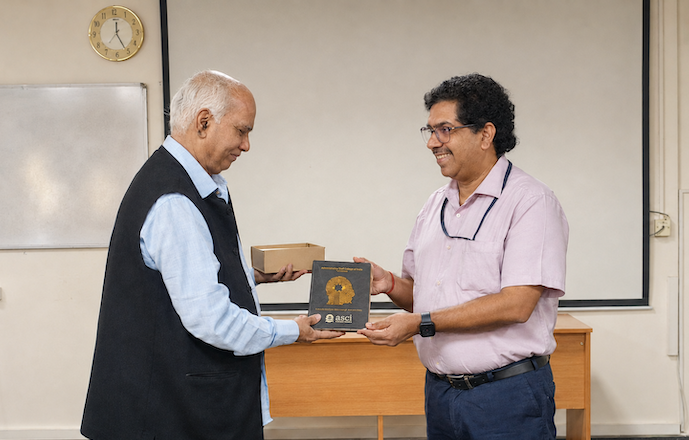
One such visit recently took me to the Banjara Hills campus of the Administrative Staff College of India (ASCI), where Dr. Subodh Kandamuthan, Professor and Director of the Dr. Kakarla Subba Rao Centre for Health Care Management, invited me to deliver an inaugural lecture to the new Batch 21 students of the PGDM (Hospital Management) programme.
It turned out to be one of those excellent visits that immediately occupy the ‘front seat’ of memory. The ASCI campus stands at perhaps one of the highest elevations in Banjara Hills. From there, one gets a panoramic view of KBR National Park, the precious green expanse that remains a vital lung for our fast-growing metropolis. The setting itself seemed to offer a lesson. As towers, roads and commercial establishments steadily encircle this surviving forest, one is reminded that progress must be measured not only by what we build, but also by what we choose to preserve.
The audience was pan-Indian: bright young students who had arrived at ASCI after walking meritorious academic paths in different parts of the country. Their presence represented India not merely as a geographical entity but as a confluence of diverse aspirations. They chose healthcare and hospital management at a moment when India’s health system is expanding rapidly but also confronting serious questions about affordability, access, ethics, and purpose.
What stayed with me most, however, was my tête-à-tête with Dr. Kandamuthan, a health economist. A native of Kerala with an MPhil from the Centre for Development Studies, Thiruvananthapuram, affiliated to Jawaharlal Nehru University, New Delhi, and a PhD in Health Economics from the Institute of Social and Economic Change, Bengaluru, his academic rigour is enriched by a perceptive grasp of India’s social complexities. In him, one can see the enduring social conscience of Indian society—a conviction that human welfare cannot be left entirely to the seasonal tides of capitalism.
Markets are powerful instruments. They can mobilise resources, encourage innovation and improve efficiency. But they cannot, by themselves, decide what a society ought to value. If profitability alone becomes the organising principle of healthcare, illness begins to acquire greater economic value than wellness. More tests, procedures, hospital admissions and interventions generate more visible revenue than fewer illnesses. The system may then grow financially while society becomes progressively less healthy.
From the stimulating and sagacious company of Dr. Kandamuthan, I could distil the need for a decisive paradigm shift: from an illness-based healthcare ‘industry’ to health economics rooted in wellness.
He drew attention to the wrong scorecard by which healthcare success is commonly measured. We count hospital beds, surgeries, diagnostic procedures, intensive-care facilities and insurance claims. These indicators are necessary, but they mainly tell us how much illness we are managing. They do not tell us how much illness we have prevented.
A hospital may perform thousands of cardiac procedures and be celebrated as a great success. But if many of those patients could have avoided severe disease through early screening, nutritional guidance, exercise, tobacco control, stress management and timely primary care, the larger health system has not truly succeeded. It has intervened efficiently at the end of a chain of failures.
Is not the cheapest hospitalisation the one that never happens?
This question brings us to the idea of the ‘Wellness Dividend’. In simple terms, a wellness dividend is the value created when individuals and communities remain healthy for longer. That value is not abstract. It is reflected in fewer hospital admissions, lower expenditure on medicines, reduced absenteeism, greater workplace productivity, longer working lives and less emotional and financial distress for families. It also frees public resources for education, sanitation, nutrition, housing and the treatment of illnesses that cannot be prevented.
Consider a person at risk of diabetes who receives timely advice, regular monitoring and sustained support to change diet and physical activity. If the onset of diabetes is delayed by ten years—or prevented altogether—the gain is much greater than the price of a few consultations and tests. The individual gains years of healthier life. The family avoids expenditure and anxiety. The employer benefits from greater productivity. Insurers face fewer claims. Hospitals retain capacity for those who genuinely need advanced care. The nation gains from the continued participation of a healthy citizen.
That combined value is the wellness dividend.
Yet our economic system often fails to recognise the wellness dividend because those who fund prevention may not receive its eventual savings. The benefits are dispersed across individuals, employers, insurers and governments—and may appear only years later. We readily calculate the cost of vaccination, screening or nutrition, but rarely the value of the illness prevented.
Realising the wellness dividend therefore requires incentives that give prevention measurable economic value. Healthy behaviour could earn lower insurance premiums, tax benefits or credits in a Personal Health Account. Employers could be rewarded for healthier workplaces, and primary-care providers for keeping communities well—not merely for treating them.
A Personal Health Account, linked securely with the Ayushman Bharat Health Account (ABHA), could serve as a lifelong health ledger supporting screening, vaccination, nutrition, mental wellbeing and chronic risk management, while safeguarding privacy and consent. It could also recognise citizens economically for remaining healthy, rather than paying only after serious illness occurs.
Hospitals and advanced care remain indispensable, but they must rest upon a vibrant primary-care system—the economic and moral foundation of modern healthcare. Without it, patients reach specialist care too late, illnesses become costlier to treat, and expenditure rises without proportionate improvement in public health. Family physicians, nurses, community health workers, nutritionists and local diagnostic centres may prevent more suffering than sophisticated hospitals can later repair; their contribution must therefore be recognised, measured and rewarded.
The movement from the economics of illness to the economics of wellness is ultimately a change in what we choose to celebrate. Do we celebrate only the dramatic rescue in the intensive-care unit, or also the quiet work that prevented a thousand people from entering it? Do we reward only the procedure, or also the years of healthy living that made the procedure unnecessary? Do we regard health expenditure as money spent after disease appears, or as an investment in human capability?
These are not merely philosophical questions. Nor are the Personal Health Account and the Wellness Dividend utopian ideals. They are practical concepts articulated by an astute economist whose thinking remains grounded in the realities of his country and its people.
India needs many more such conversations. It must also cherish institutions such as ASCI—places where administrators, economists, healthcare professionals and young managers can meet beyond their disciplinary boundaries and reconsider the assumptions governing public systems. Institutions acquire greatness not through buildings alone, but by creating spaces where experience encounters inquiry and ideas become instruments of service.
We must equally celebrate people such as Dr. Subodh Kandamuthan: true sons of the soil whose education has taken them across institutions and disciplines, but whose hearts continue to beat with their people. Their scholarship does not distance them from society; it returns them to it with greater responsibility. In their work, knowledge remains accountable to the ordinary citizen.
As I left the high-ground ASCI College Park campus, with KBR Park spread below and a new generation of healthcare managers beginning its journey, I felt renewed by Dr. Kalam’s counsel to stay in circulation. Sometimes circulation is not about travelling far. It is about reaching the right place, meeting a thoughtful person and returning home with an idea capable of changing how we see the future.
MORE FROM THE BLOG
Tea, Coffee, or Me?
Though I have been a tea person all my life, coffee has always intrigued me. During my travels in the United States, it seemed to be everywhere: at breakfast tables, in offices, beside hotel reception desks and in paper cups carried through the streets. In Ethiopia, I...
The Agony and the Ecstasy of Life
Since I met Dr Chinnababu Sunkavalli, the robotic surgical oncologist, in 2022 through an introduction by the Tangirala brothers, Venkat and Ravi, he has become part of my life. His enthusiasm, his commitment to connecting with people, and his extraordinary zeal to...
The Resilient Doctor
Dr. Prithvi Raj Jampana is a distinguished radiation oncologist with extensive experience in radiotherapy and systemic treatments for a wide range of cancers. He trained in clinical oncology at Oxford University Hospitals and worked in the UK for over two decades...
Thank You Sir for sharing this blog!
I really enjoyed reading this. The idea of a ‘wellness dividend’ really stayed with me, especially the thought that the best hospitalization may be the one we manage to prevent. We often celebrate advances in treating disease, but perhaps not enough attention goes to the quieter work of keeping people healthy in the first place. I also loved Dr. Kalam’s idea of “staying in circulation.” It is such a simple but meaningful reminder that continuing to meet people, exchange ideas, and remain open to having our own perspectives challenged is an important part of lifelong learning.
Respected Sir, Your reflection on “staying in circulation” beautifully reminds us that true wellness is not merely about living longer, but about remaining curious, connected and useful to society. Your words carry the wisdom of a life devoted to learning and serving others.
Truly inspiring, Sir.
An appealing idea of “circulation” gradually becomes more than Dr Kalam’s advice—it becomes a way of looking at life, learning, and public service.
The most interesting thought for me is the shift from the economics of illness to the economics of wellness. We usually notice what happens inside a hospital: a successful surgery, a new ICU, a sophisticated machine, or a difficult rescue. But this piece asks us to notice something much less visible—the illness that never happened or was prevented. That quiet prevention may have saved the person, the family, the insurer, and the health system much more than an expensive treatment later.
I also liked the connection with KBR Park. Prevention is the KBR Park of healthcare—it may look like “nothing is happening”, but that very absence of crisis is its achievement.
The idea of the Wellness Dividend therefore has an important human dimension. It asks us to value the nurse who notices a problem early, the family doctor who prevents complications, the community worker who encourages vaccination, and the citizen who chooses a healthier life. Their success may never make headlines because, in this case, success is often an event that does not happen.
Perhaps that is the real Wellness Dividend of your visit to ASCI. That is how intellectual circulation works—you go out to share knowledge and come back carrying something new.
Very thoughtful! For an individual, the dividend of wellness is preserving capability. A healthy person can study, work, travel, care for others, participate in society and make plans with greater confidence. Prevention may not produce a visible financial reward every month, but it preserves the ability to earn, learn and live independently.
The greatest return may be an event that never occurs: a heart attack avoided, a diabetic complication delayed, a fall prevented or a disability reduced. Because these events leave no invoice, their economic value is easy to overlook. Yet the absence of illness may protect years of life more effectively than any late intervention.
The true dividend of wellness is not simply living longer. It is retaining the capacity to decide how to use those years.
A very useful concept indeed. Hospitals are essential when people are seriously ill. But a system that measures success mainly through admissions, procedures and claims may become financially rewarded for illness after it has become expensive.
The wellness dividend asks a different question: How many complications were prevented? How many people remained stable? How many admissions were avoided without neglecting necessary care? How many patients understood their risk early enough to act?
This does not mean that every avoided admission is automatically a success. Some admissions are necessary, and reducing hospital use at the cost of delayed treatment would be dangerous. The aim is not less healthcare at any price. It is the right care at the right time, with fewer preventable crises.
Primary care, continuity, early warning and coordinated follow-up must therefore receive greater recognition and reward. A health system should value the capacity to preserve health, not only the ability to treat its deterioration.
I add a household perspective on the wellness dividend. Illness rarely affects only the patient. A serious disease can reduce family income, consume savings, interrupt education and force one member of the household to become an unpaid caregiver. Even when treatment is publicly or privately financed, transport, food, accommodation, lost wages and emotional strain may remain with the family.
Wellness protects the household from this cascade. Regular screening, vaccination, early diagnosis, nutritional support and reliable management of chronic conditions can prevent a manageable risk from becoming a financial crisis.
The household dividend is therefore measured not only in rupees saved, but also in routines preserved: children remaining in school, adults remaining at work, savings remaining available for education or housing, and older people retaining independence.
It is a very well written piece. The language of wellness can become unfair if it places the entire burden on individual behaviour. People do not choose their health circumstances from equal starting points. Income, housing, education, clean air, safe streets, food availability, working conditions, gender, disability and access to primary care all shape the choices available to them.
A wellness dividend is legitimate only when its benefits are shared. A digital health platform that serves only educated urban users may widen inequality. A workplace programme that rewards already healthy employees may exclude those who need support most. A financial incentive that ignores poverty may become moral judgement disguised as policy.
Wellness must therefore be understood as both personal and social. Individual effort matters, but institutions must make healthy choices possible, affordable and dignified.
Arunji, this is an amazing thought—the idea of looking at wellness not merely as an individual benefit, but as a dividend for society. It also made me wonder: what if we could actually measure and recognise the value of prevention?
Imagine being able to create success stories around joint families that keep generations connected and experience life together, spiritual leaders who bring peace and emotional strength to hundreds or thousands of lives, yoga teachers whose daily practices quietly improve the health and wellbeing of so many, and countless others whose contribution to wellness happens long before a person enters a hospital.
As you mentioned, we measure the cost of illness so meticulously, but perhaps it is time to measure the value of preventing illness with equal seriousness. If we can find ways to recognise, reward and celebrate these invisible contributors to health and wellbeing, the “wellness dividend” could become really large.
A very thought-provoking piece and, perhaps, a direction worth exploring further.
We often think of wellness as something deeply personal: better health, more energy, fewer medical bills, a better quality of life. But what if the real return on wellness goes far beyond the individual?
When a parent is healthier, they are better able to support their children. When an older person can remain independent for longer, it reduces not only financial pressure, but also the emotional and caregiving burden on the family. At a larger level, preventing avoidable illness also reduces pressure on healthcare systems and preserves resources for the future. That is what makes wellness an intergenerational dividend.
The value of prevention may not always show up immediately as a financial return. It shows up in healthier families, greater productivity, protected savings, reduced dependency and, most importantly, the ability for people to continue making choices about their lives with greater freedom.
For me, wellness is therefore much more than an individual responsibility. It is an investment in human capability, family resilience and, ultimately, the productive capacity of society.
Dear Arun, your essay invites us to reconsider what we count as success in healthcare. Treating illness is indispensable, but preventing avoidable suffering and helping people remain well must be equally central to our mission. We should be as proud of a heart attack prevented as of an artery successfully opened.
The challenge is to translate this philosophy into institutions whose incentives support prevention, continuity of care and financial protection—not merely greater activity. Prevention need not always save money to deserve investment; health, independence and dignity have value in themselves.
We must also ensure that “wellness” does not become another commercial product or a reason to blame those who become ill. Our responsibility is to understand the circumstances in which people live and make healthier living genuinely possible.
For me, the guiding principle remains: putting the patient first—clinically, financially and beyond the hospital walls. Thank you for bringing this larger purpose of healthcare into focus.
Prevention is better than cure, but true wellness begins within: a mind full of good thoughts, fair judgement and kind deeds already guards us against many ills.
Above all, cultivate the zeal to help others, for that may be the greatest wellness of all.
Dear Sir, Greetings! A deeply thought-provoking article. The idea of the “Wellness Dividend” resonates strongly with my own view of the future of healthcare in India. For too long, healthcare success has largely been measured by hospitals, beds, procedures, and treatment capacity. While these remain essential, I believe the next major transformation must be from treating illness to preserving health.
For a country of India’s scale, we cannot build better health through hospitals alone. Strong primary care, early screening, vaccination, nutrition, physical activity, mental wellbeing and continuous management of health risks must become equally important pillars of the system. Digital health, AI, wearables and platforms such as ABHA can potentially make preventive care more personalised, measurable and accessible.
One challenge that particularly deserves attention is the economics of prevention. Insurers and governments often bear the eventual cost of poor health, while the investment required to prevent it may come from individuals, families, employers or communities. The organisation paying for prevention may therefore not be the one receiving the eventual financial benefit. A vaccination programme creates value for families, schools, employers, hospitals and governments; similarly, good hypertension management today may prevent a stroke years later, but its benefits are distributed across the patient, family, insurer and state.
This is why I particularly appreciate the broader idea behind the Wellness Dividend. India needs a wider health ledger that makes these distributed benefits visible. We should measure not only treatment costs and insurance claims, but also healthy, disability-free years of life, productivity, household financial protection, reduced caregiver burden, and continued social participation.
Your question, “Is not the cheapest hospitalisation the one that never happens?”, captures this paradigm shift beautifully. In my view, India’s healthcare success should ultimately be measured not only by how effectively we treat disease, but also by how much disease we prevent and how many years of healthy, productive life we enable people to preserve.
Moving from the economics of illness to the economics of wellness could be one of the most meaningful transformations in India’s healthcare journey. Thank you, Sir, for articulating this important vision so thoughtfully. Warm Regards.
Prof Tiwari, this too made a good reading, may we be encouraged to invest where it matters most, ‘prevention.’
The most compelling idea here is the need to recognise prevention as an economic and social asset, rather than treating it merely as an expenditure whose value becomes visible only after illness strikes. The discussion also brings into focus an important institutional question: how do we redesign incentives so that staying healthy becomes as measurable and valued as treating disease? The conversation around wellness, primary care and the economics of prevention deserves far greater attention, particularly in a country as diverse and populous as India. A stimulating read, and one that leaves the reader with much to reflect upon.
The Wellness Dividend” makes a compelling case for changing healthcare language. Wellness is not merely the absence of illness, nor is prevention simply an expense whose benefits remain invisible. A healthier population produces a real dividend: children learn better, adults work more productively, families avoid catastrophic expenditure, and hospitals can focus on conditions that genuinely require specialised care.
The deeper challenge is that our present system rewards intervention more readily than prevention. We count procedures, prescriptions and hospital beds, but seldom measure the years of healthy life preserved through movement, nutrition, sleep, early detection and trusted primary care. The proposed Wellness Dividend therefore represents more than an economic calculation; it is a moral correction. It asks society to recognise health created, not only illness treated.
This is a timely and necessary idea. Nations do not become prosperous first and healthy later. Lasting prosperity is built upon healthy people.
Thank you Sir for your wonderful words of encouragement and wisdom; The Economics of Wellness is a much needed paradigm shift required from talking about cost of illness; it was a pleasure hosting you at our Health Care Centre at ASCI for your session which ignited the minds of students and faculty and looking forward to continued collaboration
The Wellness Dividend” offers an important framework for moving health policy beyond the conventional accounting of disease, treatment and expenditure. From a health economics perspective, wellness is a form of human capital: it improves educational attainment, labour productivity, household resilience, and healthy life expectancy, while reducing avoidable demand for costly clinical care.
The article also exposes a fundamental incentive problem. Healthcare systems readily measure and reimburse procedures, prescriptions and hospitalisation, yet the benefits of prevention are dispersed across individuals, families, employers and governments—and often emerge only over time. Consequently, those who invest in wellness may not directly capture the value they create. This is a classic positive externality and a strong justification for public investment.
The concept of a Wellness Dividend could therefore become analytically powerful if linked to measurable outcomes such as quality-adjusted life years, workforce participation, reduced out-of-pocket expenditure, fewer preventable admissions and gains in disability-free longevity. It invites us to regard prevention not as residual welfare spending, but as productive investment with social and economic returns.
The central insight is compelling: national prosperity and population health are not sequential achievements. Health is one of the foundations upon which durable prosperity is built
Arun ji, very comprehensive blog on health. I also follow the advice to be in circulation. Thank you
As mentioned by Arun ji ,economic system fails to recognise the wellness dividend as it is temporally and spatially distributed , we should come out with public health policies those take care of this aspect. Mere appeal to moral senses will not work. It is about time to do the process reengineering of both public and private health sector to ensure ultimate citizens are beenefitted.
When we retire from active service, the threat of stagnation often arises. As we have seen in this excellent blog, keeping the mind in motion—meeting new people, visiting institutions, listening to fresh ideas, and allowing our own convictions to be questioned and renewed—is the ultimate remedy against intellectual stagnation. These are not merely lines, but a true mantra that keeps our lived experience connected with emerging realities, allowing our accumulated wisdom to remain harmonised with the dynamic world around us.
This message is exceptionally apt and useful for anyone who has concluded their busy professional journey and is navigating this new phase of life. By expanding our perspectives through diverse interactions and reflecting on our established beliefs, we keep a continuous flow that prevents mental inertia. Thank you, Sir, for sharing this excellent piece.
Sir beutifully written.Especially today where we are now starting to reflect on wellness component. The idea of moving from the economics of illness to the economics of wellness is both timely and deeply meaningful. Always inspiring to read your reflections and the wisdom you bring to these important conversations
Dear Prof., I read your wonderful blog with great interest and admiration. It is a deeply thought-provoking and beautifully articulated piece, especially your reflections on Dr A.P.J. Abdul Kalam’s philosophy of “staying in circulation” and remaining a lifelong student.
Your conversation with Dr Subodh Kandamuthan and the idea of moving from an “economics of illness” to an “economics of wellness” is particularly inspiring. The concept of the Wellness Dividend beautifully captures the larger purpose of healthcare—preventing suffering rather than merely treating disease.
I was also touched by your emphasis that healthcare’s true success should not be measured only by the number of procedures performed, but by the illnesses and hospitalisations we prevent. That is both an economically intelligent and deeply humane way to view healthcare.
Your appreciation of ASCI, Dr Kandamuthan and the young generation of healthcare managers makes the article even more meaningful. The concluding thought—that circulation is sometimes not about travelling far, but about meeting the right person and returning with an idea that can change how we see the future—is particularly beautiful.
A truly insightful and inspiring read\. Thank you for sharing such meaningful thoughts and for reminding us that **healthcare must ultimately be about creating healthier lives, not simply treating more illness\.**
Arunji,
An inspiring reflection on lifelong learning, healthcare, and human welfare. The idea of “staying in circulation” is particularly meaningful, it reminds us that keeping our minds open and connected to new ideas is itself a form of wellbeing. A timely piece with an important message for the future of healthcare in India.
A powerful reminder on wellness and what it truly means — and that this dividend is one we can no longer afford to defer; the time to claim it is now. ASCI has driven forward countless initiatives for the wider good of this nation’s people. Under Dr. Kandhamuthan’s able leadership, whose drive and depth I’ve witnessed firsthand through our work together, every program carries his imprint of commitment. Tomorrow’s hospital leaders would undoubtedly have deeply valued your session — it leaves behind the kind of message that stays for a life time.
The Wellness Dividend is a masterclass in reflective storytelling. You weave Dr Kalam’s philosophy of “staying in circulation” into a vivid narrative of your visit to ASCI, using the campus overlooking KBR Park as a living metaphor for balancing progress with preservation.
Your conversation with Dr Subodh Kandamuthan forms the intellectual heart of the piece. It reveals how India’s healthcare system must shift from celebrating illness management to valuing prevention, primary care, and the profound societal gains of the “wellness dividend.” Through elegant examples—such as delaying the onset of diabetes by a decade—you show how healthier citizens strengthen families, workplaces, insurers, and the nation itself.
The essay closes with a gentle, deeply human reminder that meaningful circulation is not about distance, but about meeting the right minds and returning home transformed.
I am personally grateful for the inspiration this piece offers and for the quiet wisdom it leaves behind.
Hello Prof
Thank you for the good piece on the Wellness Dividend.
Very true – a lot of savings and gains from being well, both at individual and community levels.
I do sell insurance, so the results are as you well articulated. One way insurance companies and corporates save a lot of money is by encouraging wellness and healthy living.