
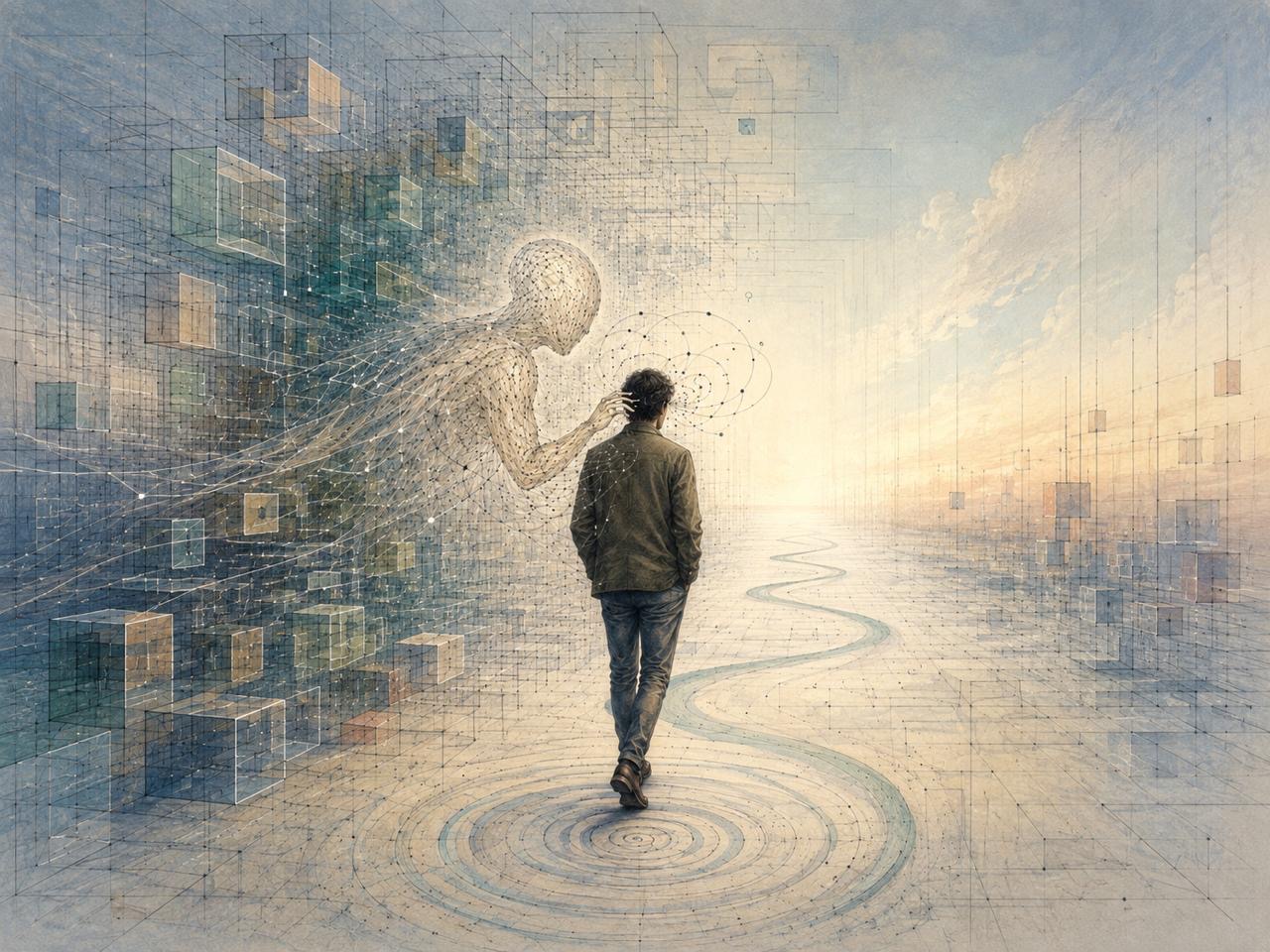
AI, Stories and the Mind
I have been reading an English translation of the Kathasaritsagara—The Ocean of the Streams of Stories—composed in Sanskrit by Somadeva, a Kashmiri writer of the eleventh century. Organised into eighteen books, it is less a conventional book than an immense reservoir of narratives. Stories arise from within other stories, branch into still more stories and then disappear back into the larger current from which they emerged. The celebrated twenty-five tales of Vikram and Vetala are embedded within this extraordinary ocean.
What fascinates me is not merely their antiquity. It is their survival. I can vouch that when I read them now in my seventies, I loved them. I could enter the tales almost effortlessly—as easily as one gets wet while walking in the rain. Something in them traverses geography and time. Or perhaps they resonate with something already present deep in the human psyche.
Increasingly, I have come to believe that we do not merely tell stories. We live through them.
When we watch a movie or read a novel, we willingly enter a deliberately streamlined version of life. Irrelevant moments have been removed. Characters have motivations. Events lead somewhere. Cause and effect become visible. A good screenplay rarely says, “This happened, then this happened, and then this happened.” Its deeper grammar is closer to: this happened, therefore that happened; however, something intervened, therefore events took another turn.
Real life is far messier. Yet when we remember it, we instinctively impose some of the same order upon it.
We remember the song played when we had dinner with a friend, but often forget the food. We remember why we left a job, why a friendship ended, why somebody betrayed us, why a particular decision changed everything. Years later, the ‘event’ may feel perfectly coherent not because our memory retains the whole event, but because it retains the meaning we constructed from it—and perhaps the emotion we felt. The mind loses details while preserving much of the interpretation.
During the past two decades, neuroscience has begun to illuminate parts of this narrative machinery. Researchers studying people watching films and listening to stories have found that the brain naturally segments continuous experience into meaningful events. It also draws upon familiar ‘schemas’—mental structures representing situations such as entering a restaurant or passing through an airport—to understand new experiences. Higher-order cortical regions appear capable of representing an event’sunderlying structure even when its surface details differ.
In other words, we possess mental scaffolds for the kinds of stories life repeatedly presents to us.
One famous experiment made this dramatically visible. In 2004, neuroscientist Uri Hasson, now a professor at Princeton University, and his colleagues placed five people in brain scanners while they independently watched half an hour of Sergio Leone’s film The Good, the Bad and the Ugly. Their brain activity showed striking synchronisation across viewers—not merely in elementary visual and auditory regions but across substantial areas of the cortex.
Five separate brains, watching the same unfolding film, showedsignificant correlated patterns of activity in several respects. A film made decades earlier produced synchronised patterns of activity in their brains as they watched it.
The brain, of course, is not a film studio, but the analogy is hard to resist. It selects scenes, identifies characters, predicts intentions, recognises familiar situations, marks transitions, and stores some experiences while letting countless others vanish.
And more than that, the brain does naturally what the storyteller does deliberately: it searches for patterns.
Perhaps this is why humanity’s oldest stories remain recognisable. The Mahabharata, the Iliad, the Odyssey, the Epic of Gilgamesh and countless oral traditions across civilisations repeatedly return to a surprisingly persistent repertoire—love and jealousy, loyalty and betrayal, courage and fear, ambition and sacrifice, justice and revenge, wisdom and folly, mortality and the desire to transcend it.
The familiar saying, “there is nothing new under the sun,” from Ecclesiastes, one of the wisdom books of the Hebrew Bible, resonates because of precisely this recognition: circumstances change enormously, while certain human patterns keep returning.
This is also why stories are powerful—and dangerous.
For a story to persuade, it must resonate with structures already present in the listener. Every culture therefore develops master narratives about success, duty, family, nation, honour, gender, wealth, heroism, failure and happiness. We inherit many of these long before we can examine them.
Then something subtle happens.
We keep living stories, fitting our experiences into parts of the template. Storytelling is therefore not merely entertainment. It is one of the mechanisms through which cultures reproduce themselves—and occasionally transform themselves.
And now enters artificial intelligence.
When I decided to attempt ‘my’ retelling of Vikram and Vetala, I gradually began to see that AI could become a new-age Vetala.
The ancient Vetala never lets King Vikram walk peacefully towards his destination. Hanging over his shoulder, from inside the corpse, Vetala tells Vikram a story, presents a dilemma and compels him to answer. If Vikram remains silent, despite knowing the answer, he will die; so he responds, and Vetala escapes back to the tree.. Vikram must return, lift the corpse once more and begin again.
It is a magnificent recursive structure.
So, I decided to call my retelling Out of the Box. The ‘box’ is not simply conventional thinking. It is the invisible architecture of assumptions through which we organise reality.
Here AI becomes interesting.
Used lazily, AI can strengthen the box we are already in. Ofcourse, AI itself has boxes of its own, shaped by the information, patterns and assumptions embedded in its training and design, as well as by the information supplied in a particular interaction. It can tell us what we already believe, reinforce our prejudices, generate comfortable explanations and surround us with endless variations of familiar ideas. Recommendation algorithms can go further, repeatedly serving material similar to what has engaged us before. A machine that can predict our preferences can easily become an extraordinarily efficient manufacturer of intellectual comfort.
But that is the least interesting use of AI.
Its greater possibility is precisely the opposite.
We can ask it: What am I missing? What assumption have I made? Argue against me. Interpret this event from another person’s position. Show me evidence that would overturn my conclusion. What would a historian see here? A scientist? A child? An adversary? What if the person I regard as the villain were telling the story?
Suddenly the machine becomes Vetala.
It pokes. It prods. It contradicts. It asks another question just when we think the matter is settled.
The greatest challenge in life is to free oneself from conditioning—to overcome fears, doubts, habits, compulsions and prejudices. Friedrich Nietzsche made ‘self-overcoming’ central to his philosophy: human beings must continually confront and transcend inherited limits rather than merely inhabit them. If human life is understood as an expansion of embodied consciousness, this becomes especially significant. Growth requires not merely acquiring more information, but seeing through the conditioning that shapes how information is received, interpreted and acted upon. True freedom begins when we can observe the forces shaping us without automatically obeying them.
For most of human history, such interrogation depended upon finding an exceptional teacher, philosopher, wise friend—or a story.
Today, we can enter sustained dialogue with an artificial intelligence that has access to an extraordinary range of human knowledge and perspectives.
So, what next? Where do we go from here?
Perhaps towards a new kind of literacy.
The essential skill of the AI age may not be learning how to obtain answers from machines. It may be learning how to use machines to question the stories through which we ourselves operate.
We must learn to recognise the narrative we have constructed, separate event from interpretation, distinguish memory from reality, invite alternative explanations and remain willing to revise the script.
Let AI be Vetala, not Vikram. Use it to question and provoke; let itchallenge you.
But we must remain Vikram—the one who walks, listens, decides and bears responsibility for the answer. For perhaps the purpose of every great story is ultimately not to tell us what happened to somebody else.
Is not the purpose of all learning, experience, travel and meditation ultimately to make us discover the story from which we ourselves need to escape?
MORE FROM THE BLOG
Tea, Coffee, or Me?
Though I have been a tea person all my life, coffee has always intrigued me. During my travels in the United States, it seemed to be everywhere: at breakfast tables, in offices, beside hotel reception desks and in paper cups carried through the streets. In Ethiopia, I...

The Agony and the Ecstasy of Life
Since I met Dr Chinnababu Sunkavalli, the robotic surgical oncologist, in 2022 through an introduction by the Tangirala brothers, Venkat and Ravi, he has become part of my life. His enthusiasm, his commitment to connecting with people, and his extraordinary zeal to...
The Resilient Doctor
Dr. Prithvi Raj Jampana is a distinguished radiation oncologist with extensive experience in radiotherapy and systemic treatments for a wide range of cancers. He trained in clinical oncology at Oxford University Hospitals and worked in the UK for over two decades...
Indeed, ‘We must learn to recognise the narrative we have constructed, separate event from interpretation, distinguish memory from reality, invite alternative explanations and remain willing to revise the script.’ So this life has to be.
The essay raises a fundamental question about the future of civilisation. For thousands of years, stories transmitted collective wisdom, moral codes, social identities, and cultural prejudices. Now algorithms increasingly mediate this process, determining what people read, watch, believe, and remember. Generative AI could intensify this conditioning by producing persuasive narratives tailored to individual preferences. Alternatively, it could become an unprecedented instrument of intellectual liberation by exposing people to contradictory evidence and unfamiliar ways of thinking. The difference lies not merely in technological design but in human intention and institutional incentives. An education system that teaches students to obtain answers from AI may produce dependence; one that teaches them to interrogate those answers may cultivate independent minds. The defining question of the AI age is not whether machines will become more intelligent, but whether human beings will become more discerning.
Modern society is surrounded by narratives created by governments, corporations, educational institutions, advertising agencies, and increasingly, digital platforms. These narratives influence what people consider successful, desirable, respectable, or even true. Most individuals absorb such messages without examining their underlying assumptions. Artificial intelligence can reinforce this tendency by supplying convenient answers that appear authoritative, or it can challenge established beliefs by presenting alternative interpretations. The outcome depends largely on how people choose to engage with it. Families, schools, and institutions must therefore cultivate the habit of asking questions rather than merely accepting explanations. A healthy society needs citizens who can distinguish evidence from persuasion, knowledge from opinion, and genuine understanding from manufactured agreement. The greatest promise of AI is not that everyone will have access to answers, but that more people may learn to ask better questions.
Dear Sir, every generation encounters new technologies that promise to transform human life, yet the fundamental human needs for meaning, belonging, recognition, and happiness remain remarkably constant. Stories have always helped people understand their circumstances, justify their choices, and find comfort in uncertainty. Artificial intelligence introduces a new dimension by enabling machines to generate stories, arguments, and explanations almost instantly. However, the abundance of information does not necessarily produce greater understanding. People may become more informed while remaining equally confused about what truly matters. The real value of AI lies in its ability to stimulate curiosity, broaden perspectives, and encourage reflection. Technology may change how we acquire knowledge, but wisdom still depends on how thoughtfully we live.
The essay raises a fundamental question about the future of civilisation. For thousands of years, stories transmitted collective wisdom, moral codes, social identities, and cultural prejudices. Now algorithms increasingly mediate this process, determining what people read, watch, believe, and remember. Generative AI could intensify this conditioning by producing persuasive narratives tailored to individual preferences. Alternatively, it could become an unprecedented instrument of intellectual liberation by exposing people to contradictory evidence and unfamiliar ways of thinking. The difference lies not merely in technological design but in human intention and institutional incentives. An education system that teaches students to obtain answers from AI may produce dependence; one that teaches them to interrogate those answers may cultivate independent minds. The defining question of the AI age is not whether machines will become more intelligent, but whether human beings will become more discerning
The most fascinating proposition in the essay is that human beings do not merely remember experiences; they reconstruct them as stories. Memory is not a recording device but an active process of selection, interpretation, and emotional association. The brain seeks coherence even where life offers none. This explains why ancient stories remain meaningful across centuries: they engage recurring patterns of human emotion, motivation, and social behaviour. Yet there is a deeper implication. If our personal identities are partly constructed through narratives, changing the narrative can change our understanding of ourselves. AI may help us reconsider these constructions, but it cannot independently establish the truth of our memories. The challenge is to distinguish what happened, what we remember, and what we have come to believe happened.
Arunji, Namaskar! The analogy of AI as Vetala and humans as Vikram is profound. AI’s true value lies not merely in providing answers, but in challenging our assumptions and expanding our perspectives. Ultimately, technology can guide our thinking, but wisdom and responsibility must remain human. A good article in today’s scenario of conflicting thoughts.
Dear Sir, Greetings! A fascinating and deeply thought-provoking article, Sir. Your analogy of **AI as Vetala and the human being as Vikram** is perhaps the most meaningful way I have encountered to describe our relationship with AI.
We often use AI to find answers, validate our thinking and make our work easier. But your article raises a much more important possibility: using AI to challenge our assumptions, expose our biases, present opposing perspectives and make us question the stories we have constructed around our own experiences.
What particularly stayed with me is the distinction between **event and interpretation**. We often believe that we remember life as it happened, whereas we may actually be carrying the story our mind created about what happened. Asking AI, *“What am I missing? Argue against me. Show me another perspective,”* can therefore become an exercise not merely in acquiring knowledge, but in self-reflection.
At the same time, your conclusion provides the essential balance: **AI can be Vetala, but we must remain Vikram.** Technology may question, challenge and illuminate possibilities, but judgement, values, decisions and responsibility must ultimately remain human.
Perhaps this is indeed one of the most important forms of literacy we will need in the AI age—not simply learning how to prompt a machine for better answers, but learning how to let it ask better questions of us.
Thank you, Sir, for another remarkable reflection connecting our ancient storytelling wisdom with one of the most important technologies shaping our future. Warm Regards,
Dear Sir, Namaste!! Thank you for this thoughtful essay. Your image of entering the tales ‘as easily as one gets wet while walking in the rain’ beautifully explains why the Kathasaritsagara still feels so alive.
One thought in the spirit of your Vetala. Vikram’s correct answers keep sending the Vetala back to the tree. Release comes only when he honestly cannot answer the final riddle. Perhaps the new literacy also means staying with questions we cannot yet answer, and doubting even the AI’s challenges, since it too tends to drift toward agreement.
And Vikram never escapes by dropping his burden. He lifts it again and again. Perhaps freedom from conditioning works the same way. We all look forward to ‘Out of the Box’. Warm regards,
Interesting indeed.
As you aptly summed it, ‘let us be Vetala and not Vikram’
As one who uses AI to find better pathways, I find that it makes mistakes – as we go deeper into the subject.
Let us use it as tool and not as means.
Best wishes to all.
‘AI, Stories and the Mind’—reading, narrating, and correlating them with Vikram and Vetala is something only Professor Arun Tiwari can do. AI hallucinates in the exact same way the Vetala used to test Vikram, yet Vikram simply walked through those stories and ultimately captured the Vetala. In the same way, we must stay alert and cautious like Vikram while enjoying the Vetala’s stories, and when the time comes, we must use Vikram’s consciousness to finish the job.
This profound intersection of artificial intelligence, narrative structure, and human consciousness finds its truest expression through the vision of Professor Arun Tiwari. Just as the cunning Vetala used mesmerising tales to test King Vikram and lead him through labyrinths of plausibility, modern artificial intelligence weaves fluent yet deceptive fabrications that manifest as algorithmic hallucinations. As we navigate this era of technological transformation through the lens of ‘AI, Stories and the Mind’, we find ourselves on a path akin to Vikram’s solitary trek, where appreciating AI’s magnificent stories and capabilities must always be balanced with deep caution and critical awareness.
When the critical moment of decision finally arrives, we must transcend the mesmerising noise of automated computation by anchoring ourselves firmly in human consciousness. Just as Vikram maintained his focus, walked through the narratives, and ultimately mastered the Vetala to complete his journey, we too must stay alert to digital trickery, using our own consciousness to complete the work at hand.
“Nothing is new under the Sun”… including AI…The only thing I am not in favour of about AI is that we humans may further restrict ourselves to our compartments… with AI to reply to anything we ask… why do we need to interact with another human being??
This Blog took me to my childhood days, when i used to read Vikram and Betal. And now reading the analogy of AI as Betal was thought provoking. AI can help us examine our assumptions, provided we are willing to hear an uncomfortable answer, and question that answer too. Vikram’s responsibility must remain ours. Thank you sir, for connecting our childhood stories with such a timely question.
Nice piece!
AI should never be used to replace the human souls – full of empathy and ethical values. It should be a tool for efficiency and accuracy in predetermined areas of operation
As a medical doctor, I appreciate the value add of AI in Heathcare – improving diagnosis and treatment outcomes