
The Wipro Visit
I have had a long association with Wipro since the 1990s. I accompanied Dr A. P. J. Abdul Kalam to the Wipro campus in Bengaluru in 1999. We aimed to develop a mobile Cath Lab, as none existed in the country outside a few large cities. There, I had the opportunity to present to Azim Premji on the civilian spin-offs of defence technology. I titled the presentation ‘Web of Life’. However, the initiative did not move forward.
Years later, my son Aseem worked with Wipro in Germany, absorbing the global rhythms of an Indian enterprise that had learned to speak many technological languages. In another phase of my journey, I co-authored Innovate Locally to Win Globally, the memoir of Mr D. A. Prasanna, Founder and CEO of Wipro GE Healthcare. The book traces the origins of India’s med-tech revolution in the 1990s, which has since grown into a US$12 billion export ecosystem.
So, when an invitation came from Seshu Venkata, Chief of Wipro Intelligence and Location Head in Hyderabad, for a tête-à-tête, it was more than a courtesy call—it was a familiar echo from the past.
The Wipro Gopanpally campus is expansive—nearly 100,000 square metres of built space, interwoven with restaurants, cafeterias, fitness centres, and a library that speaks of both scale and aspiration. Four energy-efficient towers are dotted across a meticulously landscaped 38 acres, creating a setting that feels almost surreal.
Sheshu received me in his Spartan cabin on the 12th floor—no showpieces, no paraphernalia, none of the trappings that often accompany hierarchy. For someone overseeing a workforce of over 52,000, the absence of phones, secretaries, and guards felt almost radical to an Indian mind conditioned to equate authority with visible markers. And yet, what appeared as minimalism was, in fact, a deeper discipline. I was reminded of an earlier moment in San José, when John Chambers, the CEO of CISCO Systems, hosted Dr Kalam in a similarly understated office. True scale, I have come to realise, does not need to announce itself.
In his fifties, Sheshu is a man of good health and pleasant manners, but one cannot miss a ‘no-nonsense firewall’ around his persona. He prefers to drive a Tata Safari—a deliberate choice in a world where he could afford any global brand. He commutes from his villa in Hill County, a home he acquired nearly two decades ago, long before the surrounding landscape transformed into today’s bustling technology corridor. His attire is simple, his food is home-cooked, and his rhythms are unadorned.
In his cabin, he demonstrated something far more telling than any artefact of success. On a wall-mounted screen, each of his immediate team members appeared—not in static profiles, but in motion—working in real time, assisted by AI agents that were already anticipating needs, offering insights, and intervening even before being explicitly asked. Each morning, when they arrive, their AI agent tells them that certain activities have already been completed since they left the previous evening. It was a glimpse into a living system—an organisation where intelligence had begun to flow, not as a command, but as a continuum.
Sheshu himself is a Wipro veteran in the truest sense—one who has grown with the institution. From managing Wipro’s flagship Nokia account in Finland for a decade to returning to Hyderabad and shaping it into a powerhouse that rivals even Bengaluru, his journey mirrors Wipro’s own evolution in Hyderabad. From a modest 300-seat facility, to 3,000 seats at Cyber Towers in 2000, to 30,000 in the Financial District, and now this sprawling campus—the growth is not just in numbers, but in confidence.
We spent about an hour—over tea, a simple piece of grilled toast, and a sachet of tomato ketchup that seemed almost symbolic of the times: minimal, functional, unpretentious.
With me was my long-time colleague S. G. Prasad, who pitched in where I lacked or strayed. Between us, we framed our conversation around three questions—questions that are now shaping not just the IT industry, but the very architecture of human work.
- How will AI transform the IT sector?
AI will automate much of today’s IT work—from coding and testing to infrastructure management and parts of system design—transforming, not eliminating, the profession. As routine execution shifts to intelligent systems, IT roles will evolve towards systems thinking: framing problems, interpreting outputs, designing architectures, and aligning machine intelligence with human goals. The future professional will move from coder to orchestrator, from execution to supervision. This is not an extinction event, but a profound reconfiguration in which talent, adaptability, and contextual intelligence will matter more than routine technical labour.
In fact, productivity per engineer is likely to increase dramatically. Smaller teams will build larger systems. Start-ups will challenge incumbents with unprecedented velocity. Within enterprises, the distinction between ‘business’ and ‘IT’ will dissolve—because intelligence will be embedded across functions. Jobs will not disappear; new roles will come up and demand a higher level of thinking.
2. What is India’s position as regards AI?
India’s position in AI is both promising and precarious. It commands major advantages: vast engineering talent, deep large-scale IT expertise, cost-efficient innovation, and digital public infrastructure capable of deploying AI at population scale. These strengths position India to lead the Global South—if it avoids self-inflicted setbacks. Yet foundational AI, from large models to core algorithms and semiconductor ecosystems, remains concentrated among a few global powers. India’s true opportunity lies not in replicating these giants, but in mastering AI applications at scale.
India can lead in building domain-specific AI solutions—in healthcare diagnostics for rural populations, precision agriculture for small farmers, and multilingual education systems that bridge linguistic diversity. We have the advantage of complexity, and if harnessed correctly, that complexity can become our innovation engine. The future will not be decided by who builds the largest model; it will be shaped by who applies intelligence most meaningfully.
3. What can AI do to improve the lives of ordinary people?
This, to me, is the most important question. AI must move beyond enterprise efficiency and enter the domain of human dignity. Seshu himself appeared brimming with enthusiasm on this account.
Imagine a primary health centre where AI assists a doctor in diagnosing conditions early, reducing errors and expanding access. Imagine a farmer receiving real-time, localised advice on soil, weather, and crop health. Imagine a student in a remote village learning in her own language, guided by an adaptive system that understands her pace and potential. These are not distant possibilities; they are emerging realities. AI, when aligned with public purpose, can compress inequity. It can bring expertise to places where experts cannot physically be present. It can reduce the distance between knowledge and need. But this requires intent. Technology alone does not guarantee inclusion.
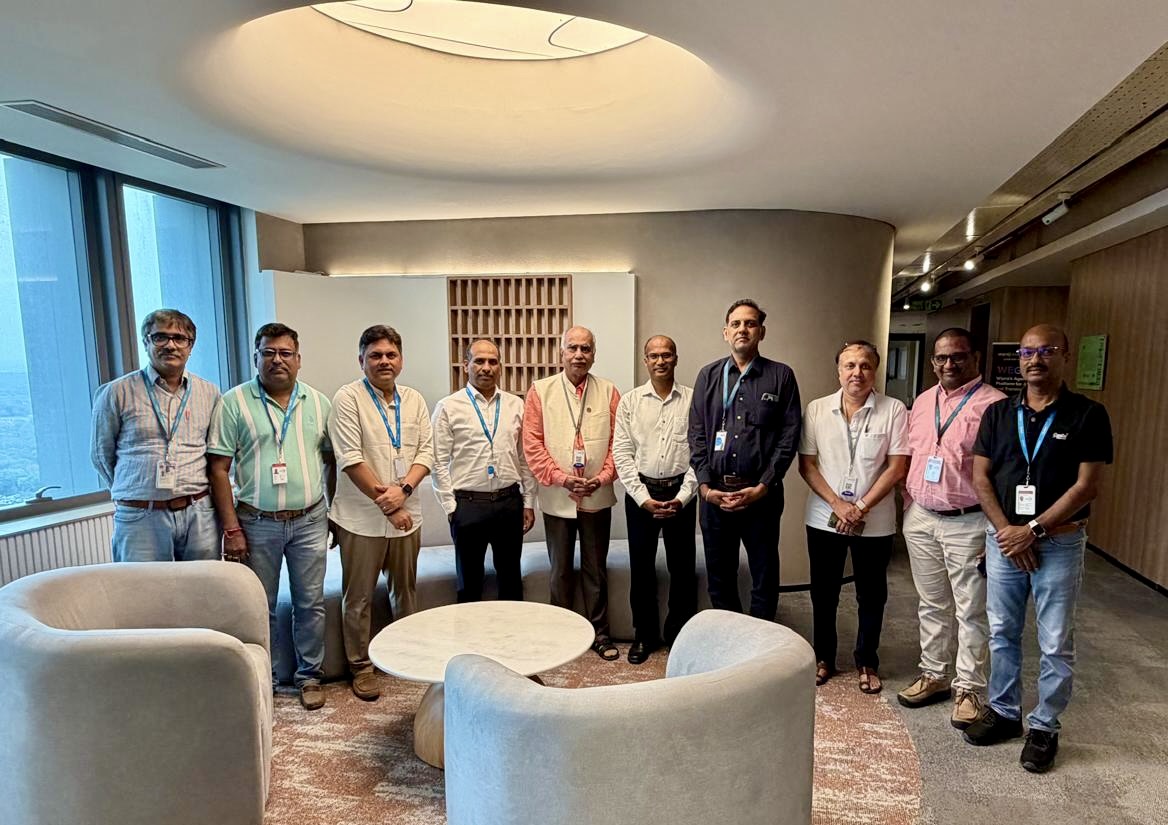
As the visit drew to a close, I was introduced to Sheshu’s twenty-strong Wings of Intelligence team. There was a quiet bonhomie among them, born of having worked together for over a decade—an ease that arose not from hierarchy, but from shared purpose. They did not speak of disruption; they embodied continuity. In many ways, they carried forward the spirit of Dr. Kalam’s Wings of Fire.
Leaving the campus, a simple thought stayed with me. The future of IT will not be written by those who chase technology as an end in itself, but by those who see it as a means to integrate systems, elevate human capability, and serve a larger purpose. The façade may evolve; the foundation must deepen. And I can already see that shift taking shape.
MORE FROM THE BLOG
Tea, Coffee, or Me?
Though I have been a tea person all my life, coffee has always intrigued me. During my travels in the United States, it seemed to be everywhere: at breakfast tables, in offices, beside hotel reception desks and in paper cups carried through the streets. In Ethiopia, I...

The Agony and the Ecstasy of Life
Since I met Dr Chinnababu Sunkavalli, the robotic surgical oncologist, in 2022 through an introduction by the Tangirala brothers, Venkat and Ravi, he has become part of my life. His enthusiasm, his commitment to connecting with people, and his extraordinary zeal to...
The Resilient Doctor
Dr. Prithvi Raj Jampana is a distinguished radiation oncologist with extensive experience in radiotherapy and systemic treatments for a wide range of cancers. He trained in clinical oncology at Oxford University Hospitals and worked in the UK for over two decades...
I worked for Wipro. To me, Wipro represented far more than a technology company. It stands as one of the symbols of India’s transformation from a developing nation struggling with scarcity into a country capable of competing in the global knowledge economy. At a time when India was still discovering its technological confidence, Wipro helped demonstrate that Indian engineers, scientists, and managers could build systems and solutions trusted worldwide. In doing so, it gave an entire generation the confidence to dream beyond conventional boundaries.
What makes Wipro’s journey especially inspiring is that it was not built overnight or through spectacle. It evolved steadily—from a company once associated with consumer products to one of India’s major technology and consulting enterprises. Wipro’s rise paralleled the rise of India’s middle class and the emergence of millions of first-generation professionals who saw education and technology as pathways to dignity and opportunity.
Dear Sir, An insightful and deeply human reflection on the evolving role of AI in society. I especially appreciated how you connected technological advancement with values such as simplicity, purpose, and the public good. Your observations on leadership, innovation, and India’s unique opportunity in AI are both inspiring and thought-provoking. Truly a meaningful read, Sir. Warm Regards.
It is a powerful reminder that India’s real opportunity lies not in competing at the frontier of model-building, but in meaningful, large-scale application. The emphasis on simplicity in leadership and purpose-driven innovation ties the narrative together beautifully.
You are absolutely correct, Professor. You have a gifted talent for predicting the future, inspiring us to think more deeply, putting wings of fire in our minds
Sir, very nicely written about Wipro, the renowned company and the role of AI in the transformation of the IT sector. Not only is AI playing a pivotal role in transforming every sector, but it is also shaping the future of the world. Indeed, it is more.
Arunji, Sheshu, is a wonderful person. What stayed with me most, reading this post, was his journey itself, a true Wipro veteran who has grown alongside the institution, carrying both its memory and its momentum. From Finland to Hyderabad, and from a modest setup to a world-class campus, his leadership reflects a rare blend of continuity, vision, and grounded simplicity. Warm Regards.