
The Art of Holding Up a Mirror
I continue here the narrative on the power of storytelling from my earlier blog, Technology, Post-Truth, and the Craft of Story. History, when reduced to dates and events, runs the risk of becoming distant—almost abstract. But when someone writes with moral clarity and an actor embodies a life with unsettling precision, the past steps forward and confronts us. In the case of Adolf Hitler, this confrontation is not merely intellectual; it is deeply human, even disturbing. Through the monumental scholarship of Ian Kershaw and the haunting portrayal by Anthony Hopkins in The Bunker, we are forced to encounter a paradox: how does a human being become an instrument of immense destruction?
Among historians, Ian Kershaw, through his landmark biographies, Hitler: Hubris 1889–1936 and Hitler: Nemesis 1936–1945, offered one of the most authoritative and nuanced examinations of this question. It is not merely a life story; it is an anatomy of power. Kershaw resists the temptation to see Hitler as a lone aberration—a monstrous exception—and instead situates him within a broader social and institutional framework. The famous Nazi phrase, ‘working towards the Führer’, captures a chilling dynamic: Hitler did not need to issue explicit orders for every atrocity. Instead, a system evolved in which subordinates anticipated his wishes and acted with increasing radicalism. Evil, in this telling, is not only imposed from above; it is also cultivated from below.
What makes Kershaw’s work so compelling is its refusal to simplify. Hitler emerges not as a caricature of villainy but as a man shaped by circumstances, resentments and opportunities. The young, failed artist in Vienna, the soldier in the trenches of the First World War, the orator who discovered the intoxicating power of mass rallies—each phase is rendered with careful attention. Yet Kershaw never loses sight of the moral gravity of his subject. The Holocaust, the war, the devastation of Europe—these are not treated as abstractions but as consequences of choices made within a system that normalised the unthinkable.
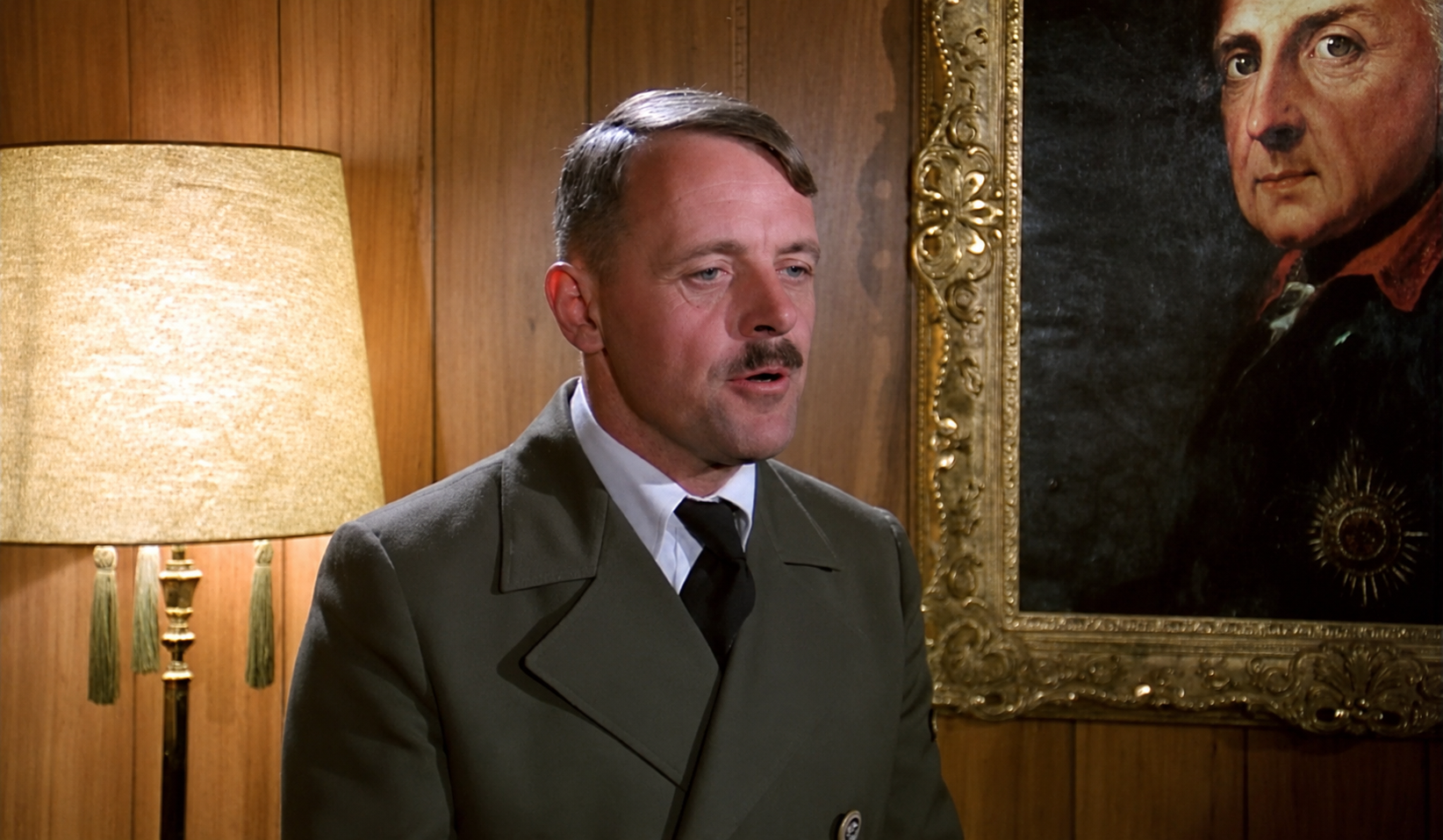
If Kershaw gives us the architecture of power, The Bunker gives us its final, claustrophobic collapse. In this film, Anthony Hopkins portrays Hitler not as a distant figure of propaganda, but as a man in decay—physically diminished, psychologically unravelling, yet still clinging to delusions of control. The setting itself—the underground bunker in Berlin during the last days of the Third Reich—is almost theatrical in its intensity. The world above is burning; inside, a shrinking circle of loyalists inhabits a reality increasingly detached from the truth.
Hopkins’s performance is remarkable for its restraint. He avoids the temptation to exaggerate. Instead, he presents a Hitler who is, by turns, petulant, paranoid and eerily ordinary. There are moments of quiet conversation, flashes of irritation and sudden eruptions of anger. The effect is unsettling precisely because it humanises without excusing. One sees not a mythical monster, but a man—fragile, fearful, and yet capable of commanding unimaginable destruction. One cannot help but feel a disturbing sympathy for a man caught in the web of his own making, moving inexorably towards a horrific end.
This is where the power of storytelling becomes evident. A historian like Kershaw reconstructs the past through documents, testimonies and analysis. An actor like Hopkins reconstructs it through gesture, voice and presence. Both, in their own ways, bridge the distance between then and now. They remind us that history is never detached from human experience; it emerges through lives, decisions, and moments that were once as vivid and immediate as our present reality.
And yet, this very humanisation raises a troubling question: if even someone like Hitler can be understood as a human being, what does that reveal about the human condition itself?
The instinctive response is to resist this idea. We prefer to see figures like Hitler as fundamentally different from ourselves—as embodiments of evil that seem removed from the accepted terrain of human behaviour. This distance provides a kind of moral comfort. But Kershaw’s analysis and Hopkins’s portrayal both challenge this comfort. They suggest that the capacity for destruction is not alien to humanity; it is a distortion of impulses that exist within it.
In Kershaw’s account, Hitler’s rise is inseparable from the conditions of his time: the humiliation of Germany after the First World War, economic instability, political fragmentation, and a widespread longing for order and national revival. These conditions did not create Hitler, but they enabled his message to resonate. They created a space in which his ideas could take root and grow. The lesson here is not that history repeats itself mechanically, but that certain patterns—fear, resentment, the search for simple answers—can make societies vulnerable.
In The Bunker, this vulnerability is seen in its final consequences. The men and women around Hitler continue to serve him even as the reality of defeat becomes undeniable. Some are driven by loyalty, others by fear, and still others by an inability to confront the collapse of the world they believed in. The film captures this psychological inertia—the difficulty of breaking away from a system, even when it is clearly failing.
Together, these works illuminate a deeper truth: large-scale evil is rarely the product of a single will. It emerges from an interplay of leadership, ideology and collective behaviour. It is sustained not only by those who initiate it, but also by those who enable it, justify it, or simply fail to resist it.
And yet, recognising this does not diminish responsibility. If history teaches anything, it is that the boundary between the ordinary and the catastrophic is more fragile. The transformation of a society does not occur overnight; it unfolds through a series of small steps, each of which may seem insignificant in isolation but becomes profound in accumulation.
This is why the work of historians and artists matters. They do more than recount events; they shape our understanding of them. They invite us to look beyond the surface, to ask difficult questions, and to confront uncomfortable truths. In bringing figures like Hitler to life—not to glorify, but to understand—they perform a vital function. They keep memory alive, not as a static record, but as a living inquiry.
The paradox is this: understanding is not the same as forgiving, and humanising is not the same as justifying. But if we refuse to understand, history turns into myth—and we may fail to recognise the same forces shaping our own world.
In this sense, the enduring value of Kershaw’s scholarship and Hopkins’s performance lies not only in what they reveal about the past but in what they ask of the present. They remind us that history is not something that happened once and is now over. It is a mirror—one that reflects both the heights and the depths of human possibility.
And perhaps the most sobering insight they offer is this: the line between good and evil runs, quietly and persistently, through the human condition itself—echoing the Bhagavad Gita’s reminder that दैवी सम्पद्विमोक्षायनिबन्धायासुरी मता (16.5): the divine qualities lead to liberation, the demonic to bondage, both residing within the same human frame. Blessed, then, are the writers and actors—for theirs is the rare art of holding up a mirror, and compelling us to see not only history as it was, but ourselves as we are.
MORE FROM THE BLOG

Tea, Coffee, or Me?
Though I have been a tea person all my life, coffee has always intrigued me. During my travels in the United States, it seemed to be everywhere: at breakfast tables, in offices, beside hotel reception desks and in paper cups carried through the streets. In Ethiopia, I...

The Agony and the Ecstasy of Life
Since I met Dr Chinnababu Sunkavalli, the robotic surgical oncologist, in 2022 through an introduction by the Tangirala brothers, Venkat and Ravi, he has become part of my life. His enthusiasm, his commitment to connecting with people, and his extraordinary zeal to...

The Resilient Doctor
Dr. Prithvi Raj Jampana is a distinguished radiation oncologist with extensive experience in radiotherapy and systemic treatments for a wide range of cancers. He trained in clinical oncology at Oxford University Hospitals and worked in the UK for over two decades...
Prof Tiwari, this is a thoughtful and deeply important article. You have handled a morally difficult subject with remarkable balance, showing that understanding history does not mean excusing evil, but confronting it with honesty. Your integration of Ian Kershaw’s scholarship, Anthony Hopkins’s performance, and the broader question of human nature is emotionally compelling. It is a fitting reflective piece of writing.
Through Ian Kershaw’s careful scholarship and Anthony Hopkins’s restrained portrayal in The Bunker, the piece reveals how power, complicity, and circumstance intertwine to produce outcomes that defy easy explanation.
It is this quiet insistence…that history must be confronted in its full human complexity…that gives the essay its lasting force.
I totally resonate with your blog, Prof Tiwari. To see Hitler as a complex human being—shaped by failure, grievance, and the contingencies of history—is not to soften responsibility or relativise evil; it is to sharpen our moral imagination so that we can recognise how to resist the complacencies that let small distortions widen into moral abyss. Even more so in the digital era, dominated by social media with its algorithmic amplification, which takes away space for deliberation. It demands discernment (viveka) and the conscious cultivation of fearlessness, truthfulness, and compassion to stay alert, support strong institutions that limit the misuse of power, encourage people to think and speak up when they disagree, and learn from history to recognise warning signs before they lead to bigger problems.
Hon’ble Arun sir, many thanks for depicting the action and impact of Adolf Hitler through story telling of History. Holding up a mirror is the process of self reflection. Philosophically it challenges the people, society and storytellers to examine the actions and acknowledge the realities in the pursuit of growth and societal progress. Rightly said that destruction is a distortion of impulses, stand taken by Mr Kershaw and Mr Hopkins was in the right perspective against the actions of Hitler. He pushed Germany on backward side and fragmented too. US President Donald Trump will refer this blog or learn something from History of WW-I and II. Thanks a lot for writing thought provoking blog.
A powerful and thought-provoking piece. The idea of history as a mirror is beautifully expressed—reminding us that understanding the past is also a way of understanding ourselves.
Arunji, Your article narrates how history becomes meaningful through storytelling. The distinction you draw between understanding and justifying is particularly important. By examining figures like Hitler through rigorous scholarship and nuanced performance, we are reminded that the greatest lessons of history lie not only in the past but in our capacity to recognize the conditions that enable intolerance, blind loyalty, and abuse of power. Thought-provoking and deeply relevant to our times.
Arun Ji, The Art of Holding Up a Mirror, is a powerful reminder that growth begins with honest reflection. As a surgeon, I have learned that diagnosis must precede treatment; the same principle applies to individuals, institutions, and nations. A mirror does not judge—it simply reveals. The courage to look into that mirror, acknowledge our strengths and shortcomings, and act with humility is what drives meaningful transformation. Thank you for eloquently highlighting the importance of self-awareness in an age that often values appearances over introspection.