
The Perpetual Proletariat
have long been an admirer of V. S. Naipaul, whose writings—especially his celebrated Indian Trilogy: An Area of Darkness (1964), India: A Wounded Civilisation (1977), and India: A Million Mutinies Now (1990)—have deepened my understanding of India beyond the comforting simplifications of nationalism or ideology. Much of what circulates in the media is crafted to flatter pride, reinforce prejudices or sustain political narratives. Great literature, however, compels us to confront societies as they are: layered, wounded, contradictory and profoundly human.
When I began reading, rather late, Midnight’s Children, published in 1981, I carried with me the exacting standards shaped by a Nobel Laureate’s gaze upon India. Yet Salman Rushdie’s achievement astonished me in an entirely different way. His extraordinary ability to capture how ordinary men and women experience history—not as abstract events in textbooks, but as disruptions that enter kitchens, refugee camps, railway compartments, marketplaces, military barracks and crowded city lanes—left me mesmerised and deeply shaken.
It is through great novels that one often encounters the deepest reality of an age. Historians may record events, statistics, treaties and political transitions, but novelists illuminate how those transformations are lived by people. Victor Hugo revealed the moral and social undercurrents of post-revolutionary France through the suffering and redemption of ordinary lives in Les Misérables. Leo Tolstoy captured the vast emotional and philosophical landscape of Imperial Russia in War and Peace, where history moves not only through emperors and generals but also through families, doubts, fears and private longings. Charles Dickens exposed the human cost of industrial England—the child labour, urban misery, debtors’ prisons and the emotional loneliness hidden beneath the triumphalism of progress. In the same way, Rushdie’s novel allows us to feel the subcontinent from within: its chaos, absurdity, beauty, violence, resilience and tragic inheritances. Great fiction does not merely narrate events; it restores texture to history and reminds us that civilisation is ultimately experienced not in slogans or statecraft, but in the fragile interior worlds of human beings.
Beneath the spectacle of history—its wars, revolutions, elections and ideological battles—there persists an older and more enduring pattern: the ordinary masses are repeatedly mobilised, sacrificed and rearranged by forces far larger than themselves. Whether one calls them Janata, the proletariat, the working class, the peasantry or simply the multitudes, they remain the human material upon which history is most violently enacted. Empires are defended by their blood, economies are sustained by their labour and political narratives are legitimised in their name. Yet the rewards of power rarely flow proportionately towards them. Those who command capital, weapons, institutions and information continue to shape the direction of societies, while the masses often inherit the consequences.
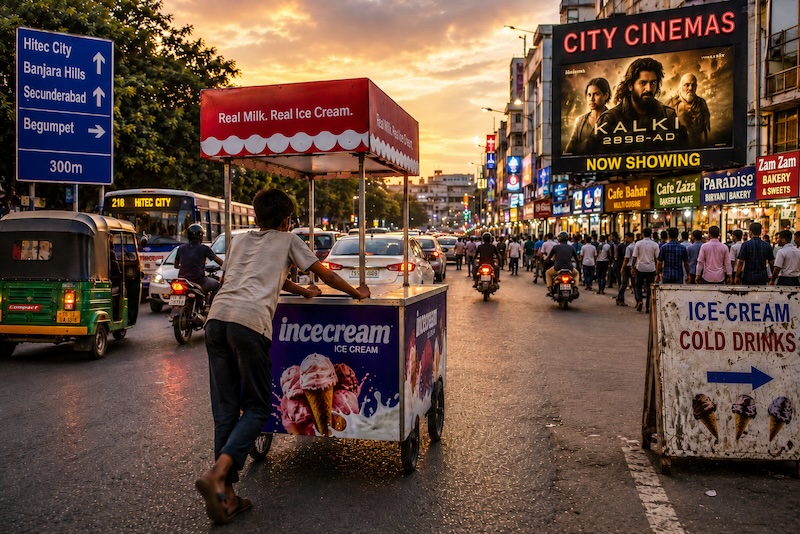
The other day, on our way back after an evening with Seshu Venkata, Chief of Wipro Intelligence and Location Head in Hyderabad, at his home, while sitting beside my son Amol in his car at a traffic junction, I noticed a lanky teenage boy slowly pushing an ice cream cart towards a nearby cinema hall. The evening show was about to end, and the boy was positioning himself for the brief rush that would follow when crowds spilt out onto the street. There was something quietly tragic about the scene: the effort with which he pushed the cart, the uncertainty of the sales ahead, and the fragile economics of an entire evening resting upon melting ice cream and passing appetites. Almost instinctively, I wondered aloud where he would keep the cart at night and what would happen to the unsold stock.
Amol smiled at my naïveté and gently corrected me. “The cart is not his,” he said. “Nor is the ice cream.” He explained that the boy was merely a daily-wage worker employed by a larger company. At the end of the day, the carts—numbering in hundreds—would be returned to the company yard, where they would be cleaned, recharged and readied for the following day’s trade. The boy owned nothing except his labour for the day. Somehow, that reality saddened me even more. The little romanticism I had unconsciously attached to the image of a struggling but independent vendor dissolved instantly. This was not entrepreneurship in any meaningful sense. It was dependency disguised as informal freedom.
Sensing my discomfort, Amol expanded the point with a clarity characteristic of his generation. “Why only the ice cream cart?” he said. “Look around. The auto-rickshaw driver often doesn’t own his vehicle. The fruit seller may be working on borrowed money. Even many shops you see are financed entirely through loans and hypothecation. The goods inside do not truly belong to them until the debt is cleared.” Then he added a sentence that stayed with me long after the traffic light turned green: “These people are not even cogs in the machine anymore. They are merely the lubricating oil.”
That remark captured, with unsettling precision, the condition of much of modern humanity. Earlier industrial metaphors at least imagined workers as “cogs” within a larger system—visible, functional components essential to the machine’s movement. But today, vast numbers of people exist in an even more precarious state: interchangeable, invisible and perpetually replaceable. They facilitate systems they neither control nor meaningfully benefit from. The delivery rider carrying food through midnight traffic, the warehouse worker directed by algorithmic schedules, the app-based driver monitored through ratings, the street vendor dependent upon digital payment platforms, the migrant labourer whose existence vanishes from policy discussions once a crisis fades—all inhabit structures of dependency increasingly mediated not only by capital, but by technology.
This is perhaps the defining paradox of the modern age. Humanity has produced unprecedented wealth, technological sophistication and material abundance, yet insecurity has deepened for millions. Ownership itself is becoming increasingly concentrated at the top, while risk is pushed downward. The platforms, data, logistics networks, financial systems and algorithms belong to distant corporations or institutional capital. The individual worker merely interfaces with them temporarily, often without protection, permanence or bargaining power. The language of freedom remains, but the architecture of dependence intensifies.
And this is where the anxieties evoked by great literature become inseparable from the realities of our century. In Midnight’s Children, ordinary people are repeatedly swept aside by political and historical forces beyond their comprehension. Today, history rolls forward through technological systems that are no less overwhelming simply because they appear efficient, convenient or invisible. The modern citizen may no longer fear only the visible tyrant—the dictator, the censor or the law enforcer. Increasingly, he confronts impersonal systems that shape opportunity, mobility, visibility and even thought itself through data and computation.
The unsettling question is not whether technology is inherently evil. It is whether human beings possess sufficient ethical and democratic wisdom to prevent technological power from becoming tyrannical. Unlike older forms of domination, technological authority often arrives clothed in the guise of convenience. People surrender data for ease, privacy for connectivity, autonomy for efficiency and, eventually, perhaps even judgment itself for algorithmic guidance. The transition is gradual, almost imperceptible. One day, a man owns his tools; the next, the tools define the conditions of his survival.
This is why the image of the teenage boy pushing the ice cream cart lingered in my mind. He was not merely a poor vendor on an Indian street. He was a quiet symbol of the age to come: labour without ownership, effort without security, movement without destination and existence suspended within systems too vast to see clearly. In him, one glimpses the future anxieties of a civilisation where wealth, information and technological power accumulate upward, while ordinary human beings continue to bear the weight of history below.
MORE FROM THE BLOG
Tea, Coffee, or Me?
Though I have been a tea person all my life, coffee has always intrigued me. During my travels in the United States, it seemed to be everywhere: at breakfast tables, in offices, beside hotel reception desks and in paper cups carried through the streets. In Ethiopia, I...

The Agony and the Ecstasy of Life
Since I met Dr Chinnababu Sunkavalli, the robotic surgical oncologist, in 2022 through an introduction by the Tangirala brothers, Venkat and Ravi, he has become part of my life. His enthusiasm, his commitment to connecting with people, and his extraordinary zeal to...
The Resilient Doctor
Dr. Prithvi Raj Jampana is a distinguished radiation oncologist with extensive experience in radiotherapy and systemic treatments for a wide range of cancers. He trained in clinical oncology at Oxford University Hospitals and worked in the UK for over two decades...
Respected Arun Sir, You have adeptly highlighted the struggles behind the life of the common man which is seldom known in detail by the society at large….
Sir, through this heartrending image of a teenage ice cream vendor, you expose the illusion of independent entrepreneurship in a modern economy dominated by corporate platforms and algorithmic dependency. It serves as a vital reminder that despite our massive technological and material progress, the architecture of systemic insecurity and economic vulnerability remains deeply entrenched.
Arunji, the final paragraph stayed with me. The reminder that large-scale evil is sustained not only by those who lead it, but also by those who enable it, justify it, or simply fail to resist it, is both profound and uncomfortable. It shifts the focus from judging historical figures to examining our own responsibilities as individuals and societies.
Many of us can see what is going wrong and spend time worrying or discussing it, but very few are able to move beyond concern and make a meaningful difference. Perhaps that is the real challenge of our times—not recognizing the problem, but finding the courage, conviction, and persistence to act.
An evocative piece that captures the asymmetries of power in modern society. Yet I am not entirely persuaded that ownership alone is the measure of freedom. A person may own little and still possess purpose, community, wisdom, and an inner sovereignty that no corporation, algorithm, or institution can easily appropriate. Perhaps the deeper question is not merely who owns the cart, but whether we have become estranged from the human spirit that gives meaning to both labour and life.
Dear Sir, Greetings! This is a deeply insightful and thought-provoking piece. Your reflection on the hidden realities behind everyday labour is powerful, and the image of the ice cream cart becomes a striking symbol of dependency in the modern age. I especially appreciated how you connect literature, history, and contemporary technological systems to show that the struggles of ordinary people are often shaped by forces much larger than themselves. It is a very moving and eye-opening article that encourages serious reflection on dignity, ownership, and the future of human work. Warm Regards.
Good analysis of common and everyday visuals reflecting all the rainbows of life in various textures
Education requires urgent reform. The purpose of learning can no longer be the acquisition of static knowledge. Machines increasingly possess information. Human beings must cultivate judgment, creativity, ethical reasoning, adaptability, and the ability to work alongside intelligent systems. A society that educates people only for tasks that machines can perform will inevitably create a perpetual underclass. A society that educates people to think, create, and lead will remain resilient. The ultimate measure of technological success is not the number of algorithms deployed, data centres built, or valuations achieved. It is whether ordinary people lead more secure, meaningful, and dignified lives. Technology must remain a servant of civilisation, not its master.
The ending really got me. Simple scene, but says a lot about where things are heading. That line about not even being “cogs” anymore… uncomfortable but very true. This blog isn’t some distant theory, it’s already around us.
The industrial age created the proletariat: men and women who owned little beyond their labour and depended upon factories, mines, and workshops for survival. Over time, societies responded through labour laws, education, social security, and opportunities for upward mobility. The goal was not merely to produce wealth but to enable citizens to participate in that wealth with dignity.
Today, humanity faces a new challenge. Technology has become so powerful that it can either liberate people from drudgery or create what may be called a Perpetual Proletariat—a vast population permanently dependent on systems they neither understand nor control. A very heart-touching and eye-opening article!
Excellent articulation of an important issue of the present times. History offers an important lesson. Societies prosper most when technological advances are broadly distributed. The Green Revolution succeeded because it empowered millions of farmers. The digital revolution flourished because personal computers reached ordinary households. Medical technologies save lives when they become affordable and accessible. Progress becomes sustainable when it lifts entire communities rather than a privileged few.
This is especially relevant for countries such as India, where livelihoods remain closely tied to agriculture, small enterprises, local manufacturing, and services. The objective should not be blind automation but intelligent augmentation. Machines should help farmers grow better crops, artisans reach larger markets, teachers educate more effectively, and healthcare workers deliver better care. Technology should become a multiplier of human capability rather than a substitute for human existence.
Human beings require more than income. They require purpose. Work is not merely a transaction between labour and capital; it is also a source of identity, skill, social connection, and self-respect. When technology strips people of meaningful participation, it erodes something fundamental to human dignity. A population sustained by subsidies but deprived of agency may survive materially while declining socially and spiritually. Technological progress should create more capable citizens, not more dependent consumers. Every major innovation should be examined through a simple question: Does it enlarge human capability, or does it merely concentrate power and profit? Thank you for articulating this important concern.
Artificial Intelligence exemplifies both promise and peril. It can help doctors diagnose disease, farmers optimise crops, teachers personalise learning, and engineers solve complex problems. Yet the same technology can also centralise knowledge, eliminate entry-level opportunities, and create economic structures in which millions become passive users rather than active contributors. A society that continuously generates wealth while continuously reducing meaningful participation risks producing a new class of citizens who are economically dependent and psychologically alienated.
Prof Tiwari, this is a thoughtful moving piece. Indeed, technology, capital, and invisible systems are reshaping ordinary lives, not doubting the assertion you made, capturing the silent tragedy of labour without ownership and effort without security. A profoundly intelligent, humane, and unsettling meditation on literature, power, and the condition of modern humanity. Another serious food for thought!
Amazing writings and analysis of unnoticed facts of life by dad and son interesting indeed
Technology has made life easier, but your piece raises an important question: Who benefits most from that progress? The problem is that by the time we realise how much power has shifted to platforms and algorithms, those systems have become deeply woven into everyday life. The tools that promise freedom can also create new forms of vulnerability. The challenge is ensuring that human dignity, fairness and accountability remain at the centre of the systems we build.