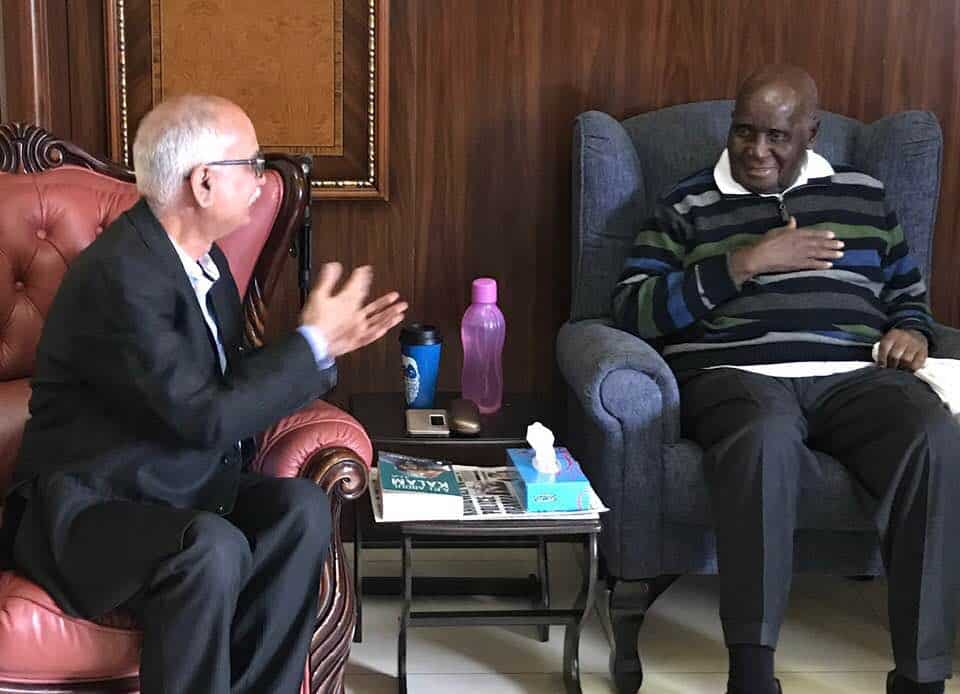
It was during the phase of expanding the Pan-Africa e-Network platform, created under a project of the Government of India that, in 2011, I landed up in Rwanda, a beautiful country with a cool climate and scenic, hilly terrain. Rwanda, due to its geographic location on the continent, is called Africa’s heart…

Beware of the puppeteer in your pocket
Beware of the puppeteer in your pocket
Few years ago, Indians were offered ‘free’ connectivity to the Internet. Suddenly, everyone had the opportunity to be ‘online’ – children were not interested in playing outdoors anymore and started playing video games instead, drivers waiting in the parking lots for their bosses to return in the evening, started watching movies, sitting in the comfort of the car, people living in apartments sharing a lift forgot the basic etiquette of saying good morning and started using that little time to browse the messages they were unable to do in the presence of their spouses, desperately waiting for the freedom. Porn reached everyone from hormone-gushed adolescents to the sexually frustrated middle-aged… all for free!
We chose to forget the basic principle that nothing is free in this world from the time when Adam and Eve plucked the apple and received the admonition of God that nothing would hereafter be free to the creature of clay and in 1942 an American political journalist Paul Allen declared: there is no free lunch. We went into a denial mode, ignoring that our minds were being hacked through free connectivity. People are now openly lured to consume – buy this, buy that, come here, go there, buy this new experience, etc. Coffee turned into Starbucks with free Wi-Fi, shopping malls turned into the new meeting places… once you come, you would buy something for sure! If nothing, at least pay the parking fee and buy a bottle of water at double the price.
Once on a Sunday afternoon in a mall in Hyderabad, I was astonished to see hundreds of young people assemble in a flash and start dancing to loudly played music in the atrium of the mall. They disappeared as if into thin air after about 15 minutes. My son told me it was a ‘Flash mob’ created by a social media group, mostly formed by the students of a prestigious computer science institute in Hyderabad in that case. Sometime back, I had attended ‘Jeevan Vidya’ workshops organized there to introduce computer science students to a value-based lifestyle. This, however, seemed to be an entirely different outcome!
In the last few months, mobile phones have been rampantly used as the new and most preferred tool of electioneering. You get up in the morning to see your phone flooded with video clips venerating or lampooning leaders. Now the cost of ‘free’ service has started showing up. It was a medium to engineer your souls to consumerism; to create segmentation in society so that it can be targeted to sell products and services—to feed businesses like Swiggy, Zomato—and discourage cooking at homes; Uber, to fire your undisciplined and always–asking-for-small-loans driver; Urban Clap, to make plumbers, electricians and carpenters in the neighbourhood disappear and metamorphose into corporate service providers; and get a ‘happy hours’ (another beer free if you buy one) notification delivered at 10 a.m. itself, lest you make other plans for the evening.
All good! India is developing! But what is also developing is the stress of the people of the Middle class whose income is only little better than the poor people, but who has to show up as belonging to the rich segment of society. In the early twentieth century, Benito Mussolini (1883—1945), the tyrant ruler of Italy, summoned philosopher Giovanni Gentile (1875—1944) to present his idea of a totalitarian state as a spiritual principle of Fascism. Later, when Russian writer Maxim Gorky (1868—1936) returned from Italy, the iron-fisted ruler of Russia, Joseph Stalin (1878—1953) hosted a grand welcome party to welcome him as the engineer of the souls! Gorky would later write to clothe Stalin rule in the philosophy of socialist realism.
Indian civilization has been based on the value system that treated human life as a debt towards parents and ancestors, education as a debt to the teachers and wealth as a debt towards the society. We have already seen how the new wealth that came with the so-called IT revolution broke the Indian family system and created nuclear families that created further employments for babysitters and businesses of playschools and crèches. Now, the Online revolution is going to further break the nuclear families into free electrons of consumers who would not only spend every Rupee they earn on their own consumption, but also accumulate credit to be repaid for the rest of their lives to buy a week’s vacation in Bangkok, Phuket, or Macao.
MORE FROM THE BLOG

South-South Solidarity

The Earthy Crown of Felicity
The underlying reason behind an increasing number of people getting angry, cynical, and restless is their disconnect with their religion – something they can’t even acknowledge…

Good Deeds, Bad Deeds
Every childhood is synonymous with instructions raining from parents and other people around. A child is continuously told to do this and not to do that. This continues throughout their childhood where they are influenced by the various people around…