
Civilisation, Sovereignty and the Future of War
Indian civilisation stretches back into prehistory, carrying within it one of humanity’s longest continuous memories. The Vedas stand among the earliest recorded repositories of knowledge, intuition, inquiry and metaphysical reflection. The spread of Indian culture across South-East Asia—visible in Angkor Wat, Borobudur, Prambanan and countless temple traditions—was not merely the result of conquest, but of a deeper civilisational radiance: trade, language, ritual, art, kingship and ideas travelling across seas and being accepted, adapted and naturalised by other societies.
Yet India has often suffered from a peculiar historical forgetfulness. Our civilisational memory is vast, but our public narration of it is fragmented. We remember invasions, but not always resistance. We remember defeat, but not continuity. Mahmud of Ghazni and Muhammad Ghori are invoked repeatedly, but less attention is given to the long intervals between incursions, the resilience of local powers, and the fact that India was never a passive geography waiting to be conquered. Alexander’s retreat from the north-west, the presence of Greek envoys at Chandragupta Maurya’s court, the vast sweep of Mauryan power, the maritime reach of Indian influence, and later, the Maratha expansion from the north to the deep south—all deserve equal space in our national imagination.
The same is true of the Mughal period. Their rule was powerful but uneven, imperial but never total. They controlled courts, cities, armies and revenue systems, but India’s social and cultural life remained deeply plural, local and resilient. The inability of even long imperial rule to homogenise India’s religious and civilisational identity shows not merely resistance, but the depth of Indian society. Aurangzeb’s final years in the Deccan, far from Delhi, and his burial near Chhatrapati Sambhajinagar (formerly Aurangabad), symbolise the limits of imperial overreach. India was politically conquered many times, but rarely culturally subdued.
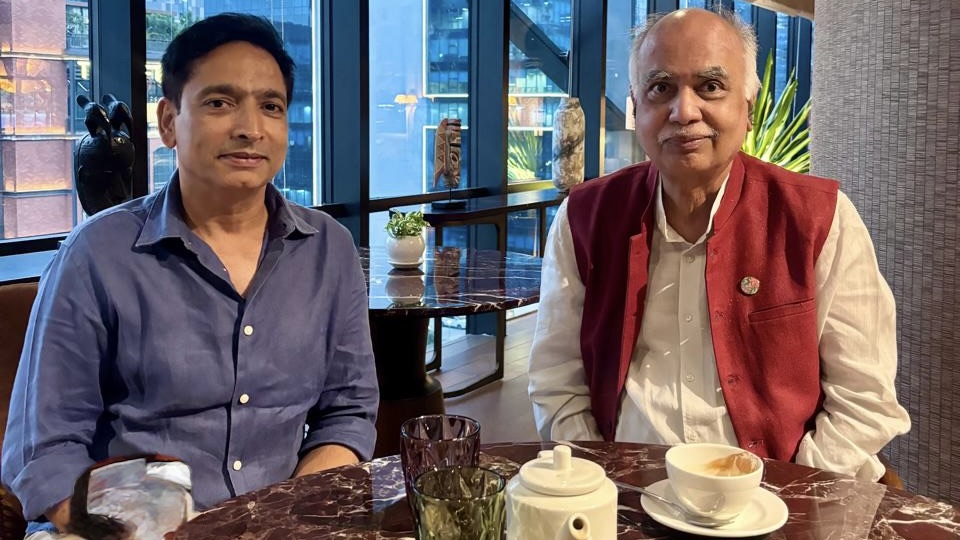
It was in this spirit that I spent a memorable afternoon with Wing Commander M.V.N. Sai, a distinguished Indian Air Force officer who retired after 24 years of service. He played an important role in the evolution of India’s Integrated Air Command and Control System (IACCS), a critical air-defence network that integrates sensors, command nodes and weapon systems for real-time response. Considered a credible ‘think-tank’, his recent analyses have also highlighted the importance of IACCS in India’s network-centric air defence architecture.
Our conversation took place at Quorum in HITEC City, Hyderabad, graciously hosted by our mutual friend, Gopi Krishna Reddy. It was not merely a meeting; it was a reflection. We recalled how India fought wars, how it produced nearly a quarter of global GDP before colonial disruption, how Partition created two militarised flanks on India’s west and east, and how the British departure left behind not only borders but strategic constraints. Yet India, despite technology-denial regimes, geopolitical sanctions, and prolonged economic constraints, became both a nuclear and a missile power. Operation Sindoor, as described by official Indian sources, showcased the increasing importance of indigenous defence systems, layered air defence, electronic warfare and precision capabilities in modern conflict.
The central question before us was this: what kind of war is still ‘tenable’ in the twenty-first century?
Large conventional wars have not disappeared, as Ukraine’s prolonged resistance to Russian military power has demonstrated. But the texture of war has changed. It is no longer only about tanks crossing borders or aircraft dominating skies. It is about drones, satellites, cyber systems, energy grids, financial networks, ports, undersea cables, social media narratives and psychological endurance. The battlefield has expanded from land, sea and air into space, cyberspace, cognition and infrastructure.
The drone has changed military arithmetic. A cheap unmanned system can threaten an expensive platform. Even when claims of drones bringing down stealth aircraft must be treated carefully, the larger lesson is undeniable: asymmetry has returned with force. In fact, recent reports show F-35s being used to shoot down drones, raising questions about cost, sustainability and tactical efficiency. The issue is not that advanced aircraft have become useless; it is that superiority now depends on integration, speed, software, sensors, electronic warfare and layered defence.
This does not mean the end of military warfare; rather, it means the end of old-style military thinking. Militaries will still matter. Navies will still matter. Air power will still matter. But none can function effectively in operational isolation. The decisive force of the future will be the nation’s ability to integrate military strength with technological depth, industrial resilience, civil preparedness and strategic clarity.
The Strait of Hormuz crisis shows how fragile the world remains. The United States has recently warned shipping firms against paying Iran for transit through the Strait, while reports indicate ongoing negotiations and tensions over keeping this vital energy route open. A narrow maritime passage can affect oil prices, inflation, insurance, shipping, diplomacy and war planning across continents. This is exactly why sea lines of communication are no longer abstract naval concerns—they are the arteries of civilisation.
The most frightening dimension, however, lies in cyber warfare. What happens if a national power grid is paralysed? What if banking systems freeze, railway signalling collapses, airlines are grounded, hospitals lose digital access, or ports cannot process cargo? Such an attack may not kill immediately like a missile, but it can immobilise a nation. The next war may begin not with an explosion, but with silence: screens going blank, cities going dark, accounts becoming inaccessible, and command systems failing.
Therefore, India’s preparation must be on a civilisational scale. It must bring together the armed forces, engineers, scientists, cyber experts, aerospace entrepreneurs, maritime strategists, AI specialists, energy planners and young innovators. National security cannot remain confined to cantonments and ministries. It must become a whole-of-nation discipline.
The best solution is not merely more weapons, but deeper preparedness: indigenous technology, secure supply chains, hardened digital infrastructure, resilient power grids, cyber reserves, drone and counter-drone ecosystems, maritime aviation, space-based surveillance and rapid decision networks. Above all, India must recover confidence in its own historical continuity. A civilisation that has survived millennia must not think episodically. It must think in centuries.
The wars of the future will not be won merely on battlefields of land, sea, or air, but in the far more complex theatres of intelligence, technology, economy, information and national resolve. They will not be secured by anger—an emotion that exhausts itself—but by awareness: a clear understanding of history, strategy, vulnerabilities and emerging realities. Nations that survive and lead will be those capable of seeing the world as it is, not as they wish it to be. Memory remains essential, for a civilisation without historical consciousness becomes vulnerable to manipulation and repetition of past mistakes. Yet memory alone is insufficient unless transformed into preparedness—into strong institutions, scientific innovation, strategic industries, military capability, educational excellence and social cohesion.
The future belongs neither to those who merely imitate dominant powers nor to those trapped in nostalgia. Blind imitation breeds dependency; nostalgia without innovation breeds irrelevance. True sovereignty arises when a civilisation draws strength from its own intellectual and cultural foundations while simultaneously controlling the engines of contemporary power. Civilisational self-belief is, therefore, not arrogance, but confidence rooted in continuity—a recognition that a people secure in their identity can engage the future creatively rather than defensively. For India, this means uniting the philosophical depth of one of the world’s oldest civilisations with leadership in artificial intelligence, defence systems, energy security, biotechnology, cyber capability and economic resilience.
A nation that remembers its civilisational inheritance while commanding cutting-edge technology becomes far more than a reactive state—it becomes a decisive force in history. Such a society does not merely defend borders; it defends narratives, institutions, values and the capacity to define its own destiny. In this lies the ultimate lesson: the decisive victories of the coming century will belong to those nations that combine wisdom with innovation, heritage with scientific excellence, and strategic patience with bold execution. For in the end, the greatest power is neither conquest nor rhetoric, but the enduring ability of a civilisation to rise, adapt and lead with confidence in both its soul and its systems.
MORE FROM THE BLOG
Tea, Coffee, or Me?
Though I have been a tea person all my life, coffee has always intrigued me. During my travels in the United States, it seemed to be everywhere: at breakfast tables, in offices, beside hotel reception desks and in paper cups carried through the streets. In Ethiopia, I...

The Agony and the Ecstasy of Life
Since I met Dr Chinnababu Sunkavalli, the robotic surgical oncologist, in 2022 through an introduction by the Tangirala brothers, Venkat and Ravi, he has become part of my life. His enthusiasm, his commitment to connecting with people, and his extraordinary zeal to...

The Resilient Doctor
Dr. Prithvi Raj Jampana is a distinguished radiation oncologist with extensive experience in radiotherapy and systemic treatments for a wide range of cancers. He trained in clinical oncology at Oxford University Hospitals and worked in the UK for over two decades...
Narratives also simplify complexity. Human beings cannot process the overwhelming scale of reality in purely analytical terms, so they organise experience through stories that provide emotional coherence and direction. This is why stories often move societies more deeply than statistics. Economic choices, political movements, technological adoption, and even personal relationships are frequently shaped less by objective reality than by the narratives people believe about reality. In the digital age, this influence has multiplied enormously, as algorithms, images, slogans, and viral content can shape public perception faster than institutions can meaningfully respond.
Education, therefore, is not merely the transfer of information; it is also the formation of a worldview. Every generation inherits assumptions about history, morality, success, and human purpose through family, culture, literature, media, and institutions. Individuals who consciously examine these inherited narratives often become more thoughtful and less susceptible to manipulation. Self-awareness begins when people recognise that many of their convictions are not entirely self-created, but emerge from larger cultural and historical stories within which they have been formed.
Narrative and worldview are far more important than they first appear because human beings rarely act on facts alone. They act on the stories through which they interpret facts. A worldview determines what we notice, what we ignore, whom we trust, and what we fear. Two people may witness the same event and yet arrive at entirely different conclusions because they inhabit different mental worlds. In this sense, the worldview functions like an invisible operating system of the mind, shaping moral judgments, aspirations, and definitions of success long before conscious reasoning begins. Hats off to Wg Cmdr Sai.
The most transformative leaders in history are often those who reshape narratives rather than merely administer systems. They alter how people imagine themselves and their future. A healthy civilisation requires narratives that combine aspiration with responsibility, freedom with restraint, and progress with moral depth. In the absence of meaningful narratives, societies become vulnerable to cynicism, extremism, and fragmentation, because human beings cannot live long in a vacuum of meaning. Ultimately, narratives do not merely influence life from the margins; they shape what individuals and societies believe is worth striving for, preserving, and even sacrificing for.
There is truth in the old observation that the victors often write history. In the aftermath of conflict or upheaval, power does not merely reshape institutions; it also reshapes memory. The fallen tyrant is condemned, the triumphant side sanctified, and complex realities are frequently compressed into moral certainties. Yet once the immediacy of fear and propaganda has passed, societies must find the courage to revisit these narratives with greater honesty and depth. Revising history does not mean rehabilitating tyranny or diminishing suffering; it means resisting the temptation to replace one simplification with another. Human beings, nations, and historical events are rarely reducible to absolute heroes or villains. Mature civilisations are those that can re-examine their past without vengeance or sentimentality, acknowledging both crimes and contexts, failures and achievements. For if history becomes merely an instrument of political convenience, it ceases to illuminate the past and begins instead to imprison the future.
Very interesting article. At the societal level, narratives become even more powerful. Nations, institutions, and civilisations are sustained not merely by laws, armies, or economies, but by shared ideas of identity, destiny, sacrifice, justice, and progress. Many conflicts in history were, at their core, clashes of competing narratives—about religion, race, nationhood, class, or historical grievance. A society that loses confidence in its own narrative often begins to decline internally before any visible economic or political collapse becomes apparent. Civilisations weaken first in imagination and meaning, and only later in power.
A thoughtful and compelling essay that links civilisational memory, strategic depth, and the changing nature of war. Its strongest message is that sovereignty in the 21st century depends not only on weapons, but on technological preparedness, institutional resilience, and a confident civilisational self-understanding. Framing sovereignty not just as a modern state concept, but as something rooted in civilisational continuity and long memory is a powerful lens, especially when discussing security, identity, and resilience.
A very engaging and thought-provoking piece. I especially liked how it connects our civilisational past with the realities of modern warfare…it doesn’t feel like two separate discussions, but one continuous thread. The part about war moving beyond battlefields into cyber, infrastructure, and everyday systems really stays with you. It’s also a strong reminder that preparedness today is not just military, but technological and societal. But what really stands out is the Red jacket in the picture 🙂
Namaste Arunji – a deeply thought-provoking and timely article. The way it beautifully weaves together a profound pride in Bharat’s civilisational past, a sharp understanding of present geopolitical realities, and a visionary preparedness for the future is truly commendable.
The article reminds us that sovereignty in the modern world is no longer confined to borders alone, but extends into technology, cyber capabilities, space, energy, maritime strength and narrative-building itself. The insights on future warfare and civilisational resilience are especially powerful.
One sincerely hopes that the right authorities and institutions are already working in this direction — bringing together our armed forces, engineers, scientists, cyber experts, aerospace entrepreneurs, maritime strategists, AI specialists, energy planners and young innovators into one integrated national mission.
Such a collective civilisational awakening, guided by strategic clarity and national purpose, is perhaps the need of the hour.
Professor Arun Tiwari ji, your essay is a powerful reminder of what true civilisational thinking looks like. The way you trace India’s long arc—from ancient memory to modern strategic complexity—reveals a clarity that is painfully absent in much of today’s global leadership. Your insights show that the future of conflict is no longer about armies alone, but about technology, institutions, resilience and the ability to think in centuries rather than election cycles.
At a time when myopic and arrogant leadership across the world has pushed humanity into an avoidable and unlikely crisis, your writing stands out for its sobriety and depth. You remind us that nations survive not through bluster, but through integration—of wisdom with innovation, heritage with preparedness, and identity with strategic foresight.
Thank you for offering a perspective rooted in continuity, responsibility and civilisational confidence. Your guidance remains a steadying force for many of us.
Namaste sir, This is a brilliant analysis on why future sovereignty requires a ‘whole-of-nation’ preparedness. The emphasis on bridging our ancient civilisational continuity with advanced technology like AI, secure cyber networks, and domestic industrial depth is spot on. You perfectly capture how modern victories will be defined by strategic patience, tech resilience, and national resolve.
Yes we had vedas and upnishads and yes we are now self appointed ‘vishwaguru’ yet we were mauled, ruled, looted by any T-D-H who took the trouble to cross Hindukush…we offered ourselves on plate to anybody who asked….because we were happy, and still are, patting out backs on our past glory….2000 years old. We never try to analyze our fundamental weakness as a society….because we know it already….
”Civilisation, Sovereignty and the Future of War”—this blog title by the honourable Professor Arun Tiwari is far from being a mere academic discourse or a catchy headline. In the crucible of the present global geopolitical and technological landscape, it stands as a stark, existential warning for the survival of global civilisation itself. Today, our advanced societies exist in a state of hyper-connectivity, yet this very progress has rendered us fragile. If we look beyond the immediate machinery of kinetic warfare and ponder a singular catastrophic event—the sudden collapse or shutting down of the global internet grid—the vulnerability of modern humanity becomes terrifyingly clear.
The Illusion of Progress and Total Dependence
Every tangible and intangible asset of modern life is now inexorably linked to the digital matrix. We have outsourced our memories, our finances, our infrastructure, and our survival to invisible servers. This absolute dependence has bred an alarming sense of complacency. As observed in daily life, we have become so profoundly careless that the basic habit of maintaining physical, manual records—such as updating a bank passbook—has been entirely abandoned.
This is not just a minor oversight; it is a symptom of a deeper civilizational malaise. Our supply chains, healthcare systems, electrical grids, and defense mechanisms are anchored to a virtual reality. If the plug is pulled, our systems will not merely stall; they will disintegrate.
The Sanatana Tradition of Knowledge Preservation vs. Virtual Fragility
From a Sanatani perspective, the preservation of knowledge was never left to chance or ephemeral media. The ancient Indian tradition relied on a time-tested, unbreakable continuum of Shruti (that which is heard) and Smriti (that which is remembered). This internal cognitive fortress was later externalised onto enduring physical media—scripted onto stone edicts, engraved on bronze plates, preserved on birch bark (Bhojpatra) or palm leaves, and eventually bound into printed books.
This physical tradition survived centuries of foreign invasions, natural disasters, and the passage of time, ensuring that we still have direct, tangible access to the wisdom of millennia.
In sharp contrast, what guarantee does the modern virtual medium offer? The digital world promises omniscience but delivers cognitive atrophy. A poignant example of this decline is that we no longer even remember the telephone numbers of our closest family members. We have traded human memory for machine storage, leaving our minds vacant.
The Civilisational Amavasya (The Total Eclipse)
As Professor Tiwari has outlined, the collapse of this virtual ecosystem—whether through state-sponsored cyber warfare, satellite disruptions, or unforeseen technological failure—will not be a temporary inconvenience. It will trigger a total collapse of civilisation.
When the screens go blank and the networks vanish, the global population will find itself stripped of its modern tools, plunged into an unfamiliar, chaotic darkness. It will not be a mere power outage, but a Civilisational Amavasya—a spiritual and systemic dark moon night. In that absolute blackout, humanity will be forced back into a primitive, desperate struggle for mere survival, robbed of its history, identity, and order. This commentary is a call to recognise that while we look toward the future of sovereignty, we must not let our virtual dependencies completely erase our physical and intellectual foundations.
Prof Tiwari is one of the deepest thinkers I have met, who understands dimensions of a subject at first reference. I really do enjoy having detailed conversations with you, sir, and they bring out more creative ideas in me. Thank you for your time.
Dear Prof. Tiwari, this is an outstanding and visionary reflection on India’s future preparedness and civilisational strength. The integration of strategic thinking, technological leadership and cultural confidence has been expressed with remarkable clarity and depth. Particularly inspiring is the emphasis that true national power comes from combining historical wisdom with innovation, resilience and scientific excellence. A highly thought-provoking and impactful piece.
In the 1980’s, when you and I used to enter the gates of DRDL, a signboard saying ‘ETERNAL VIGILANCE IS THE PRICE OF LIBERTY’ used to greet us. True, we have to stay contemporary in our skills while preserving the values of our past.
Pranaam Sir, Your new topic in every blog is a need of the hour, giving a fresh Breeze to my mind. With Respect.
Arunji, very thoughtfully articulated. The most important point is that future conflicts may not always announce themselves through visible warfare, but through the disruption of systems that sustain everyday life. National resilience today must therefore extend beyond military strength into technology, infrastructure, cyber capability, innovation, education and societal cohesion.
A civilisation like India, with deep historical continuity and intellectual capital, must think long-term — not react episodically. Preparedness, awareness and self-reliance together become the strongest form of national security. Warm regards.
Namaste mausaji … Your blog was very informative & a true reflection of the current situation. You’re right that we should be proud of our historical accomplishments without getting complacent.
Prof., as we all watch the ongoing tragic wars in Ukraine and Iran, we should concur with your intelligent piece of writing.
Every nation should draw on the strength of its history and civilisation to create a logical roadmap for defending itself against foreign enemies. Technology and innovation are the current and future determinants of victory in warfare.