
One Milk, Many Marvels
For a middle-class Indian of my generation, cheese was hardly an everyday food. My first memorable encounter came late in life, in February 2006, when I travelled with President A.P.J. Abdul Kalam on his state visits to Singapore, the Philippines and South Korea. On board the aircraft, A.K. Mangotraji, Joint Secretary to the President, offered me two Monaco biscuits, with a small piece of cheese held between them, in his characteristic affectionate manner. It was delicious. Perhaps memory has seasoned it, but I do not recall tasting anything quite as good since.
Two years later, in 2008, Anand Shankar, a young engineer working for Satyam Computers in San Francisco, took me to a Subway outlet. There I ate, for the first time, what I understood then as a ‘submarine sandwich’—a long roll filled with salad, sauces and a sheet of cheese. When I returned to Hyderabad, I found a Subway in Gachibowli on my way to the University of Hyderabad. Before my weekly class from two to five in the afternoon, I began making it a point to stop there and eat a sandwich for lunch. Even today, I consider it an excellent working lunch. The vegetables and bread make it wholesome and the sauces make it interesting, but I remain convinced that the thin sheet of cheese makes all the difference.
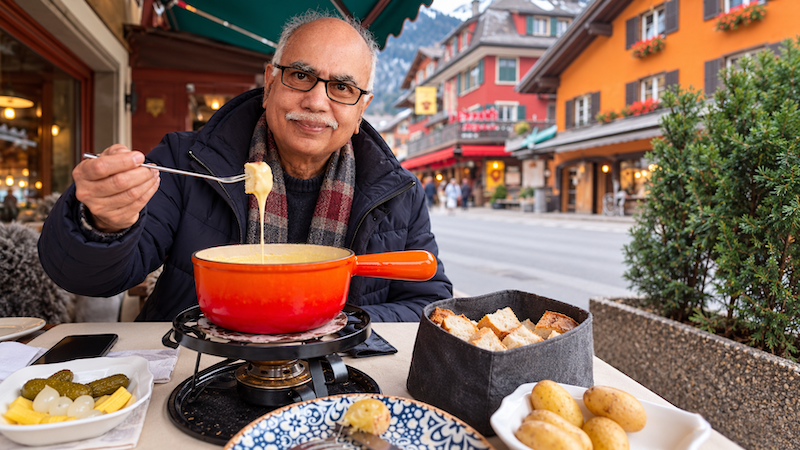
My most memorable encounter with cheese was in Switzerland in 2016. My host, Dil Patel, took me to a Sunday breakfast where traditional cheese fondue was served in a pot, kept over a spirit burner. The molten cheese simmered as everyone dipped breadcrumbs into it with forks. Outside, the Swiss air was pleasantly cool; inside, the warmth of the gathering was matched by the rich aroma and velvety texture of the melted cheese. Each morsel of bread emerged coated in a silky layer of cheese, to be savoured in real time. It was a delightful experience of flavour, warmth and companionship. The cheese, which I thought of as an accompaniment to food, was the centrepiece of the entire meal.
Meanwhile, I also read the popular book Who Moved My Cheese? Written by Dr. Spencer Johnson, its central message is about adapting to change rather than becoming attached to what is familiar. But I have to admit, it did little to deepen my understanding of cheese. Cheese remained a mystery to me anyway.
Today, of course, things are different. Cheese is easily available, and a packet of cheese slices usually sits in our refrigerator. A slice occasionally finds its way between two pieces of toast or into a sandwich as a change from butter. Curd and ghee, by contrast, are inseparable from my everyday meals. Yet when I started thinking about them together—curd, paneer, butter, ghee, and cheese—I discovered that what seems like a collection of unrelated foods is actually a beautiful lesson in science.
They all begin with the same white liquid.
Milk contains mostly water, but fat, proteins, lactose and minerals are present in different forms within it. Tiny fat droplets are dispersed through the water, while lactose and many minerals are dissolved in it. Its main protein, casein, forms microscopic structures called casein micelles. Milk appears simple because all these components coexist in remarkable stability. The art of dairying lies in disturbing that stability in different ways.
Curd begins with life. When a little curd is added to warm milk, lactic-acid bacteria feed on lactose and convert it into lactic acid. As acidity rises, the milk’s pH falls from about 6.6 to around 4.6, causing casein proteins to reorganise into a delicate three-dimensional network that holds water and fat. Liquid milk becomes a soft gel—curd. Its sourness comes mainly from lactic acid, while temperature and setting time shape its flavour. What happens daily in millions of Indian kitchens is, scientifically, controlled microbial fermentation.
Paneer takes another route. Warm milk is gently curdled with an acid such as lemon juice, vinegar or citric acid. As acidity rises, casein proteins lose stability and gather into soft curds, leaving behind pale liquid whey. The curds are collected in cloth and pressed into the familiar white block. There is usually no fermentation, churning or ageing. In this sense, paneer is India’s fresh cheese: a simple way to concentrate much of milk’s casein protein and fat, while water, lactose and soluble whey proteins largely remain in the whey.
Butter takes a different path, driven by fat rather than protein. Churning breaks the protective membranes around fat globules in cream, allowing them to join into a continuous mass: butter, while the watery portion separates as buttermilk. Butter contains roughly 80–82 per cent milk fat.
Heat the butter gently, and the remaining water evaporates while the milk solids separate and brown, creating ghee’s characteristic nutty aroma. After filtering out these solids, what remains is almost pure milk fat. With very little water available for microbial growth, ghee also keeps much longer than butter.
Cheese begins somewhat like curd but travels much further. Milk proteins are coagulated by acid, enzymes such as rennet, or both. Rennet weakens the protective layer around casein particles, allowing them to join into a firm gel. The gel is cut so whey can escape, and the curds are then stirred, heated, pressed or salted, depending on the variety. Many cheeses are subsequently matured.
What follows creates cheese’s astonishing diversity. During ripening, bacteria, moulds and enzymes slowly transform proteins and fats, producing distinctive textures, aromas and flavours. Mozzarella, cheddar, Parmesan, Brie and blue cheese may begin with essentially the same milk; what distinguishes them is culture, enzyme, temperature, salt, moisture—and, above all, time.
The science can be remembered: curd acidifies and gels milk protein; paneer coagulates and concentrates it; butter gathers the fat; ghee further purifies that fat by removing water and solids; cheese coagulates, concentrates and often ages the protein-fat matrix.
Greek yoghurt and whey protein may look modern, but both come from old ideas. Greek yoghurt is simply fermented curd with much of its whey strained away, making it thicker and richer in protein. Indian kitchens have long done the same by hanging curd in muslin cloth to make hung curd, the basis of dishes such as shrikhand. What was once a kitchen practice is now industrially standardised, packaged and sold as Greek yoghurt.
Whey has travelled in the opposite direction. For centuries, cheesemakers focused mainly on the solid curd. The escaping liquid was a secondary product, sometimes used in cooking, sometimes fed to animals and sometimes discarded. Modern nutrition has found that this supposedly humble liquid still contains something valuable: highly digestible proteins, including beta-lactoglobulin and alpha-lactalbumin, along with lactose and minerals.
Food technology has learned to isolate and condense these proteins. This has led to whey protein concentrate (WPC) and whey protein isolate (WPI), which are sold today in large containers to athletes, bodybuilders, older people and anyone seeking extra protein. WPI may be a better option for older people. Isolate significantly reduces common digestive problems like bloating, gas and cramps.
There is an interesting paradox in this transformation. The supermarket now sells both sides of an ancient separation at premium prices: thickened curd after much of its whey has been removed, and protein extracted from that very whey. Modern food technology often does not invent new foods; it refines old processes, separates their components more precisely, concentrates them, repackages them and creates new markets.
For vegetarians, these transformations are especially valuable. A rough daily protein target of about one gram per kilogram of body weight can be difficult to meet through ordinary portions of dal alone. Milk, curd, paneer, Greek yoghurt and whey can help provide concentrated, high-quality protein without excessive bulk.
Perhaps this explains milk’s privileged place in vegetarian cultures. Its significance extends far beyond nutrition. Through centuries of observation, experimentation and ingenuity, human beings have transformed milk into an extraordinary variety of foods. Beneficial bacteria turn it into curd; heat and acid transform it into paneer; churning converts cream into butter; gentle heating and clarification transform butter into ghee; and carefully controlled coagulation, drainage and maturation produce countless varieties of cheese. Even whey, once regarded largely as a by-product, has found renewed value as a rich source of nutrition. Few natural foods demonstrate so vividly how human ingenuity can multiply the possibilities of a single biological resource.
All this is hidden inside a glass of milk—a simple white liquid containing an astonishing world of taste, nourishment and science.
Milk is truly wonderful!
MORE FROM THE BLOG

The Right to an Ordinary Life
In the unhurried days of retirement, with travel now limited, I return to scenes from my earlier life through books. After graduation, as a teaching associate at G. B. Pant University, I once painted a crude copy of Van Gogh’s sunflowers to brighten the bare wall of...
Molecules, Mirrors and the Meaning of Life
When the 2026 Nobel Prize in Chemistry was announced on 7 October, I immediately thought of a scientist I have known and admired for many years—Dr. Srivari Chandrasekhar, formerly Director of the CSIR–Indian Institute of Chemical Technology, Hyderabad. The Nobel Prize...

O Mississippi
Rivers shape civilisations, nourish their fields, connect their settlements, and enter their collective memory. The Sindhu, Ganga and Kaveri helped shape the civilisation of the Indian subcontinent– a rich tapestry of kingdoms and cultures; the Nile sustained ancient...

No doubt, milk is a superfood! Thanks so much for the reminder, Prof. Tiwari!
The skillful manner in which you have elaborated on milk, dairy products, and their intricate details—in such a simple yet engaging way—reflects your exceptional writing skills and deep scientific understanding. Many thanks and appreciation for this wonderful article!
Dear Arun Ji,
Most of us have a similar experience on Cheese. My first and the only experience with Cheese fondue was at a bordering town of France and Switzerland. Recently one school kid asked me the difference between Cheese and Butter and I had to ask AI for a proper answer. Now I will share this article to the kid.
All mammalian life begins with milk as its primal nourishment, and the journey from that first drop of sustenance to the rich evolution of cheese is a profound connection to the fundamental essence of existence. Professor Arun Tiwari weaves science and simplicity into this tapestry of memories and culinary culture, much like the insights he so masterfully shared within the pages of his book We Are What We Eat, bringing forth a narrative that touches the very core of the reader’s consciousness.
His evocative power breathes life into substances, making them feel as though they are physically present on the reader’s table. Compounded by that familiar, teasing smile on the cover, his presence mirrors the deep warmth and affection that we have all been privileged to share.
It is our great fortune to have received his mentorship and love. I earnestly hope that this creative journey and that inspiring smile continue to bless us indefinitely.
Arun ji, Thank you for sharing. Except ghee I do not consume any other product of milk.