
The Right to an Ordinary Life
In the unhurried days of retirement, with travel now limited, I return to scenes from my earlier life through books. After graduation, as a teaching associate at G. B. Pant University, I once painted a crude copy of Van Gogh’s sunflowers to brighten the bare wall of my bachelor accommodation. Recently, reading Irving Stone’s Lust for Life, his biographical novel about Vincent van Gogh, brought that memory back. Unexpectedly, it also brought to mind Dr. Diwan Singh Rawat, who taught me two calculus courses during my engineering studies in 1971–72. Let me present the association of ideas here.
Vincent van Gogh (1853–1890), the Dutch Post-Impressionist painter, was one of the most remarkable figures in art history. Largely unrecognised in his lifetime, he created more than 2,000 artworks and died very young at 37. His story embodies the human struggle to give meaning to existence. Poverty, disappointment, loneliness, and suffering did not extinguish his urge to paint. He found beauty in ordinary things and affirmed that life mattered through his engagement with the world around him.
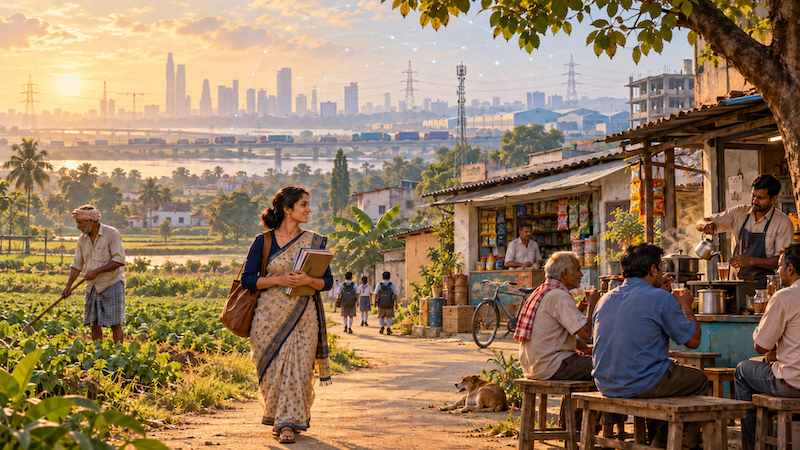
Engaging with life meaningfully is not easy. Everyone lives, but many brood and lament over their circumstances. Trapped in poverty and closed social systems, people teach in schools, cultivate small farms, run neighbourhood shops, prepare tea, raise children, and pursue modest professions such as plumbing, carpentry, tailoring and so on. Does their ordinariness make their lives any less meaningful?
We, with good careers, middle-class comforts and settled lifestyles, tend to imagine that life reveals its purpose through a great achievement or a decisive turning point. Only now, in my seventies, do I realise that life discloses what it asks of us in small, almost microscopic increments. A conversation changes our understanding of another person. A disappointment reveals the limits of ambition. Kindness opens a possibility that calculation overlooked. Illness alters our sense of time. Each day brings its own small change or delta to the course of our existence.
This thought led me back to calculus. The derivative, as we call it in mathematics, describes the rate at which a quantity changes at a particular moment; integration describes what accumulates across an interval by adding up many small contributions. As a metaphor for living, the derivative is the responsibility of the present moment; the integral is the meaning accumulated over a lifetime.
No single day contains a life’s full significance, yet each contributes to it. A teacher may never know how deeply a lesson influenced a student. A person who plants a tree may never see the fruits it would bear. An honest lawyer who rejects an unjust advantage may never learn how that decision might have protected the interests of future generation of family. We cannot know the final value of the integral while we are still living; we can only attend faithfully to what lies before us – today, here and now. How people respond to the responsibilities that life places before them, and whether they accept or evade those responsibilities, shapes the drama of life..
Blessed are those who discover early that their vocation accords with their abilities, convictions, and the needs of others. Work then becomes an expression of life rather than merely a means of sustaining it. Others arrive at that alignment through unsuitable occupations, mistaken ambitions, unexpected duties, and apparent failures. Their detours may themselves prove indispensable. We do not always find purpose before undertaking our responsibilities; often, it emerges as we fulfil them. No clear-cut signposts show us the way. Each one of us must find the way ahead. Most people follow conventional paths only to reach nowhere in their lifetimes, ending up exhausted and disillusioned. A few others find their own unique vocations, tread paths of their own choosing, and enjoy the process of being alive till their last moment.
Life is never a function of a single variable. Health, livelihood, affection, security, freedom, opportunity, and social relationships interact in ways that no solitary measure can capture. Here another idea from calculus becomes useful: partial differentiation. A partial derivative measures how a function of several variables changes when one variable changes and the others are held constant. A partial differential equation is an equation involving such derivatives. In life’s metaphor, it suggests discernment (viveka): recognising which condition requires attention, which can be changed, and which must be accepted. Swami Vivekananda lived up to the very ideal embodied in his name. He understood religion not merely as belief, ritual, or withdrawal from the world, but as a continuous striving for excellence in character, thought, and action, expressed through selfless service to humanity. For him, spiritual awakening was inseparable from the dignity and welfare of ordinary people. Discernment thus becomes meaningful not merely in understanding life, but in choosing how best to serve it.
When someone struggles, we too readily prescribe greater effort. But effort directed at the wrong variable may deepen the difficulty. A shopkeeper may not need longer working hours, but fairer credit and a more equitable marketplace. A teacher burdened by administration may need more time to teach, rather than a lesson in efficiency. A smallholder farmer may need a fair share of the harvest’s value, not another exhortation to raise productivity.
Over the years, I have known schoolteachers, honest lawyers, smallholder farmers, shopkeepers, and tea sellers who live simply, without being seduced by affluence. Not all are free from hardship. Yet some possess what wealth cannot guarantee: peaceful contentment. They have discovered the meaning of enough.
The neighbourhood shopkeeper knows his customers, sometimes extends credit to a family in difficulty, earns a modest income, and returns home satisfied. A teacher takes pride in students’ progress; a farmer in tending the land and sustaining a household; a tea seller in honest work and familiar human relationships. Their frugality is not necessarily a sign of deprivation, nor is their modesty a form of resignation. They have ambitions proportionate to their idea of a good life, and identities not wholly defined by possessions.
What distresses me is the trend of such lives becoming needlessly precarious through economic and technological change. People who have sustained themselves honourably, often with little protection, increasingly find their faith in goodness shaking and their contentment eroding.
Scientific advances can give farmers better seeds, irrigation, machinery, storage, and market information. Yet concentrated supply chains may also impose costly standards, dependence on purchased inputs, volatile prices, and weak bargaining positions. Output can rise while security declines. Digital commerce can extend a shopkeeper’s reach, but large platforms command advantages in capital, data, logistics, and pricing that years of personal trust cannot easily match.
In education, digital tools may help children learn, but an obsession with measurable outputs can deprive teachers of the time and freedom required for intellectual and emotional development. Even a tea seller may become vulnerable to rising rents, platform commissions, payment arrangements, and commercial terms set by institutions far more powerful than the person behind the counter.
Technology is not inherently the enemy. The danger lies in organising progress primarily around scale, financial returns, efficiency, and ever-expanding consumption, while overlooking the security and independence of ordinary livelihoods. A small enterprise should not be deemed inefficient because it cannot scale; a modest occupation should not become expendable because its financial returns are limited. Human beings must not be thrown under the bus of financialism and consumerism merely because their lives do not satisfy the demands of powerful systems.
We rightly speak of rights to education, health, livelihood, freedom, and opportunity. Beneath them lies a wider moral claim: the right to an ordinary life—to work with dignity, fulfil responsibilities, sustain relationships, and seek contentment without being needlessly overwhelmed by forces beyond one’s control. Technology should enlarge human capabilities, not render people disposable because selected tasks can be performed more cost-effectively.
The calculus metaphor thus comes full circle. Limits remind us that human knowledge, power, and time are finite, even as our aspirations reach beyond them. The derivative calls us to responsibility in the present; partial differentiation asks us to discern what truly needs to change; integration reminds us that a life’s significance accumulates through innumerable acts, many unnoticed and some bearing fruit only after death.
Civilisation has a corresponding responsibility: to preserve the conditions in which this quiet calculus of living remains possible for everyone, not merely the wealthy, powerful, or exceptionally gifted. We should strive for a world in which no Van Gogh has to die poor and suffering, and every child gets a chance to blossom. Protecting the right to an ordinary life is not a concession made at the expense of progress. It is among the highest purposes of progress itself.
MORE FROM THE BLOG
One Milk, Many Marvels
For a middle-class Indian of my generation, cheese was hardly an everyday food. My first memorable encounter came late in life, in February 2006, when I travelled with President A.P.J. Abdul Kalam on his state visits to Singapore, the Philippines and South Korea. On...
Molecules, Mirrors and the Meaning of Life
When the 2026 Nobel Prize in Chemistry was announced on 7 October, I immediately thought of a scientist I have known and admired for many years—Dr. Srivari Chandrasekhar, formerly Director of the CSIR–Indian Institute of Chemical Technology, Hyderabad. The Nobel Prize...

O Mississippi
Rivers shape civilisations, nourish their fields, connect their settlements, and enter their collective memory. The Sindhu, Ganga and Kaveri helped shape the civilisation of the Indian subcontinent– a rich tapestry of kingdoms and cultures; the Nile sustained ancient...

Dear Prof. Tiwari, I agree with you. When progress leaves behind some of the very people it is meant to serve, it does an injustice to those already on the margins.
Many of us live with a scarcity mentality. We fear that if our neighbour has enough, there will be too little left for us. Yet the good Lord who feeds innumerable creatures cares for us all. We would do well to be content with what makes life meaningful and to share what we have. When I hoard at my neighbour’s expense, I sin against my neighbour. It is a failing we must reckon with as a human family.
Your words capture what is at stake: “We should strive for a world in which no Van Gogh has to die poor and suffering, and every child gets a chance to blossom. Protecting the right to an ordinary life is not a concession made at the expense of progress. It is among the highest purposes of progress itself.”
May the Lord give us the courage and generosity to live by these words, and may He find us doing so day by day.
A deeply touching and thought-provoking piece, Sir
Having read many books on philosophy and human existence, I could truly appreciate the depth of your reflections. Sometimes, we become so occupied with pursuing extraordinary achievements that we forget the beauty and dignity of an ordinary life. Your words touched something deep within me.
Truly, some writings don’t just make us think, they make us look at life from an entirely different perspective.
I truly marvel at how the calculus metaphor brings out the value of life. And I worry too about how this value of life is today measured by a totally different matrix, one that almost entirely ignores man’s very purpose in this life as intended by the Creator (acknowledging that the idea of the Creator may be different for various people)… and whether a recalibration back to a true measure of human value (as the norm and not the exception) will be attained in our lifetime….
Arun ji, the sunflower painting from 71-72 is a very good memory. I appreciate Arun ji’s creativity. Thank you for sharing.