
Two Paths up the Human Mountain
I have read Sri Aurobindo for many years, and my spiritual framework has been deeply shaped by his intellectual spirituality. From The Secret of the Veda to Savitri and The Life Divine, he produced perhaps the most profound exposition of Indian philosophical thought in the English language. Therefore, when I recently read Friedrich Nietzsche’s Thus Spoke Zarathustra, accompanied by R. J. Hollingdale’s masterly introduction, I found Sri Aurobindo resonating in the background of my reflections.
Both Nietzsche and Sri Aurobindo were dissatisfied with ordinary humanity – the ‘business as usual’ of the world. Neither regarded man as a ‘finished’ product – established in health and firm in mind. Both saw human life as a transition towards something greater and saw ‘seeking’ as a movement beyond complacency and conformity. It is, therefore, tempting to equate Nietzsche’s concept of Übermensch, or Superman, with Sri Aurobindo’s ideal of Supramental Being. Yet the resemblance is more apparent than real, for beneath it lie profoundly different understandings of human nature, consciousness, and the ultimate direction of evolution.
For Nietzsche, the Superman emerges after the ‘death of the idea of God’. Human beings can no longer rely on inherited moralities, the idea of a divine authority, or notions of cosmic guarantees – about justice, rationality, or even certainty. Nietzsche is fundamentally existential. Through courage, creativity, self-mastery, and the exercise of what he called the ‘will to power’, man rises beyond himself. His famous declaration is unequivocal: “Man is something that shall be overcome.”
Sri Aurobindo begins from an entirely different premise. Reality, for him, is fundamentally divine. Evolution is neither accidental nor merely biological; it is the progressive unfolding of consciousness through matter, life and mind towards higher forms of awareness. Humanity is not the culmination of this process but an intermediate stage in a greater evolutionary ascent. The Supramental Being is the manifestation of a higher consciousness transforming human nature itself. Dissolution of the ego happens as a collateral development.
What is striking, though, is that both philosophers – one Western and the other Eastern – reject passive conformity as the natural way of a human life. Nietzsche criticises herd mentality; Sri Aurobindo critiques a dulled consciousness. But thereafter, Nietzsche celebrates the highest possibilities of individual selfhood around the idea of ‘I-ness’, whereas Sri Aurobindo seeks its transformation through a consciousness beyond the ego. One might say that Nietzsche reaches an extraordinarily elevated expression of the embodied spirit—heroic, creative, fearless and life-affirming. Yet Sri Aurobindo envisages a still deeper possibility. His Supramental Being is an individuality that becomes transparent to a universal reality.
Nietzsche would likely reject such a formulation because he distrusted metaphysical and spiritual claims. Sri Aurobindo, by contrast, might regard Nietzsche’s Superman as an important yet incomplete stage—an awakening of strength without the final illumination of consciousness. Thus, while both reject the adequacy of ordinary humanity, they differ radically on what lies beyond it. Nietzsche points towards a higher human being; Sri Aurobindo towards a supramental mode of consciousness.
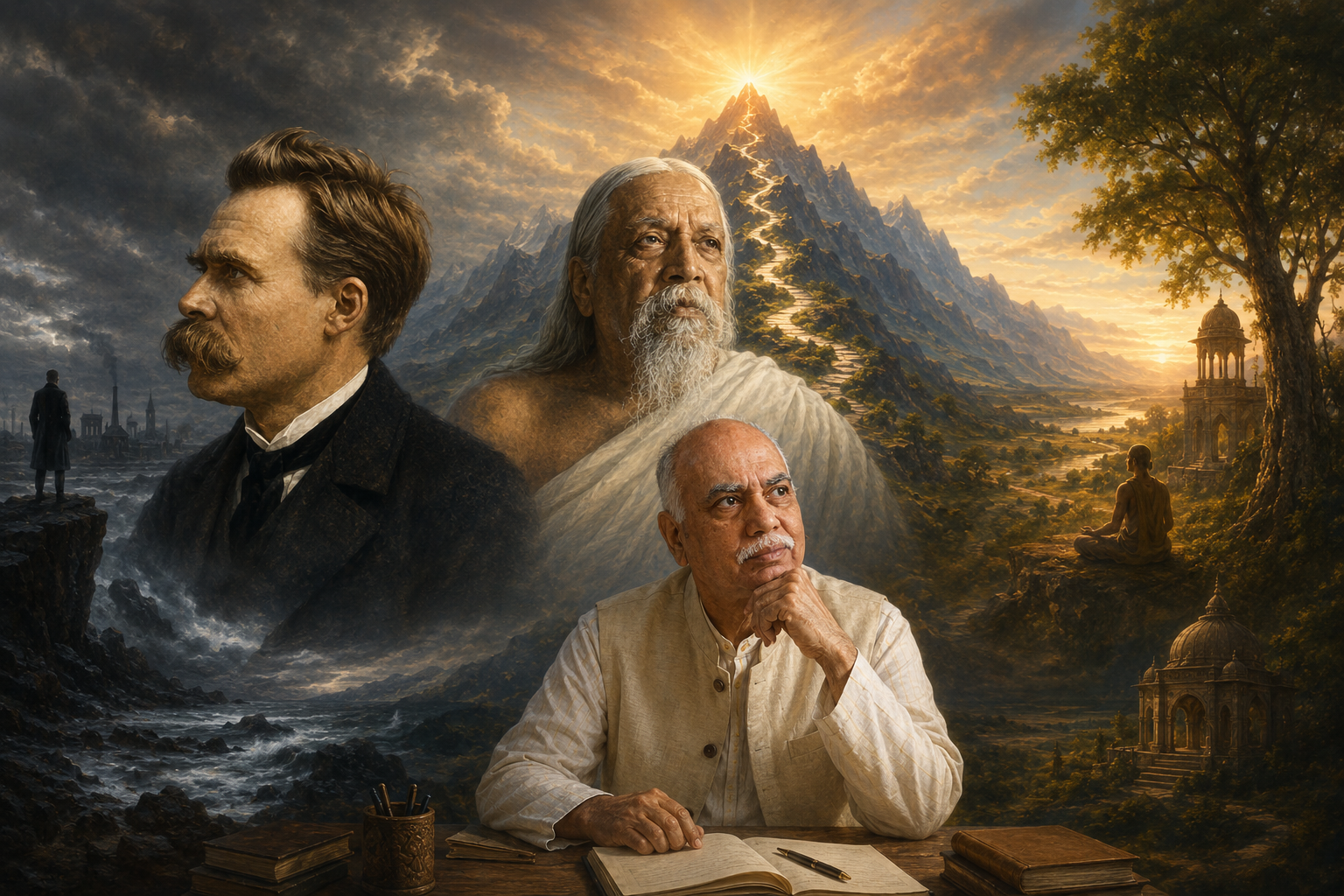
A useful metaphor is that of a great mountain rising before humanity.
On the western slope stands Nietzsche’s climber. He ascends by shedding dependency, inherited beliefs, resentment, fear and weakness. The ascent demands courage and self-overcoming. His declaration is, “I shall become what I am.”
On the eastern slope stands Aurobindo’s climber. He ascends through the purification of desire, the expansion of awareness, and the discovery of the divine reality concealed within. His declaration is: “I shall discover who I truly am.”
The routes appear different because the destinations are different. Nietzsche distrusts transcendence, fearing that it may become an escape from life. Sri Aurobindo embraces transcendence because he sees it as life’s fulfilment. Nietzsche exalts individuality; Sri Aurobindo seeks universality. Nietzsche’s hero stands alone; Aurobindo’s yogi becomes one with all.
Yet both reject mediocrity and insist that human life contains unrealised possibilities.
Looking to the Bhagavad Gita for an answer is rewarding. Shri Krishna first urges Arjuna to fulfil his duty as a warrior by fighting without shrinking from battle—an exhortation to wholehearted engagement in one’s role that Nietzsche might have admired. Shri Krishna then asks him to surrender the ego and become an instrument of a higher consciousness—a theme Sri Aurobindo develops with extraordinary depth.
In this sense, the Gita appears as a bridge between Nietzsche and Sri Aurobindo: first become fully human, then discover what lies beyond humanity. Yet this is not merely an abstract philosophical debate. It speaks directly to the predicament of our age. Why should I write this and expect you to read it? Because I believe it addresses the deepest philosophical questions of the modern age. Despite their education and affluence, many young people experience midlife loss-of-meaning crises. Many find solace in addictions; some merely dabble in them, while the rest suffer profound agony.
Nietzsche feared that appeals to the Absolute, the Universal, or the Divine often diminished the individual. History had shown him religions, ideologies and collective moralities demanding that exceptional individuals sacrifice themselves for abstractions. His response was a cry of rebellion: protect the individual flame; do not let it be swallowed by the blaze of the collective. For Nietzsche, the purpose of human development is to produce singular peaks—Beethoven, Goethe, Leonardo da Vinci and Shakespeare. Humanity justifies itself through the creation of greatness.
Sri Aurobindo begins from the opposite premise. Individuality is precious, but what we ordinarily call individuality is only a provisional form. The ego is not the true Self; it is merely a temporary scaffolding. The genuine individual does not disappear in higher consciousness but becomes more fully itself. The drop does not vanish upon reaching the ocean; it discovers that it was never merely a drop. In much of Indian philosophy, liberation is not annihilation but expansion. The fear of dissolution arises because the ego mistakes itself for the whole person.
Nietzsche climbs until every support falls away and he stands upon a magnificent ridge overlooking the plains of conformity. The more I reflect upon Nietzsche’s writings, the more I see him as the great physician of a civilisation weakened by guilt, dependency and inherited certainties. He teaches humanity to stand upright. He strips away comforting illusions and demands courage. But his ‘individual’ is prone to fall into the abyss of despair.
Sri Aurobindo begins where Nietzsche leaves off. Once man has learned to stand upright, he asks a further question: Is strength the destination, or merely the preparation? Nietzsche teaches freedom from servility, and Sri Aurobindo teaches freedom from limitation itself. Their differences lie in what they believe evolution is moving towards. Nietzsche’s horizon is greatness. Sri Aurobindo’s horizon is consciousness. The Gita’s horizon is wisdom in action.
What strikes me most is their shared conviction that humanity is not a finished product but a transitional being. The Upanishadic sages, the Bhagavad Gita, Nietzsche, Swami Vivekananda, Sri Aurobindo, and even modern evolutionary thinkers all reject the notion that present-day humanity represents the final chapter of existence. Each, in a different language, points towards growth, self-transcendence, and the unfolding of higher possibilities within human life. Even contemporary thinkers such as David Deutsch see the expansion of knowledge as the driving force behind human progress and evolution.
Perhaps that is why these conversations remain alive across the centuries. Each captures something essential about the human journey. Humanity needs Nietzsche’s courage and Sri Aurobindo’s vision.
Perhaps my mentor, A. P. J. Abdul Kalam, sensed this synthesis intuitively. He constantly urged young people to cultivate courage: “the courage to think differently, the courage to invent, to travel the unexplored path, to discover the impossible, to combat problems and succeed.” For him, courage was not merely a personal virtue but the engine of human advancement.
Yet the human task is not simply to be courageous, nor merely to be wise, but to hold both qualities in creative tension. Courage enables us to face the world; wisdom helps us understand it; while vision gives direction to the journey. When any one of these stands alone, something essential is lost. As the years pass, I find that the most interesting question is no longer, “Who was right?” but rather, “What did each one see from the height he reached?” That question allows us to view philosophical traditions not as competing dogmas but as different windows onto a reality larger than any single system can fully contain.
MORE FROM THE BLOG

The Resilient Doctor
Dr. Prithvi Raj Jampana is a distinguished radiation oncologist with extensive experience in radiotherapy and systemic treatments for a wide range of cancers. He trained in clinical oncology at Oxford University Hospitals and worked in the UK for over two decades...

AI, Stories and the Mind
I have been reading an English translation of the Kathasaritsagara—The Ocean of the Streams of Stories—composed in Sanskrit by Somadeva, a Kashmiri writer of the eleventh century. Organised into eighteen books, it is less a conventional book than an immense...
The Wellness Dividend
One teaching of Dr. A.P.J. Abdul Kalam that I have always tried to follow is to ‘stay in circulation’, as he put it. By this, he did not merely mean travelling, attending meetings or remaining publicly visible. He meant keeping the mind in motion—meeting people,...
I really enjoyed how you didn’t try to declare one philosophy superior to the other. Instead, you showed how Nietzsche and Sri Aurobindo illuminate different dimensions of human growth. The closing thought, asking not “Who was right?” but “What did each one see from the height he reached?”, honestly remained with me like an after taste soon as I finished reading.
I really enjoyed how you didn’t try to declare one philosophy superior to the other. Instead, you showed how Nietzsche and Sri Aurobindo illuminate different dimensions of human growth. The closing thought, asking not “Who was right?” but “What did each one see from the height he reached?”, honestly stayed with me even after I finished reading.
Namaskaram sir. Thank you for yet another beautiful article and the interesting link you crafted so beautifully.
Sri Aurobindo praised Nietzsche’s thought, for in some places he had risen to the word of truth he had seen and heard, but in most places there was a mixture (mishran) that drowned out the truth, making him see God only as power rather than love.
Quoting Sri Aurobindo’s words on Nietzsche, “He presents to us sometimes a superman who fiercely and arrogantly repels the burden of simple sorrow and service, not one who arises victorious over mortality and suffering, his ascension vibrant with the triumph-song of a liberated humanity.”
It is often said that the climax of eastern and western philosophies is represented by Shri Aurobindo and Nietzsche respectively. In their own rights, Both the philosophers are difficult to comprehend. It is the skill of the author, Shri Arun Tiwari to summarise both the philosophies in a simple manner. The simile of climbing a mountain from different side is remarkable.
Thank for the article and more the reminder from the words of A. P. J. Abdul Kalam, who constantly urged young people to cultivate courage: “the courage to think differently, the courage to invent, to travel the unexplored path, to discover the impossible, to combat problems and succeed.” For him, courage was not merely a personal virtue but the engine of human advancement, he could not have said it better
Dear Sir, Greetings! Your article beautifully presents the two great paths of human evolution — Nietzsche’s path of courage, self-overcoming and individuality, and Sri Aurobindo’s path of consciousness, transformation and universality.
What touched me most is your reflection that humanity is not a finished product, but a transitional being with higher possibilities waiting to unfold. The metaphor of the mountain is very powerful: one climber rises by strength and courage, while the other rises through awareness and inner transformation. Both paths remind us that ordinary life should not be accepted as the final limit of human potential.
Your connection with the Bhagavad Gita is especially inspiring — first becoming fully human through duty, courage and action, and then rising beyond ego towards wisdom and higher consciousness. This synthesis of courage, wisdom and vision feels extremely relevant for today’s generation, especially when many people are searching for meaning despite education, success and material comfort.
Your writing encourages us not only to think deeply, but also to live more consciously. Thank you for sharing such a profound reflection that brings together philosophy, spirituality and the practical challenge of modern human life.
Warm Regards,
A genuinely illuminating comparison, thank you very much, Arun sir, for this igniting, thought-provoking blog. What strikes me is that your mountain metaphor quietly resolves what looks like opposition into a sequence — the western slope’s self-overcoming isn’t refuted by the eastern slope’s self-discovery, but is completed by it, which is exactly the movement the Gita traces when Krishna first asks Arjuna to act and then to surrender the actor.
I’d gently add that the Toltec traditions arrive at something similar from a third direction: dismantling the ego’s “personal importance” is framed not as annihilation but as freeing energy for a larger seeing, echoing your point that the drop was never merely a drop. Perhaps Nietzsche’s real gift is that he refuses to let transcendence become an escape hatch — he insists we earn the eastern slope by first standing fully upright on the western one. Vivekananda’s “strength is life, weakness is death”, and Aurobindo’s supramental vision may finally be the same instruction heard at different altitudes.
Arunji, this blog provides a profound reflection on the evolution of human consciousness. Nietzsche inspires us to cultivate courage, self-reliance and freedom from conformity, while Sri Aurobindo invites us to transcend the ego and awaken to a higher consciousness.
Together, they remind us that true evolution is not merely about becoming stronger, but becoming wiser, more expansive and deeply aligned with our highest self through conscious action. Good one.
An exceptional blog from Prof Tiwari Ji that explains two philosophies with clarity. I felt inspired to read more of Sri Aurobindo and Friedrich Nietzsche. Dr. Abdul Kalam’s call to cultivate courage is beautifully described and it should be followed.
This was a beautiful read and honestly quite inspiring. The way you’ve held Nietzsche and Sri Aurobindo together without forcing a comparison shows both depth and sensitivity. The mountain metaphor was especially striking, and the Gita connection brought everything together so naturally. It’s rare to come across writing that feels this intellectually rich yet so personal and sincere at the same time. Truly enjoyed this.
A beautifully written and thought-provoking article. I really enjoyed the analogy of two paths up the same mountain—it reminds us that there can be different journeys toward human growth and excellence. Your balanced perspective encourages reflection rather than taking sides. Thank you for sharing such a meaningful and inspiring piece.
Namaste Arunji, this is a beautiful reflection. The two paths up the human mountain are often seen as separate, but your writing reminds us that they are complementary. Science helps us understand the world, while spirituality helps us understand ourselves.
Perhaps the real summit is reached only when both journeys come together. Thank you for presenting such a timeless perspective in a simple and engaging way.
This profound synthesis by Professor Arun Tiwari jee as usual, underscores that the evolution of human consciousness transcends any single cultural or philosophical horizon. We have entered an era of total integration, where the dynamic courage of Western individualism and the deep spiritual wisdom of Eastern universality must converge to light the way ahead. By extracting the finest essences from both traditions, we shape a resilient framework for our collective future, anchored in the absolute realization that this evolutionary ascent admits no final destination—the journey of human progress is infinite, and the path forward is never-ending.