
Solidified Air
I am enjoying re-reading Thus Spoke Zarathustra by the German philosopher Friedrich Nietzsche. In Part I, in the chapter Of the Tree on the Mountainside“, he uses the image of a lonely tree growing high on a mountain to describe the fate of those who strive to rise above the ordinary. This simple symbol expresses a profound truth. After all, in any group of a hundred people, only a small fraction excel, while the majority drift through life without ever realising their potential
The modern education system, especially since its increasing commercialisation over the past few decades, has often produced shallow thinkers while cultivating an attitude of entitlement. I recently asked several young people—including professionally educated ones—a simple question: Where does a tree get its mass? The response was usually a puzzled stare, as if I had posed a metaphysical riddle.
Before I proceed further into philosophy, let me pause to consider a simple scientific phenomenon that unfolds before our eyes every day. It is the story of how the invisible becomes visible. Most of us remain oblivious to it, enthusiastically consuming endless public chatter about elections, celebrity fortunes, cricket auctions and currency fluctuations. At times, it seems as if a virus of triviality has infected our minds and eaten away at common sense.
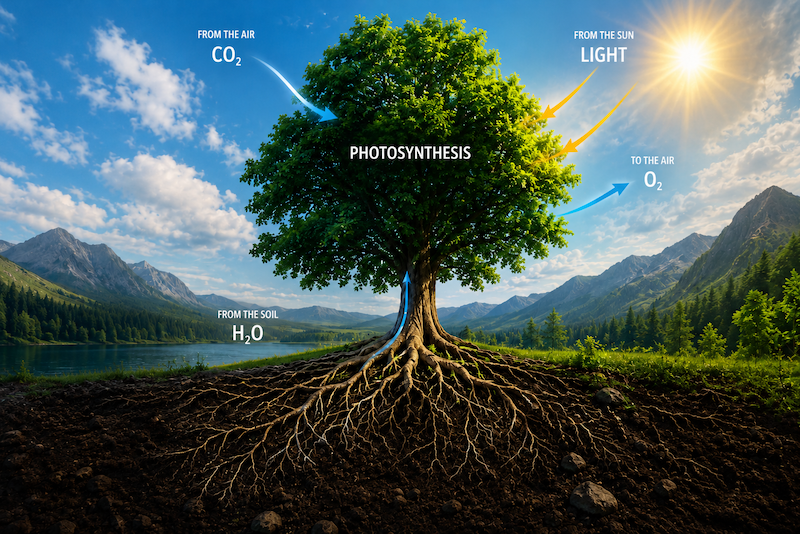
One of the most surprising facts in biology is that most of a plant’s dry mass comes not from the soil but from the atmosphere. A tree may weigh several tons, and it is natural to assume that all that wood came from the ground. In reality, the bulk of the carbon in the wood was once carbon dioxide floating in the air.
Photosynthesis makes this possible. Using sunlight, plants take in carbon dioxide from the atmosphere, water from the soil, and small amounts of minerals such as nitrogen, phosphorus and potassium. The carbon atoms from carbon dioxide are assembled into sugars, cellulose, lignin, starches, oils and all the organic compounds that make up leaves, stems, roots, fruits and wood.
Modern measurements show that about 95 per cent of a plant’s dry mass comes from carbon, oxygen and hydrogen obtained from carbon dioxide and water. Only a small fraction comes from mineral nutrients absorbed from the soil. To put it differently, a wooden table is largely solidified air. The carbon in that wood was once present in the atmosphere as carbon dioxide.
The soil remains indispensable because it supplies nitrogen for proteins and DNA, phosphorus for energy transfer and genetic material, potassium for cellular regulation, and trace elements such as iron, zinc, copper and molybdenum. Without these minerals, plants cannot thrive. Yet, they contribute only a small fraction of the plant’s total mass.
Forests are gigantic atmospheric carbon-capture systems. Every trunk, branch, and leaf is a record of carbon removed from the air and stored in living tissue. Yet most of this labour remains invisible to us. It sustains life itself, especially human beings, who inhale oxygen and exhale carbon dioxide roughly 12 to 20 times per minute, every day of their lives.
The next time you sit with a friend over a cup of coffee, ask a simple question: Where does the wood used to make this table and chair come from? Most people will confidently answer, “From wood.” Press a little further, and they may say, “From trees.” But ask the next question—how is wood made?—and a curious silence often follows.
And, by the way, a coffee bean is itself a marvel. It contains more than a thousand chemical compounds, of which a few dozen are chiefly responsible for its aroma, flavour and stimulating effect. Every sip is a small chemical symphony, yet most of us drink it without ever wondering what lies within.
The same happens with countless things that surround us every day. Where does salt come from? Why are spices added to food? Why are fruits essential to our health? How does a seed become a tree, and a tree, a table? These are not difficult questions. They are small doors that open into a larger understanding of reality. However, many educated people pass through life without ever pausing to ask them.We have become skilled consumers of information but poor observers of reality. The wonder is not that the answers are difficult; the wonder is that we have stopped asking the questions. Science is born not in laboratories but in curiosity. Civilisation advances not because people know everything, but because someone asks “Why?” and refuses to stop until an answer emerges.
Why is such awareness—essential knowledge about our own lives and environment—so often missing from our education?Part of the answer lies in the way we have come to define education itself. We increasingly mistake information for knowledge, credentials for understanding, and employability for wisdom. Students are trained to pass examinations, but not always encouraged to ask simple questions. The child who asks, “Why am I me and not someone else?” has already begun a philosophical journey that has occupied humanity’s greatest minds. Yet such questions rarely find a place in the classroom. Instead of cultivating wonder, we often reward memorisation. Slowly, the habit of inquiry withers.
Yet, I do not share the fashionable pessimism that everything is lost. Every generation inherits its limitations, but every generation also receives new tools. Ironically, at the very moment when attention is under assault from television noise, social media chatter, and endless streams of trivial information, humanity has acquired one of the greatest instruments for self-education ever created.
Today, any curious individual can ask a question and, within seconds, explore ideas that once required access to great libraries and learned scholars. One can discuss science, philosophy, history, literature and public affairs at any hour of the day. Yet the greatest obstacles to learning have never been technological. They are indifference, complacency, and the habit of letting others think for us. No individual can reform the education system single-handedly. Institutions change slowly. Bureaucracies move reluctantly. But no one can prevent a person from learning. No one can stop a family from discussing ideas over dinner. No one can stop friends from exchanging books, debating questions, or exploring knowledge together. The republic of learning has always been built from such everyday conversations.
The real question, therefore, is not whether knowledge is available. It has never been more available. The question is whether we desire it. Why do so many of us willingly surrender our waking hours to idle television, endless scrolling, celebrity gossip, political shouting matches, and the commerce of outrage? Why do we spend precious years consuming noise when we could be cultivating understanding?
Nietzsche’s image of the tree on the mountainside offers a powerful metaphor. The higher a tree rises towards the light, the deeper its roots must penetrate the darkness below. Growth demands effort. It is easier to remain in the valley than to climb. It is easier to repeat opinions than to examine them. It is easier to seek distraction than to pursue self-transformation. Yet, every civilisation advances because a few individuals choose the harder path. They ask questions. They seek understanding. They refuse to be satisfied with appearances.Perhaps the task before us is not to complain about ignorance but to become examples of curiosity. A thoughtful conversation can inspire a child. A shared book can open a mind. A simple question—such as where a tree gets its mass—can awaken scientific wonder. Knowledge, like photosynthesis itself, transforms the invisible into the visible. An unseen idea becomes understanding; understanding becomes action; and action, sustained over time, becomes civilisation.
Nietzsche’s tree still stands on the mountainside. The tools for learning are now in our hands as never before in human history. The question is whether we are willing to trade distraction for discovery, noise for understanding, and idle opinion for the lifelong adventure of asking, “Why?”
MORE FROM THE BLOG
Tea, Coffee, or Me?
Though I have been a tea person all my life, coffee has always intrigued me. During my travels in the United States, it seemed to be everywhere: at breakfast tables, in offices, beside hotel reception desks and in paper cups carried through the streets. In Ethiopia, I...

The Agony and the Ecstasy of Life
Since I met Dr Chinnababu Sunkavalli, the robotic surgical oncologist, in 2022 through an introduction by the Tangirala brothers, Venkat and Ravi, he has become part of my life. His enthusiasm, his commitment to connecting with people, and his extraordinary zeal to...
The Resilient Doctor
Dr. Prithvi Raj Jampana is a distinguished radiation oncologist with extensive experience in radiotherapy and systemic treatments for a wide range of cancers. He trained in clinical oncology at Oxford University Hospitals and worked in the UK for over two decades...
Prof Tiwari, this could not have been written any better. Thanks for reminding us: ‘Growth demands effort. It is easier to remain in the valley than to climb. It is easier to repeat opinions than to examine them. It is easier to seek distraction than to pursue self-transformation. Yet, every civilisation advances because a few individuals choose the harder path. They ask questions. They seek understanding. They refuse to be satisfied with appearances. Perhaps the task before us is not to complain about ignorance but to become examples of curiosity. A thoughtful conversation can inspire a child. A shared book can open a mind. A simple question—such as where a tree gets its mass—can awaken scientific wonder. Knowledge, like photosynthesis itself, transforms the invisible into the visible. An unseen idea becomes understanding; understanding becomes action; and action, sustained over time, becomes civilisation.
Solidified Air resonates deeply with both my analytical mind and creative heart. Though I knew of it, I had never truly seen a tree or a forest for what it essentially is. Thank you, Professor Arun Tiwari, for transforming my perspective and opening my eyes to its profound essence.
An exceptional piece of writing, Sir. Solidified Air is much more than a scientific expression—it is a powerful reminder that what appears invisible often forms the very foundation of life. Your ability to connect science, nature and philosophy inspires readers to see trees not merely as plants, but as living embodiments of the air they breathe and the sunlight they capture. Thank you for making science meaningful, poetic and transformative.
Reading this reminded me that some of the best learning doesn’t come from textbooks. It comes from asking questions we’ve walked past all our lives. I don’t think I’ll look at a tree or even a wooden table quite the same way again.
Thought-provoking and beautifully written. It reminds us that curiosity is the foundation of true education.
A brilliant blend of science and philosophy. Every student should read this.
Outstanding article. “Solidified air” is a powerful scientific insight and a memorable metaphor for lifelong learning.
Dear Sir, an excellent eye-opening blog. Very rightly brought out that our questioning depth doesn’t go beyond the obvious. We stop after we say that the wood comes from the tree. Nature has so much to offer and supports human life, but we, on our part, would like the very nature that silently helps us survive.
The objective type of examination/assessment and the pursuit of marks/ranks are dimming the individual’s inquisitiveness. As you have rightly pointed out, there are multiple social media applications that can distract and hinder your mental growth, but on the other hand, there is a wealth of information at your fingertips. It is left to the individual to apportion the time for growth and entertainment. But the latter is available readily.
As the blog says, if one has to grow taller, the roots have to go deeper; that sums up what needs to be done. If this prescription is followed, there is no cause for concern about growth. The solace is that the world is progressing, of course, following the 80-20 formula. The 20 will ask WHERE DOES THE TREE GET ITS MASS FROM? Thank you, sir, for an educational blog.
An excellent article by Arun Tiwari Sir especially in the context of trees and forests being carbon capture media in the perspective of challenges we face w.r.t. global warming and climate change
Dear Arun Ji, It was an emotional read for me. That description of a wooden table being “solidified air” is just beautiful—it really makes you stop and look at everyday things differently.
It actually reminded me of a book I just started reading, “We Are Eating the Earth” by Michael Grunwald. It explains that even when we plant crops for agriculture, they can never capture carbon dioxide the way a wild, natural forest does.
Your point about people losing their curiosity really hits the nail on the head. Genuine questioning feels like an endangered habit these days. With AGI coming in so fast over the next decade, the real danger is that we might just stop thinking and asking “Why?” altogether, letting machines do all the wondering for us. Hope the English word “WHY” will not be removed from the dictionary as its use is stopped.
Like Nietzsche’s tree on the mountain, growing takes real effort.
I really hope this article gets people to start asking the right questions again!
Another thought-provoking piece, Arunji. What struck me most was your perspective on photosynthesis. Like many of us, I learnt about it in school as a biological process, but I had never paused to see it as the profound wonder that it truly is—the transformation of sunlight, water, and air into the very foundation of life on Earth.
I also loved this line:
“The question is whether we are willing to trade distraction for discovery, noise for understanding, and idle opinion for the lifelong adventure of asking, ‘Why?’”
A beautiful reminder that curiosity is not just a habit of learning, but a way of living. Thank you for sharing such reflections.
Thank you, Sir, for sharing this wonderful blog! What I enjoyed most was how it used a simple scientific fact to make a larger point about curiosity. The idea of wood as “solidified air” is both surprising and memorable, reminding us how much of the world we take for granted. I particularly appreciated the connection to Nietzsche’s tree on the mountainside and the message that growth comes from questioning, learning, and thinking independently. A timely reminder that wisdom begins with the simple habit of asking “Why?”
Curiosity is the true beginning of science. Not laboratories, textbooks, examinations, or even sophisticated instruments. Science begins when a child looks at an ordinary object and asks an extraordinary question: Why? The history of human knowledge is, in many ways, the history of such questions. Unfortunately, modern education often teaches students to memorise answers before they have learned to wonder about the questions. As a result, many students pass examinations successfully while remaining strangers to the spirit of scientific inquiry. Please keep championing the spirit of good education.
Such an eye opener! The challenge before educators is not merely to improve examination results but to revive the culture of questioning. A science teacher should not simply explain photosynthesis; the teacher should ask students where a tree’s mass comes from. A physics teacher should encourage students to investigate everyday phenomena. A chemistry teacher should transform the kitchen, the garden, and the marketplace into living laboratories. Learning should begin with observation and curiosity, and only then proceed to theory.
The purpose of education is not to fill the mind with information but to awaken the desire to understand. Facts learned for an examination are often forgotten within weeks. Insights gained through curiosity remain for a lifetime. A student who discovers that a tree is made largely from solidified air will never look at a forest in quite the same way again. Such moments create not merely successful examinees but lifelong learners.
Science flourishes wherever curiosity is encouraged. Every child is born with the instinct to explore, to question, and to wonder. The task of education is to nurture that instinct, not replace it with rote memorisation. If schools can restore curiosity to the centre of learning, higher education will once again receive students who are not merely knowledgeable but genuinely scientific in spirit. And that spirit—the courage to ask questions about the world around us—is the foundation upon which all human progress ultimately rests.
Hon’ble Arun Sir, Thank you very much for writing such a great blog about the development of society through a sound education system, by giving a wonderful example of a tree standing alone. Profoundly accurate and beautiful reflection. Metaphors of a tree exactly capture how a sound education system provides invisible roots for a civilisation to reach heights like a tree, which is otherwise nourished by atmospheric air through photosynthesis. Growth and development potential rely on a deep, strong foundation in both nature and society. It is true that soil serves to anchor the trees and provides water and some minerals, mostly cellulose and lignins (comes from air), which are used in many forms. Rightly said by your good self that a robust education system nurtures human curiosity, asks the essential questions – Why, Where, and When, and supports civilisation so that its culture, technology, and human potential flourish. Thanks and regards.
A very thought provoking and insightful article which beautifully combines scientific knowledge, innovation and societal development. Arun Tiwari’s blog presents a very complex subject in a common language for better readership. It inspires for more thinking on transformative potential of science and technology. A very informative, aspiring and stimulating read.
The greatest scientists were driven by curiosity rather than examination marks. When a falling apple attracted the attention of Isaac Newton, he did not merely observe an apple; he asked why objects fall toward the Earth. When Michael Faraday observed magnets and wires, he saw possibilities that would eventually transform civilisation through electricity. When Albert Einstein imagined riding on a beam of light, he was engaging in curiosity that led to revolutionary insights into space and time. Their discoveries emerged not from preparing for examinations but from sustained wonder about the world.
Unfortunately, much of contemporary schooling has moved in the opposite direction. The primary objective has become success in examinations. Students are trained to reproduce definitions, formulas, and standard answers. Questions are valued only if they are likely to appear in the examination paper. The natural curiosity of childhood is gradually replaced by the anxiety of performance. Learning becomes a transaction rather than an exploration. Hats off to you for pointing this out Sir.
The invisible gas around us becomes tangible biomass. This single fact opens a doorway into multiple branches of science. One begins to understand chemistry because molecules are rearranged. One understands biology because living organisms perform this transformation. One learns physics because sunlight provides the energy driving the process. One appreciates ecology because forests become vast reservoirs of atmospheric carbon. Most importantly, one develops the habit of seeing the extraordinary hidden within the ordinary. Very refreshing insights.
Most students know that plants grow through photosynthesis. They can write the chemical equation in an examination and score full marks. Yet very few stop to ask a fascinating question: Where does the mass of a tree come from? When a tiny seed becomes a giant banyan tree weighing several tonnes, from where has all that matter appeared? The intuitive answer is that it comes from the soil. However, as you rightly point out here, the soil contributes only a small fraction. Most of the tree’s mass actually comes from carbon dioxide in the air. Through photosynthesis, the tree captures carbon from the atmosphere and converts it into wood, leaves, roots, and fruit. In a profound sense, the tree is made of solidified air. The invisible gas around us becomes tangible biomass.
As a Gen Z individual who grew up with the privilege of having access to knowledge at my fingertips, I make a conscious effort to stay curious and question the world around me. I think our generation often takes this unprecedented access to information for granted. Because knowledge has always been readily available, many of us have become comfortable not knowing something in the moment rather than making an effort to learn it, assuming we can always look it up later. While instant access to information is a remarkable advantage, it can sometimes discourage the habit of actively seeking understanding and retaining knowledge.
We have been worshipping the ‘five buthas’ – elements since time immemorial. Many of us do so without knowing the origin or the meaning. Neither do many of us know that our human body is made of these five elements.
Thanks to the education system, these are neither taught nor allowed to be explored, as there is ‘no time’ for these activities. Environmental science has been taught for a little less than a decade. I wish that these finer aspects were also taught or encouraged to think about under this subject.
Prof Arun Tiwari, very interesting blog highlighting (1) nature’s ability to maintain an ecological balance and (2) the need for humans to seek answers to ensure civilization reaches greater heights. Enjoyed reading it.
I fully agree with you that humans’ critical-thinking abilities are declining with each generation. It is indeed a matter of concern. The question is how to inculcate this quality through our education system and other modes of learning. Your views please!
A truly brilliant and intellectually stimulating blog Bhai Sahab. It demands deep contemplation rather than superficial commentary. Indeed, if the sublime beauty of nature had not ignited human curiosity, the vital spark of ‘why’ and the subsequent investigation into ‘how’ would never have arisen. By posing such a monumental question, the reader as well as generation is left with an enduring invitation to think.
People are not incapable of asking questions…they ask them all the time, just in different domains. The same person who cannot explain where a tree gets its mass might spend hours understanding markets, politics, or technology in great detail. So is it a failure of education, or a shift in what we choose to pay attention to? Also, the idea that only a few rise while the rest drift…I’m not sure it is always about effort or willingness. Sometimes the system itself shapes what kind of thinking is rewarded and what quietly disappears. That said, your central point lands…asking simple questions still feels like the most powerful starting point. Maybe the harder part is not asking “why,” but deciding what is worth asking it about.
A tree is the most advanced and efficient machine that nature created… and then some of it evolved into the worst kind of species…humans…who are one day going to destroy all other living beings. Then trees will repossess the earth…how nice it will be. No humans…only trees…birds and butterflies!!
Arunji, I never considered the view that the wooden objects we see are largely solidified air, which, when I think about it, is actually true. My perspective changed. It’s natural for anyone like me to think that it is all from the soil. Good blog to read.