
Salt, Spice and Time
Recently, I had the pleasure of attending a family dinner hosted by Vishal Arora, a young CEO and a friend of my son Amol. His wife’s parents were also present. Although they all come from New Delhi, they seemed to carry with them something of the city’s older culture—refinement in living, warmth in social relationships and a deep appreciation of food. We spent nearly four hours together, but the evening passed like a mild breeze.
As we were leaving, Vishal, who is also an accomplished chef by passion, presented me with a small glass jar of pickle. He invited me to choose from a remarkably wide variety that he had prepared and curated himself. I selected a dried raw-mango pickle seasoned prominently with black mustard seeds—rai in Hindi. It contained only a minimal quantity of mustard oil, used less as a heavy covering than as a medium for carrying the flavour and aroma of the spices.
Pickles are almost inseparable from Indian food. A small portion may accompany an otherwise simple meal of dal, rice, roti, curd or khichdi and transform its entire sensory character. Vishal’spassionately curated collection made me reflect upon the considerable science concealed within this ordinary-looking food. A pickle is not merely a fruit or vegetable immersed in salt, oil and spices. It is a deliberately constructed biochemical environment in which water, acidity, oxygen, microbial life, plant enzymes and aromatic molecules are brought into a controlled relationship.
The first principle of pickling is the management of water. Fresh mango, lemon, chilli, carrot, radish, amla, garlic and most other vegetables contain enough available water to support the growth of bacteria, yeast and mould. Salt begins the preservation process through osmosis. When salt surrounds the plant tissue, water moves out of the cells towards the region of higher solute concentration. This produces the familiar brine that appears even when no water has been added. The removal and binding of water reduce its availability to microorganisms. At the same time, salt penetrates the plant tissue, changing its texture and creating conditions in which some organisms are inhibited while more salt-tolerant species may survive. Studies of vegetable fermentation show that salt concentration influences not only preservation but also the composition of the microbial community, the speed of fermentation and the final flavour. Excessive salt may inhibit even desirable fermentative organisms, while insufficient salt can permit spoilage microbes to dominate.
Drying, as in the mango pickle Vishal gave me, adds another layer of protection. Sun-drying or controlled dehydration removes a substantial part of the fruit’s moisture before it enters the jar. The biochemical reactions that require available water consequently slow down. Enzymes become less active, microbial multiplication becomes difficult, and the mango acquires a concentrated sourness and a resilient, chewy texture. Drying does not sterilise the fruit, but it makes the internal environment much less favourable to rapid decomposition.
Acidity is the second great principle. Raw mangoes and lemons naturally contain organic acids, while many recipes add vinegar or lemon juice. In genuinely fermented pickles, naturally occurring lactic acid bacteria metabolise sugars present in the fruit or vegetable and convert them largely into lactic acid. As acidity increases and the pH falls, many undesirable organisms are progressively excluded. Fermentation also creates new flavour molecules, which is why a fermented pickle tastes more complex than a vegetable merely dipped in vinegar. Traditional Indian pickles have yielded diverse lactic acid bacteria, yeasts and other microorganisms, demonstrating that the pickle jar can become a small, evolving ecosystem.
It is important, however, not to call every pickle ‘fermented’. Many Indian achaar preparations are preserved primarily through a combination of drying, salt, natural or added acid, spices and oil. Their purpose is to prevent microbial activity rather than encourage a controlled fermentation. Similarly, not every homemade pickle should automatically be described as probiotic. Researchers have isolated organisms with potentially beneficial properties from certain traditionally fermented mango pickles, but such findings relate to particular strains studied under defined conditions. Whether those organisms survive storage, remain present in sufficient numbers and withstand digestion must be demonstrated before a specific pickle can legitimately be regarded as probiotic.
Mustard seeds bring a small chemical drama to the pickle jar. Black and brown mustard contain sinigrin and an enzyme called myrosinase, which are stored separately within the seed. Crushing and moistening the seed brings them together, producing allyl isothiocyanate—the volatile compound that gives mustard its sharp, nose-clearing bite. It can also inhibit some bacteria and fungi, allowing rai to contribute both flavour and modest chemical protection. Yet it is only one part of the preservation system.
Mustard oil spreads spice aromas, coats the fruit or vegetable, and helps limit contact with air and moisture. The oil layer at the top of a jar also discourages surface contamination. But oil alone cannot preserve a wet, poorly salted or insufficiently acidic pickle. Safety and stability arise from several barriers working together: salt, acidity, reduced moisture, antimicrobial spices, limited oxygen and clean handling.
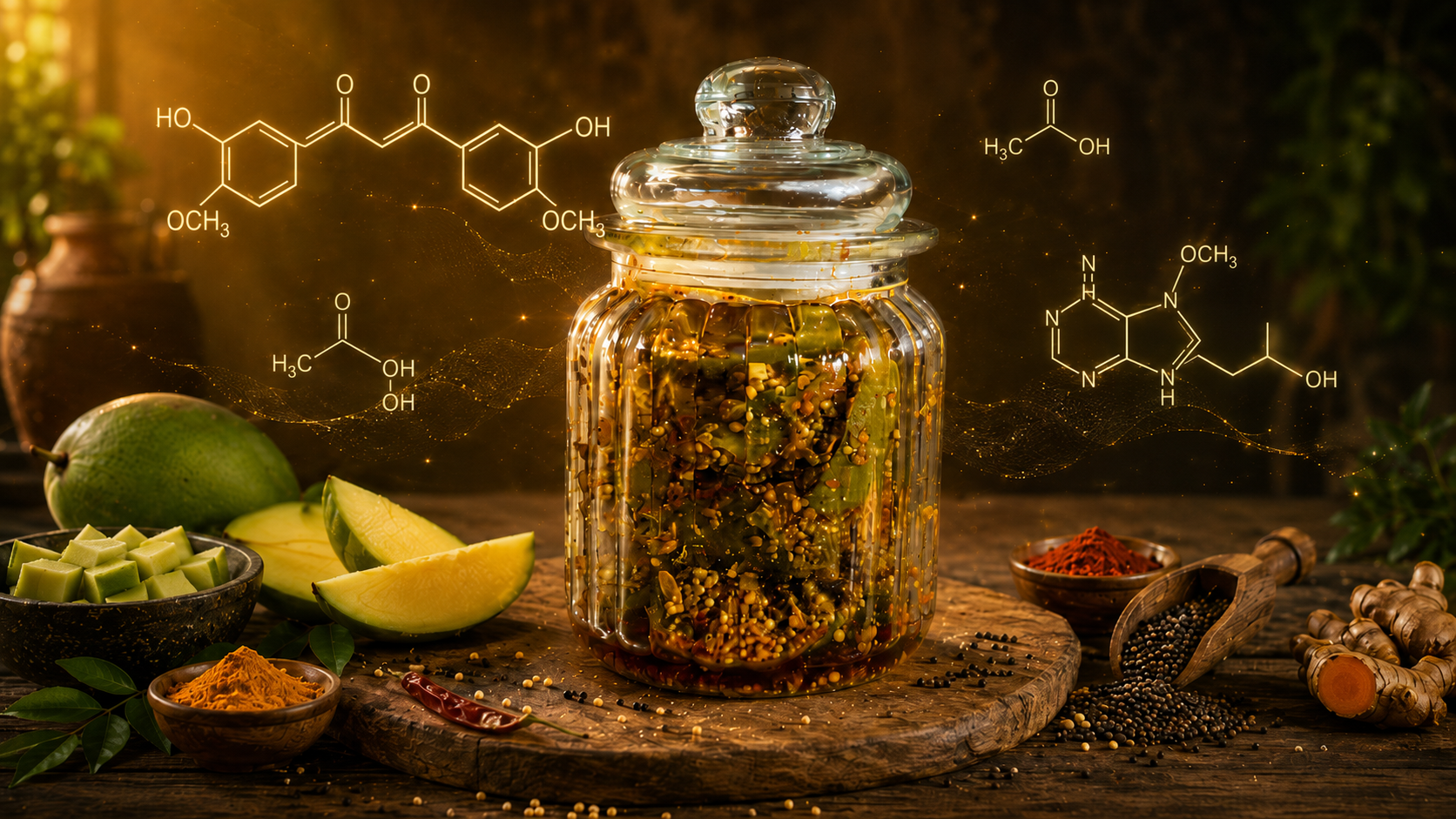
The glowing colours of Indian pickles are also products of chemistry. Turmeric owes its golden hue mainly to curcumin, a pigment that can also slow some oxidation reactions. In experimental studies on pickled cucumbers, turmeric reduced the formation of volatile aldehydes associated with oxidative deterioration. Chillies add red carotenoid pigments and capsaicinoids, the compounds responsible for their heat. Fenugreek, fennel, cumin, ajwain, ginger, garlic and asafoetida contribute their own essential oils, sulphur compounds, phenolics, bitters and aromatic molecules. Together, they create a rich flavour system: acids provide sourness, sodium ions saltiness, plant compounds bitterness, mustard and chilli pungency, and numerous volatile molecules the characteristic aroma.
Time then works quietly within the jar. Salt and acid move deeper into the mango, while spice compounds pass into the oil and plant tissue. Sharp individual flavours gradually blend and soften. Some aromas fade, new ones emerge, and the texture changes as cell membranes and cell-wall materials are altered. A freshly prepared pickle and a matured one may contain exactly the same ingredients, yet taste remarkably different. Maturation is therefore not merely waiting; it is a continuing series of physical and biochemical exchanges.
India also has a smaller but notable tradition of non-vegetarian pickles, particularly those made from fish and prawns in coastal and southern regions. The basic principles remain the same—thorough cooking, moisture reduction, salt, acid, spices and oil—but the chemistry is more demanding. Protein-rich foods can support microbial growth, while animal fats are vulnerable to oxidation and may develop rancid flavours. Careful cooking, scrupulous hygiene, minimal residual moisture and proper storage are therefore essential to the pickle’s safety, quality and shelf life.
Pickles are best enjoyed in modest quantities. Their concentrated salt, acidity, oil and pungency allow even a small spoonful to stimulate the appetite, sharpen flavours and provide a lively contrast to the rest of the meal. Larger quantities, however, may add excessive salt and oil while overpowering the food they are meant to complement.
The science of pickles offers a useful lesson about tradition. Traditional practice should neither be romanticised as infallible nor dismissed as primitive simply because its practitioners did not speak in the language of pH, water activity, osmotic pressure, glucosinolates or microbial ecology. Through generations of observation, households learned that mango must be dried, jars must remain clean, moisture must be controlled, salt must be sufficient, spices must be properly prepared, and the contents must be protected from air and contamination.
Science does not diminish this inheritance. It reveals its architecture. The jar that Vishal placed in my hands contained mango, mustard, salt, oil and spices—but it also contained osmotic gradients, organic acids, enzyme reactions, volatile antimicrobials, antioxidant molecules and the memory of countless domestic experiments. What appears at the table as a modest spoonful of achaar is, in reality, a beautifully balanced exercise in biochemistry.
MORE FROM THE BLOG

Tea, Coffee, or Me?
Though I have been a tea person all my life, coffee has always intrigued me. During my travels in the United States, it seemed to be everywhere: at breakfast tables, in offices, beside hotel reception desks and in paper cups carried through the streets. In Ethiopia, I...

The Agony and the Ecstasy of Life
Since I met Dr Chinnababu Sunkavalli, the robotic surgical oncologist, in 2022 through an introduction by the Tangirala brothers, Venkat and Ravi, he has become part of my life. His enthusiasm, his commitment to connecting with people, and his extraordinary zeal to...

The Resilient Doctor
Dr. Prithvi Raj Jampana is a distinguished radiation oncologist with extensive experience in radiotherapy and systemic treatments for a wide range of cancers. He trained in clinical oncology at Oxford University Hospitals and worked in the UK for over two decades...
The biochemistry of pickles is a fascinating example of traditional wisdom in action. Salt draws water out of vegetables by osmosis and creates an environment in which desirable microorganisms—especially lactic acid bacteria—can flourish. These bacteria convert natural sugars into lactic acid, lowering the pH and suppressing many spoilage and disease-causing organisms. In vinegar-based pickles, acetic acid performs a similar preservative role.
Spices add much more than flavour. Mustard, turmeric, chilli, fenugreek and other traditional ingredients contain phenolic compounds, essential oils and antioxidants with varying antimicrobial and oxidative-protective effects. In many Indian achaars, oil also limits contact with oxygen, helping retard oxidation and surface spoilage.
During maturation, acids, salt, enzymes and microorganisms gradually alter sugars, pectins, pigments and aromatic compounds. That is why a pickle does not merely “remain preserved”—it develops chemically with time. The familiar balance of salt, acidity, spice, oil and time is therefore, in biochemical terms, a carefully managed miniature ecosystem.
Perhaps that is the real science inside the achaar jar: preservation through controlled chemistry, transformed by time into flavour.
Dear Sir, pickles are a simple example, yet one of the most powerful, of food biochemistry. Salt removes water and slows the growth of harmful microbes. In fermented pickles, useful bacteria convert natural sugars into acids, which preserve the food and give it its sour taste.
Spices such as mustard, turmeric and chilli add flavour and also contain natural antioxidant and antimicrobial compounds. Oil helps protect the pickle from air and spoilage.
So, a jar of pickle is really a small biochemical system where salt, acid, spices, oil and time work together to preserve food and create flavour.
Dear Prof. Arun Sir, we use pickles, or achaar, in our day-to-day lives, but your column has given us complete insight into the art and science of the recipe—especially the delicate balance of spices and salt, and their relationship with time.
You described a small gift of a jar of achaar, offered as a traditional gesture by Mr Vishal Arora, so beautifully, with so much warmth and affection. The way you have brought together science, Indian values and age-old traditions shows that they can still coexist meaningfully in today’s fast-paced life.
Such blogs are extremely important and valuable for our younger generation, as they help them understand the wisdom hidden in our everyday traditions.
Please keep enlightening and inspiring us.
Jai Hind!
Arunji, very nice to read this spicy blog. Vishal is like my younger brother very similar to Amol.
Its a beautiful reflection that turns an everyday pickle into a fascinating lesson in science, culture and tradition. Your ability to find such depth in the simplest experiences makes this a truly delightful read.
Arun ji again a great piece written by you .The line that stayed with me is that science does not diminish tradition—it reveals its architecture. A wonderful blend of knowledge, culture and storytelling, making the humble achaar truly come alive.
The art and science of the pickle explained in a simple and elegant manner.
Respected Prof Arun Sir,
The way you explained the science hidden in our simple, traditional achaar was truly beautiful.
It made me look at something so familiar from a completely different perspective. Thank you, Sir, for making science so simple, relatable and meaningful.