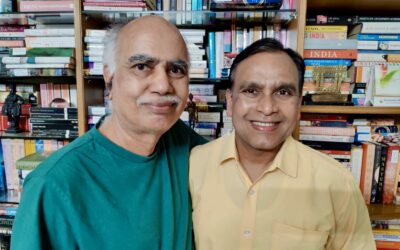
My long-standing friend and publisher of several books Piyush Kumar sent me a copy of Lifespan, a book by David Sinclair, regarding the science behind aging, during my stay at AIIMS, New Delhi. Dr. Sinclair (b. 1969) is an is an Australian-American…

Party was good; where is the return gift?
Party was good; where is the return gift?
It was in November 2018 that Anurag Srivastava, the engineer-turned-diplomat Ambassador of India to Ethiopia, took me to Dr. Getahun Mekuria, the engineer-turned-Minister of Innovation and Technology, Ethiopia. Riding in a Land Rover from the Indian Embassy to the Ministry with the Indian flag on the bonnet fluttering in the cold breeze of Addis Ababa, situated at an elevation of around 8000 feet, was surreal and most gratifying.
Dr. Mekuria briefed us as to why Ethiopia had renamed their Ministry of Science and Technology as Ministry of Innovation and Technology. Ethiopia, the biggest country in Africa with a population of more than 100 million, needed innovative and indigenous solutions to solve the problems of its people, thus avoiding imports, for which they had no money. He shared with us the idea of celebrating the Innovation Festival every year and inviting a country to showcase their technology, starting with China. Naturally, we suggested starting with India, and Dr. Mekuria most graciously agreed.
In February 2019, Dr. Getahun came to Hyderabad and signed the papers for the launch of the India-Ethiopia Innovation, Science and Technology Commercialization Programme, in the presence of Dr. Harsh Vardhan, our physician-turned-Union Minister of Science & Technology, Earth Sciences and Environment, Forests & Climate Change, from the platform of the sixth DST-FICCI Global R&D Summit. I was seated in the audience, applauding with the others at the gala event.
It is a great feeling to see India being wooed by Africa for science and technology. I had completed my higher education at the G.B. Pant University of Agriculture and Technology, an institution modelled on the land-grant model of the University of Illinois. Equipment and books tagged with USAID were everywhere. Most of the faculty had been to US Universities. When a food crisis hit the country in the mid 1970s, American agronomist Norman Borlaug (1914—2009) became a household name in India for his high-yield wheat variety.
All bright students from IITs and other scientific institutions would, by default, go to the USA for higher studies and eventually settle there. Name any senior scientist at any Indian institution of today and he would have been to an American or European University for education or research. Then came computers and the ICT revolution and Indians were everywhere. Vinod Khosla (b. 1955) co-founded Sun Microsytems. Arun Sarin (b. 1954) became the CEO of Vodafone, Rajeev Suri (b. 1967) became the CEO of Nokia. As of now, Satya Nadella (b. 1967) is the CEO of Microsoft, Sundar Pichai (b. 1972) is the CEO of Google and Ajaypal ‘Ajay’ Singh Banga (b. 1960) is the President and CEO of Mastercard.
India took up innovation in a serious manner. APJ Abdul Kalam (1931–2015) and Raghunath Mashelkar (b. 1943) nurtured hundreds of affordable world-class products in India. A.V. Rama Rao (b. 1935) pioneered the development of affordable pharmaceuticals. T. Ramasamy (b. 1948) revolutionized leather-processing technology. A. Mohan Rao (b. 1945) produced automobile grade biogas from sugar mill waste. At no other place in the world would these developments have taken place, as they concerned the needs of the poor and not the markets. We have the MedTech Innovation Centre at IIIT, Hyderabad, where Ramesh Loganathan and Radha Rangarajan are developing medical products based on cutting-edge technology. Rajeev Varshney at ICRISAT is one of the world’s top-notch seed genetic scientists.
So I rejoice at the launch of the India-Ethiopia Innovation, Science and Technology Commercialization Programme at Addis Ababa on May 24, 2019, by Ambassador Srivastava, a zealous champion of India in Africa. Thanks to a very large number of Indians who made a great mark in science and technology at the global level, India has done well in creating a robust system of innovation through our councils of medical research, industrial research and agricultural research. We had a grand party indeed, thanks to a generation of scientists who were protégés of people sitting in global labs who shook their trees to yield fruits, whenever needed. It is time to give a return gift as a token of recognition and appreciation of the same.
[DISPLAY_ULTIMATE_SOCIAL_ICONS]
MORE FROM THE BLOG

Intentional Asceticism
The Culture of Excellence
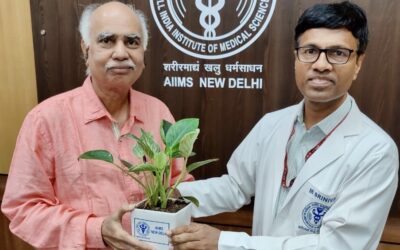
I spent a week at the All India Institute of Medical Sciences (AIIMS), New Delhi. My cardiac situation needed an evaluation and thanks to my long-standing friendship with Dr M. Srinivas, Director, AIIMS, it was done. I am back in Hyderabad and sharing some nice memories of the Institute and the people who work there…
Living in Devotion
I had a respectful familiarity with the Sri Ramakrishna Mission. Besides reading the excellent books that they have been publishing, I had the fortune of visiting the Dakshineshwar Kali Mandir in Kolkata twice where Sri Ramakrishna met Narendra…