I was born in 1955 in independent India. When I look back today, without hesitation, the best moment in public life I witnessed is the construction of a grand temple and the consecration of the idol of Shri Rama Lalla in Ayodhya on January 22, 2024…
No permanent friends, or permanent enemies; only permanent interests
No permanent friends, or permanent enemies; only permanent interests
The three hallmarks of the modern world are (1) online connectivity, (2) the consumption-driven pursuit of happiness, and (3) the rise of nationalistic feelings. Those who are not into these three, whether individuals, communities or countries, are considered outside the mainstream and are left out. The new thing about New India is that an increasing number of Indian people are joining the new world and our politicians are forced to adapt their ways and update their ideologies.
China, as a neighbor, is indeed a tough fate for India. In the last thirty years, and especially after transforming itself as the factory of the world, China amassed immense wealth and with it has come formidable military might, so much so, that even the United States sees it as a rival out to change the American-dominated world order. Indian markets are ruled by Chinese products and we import USD 50 billion worth of goods every year in excess of what we export to China. But this is not considered when China supports anti-Indian endeavors of Pakistan in every possible way.
In a recent book Fateful Triangle, Tanvi Madan analyzed how India and the United States could never become allies, bringing out the brutal fact that international relations are indeed based on national interests. While China and Pakistan were more than eager to counterbalance Soviet Russia, India had little to offer to the US in a tangible sense. Further, as neither country posed a threat to the other, Indo-US bilateral relations remained superficially cordial and hollow of substance.
When the Soviet Union fell in 1991, largely due to implosion and aided and abetted by President Ronald Reagan (1911–2004), Deng’s China was seen as the next goose to be caught for dinner. The American big business community – called Fortune 500 that functioned out of the U.S. Chamber of Commerce – made it clear—first to President Bill Clinton (b. 1946) and then to his successor, George W. Bush (b. 1946)—that trade with China was its highest priority.
The ideological hangover of the Tiananmen Square, where a pro-democracy demonstration was brutally crushed in 1989 by Deng, was quickly shed away. And by the time the new millennium arrived, China was a PNTR (permanently normalized trade relations) country for the United States of America. With no fear of China’s favorable access to the U.S. market ever being revoked, the Fortune 500 opened their coffers as floodgates of investment, working hand in glove with Beijing to create new, China-centric supply chains.
In 2012, when Xi Jinping (b. 1953) arrived on the scene, he rolled out the Made in China 2025 plan, without any pretense, to make China dominate key growth industries in the world. The Chinese government under Xi Jinping, unleashed Chinese bureaucracy demanding never-ending regulatory compliances and technology transfers on one hand and conducting blatant violation of intellectual property on the other. With a mix of idealism of President Barack Obama (b. 1961) and the unwillingness of the Fortune 500 in calling a spade by its name, China started considering itself not only as an equal to the U.S., but also an adversary for the top slot in world trade.
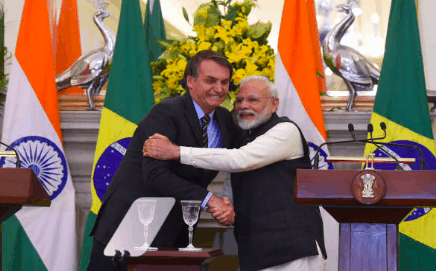
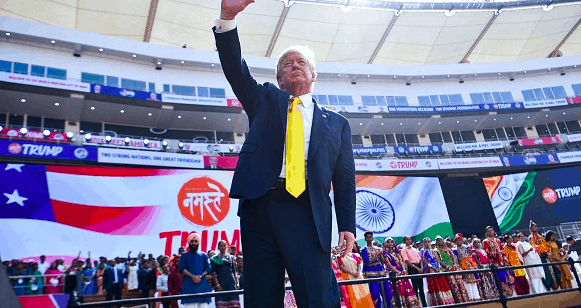
Now, for the first time, the U.S. is seeing China as a threat. The role of Pakistan in Afghanistan is almost over. The unplugging of China from the great American economic machine is imminent. Can the corollary of this decoupling be an India-US alliance? With business-friendly President Trump and Prime Minister Narendra Modi at the helms, there can hardly be second thoughts on this. In the last few years, a great distance has been covered by both countries towards each other and when President Trump came to India last week and made a historical defence deal with the promise to make a ‘very big trade deal’ soon, it was not a new start but the conclusion of a thought process going on for a while.
History is a great theater of ‘what ifs’. Nothing in history is predetermined and that extends to national political trajectories too. What if, Prithviraj Chauhan had killed Muhammad Ghori when he attacked the first time and had not allowed him to return? What would have happened if the British had never come to India, or say, by 1810 or so, a loose confederacy of Sikh, Maratha and the Deccan rulers had managed to kick out the British, the French and the Portuguese? What would have happened had Mir Jafar, the commander-in-chief of Siraj-ud-Daulah’s army not betrayed his nawab? Or, had Cyril John Radcliffe applied mind and method and not divided Bengal and Punjab in five weeks? Or, had Prime Minister Nehru accepted President John F Kennedy’s offer of helping India detonate a nuclear device much before China did in 1964?
In 2020, another ‘what if’ is staring at us. The U.S. and China are locked in a tussle for the commercial control of the South China Sea, which serves as a passage for annual trade worth USD 3.5 trillion. Can India partner with Japan and Australia as U.S. allies to keep China at bay? Or, do we bury our head in the sand, and keep debating over citizenship even after seven decades of our nationhood?
The outbreak of the Coronavirus in China has just highlighted how the best of man’s plans can go astray without any warning. Not only is the biggest factory of the world closed, but China is also on a total war footing. The longer the curbs on work and travel persist, the greater will be the global economic shock. No one country apparently has a solution to this problem and working together is the only way forward. When Prime Minister Modi wrote to President Xi offering assistance to deal with the Coronavirus outbreak, it was seen as “India’s acts of goodwill fully demonstrating its friendship with China.”
President Donald J. Trump is the seventh United States’ president to visit India. President Dwight D. Eisenhower visited India in 1959, President Richard Nixon (1969), President Jimmy Carter (1978), President Bill Clinton (2000), President George W. Bush (2006), and President Barack Obama (2010 and 2015). In fact, thanks to President Kalam, I met President Bush and also dined with him. Earlier U.S. Presidents used to club India and Pakistan trips together, but not anymore.
The three powerful leaders of our times indeed have a great opportunity to make Planet Earth a better place to live for humanity. It is important, however, to be clear about the limits of engagement between India and the United States against China, their common adversary, and to remember the admonition of Lord Palmerston (1784–1865), who dominated British foreign policy during the height of its imperial power and who is considered the best Prime Minister under Queen Victoria. He stated that in international relations, there are no permanent friends, or permanent enemies, but only permanent interests!
MORE FROM THE BLOG

A Moment of Civilisational Pride

Heaven, Not Up There, But Right Here
The Tower of Babel is mentioned in the Bible (Genesis 11:1-9). The prideful ancient Babylonians wanted to build a mighty city and a tower with its top in the heavens. The work remained incomplete after they were cursed to speak different languages…
Seer of the Past and the Future in the Present
The New Year 2024 begins on a positive note. The Indian economy is doing well, and people generally enjoy good times, if not great. There is no distress or despair in the air except for some intransigent pessimists who are perhaps blind to everything good…