One of my cherished childhood memories is singing before the image of Mother Durga created on the wall using cow dung, called Sanjhi, in our home every year during Navratri. This was not done in every house in our locality and many children would…

Family foremost
Family foremost
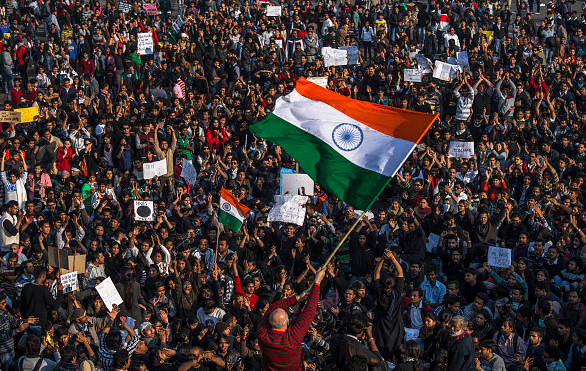
India is celebrated as a democracy by large numbers of Indians. We are the world’s largest democracy. We place ourselves in the company of the United States, the United Kingdom, France, Canada, Germany and many other democratic countries. There are problems in Pakistan but there is fully functional democracy in Bangladesh, Nepal, and Sri Lanka. In many ways, our democracy has its own defects, the recent drama in Maharashtra being testimony to this.
The history of democracy can be viewed in two ways. The Indian view is that the Indian Mahajanapadas were democratically governed by the people. The Western view is that democracy was born in the Greek City States of Athens. However, both in the West and the East, democracy did not flourish as kingdoms and empires prevailed over people. The real birth of democracy in the modern world happened in the United States, in the latter half of 1700s. The Constitution of the United States of America is the world’s first formal blueprint for a modern democracy.
In the words of Abraham Lincoln (1809 – 1865), “The story of America’s birth should be read of, and recounted, so long as the Bible shall be read. The Founding Fathers’ noble experiment—their ambition to show the world that ordinary people could govern themselves—had succeeded.” Lincoln in his Gettysburg Address immortalized the definition of democracy as “government of the people, by the people, for the people,” which he borrowed from John Wycliffe (1328 –1384), who wrote it in the prologue to his translation of the Bible as the God-inspired way of living together.
Indian democracy passed its acid test in the 1970s. The people of India endured the Emergency and large-scale confinement of political leaders and press censorship and voted out Prime Minister Indira Gandhi’s government, when elections were held in 1977. People once again voted out the inefficient and squabbling government of the Janata Party in 1980. The massive mandate for the Congress after Indira Gandhi’s assassination was squandered and the country hit rock bottom before turning itself around in 1991. There has been no going back since then. Democracy is on the roll. But where it is rolling to?
I personally consider leaders as the products of their times. Individuals rise to the demands of their times, deliver and fade away after doing their bit, passing on the baton to the new leaders to solve the new challenges posed by the new times. Ten years is a good time for any leader. It can be stretched to fifteen, but after that, it is all about sticking to the position and solving things rather than inspiring and leading.
It has happened world over and is now a proven pattern. When a great leader is ruling, another great leader is in the making in the crucible of changing time from a lot of many. And if this is not so, there is a problem. These leaders will rise from the society, from the communities in the society, and the families in the community. Leaders coming from broken families will not be able to hold people together.
India is a pluralistic society, a very vast nation, and has a wide spectrum of political thoughts. All thoughts – left, center and right are gloriously present. In the history of independent India, we always took a center position – mixed economy – and swung to the left initially to socialism and off late, to the right towards capitalism. The nation today faces some serious questions: what is to be done with the vast public sector industry, which is inefficient, badly managed and a drain on the overall economy rather than being an engine to take it forward? Can the private sector be trusted to safeguard the interests of employees and the people of India, specially the farmers, artisans, shopkeepers, laborers and service providers in the informal sector, and the vendors on the roads?
The rise of the BJP is as phenomenal as the fall of Congress is spectacular. The Left is mostly absent in our legislative bodies but very much alive and active on the ground, and in the minds of the people. The caste-based parties still exist, and family-centric parties have not gone away either. British political scientist and historian Archie Brown (b. 1938) in his book The Myth of the Strong Leader, published in 2014 and revised in 2018 writes, “strong leaders often propagate a myth that obscures their weakness while putatively weak leaders may leverage hidden strength to accomplish great ends.”
It is time that all the political parties of India, which are required for the good of our nation, groom their new leadership. It is a pity that no inner party democracy is functional in most of the political parties of this democratic nation. If this is not changed, those parties will fade away with time. And it is incorrect to find this leadership in universities because they are already conditioned by politics and there is nothing new there. New India needs new leaders coming from its working people, entrepreneurs, strugglers, inclusive in their hearts and tolerant in their minds.
And finally, the spirit of service is the key. Most of the young leaders are already arrogant, flashy in their styles and aggressive in their tones. Democracy does not like such leaders; it packs them off on the first opportunity, even if they manage to rise and hold on to power. Democracy is a system. It rests on its institutions. The institutions can be both great enablers and constraints for their leaders. A leader can’t cherry pick them in a democracy. Let us not allow our institutions to be compromised. New leaders must learn the art of working with them and not against them.
It starts with the family. Does the family respect its aging and non-earning elders, give equal rights to the female spouse and the female child, treat the maid with dignity, give the children a balanced childhood, and earn its living without corrupt means? It is stupid to keep flaunting the Vaisudhiava Kutumbakam heritage of Indian civilization and seeing our family system disintegrate, driven by the arrogance of new wealth (or the frustration of its absence) and addictions amongst young people.
Let us give to the world a robust and exemplary democracy, starting with democratically enabled and flourishing families. Let us lead our lives with purity of the heart and the mind and not follow the herd and advertisements. Failure to do this shall turn us into fodder for the global consumer machine in full run to devour our present and future as well.
MORE FROM THE BLOG
The Mother Code

Spiritual Turnpikes
I recently met Mr. Chandu Thota, Vice President at Google, when he was here in Hyderabad, where he studied at Osmania Engineering College. Chandu played a pioneering role in the development of digital mapping. He worked at Microsoft from 2002 to 2007 on maps and later established his own company…
Can the Change be Stopped?
Meeting people gives meaning to life. I consider myself profusely blessed to have met some of the finest people and learned from them. Chandu Thota, Vice President and Head of Engineering at Google Headquarters in Silicon Valley , is one such person whom I met rather late, but except for a wish that we could have met earlier and worked together…