Tanya Seth is the quiet architect behind my blog and, in many ways, one of the unseen custodians of my intellectual journey. She created my website in May 2019 and has selflessly nurtured and maintained it ever since—not merely as a technical administrator, but as a...
Kafka in the Age of the Gig Economy
Kafka in the Age of the Gig Economy
In my youth, when I first read Franz Kafka’s Metamorphosis, published in 1915, it seemed to belong to a distant, shadowed landscape of European modernism—strange, unsettling, intellectually luminous, yet safely contained within literature. One reads differently at twenty, differently again at forty. Now, in my seventies, I find that the story has quietly crossed the boundary between page and world. Gregor Samsa no longer lies only in a narrow room of fiction; he appears, flickeringly, in the restless movement of our cities, in the blue glow of handheld screens, in the hurried footsteps of the young who labour without certainty, protection, or even the assurance of being remembered. Time, which softens many impressions, has sharpened this one. I do not merely recall Kafka now—I return to him as one returns to an unfinished question.
What troubles me is not hardship alone. India has known poverty and endurance, yet it has also sustained neighbourhoods of care, invisible threads of reciprocity, and a moral vocabulary that ensured no one disappeared entirely from the circle of recognition. The disquiet I feel today is subtler, almost soundless: the thinning of identity itself. In the expanding gig economy, I watch young men and women in perpetual motion—delivering meals, steering strangers through traffic, coding unseen architectures of the night, moderating conversations they will never join. They are everywhere visible yet nowhere known. Their labour is measured to the second; their lives remain immeasurable. Ratings rise and fall like small, indifferent tides. A missed day, a moment’s illness, an algorithm’s quiet judgment—and the fragile thread of belonging begins to loosen. Looking at them, I feel the faint, persistent echo of Kafka’s insect—not grotesque in body, but diminished in social presence, reduced to function without story.
Age brings with it an altered scale of perception. One begins to notice not only what is built, but what quietly recedes. I have lived through decades that promised continuity: institutions that offered lifelong work, professions that carried an inner dignity, and social contracts—imperfect, contested, yet real—that linked effort with security. The young inherit astonishing technologies, velocities of connection we could scarcely imagine; yet the ground beneath their feet feels less stable than ever before. They improvise brilliantly, adapt with courage, and move with a fluency that commands admiration. And yet, beneath this brilliance, I sense a civilisation learning to celebrate flexibility while gently withdrawing responsibility. Progress glitters; assurance fades.
Perhaps this is why Kafka returns with such quiet insistence. His question was never truly about transformation into an insect. It was about recognition—about what remains of the human when usefulness becomes the only language spoken. In the gig economy, usefulness is immediate and dissolvable. One is needed intensely for an hour, forgotten the next. Efficiency governs; covenant retreats. There is elegance in the system’s design, even a kind of technological poetry. Yet beneath that elegance lies an absence difficult to name: the promise that society fails to keep with its youth. Work exists, but work without protection becomes a delicate form of invisibility.
I find myself unexpectedly restless in the face of this reality. Old age is often imagined as a season of detachment, of philosophical acceptance. Instead, I discover a heightened tenderness towards vulnerability—perhaps because dependence no longer appears theoretical. To see millions begin their adult lives already exposed to such precarity evokes not anger, nor nostalgia alone, but a quiet sorrow that settles like evening light—gentle, persistent, impossible to ignore. One wonders whether speed has outrun wisdom, whether innovation has moved faster than compassion can follow.
And yet despair feels too simple, almost a failure of imagination. I have witnessed too much resilience in our people, too much unrecorded generosity, to believe that invisibility is destiny. History reminds us that systems forgetting humanity eventually confront their own incompleteness. The gig economy, still young, need not remain a landscape without shelter. It could grow toward something more humane—where flexibility walks beside security, where technology enlarges dignity rather than thinning it, where society renews its quiet promise to those who carry its future in their uncelebrated labour.
Reflecting on Kafka now, I am struck by another tenderness in his fate. He did not live to see the reach of his own words; recognition came largely after his death. Such is the mysterious endurance of the written thought: it travels beyond the writer’s breath, waits patiently in time, and awakens when the world becomes ready to hear. Ideas, like seeds, choose their own season. That a solitary imagination from a century ago can illuminate the anxieties of our digital present is itself a form of hope—the assurance that meaning outlives circumstance.
Age, then, becomes not withdrawal but witness. To grow old is to watch patterns gather across decades, to recognise when metaphor hardens into reality, and to feel—quietly, insistently—the responsibility to speak before silence turns into consent. My unease is, therefore, not complaint but care, a refusal to accept anonymity as the price the young must pay for opportunity. Care, in later life, often takes this form: a gentle persistence of attention.
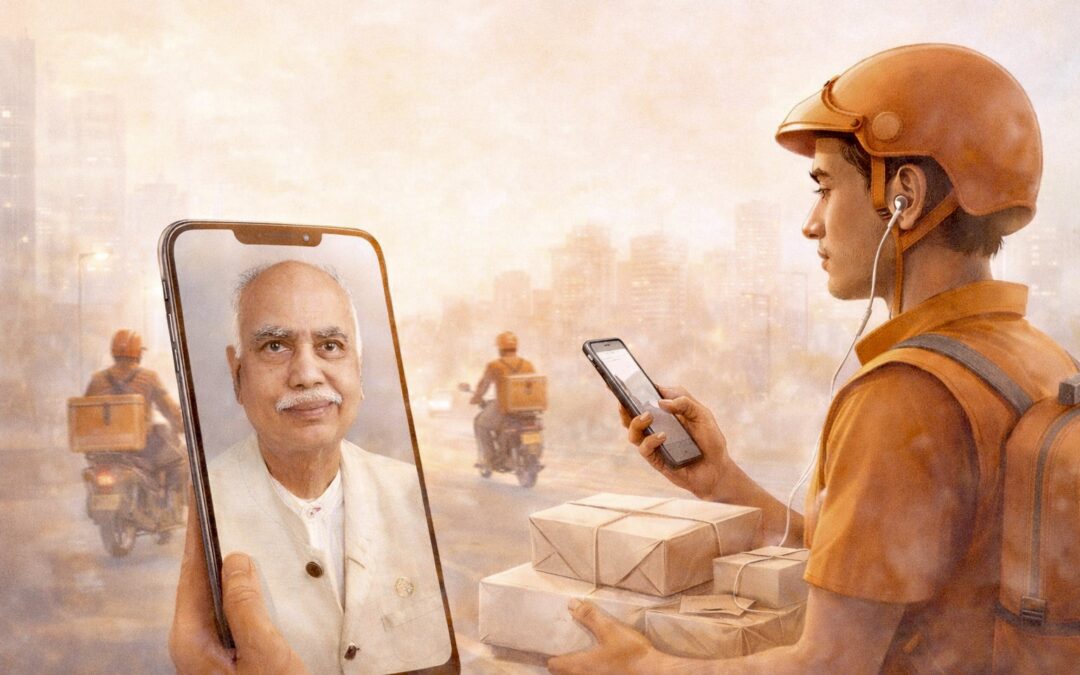
Kafka, returning softly through the corridors of memory, offers not darkness alone but warning—and also invitation. Even in one’s seventies, the heart still hopes that stories might end differently than before; that recognition may arrive in time; that dignity may prove more durable than efficiency. I am reminded of this in the smallest of encounters: the brief moment at my doorway when a young gig worker places a packet into my hands, his eyes already divided between the present and the next demand waiting inside the earplug-connected mobile through which another customer’s voice is calling. He carries several packets at once, time folded tightly around him, and from me he seeks nothing more than a good rating—an invisible gesture that may shape his remaining day. Our exchange lasts only seconds, yet something in it lingers: the quiet asymmetry between a life measured in hurried deliveries and a life pausing long enough to notice. And so, the question returns, tenderly but insistently: whether somewhere, within the swift machinery of the modern world, space may still be made for the simple, irreducible presence of the human being—seen, named, and held in quiet regard.
When I pause at a traffic signal and see helmeted riders waiting in the dust-filled air, or glimpse tired eyes illuminated by midnight screens, I do not see insects. I see nascent citizens of a future still searching for its moral language. Their anonymity is not natural; it is constructed—and what is constructed may yet be reimagined.
If my generation holds any remaining task, perhaps it is simply this: to insist, without bitterness and without noise, that progress must encompass compassion within it, or remain incomplete. For in the end, the truest metamorphosis is not Gregor’s, nor the world’s machinery of work, but the awakening of recognition within us. And if that awakening comes—even quietly, even late—then perhaps the story is still being written toward the light.
MORE FROM THE BLOG
Inner Frontiers

The Perpetual Proletariat
have long been an admirer of V. S. Naipaul, whose writings—especially his celebrated Indian Trilogy: An Area of Darkness (1964), India: A Wounded Civilisation (1977), and India: A Million Mutinies Now (1990)—have deepened my understanding of India beyond the...
Who Builds for the Billion?
There are moments when knowledge does not come from books or structured lectures, but from the quiet authority of lived experience. I have increasingly come to believe that the most important knowledge comes from listening—listening to people as they recount what they...