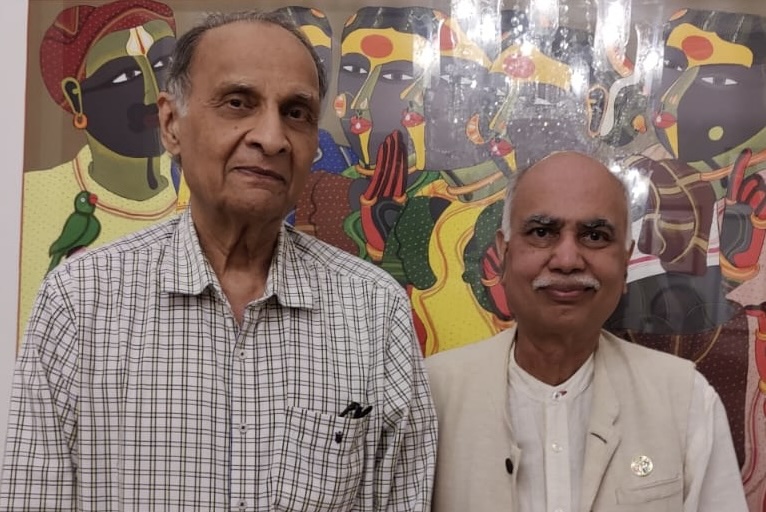
I count it among the quiet privileges of my life that I live in Cyberabad, that curious frontier of Hyderabad where glass and code rise together, and where the pulse of the contemporary world beats with an almost inaudible insistence. Yet, even here, amid the measured...
A Small Republic of Trust
A Small Republic of Trust
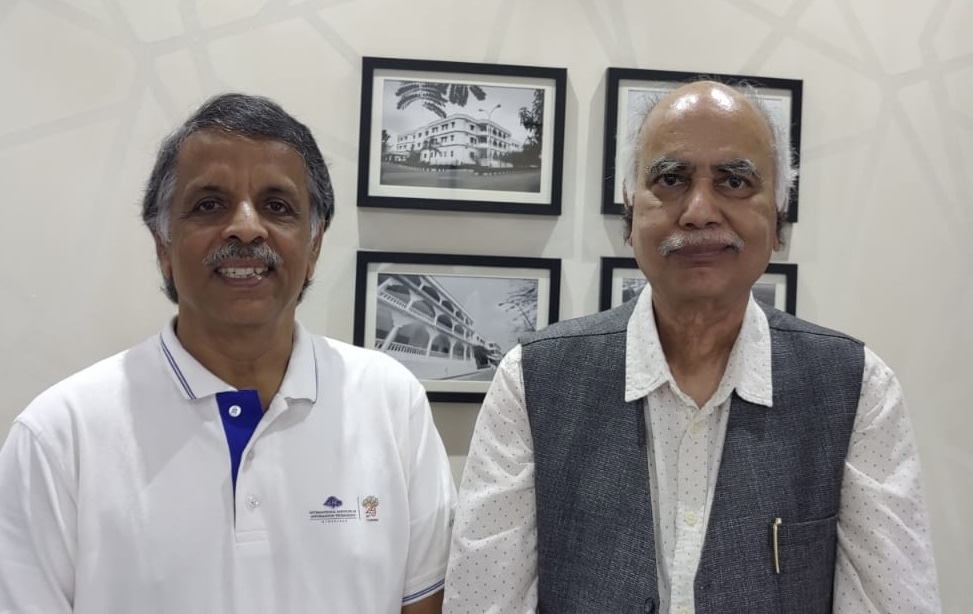
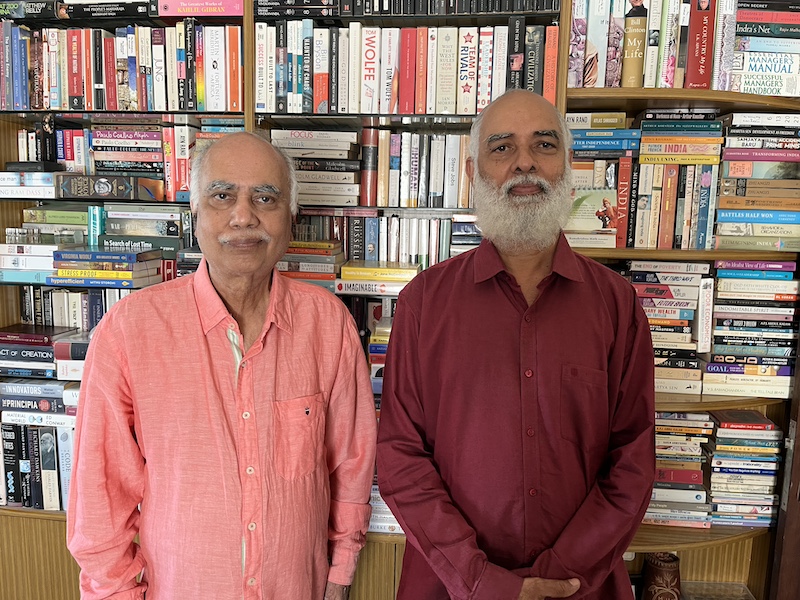
It was a quiet forenoon when they arrived — father and son, two physicians bound by a lineage of service and an unspoken continuity between action and thought. The air outside was still, save for the occasional chirping of birds on my 14th-floor east-facing balcony. By noon, the sun had moved overhead, leaving the balcony in shade and pleasantly cool.
Dr Venkata Ratnam Vakkalanka sat opposite me, unhurried, his eyes clear, his presence light yet steady. There was no theatricality about him, no performance of virtue. Sagacious, with his white hair and beard, he spoke in simple sentences that carried the ring of lived truth — a rhythm as steady as his pulse.
He is about my age, and yet I felt, as we talked, that he had lived a life more centred, more certain of its course. He had chosen his orbit early and had remained within it — like a planet loyal to its sun. As he spoke, memories came flooding back — of Kakinada, that quiet coastal town I had been to ‘once upon a time’. A paradise of tranquil order, I had called it then — a place where life seemed to move with purpose yet without haste. It was easy to imagine him there, tending to his patients not merely as cases of sugar and blood pressure but as whole lives, luminous and complicated, each seeking equilibrium.
In a world where most young doctors fled toward neon cities and richer destinies, he had stayed behind. Not out of inertia, but out of faith — faith that one need not go far to serve greatly. His wife, Smt. Padmaja provided anchoring. His clinic, modest by city standards, had become a sanctuary for those who sought not miracles but understanding. He had turned medicine into dialogue, and dialogue into healing.
He spoke of diabetes — not with the mechanical certainty of textbooks but with the tenderness of a philosopher. “Diabetes,” he said, “is a rhythm gone astray. The human body is a system of balances — intake and expenditure, rest and effort, indulgence and restraint. When the rhythm is lost, disease enters. My task is not to overpower it with drugs but to guide the rhythm back.”
Remembering his guru, legendary diabetologist Dr M. Viswanathan in Chennai, he said, smiling gently, “I often tell my patients — Metformin is not a miracle, it is a foundation. It gives us a base to rebuild upon. But without discipline, without the steady pulse of daily practice, even the best medicine becomes futile.” Healing is never a technical fix but a repairing act — a restoration of harmony between man and his body, between desire and discipline. He believed that the truest medicine was awareness.
His son, Dr Sujit Vakkalanka, sat beside him — younger, thoughtful, with the stillness of one who has seen the world and carries both its promise and fatigue. Trained in the United States, he now stood poised at the threshold of a new frontier — that of using artificial intelligence to treat diabetes. He spoke softly, almost diffidently, of algorithms piggybacking on the mobile phone that could monitor energy intake and expenditure in real time, whisper gentle reminders when indulgence crept in, and make health a living dialogue between man and machine.
“The body always tells us everything,” he said. “We just don’t listen. AI could help us listen better.” It was a beautiful image — not of machines replacing wisdom but extending it. The father saw in his son’s vision the evolution of his own lifelong practice: what he had done through intuition, the son hoped to do through data. Between them stood not a generational divide but a bridge — one built of the same compassion, expressed in different tongues.
I asked Dr Vakkalanka whether he had ever regretted not leaving Kakinada for a larger city, such as Hyderabad. He shook his head slowly. “No,” he said. “A doctor’s work is not measured by where he practices but by how deeply he listens. My patients are my teachers. Many of them have gone elsewhere, yet they still come for consultation. I never felt the need to go elsewhere.” The sentence lingered between us like a benediction.
In that moment, I understood something rare: that staying is also a form of courage. In an age where ambition is defined by departure, to remain rooted is almost radical. Dr Vakkalanka had not chased success; he had cultivated meaning. In the quiet streets of Kakinada, he had built a small republic of trust. I remembered again that town — its symmetry, its discipline, the rhythm of its tides — and saw how his life mirrored its geography. The man and the place seemed woven from the same calm cloth.
We spoke of food, of sleep, of the unseen mathematics of metabolism. He believed that modern life’s tragedy was excess — not just of calories, but of noise, anxiety, distraction. “We live,” he said, “as though energy were infinite. But it is not. Whether physical or emotional, every indulgence must be balanced by stillness. The healthiest people are not those who do the most, but those who do enough.”
His words were less prescriptive than philosophical. I thought then how his son’s vision — AI monitoring our daily rhythm — was, at heart, an echo of the father’s teaching. The old wisdom clothed in new syntax. Awareness translated into code. Perhaps that is how knowledge evolves — one generation feels, the next measures. One listens to the pulse, the other to the data. Yet both, in the end, seek the same harmony. When they rose to leave, the air around me seemed lighter and the sunshine brighter.
In the night, in the brief spell before sleep takes over, the images of Kakinada returned — of its still waters and soft light. Dr Vakkalanka had embodied Kakinada: its tranquillity, its balance, its quiet assurance that service is richer than ambition. And through his son, that same spirit was finding its way into the circuitry of the future. Perhaps this is what it means to heal — to make the hidden rhythm visible again, whether in the bloodstream or in the algorithm, whether in a small town by the sea or on the luminous screen of a machine.
And perhaps, when the world grows too hurried, too indulgent, it will need more men like Dr Vakkalanka — those who stay, serve, and remind us that the healthiest system, human or digital, is the one that remembers to live in rhythm. Life, after all, is like the deep ocean: stillness rules its depths, holding treasures for those with the courage to dive deep. The world of families, communities, livelihoods, media, and other vanity fairs is like waves on the ocean surface: roaring, glittering, crashing, and vanishing — a fleeting display of entropy! But like there is always the enduring calm below, there is eternal immortality residing within all of us, witnessing the drama of our lives.
MORE FROM THE BLOG
Technology, Post-Truth, and the Art of Storytelling

Awakening the Atom: India’s Quiet Energy Revolution
It is one of history’s great ironies that nuclear energy—arguably among humanity’s most profound technological achievements—remains burdened with the shadow of destruction. The association is not without reason; it was forged in the searing memory of the Hiroshima...
Water, Wisdom and the Fortitude of the Indian Farmer
There are days that begin as routine engagements and quietly unfold into moments of reflection—days that leave behind not just memories, but also a gentle reordering of one’s thoughts. My visit to the ICAR – Central Research Institute for Dryland Agriculture (CRIDA)...