
I am a mechanical engineer who worked for 15 years at the Defence Research & Development Laboratory (DRDL) in Hyderabad. There, I developed the Trishul and Akash missile airframes and Titanium Airbottles…

Welcome to the world!
Welcome to the world!
I recently got the opportunity to offer the first sip of water to my younger brother’s granddaughter. The week-old child looked into my eyes and seeing her quaffing the first drop of water was such a great pleasure. My brother’s son-in-law is a Squadron Leader in the Indian Air Force and stationed at Hyderabad these days. I had somehow missed this occasion earlier when my sons and even my grandson came into this world. So, this joyous moment came very late to me, but nevertheless, it came.
We all come into this world as little babies – weighing some 3 kg, as a bundle of joy for our parents and grandparents. Some have elder siblings around doting on them; others, the first child like me, are treated like a princeling anyway. I have no doubt whatsoever that each one of us enters the world as an immortal essence of consciousness assuming physicality. This conscious is smeared with experiences of earlier lives, making a little child laugh and cry for no apparent reason. As the child grows, it gets integrated into the world. However, past lives impressions remain operative as innate temperaments, whims and fancies.
A lot has been said about fate, destiny and free will. Put simply, our fate gives us birth in a particular family and the initial conditions of growing through our childhood. We can also add our temperaments, embedded emotional drives and even genes as our fate. Parents and other influencing people around – grandparents, elder siblings, teachers, and so on – impose upon a child their own wills. Human destiny is all about emerging out of these traps. To become a person first, escaping the imposters. And then expand the personal consciousness from social to universal to cosmic. It is here that people differ – one life may blossom and the other life may wither away.
Nature versus nurture is an old debate. With the maturity of the science of epigenetics, this debate has ended; only the ignorant are continuing with the argument. A very large portion of our DNA—up to 98 percent—does not code for proteins. Believed to be inert evolutionary leftovers, it merely lives within us. Merely some 20,000 and odd genes are expressed – deciding our bodies, cognitive apparatus, and temperamental hue. Gene’s expression heavily depends on the environment – the internal milieu of our bodies as well as our surroundings. Children growing up listening to music around, loving kindness, and abundance grow up as different persons from those who suffer noise, neglect, violence and hardships of poverty in their early days.
But even adversity carries with it the seed of greater benefit. As the child grows, the harsh conditions provide strength, toughness and endurance. Many who grew up living within balloons of comforts and privileges find themselves weak, insecure, and fragile in their adult lives. Life is indeed a great leveler. The unevenness of outer conditions in earlier life is eventually levelled off. I have seen examples of APJ Abdul Kalam, Barak Obama and Lula da Silva in my own lifetime.
In India, horoscopes are still considered at the time of marriage and there is a tradition of “matching” the planetary charts at the time of the births of the bride and the groom. I have seen all sorts of marriages – working, not working, and even dissolving in divorces – and horoscope matching is a wasteful exercise – amusement at best. Tuning of temperaments is what matters most in living together.
But perhaps the biggest problem of modern families is dysfunctional communication. People are not talking to each other. It is very common to find TV always “on” in the evenings when the family reunites after their day-long outings and even at the dinner table mobile phones are continuously used. Children speak in monosyllables. What are you doing? Nothing. Where have you been? Outside. The old art of writing letters is also forgotten, and a horrible style of writing has appeared where the is written as “d” and great as “gr8”.
Neglect of the elderly is becoming commonplace. Old age homes are not common, but Ashrams are full of elderly people. Everyone, including elders, is responsible. People are obviously living longer and it is very common for people to hang around 2 to 3 decades after their retirement. The spirit of the third stage of life, vanaprastha – where the elderly take up a detached stance and do not get much involved in their grownup children’s lives – is by and large ignored. Either way, the grace of old age is either lost or robbed.
There is an interesting story of Aesop, a storyteller of ancient Greece. A horse, an ox and a dog came and begged for shelter in a man’s home one winter day during a fierce storm. He welcomed them and provided them with warmth by lighting a fire and served food – hay for the ox, oats for the horse, and leftovers from his own dinner to the dog.
Once the storm subsided, the grateful animals blessed the human and each gave a portion of its characteristics to him. The dog blessed old age, which is why old men are frequently peevish and ill-tempered. The horse blessed youth and, as a result, young men are high-tempered and impatient of restraint. The ox blessed middle age, making men in middle life steady and hardworking.
But these problems, though in plenty, are not the serious ones. As Leo Tolstoy wrote in the first sentence of his 1877 novel Anna Karenina, “All happy families are alike; each unhappy family is unhappy in its own way,” people – young and old – devise their own methods to co-exist. The biggest challenge is the failure to live the human destiny of expanding consciousness. Selfish people somehow create unhappiness wherever they are.
There is no scientific conclusion as to what exactly consciousness is, except that it is a fundamental characteristic of life. From conception in the mother’s uterus to the moment of death, every sentinel being is conscious – from bacteria to plants to insects and all sorts of animals, waterborne, amphibians, moving on earth and flying, and man walking on his two feet – are conscious of their surroundings and deal with it, knowingly or unknowingly, every moment of their lives and therefore, to be alive is to be conscious.
Human beings have a unique gift of imagination. They remember the past and fantasize about the future. They can dream about their desires and strive for them. Not doing that is the biggest failure of one’s life. In Ramcharitmanas, Goswami Tulsidas compared the squandering away of this opportunity to expand the consciousness after sensory pleasures to throwing away a gem in the hand to pick up a shining piece of glass: काँच किरिच बदलें ते लेही। कर ते डारि परस मनि देहीं।. The neglect of the capacity to develop the divine consciousness is indeed wasting human life.
The child is named Shambhavi (शाम्भवी), who is loved by Shiva, the eternal God. Everything emerges out of eternal nothingness and is sucked back into it at the appointed time. What we call day and night is the never-ending movement of the earth around the Sun. May Shambhavi grow up to the fullest of the feminine dimension of energy functions – balance strength with gentleness, express subtle energies lying deep within the unconscious – the real purpose of human life.
MORE FROM THE BLOG
Take the Bull by the Horns
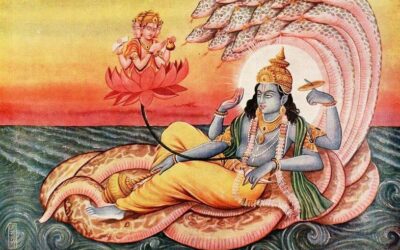
Mythology: Imagination or Coded Secrets?
Myths often reflect the creativity and storytelling traditions of cultures. They can be seen as symbolic narratives that explain natural phenomena, human behaviour and societal values. These stories often incorporate fantastical elements and characters…
Whose Truth and By what Facts do I Live?
I exist. My family, friends, and people I wouldn’t say I like all exist. I face situations both comfortably and disquietly. I feel happy and sad, relaxed and anxious. Like a flowing river, the stream of thought in my mind sometimes flows smoothly…


