
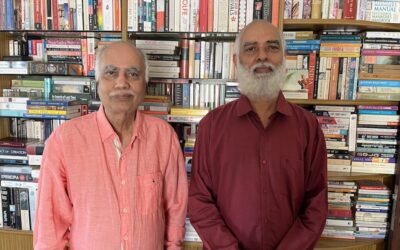
It was a quiet forenoon when they arrived — father and son, two physicians bound by a lineage of service and an unspoken continuity between action and thought. The air outside was still, save for the occasional chirping of birds on my 14th-floor east-facing balcony....

The Mother Code
The Mother Code
One of my cherished childhood memories is singing before the image of Mother Durga created on the wall using cow dung, called Sanjhi, in our home every year during Navratri. This was not done in every house in our locality and many children would visit our home out of curiosity and of course, for the prasad, that would be distributed by my mother after the half hour ceremony, during the nine-day period in October-November every year.
I come from the Gaur Brahmana community in Western Uttar Pradesh. My ancestors are believed to come from the Gaur Pradesh of Bengal, an ancient kingdom in the modern-day Malda district, and were said to have been invited by King Parikshit, the son of Abhimanyu and Uttara, and the grandson of Arjuna. He was the successor of Yudhishthira to the throne of Hastinapur and was to perform a particular yajna, which would not be considered complete without these exalted Brahmanas.
After the yajna was concluded, the king requested them to settle and granted them land. Millennia have passed but Gaur Brahmanas continue to worship Mother Durga as they were doing in Bengal. My father would fast during Navratri and recite the Devi Mahatmya every day. On the eighth day, he would perform a yajna officiated by a priest. The next morning, children from the neighborhood were fed by my mother and grandmother. My brother Salil Tiwari continues this tradition.
As a child, although I sat through the recitation of Durga Saptashati, I could never capture the content. When I read it later, I found the account of Mother Durga and Kali killing demons rather gory and wondered what merit reciting all this violence would incur. Aware of the fact that mine is perhaps the last generation who is aware of our traditions and scriptures in their original forms, I have decided to dive deep into the Devi Mahatmyam, part of the Markandeya Purana. The 700 shlokas in the chapters 81-93 give this text the name Durga Saptashati.
Two unlucky men, a dispossessed king Surath and a destitute merchant Samadhi, meet in a forest. They are deeply disappointed, but not disillusioned. They approach a sage for help. Both are highly egoistical, brimming with self-pity. The sage sees that their hurt sense of I-ness and my-ness was tormenting them. Their misery would end if they were turned towards the Divine. So, the sage engages them by telling the three charitras, episodes of the exploits of the Supreme Shakti and her emanations.
In the first episode of chapter one, Devi is in her Maha Maya form. Demonic twins Madhu-Kaitabh are obstructing Lord Brahma during the creation of the cosmos. Lord Brahma prays to Vishnu who is in deep sleep. Maha Maya emerges out of Vishnu and kills the demons.
The second episode of the three chapters presents the creation of a great effulgence, as Devi, the feminine form of all the gods. The world was under attack by the shape-shifting Mahishasura, a demon who uses deception to disarm his opponents. Devi, in the form of Chandika, riding a lion, slayed the demon hiding in the form of a buffalo.
In the final episode of nine chapters, the demons, Shumbha and Nishumbha conquer heaven. On the request of the expelled gods, Devi Parvati takes the form of Ambika. In the battle with Dhumralochan, Chanda, Munda and Raktabeej, the lieutenants of demon kings, the seven mothers, appear including Kali. In the iconic battle with Raktabeej, who is reborn every time Durga kills him and his blood falls on the ground, Kali sucks the spilled blood to ensure his end. Nishumbha and his army are defeated by the seven Mothers.
In the final battle against Shumbha, Devi absorbs Kali and the seven mothers and slays the demon as Ambika of eight arms. Devi is venerated as the creator, preserver, and destroyer of the universe in a hymn, Narayani Stuti.
Devi gives the merchant and the king her vision after they both perform austerities directed by the sage. The king asks Devi for his lost kingdom, the merchant asks for wisdom, and both are granted. With a promise that she will always destroy the demons and bring peace on Earth, Devi disappears.
Coming to the coded secrets, Surath and Samadhi are the dual nature of the Jivatma – seeking pleasures in the material world, as well as curious to find and return to the Source. Our life on earth is a battle. Each one of us is carrying inside us a battlefield full of helpers and hunters, friends, and enemies. The help will come only from the Creator behind the phenomenon. There are two ways to invoke the Creator – approach the heavenly Father, the spirit Purusha. Another is to approach the mother, Prakriti, right here as the cosmos and the life. Seeking help from the Mother right here is easier and more effective.
Madhu and Kaitabh, honey, and the bee represent our tendency to extract. Mahishasura, the mighty buffalo is our ego. Dhumralochan, smoky eyes, is the illusion of worldly forms. Chanda and Munda are the tendencies of attraction and aversion. Raktabeej represents never-ending desires, like new bodies growing from every drop of blood that falls on the ground. Kali is an emanation of the Devi, and she must wage a relentless war to kill Nishumbha. When I read Devi Mahatmyam with these insights, every shloka made perfect sense. I can now see the kindest and the most loving Mother in the seemingly terrible form of Kali, protecting my soul in this world from the demonic forces inside and around me.
Her sword of knowledge severs the head of pride and prejudices, the fearlessness of riding a lion, her long and black hair for nature’s supremacy over any civilizational arrangements, the protruding red tongue, her rajasic nature being conquered by the sattvic nature of the white teeth, unclothed as beyond the covering of Maya, dark as the Unmanifest origin of the manifested creation, continues to exist even when the universe ends. She stands with her foot over Shiva, conveying immortality that dismantles life and puts it back again. The more you mediate on Mother Kali, the deeper goes the meaning of every feature. Of course, Mother as Durga is most splendorous. Her multiple hands giving all that is needed and above all protection.
Know that beneath this pomp and show, beauty and pleasures, dresses, ornaments, and possessions, you are a helpless body – skull and limbs – aging to eventually die. Slay your ego (I-ness) and attachments (mine-ness) with the knowledge of your and others’ divine origin. Stand before Kali. She is not angry; she is calm. Feel assured of the divine vigilance over human affairs on earth. It is not only during a crisis that the world would be under the complete control of demonic forces; it can happen every day, every living moment. But we can overcome this right here, right now, by slaying our “I-ness” and “mine-ness” and enjoy the bliss of “immortality.”
MORE FROM THE BLOG
A Small Republic of Trust

From Wings to Light
My name found its place in the world through Wings of Fire, the autobiography of Dr A.P.J. Abdul Kalam, who invited me to walk beside him as co-author. When it was first published in December 1999 by Universities Press, the book did not immediately take flight. I...
Maya, Science, and the Dance of Consciousness
For as long as I can remember, a quiet thought has drifted through my mind in the still hours between dusk and sleep: what if life itself is a simulation—an elaborate stage play in which we, vivid though we seem, may yet be characters animated by some higher...


