
I exist. My family, friends, and people I wouldn’t say I like all exist. I face situations both comfortably and disquietly. I feel happy and sad, relaxed and anxious. Like a flowing river, the stream of thought in my mind sometimes flows smoothly…
From Russia with Love
From Russia with Love
In 1965, there was a war with Pakistan. In January 1966, Russia presided over a compromise in Tashkent, now the capital of Uzbekistan. On the night of signing the agreement, Indian Prime Minster Lal Bahadur Shastri died. Russian Prime Minister Alexei Kosygin escorted his body to India. That is how as a child I got introduced to Russia.
I watched my first English film in 1968 in my hometown, Meerut. It was a James Bond movie called ‘From Russia with Love.’ I walked about five kilometres with a few of my friends, all senior to me, to the Palace Cinema in Cantonment where English films were shown. I could not understand much of what was being shown, but I liked the beautiful locations of Istanbul in Turkey. The hero was like a god and even the villain was sophisticated and well-mannered. For many years, I used to identify actor Sean Connery only as James Bond.
Then came Raj Kapoor’s film, ‘Mera Naam Joker’ in 1970. It was more than four hours-long and had two intervals. There was a Russian circus artist, Marina, in the film, played by actress Kseniya Ryabinkina, whom the hero loved, but she had to return to Russia. I saw it in Nishat Cinema with my father, who was a big fan of Raj Kapoor’s. He did not like the film and I too was confused. Without any fight or a villain, the hero failed in his love three times!
In 1971, India got involved in the liberation movement in East Pakistan and Russia stonewalled the American Seventh Fleet that was expected to intervene in support of Pakistan. Thus, the nation of Bangladesh was created. India signed a 20-year treaty with Russia, and we all saw Russians as our big friends. Nothing of this sort was ever done before or after this in the history of India.
I joined the GB Pant University for my engineering studies and there, a big book exhibition arrived, selling Russian books translated into English and Hindi. Not only were the books attractive in look and feel, but they were also attractively priced. For twenty rupees that I had to spare, I could buy two books — the Hindi translation of Maxim Gorky’s novel, ‘Mother’ and S. Venetsky’s ‘Tales About Metals,’ where I first read about Titanium, a great metal given the exalted name — ‘Son of the Earth.’
When I joined DRDO in 1982 and was posted at DRDL, Hyderabad, to work as a Missile scientist, there was Russia all around. My boss, Colonel VJ Sundaram, tasked me to prepare a bill of material of the airframe of the Kavadrat surface-to-air missile that later became ‘TRISHUL’ after redesign. I struggled with Russian drawings, excellently made, and slowly picked up how to read the nomenclature of the components. When I later developed India’s first titanium air bottle, the ‘Tales About Metals’ was still with me.
In Hyderabad, there was a regular bookshop called ‘Vishal Andhra’, selling Russian books and whenever I used to visit the Koti area, I would go there to spend time and buy a book. ‘War and Peace’ and ‘Anna Karenina’ by Leo Tolstoy, ‘Crime and Punishment’ by Fyodor Dostoevsky and ‘Undertaker’ by Alexander Pushkin were a few of the precious literary gems that I acquired. Later, Dr APJ Abdul Kalam, a great Russian enthusiast himself, gave me ‘Dreams of Earth and Sky’ by Konstanti Tsiolkovsky, one of the founding fathers of modern rocketry and astronautics and a great writer, from his personal collection. I read all these books and they become the foundation on which I developed my writing career.
In 1999, I visited Bishkek, the capital city of Kyrgyzstan that became independent after the dissolution of Soviet Russia in 1991. Russia language was everywhere including on the Moscow TV channel, as the sole connection with the outside world. I went there thrice and visited Almaty, the largest city in Kazakhstan from there. I wanted to go to Tashkent too, but the bilateral relations between Kyrgyzstan and Uzbekistan were estranged. When the President of Kyrgyzstan, Askar Akayev, came to India in 2003, President Kalam ensured my presence in the Rashtrapati Bhavan.
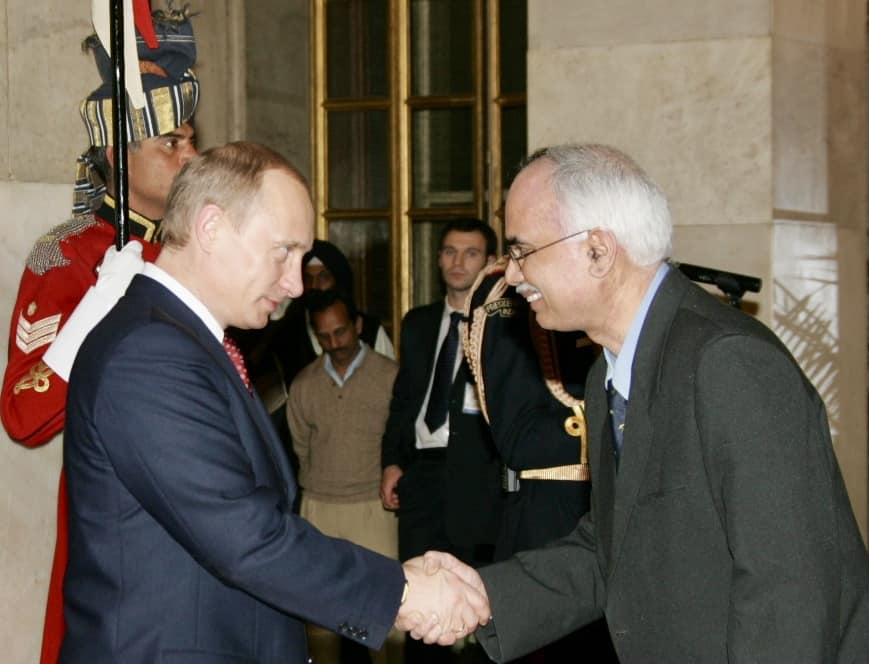
In December 2004, when President Vladimir Putin visited New Delhi, President Kalam invited me to the State Banquet that he had hosted in his honor. All the eighty members of President Putin’s entourage, including some 20 ladies, were all dressed in black. Dr Kalam introduced me to President Putin as a devotee of Russian literature. President Putin did not say a word to anyone but spoke from his eyes and I will never forget the pure love and kindness his expression conveyed. Later, when I met the President of Uzbekistan, Islam Karimov, in April 2005, I was astonished to see the well-built Uzbeks. President Karimov handled Islamic terrorism in his country with an iron hand and kept his country safe and progressing.
It is obvious that Russia has taken a different posture in the new Asian realities and that the historical Indo-Russian bonhomie has cooled off if it is not over. A perception was created by Russia that Western powers have adopted an aggressive and devious policy to engage India in anti-China games even while they are ignoring the aggression by China against India. Relations between Moscow and Beijing are at their best-ever level today, even better than they were in the 1950s when newly independent China made Russia its ideological soulmate, and Joseph Stalin and Mao Zedong signed a formal treaty of alliance in 1950.
The way the United States has left Afghanistan and the regime has changed overnight; Russia-China appears to be the new superpower of the world. For sure, Russia and China have teamed up for a robotic mission to an asteroid in 2024. They are coordinating a series of lunar missions intended to build a permanent research base on the south pole of the moon by 2030. The powerful tenures of Chinese President Xi Jinping and President Putin are looking as if they will extend much deeper into the 21st century.
India must recalibrate its position and this is not an easy task. Two roads diverge. In the coming few months, the great hope of India joining the expanded G-7 grouping would be validated by how the West decides to take the new regime in Afghanistan. Is it time to restore our alliance with Russia? Is this possible?
Tolstoy writes in ‘Anna Karenina’, “Respect was invented to cover the empty place where love should be.” It is time to find love and not be drowned in the deluge of hate. Love is a package deal. You can’t pick and choose and expect people to be as you’d like them to be. So, take a pause, and do that which is the best interests of our nation. Let leaders from all political parties sit together and decide where they want to see India in 2050.
It so happens that my nephew (brother’s son) married a Russian girl studying in the United States, and they have recently been blessed with twin daughters. Yesterday, when I was interacting with the family online, I realized that my buying Gorky’s book, ‘Mother’ in the mid-1970s was not some random event but an omen announcing the very distant future that has finally arrived now!
MORE FROM THE BLOG

Whose Truth and By what Facts do I Live?
Devotion merely a technique to quieten the Mind?
I visited Mr Radhakrishna Chandramouli, a long-standing friend and successful banker who spent two decades in Africa and is a devout Brahmin. My son Amol accompanied me. Now retired, Mr Chandramouli lives in his palatial house in upscale Banjara Hills in Hyderabad with his wife…

Living In the Shadows of Our Ancestors
Last fortnight was the Pitra Paksha, an annual 15-day period in Hindu tradition observed to honour and pay homage to ancestors. During this period, Hindus perform various rituals such as Tarpan (offering water), Shradh (ceremonial offerings of food), and other acts…


