Can Indian democracy solve real issues?

Can Indian democracy solve real issues?

Can Indian democracy solve real issues?

The elections are on; all news on television is breaking news, and social media is abuzz with forwarded messages. Indians celebrate elections as the festival of democracy. It has indeed become a carnival now – turncoat politicians, stale rhetoric, cliché slogans and debates about allegedly important issues which have surprisingly managed to survive seven decades of politics! I waited throughout the election campaign for good vision from some politicians, but all that was talked about were threats to national security, social inequality, loan waivers and anti-poverty payments to millions of people. No leader, I repeat, no leader, spoke about the serious threat of energy dependence to the future of the Indian economy. Poverty, social inequality and the biggest threat to national security all revolve around India’s dependence on oil imports and expensive diesel generators, and the resulting shortage of grid electricity to power small industries 24×7.

I watched the enthusiasm of young voters on Facebook with amusement. Do they really know how politics works, or how election donations are made? Major firms lobby their business interests through elected representatives. They do not post a ‘like’ on any Facebook pages, but buy ‘electoral bonds’ and place them well on pieces of their choice on the chessboard of Indian politics. They craft coalitions to decide which laws are to be blocked and which are to be passed. They do not voice their interests on Twitter or in chat rooms, but during meetings in five-star hotels and in their board rooms.  

The most opaque of all Indian businesses is the business of Energy. Who really owns Indian oil companies? Who decides the rates of petrol and diesel? Why are they still not covered under GST? Why is the law of getting 10% of your electricity from renewable sources not enforced? Why is shale gas not pursued as an energy source? Why are planned nuclear power projects not taking off? Who is blocking them? And why are Indian companies dragging their feet in the African energy market, instead of grabbing it with both hands? At the root of all these issues, is the single question – why are our politicians not raising these questions?

In 2012, American author and energy expert, Daniel Yergin (b. 1947) published a very thoughtful book, The Quest: Energy, Security, and the Remaking of the Modern World. Dr APJ Abdul Kalam mooted the idea of Energy Independence by 2030. We covered it in our book, Squaring the Circle (2013). Dr Kalam’s idea of Providing Urban Amenities in Rural Areas (PURA) spoke about providing energy to the village industry at the turn of the new millennium. The biggest reason for poverty in India is our energy poverty. The business of energy is, after all, a global business, affecting every single local business. We are paying close to USD 100 billion to buy petroleum every year. Our supplies from Iran are not in our control. China holds sway over most of the African oil market. We can’t afford the old-fashioned way of importing oil. We need to generate our own energy – solar, wind, nuclear, whatever. If India wants to be big, it has to be big in big things. And Energy is one of those big things.

The worst part of our democracy has been our inability to make big decisions and rally around them. Let the next Prime Minister of India show the authority to forge an integrated national energy system from the patchwork we have now. Let the next Prime Minister display the artistry to weave together the interests of the millions of poor Indians who face the real consequences of rising Energy costs and the havoc they play with their livelihoods. Let the next Prime minister cut through the legacies of big energy businesses, shut off all the pleading special interests, find a way through the great Indian bureaucratic maze, and create a top-down order of energy pricing, regulations and standards, above all not succumbing to the pressure of sponsored TV debates, fake news and corporate lobbying. Let the swearing in of the new government in May 2019 see the emergence of a Ministry of Energy Independence.

The Indian economy is indeed under the siege of oil imports. The nation can’t assert itself on the global stage without having energy independence. It is time that electoral politics gives space to developmental politics and some long-term strategic decisions are taken by the Parliament that go beyond which party is in power and which is in the opposition.   

MORE FROM THE BLOG

Lower Self, Higher Self

Lower Self, Higher Self

Life is an enigma. The randomness of events and the unpredictability of human nature make things complicated at times. Not only are people so very different from one another, even individuals change with time and their behavior with different people is tinged with many different shades…

Hinterland

Hinterland

When I accompanied Dr APJ Abdul Kalam to Patna in Bihar State in 1999, he was the Principal Scientific Advisor to the Government of India. The Technology Information Forecasting and Assessment Council (TIFAC), which Dr Kalam chaired, had initiated an agriculture project in Paliganj…
Look within, where all the answers lie

Look within, where all the answers lie

Tanya visited me on Diwali with her husband, Gopi Reddy. Fresh from a Vipassana retreat of ten days, she radiated joy – face lit with a smile and gait poised in serenity. I am familiar with this form of meditation, but I asked her to narrate her experience…

November 30, 2018

November 30, 2018

November 30, 2018

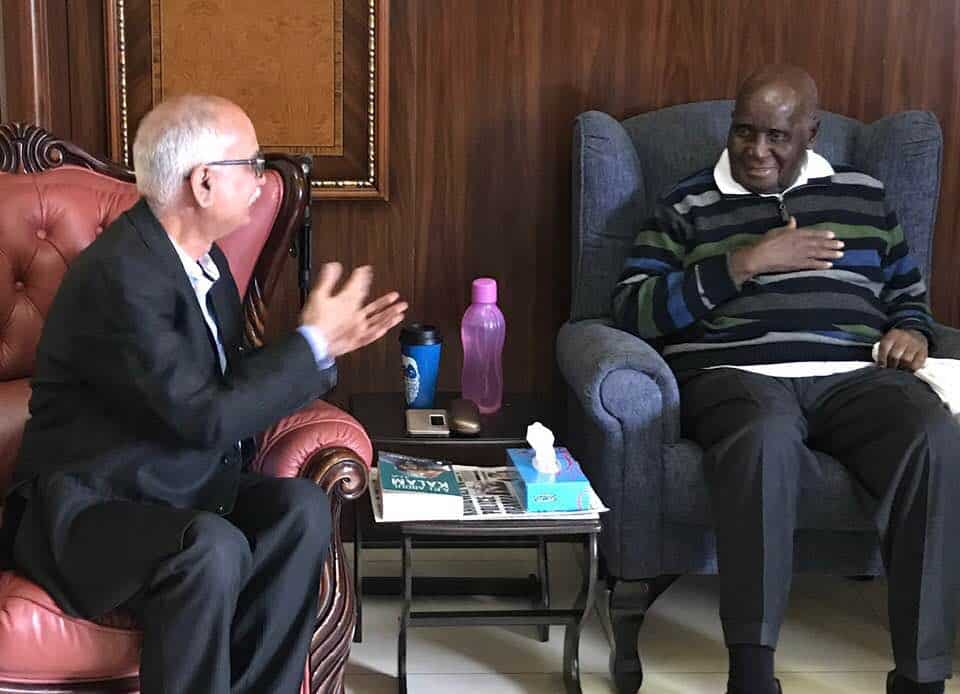
I visited the ‘father of the Zambian nation’ and ‘Gandhi of Africa,’ Dr. Kenneth Kaunda (b. 1924), at his home outside Lusaka. Born to a missionary teacher, Reverend David Kaunda, he started his career as a teacher before getting involved in the struggle for independence from British rule. Later, he founded the Zambian African National Congress, and eventually won independence for his country. In 1964, Dr. Kenneth Kaunda became the first President of independent Zambia and served as Head of the State till 1991.

Saddened by one of his children being claimed by HIV/AIDS in the 1980s, Dr. Kaunda did not hide it out of fear of shame or stigma, but courageously faced the reality of HIV/AIDS and zealously worked in the fight against the spread of the pandemic and considered an Indian contribution in developing low-cost antiretroviral drugs. Indian triple-therapy drug ‘cocktails’ for $350 a year keep HIV-infected patients alive for years. When we met, he got up from his chair and blessed me, reciting the Biblical Prayer, while holding his hand on my head, “For you bless the righteous, O Lord; you cover him with as with a shield.” My eyes welled up with tears and I sent a silent prayer to God to protect him too.

August 8, 2018

August 8, 2018

August 8, 2018

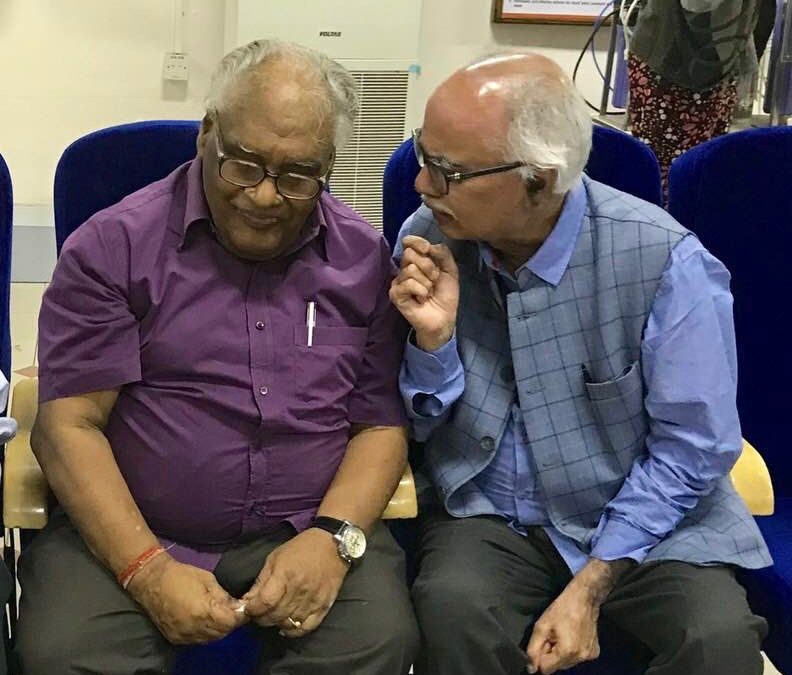
I met Prof. C.N.R. Rao (b. 1934) during the Platinum Jubilee celebrations of the Indian Institute of Chemical Technology, Hyderabad. Conferred with a Bharat Ratna, the highest civilian award in India, in 2013, Rao Sir serves as the Head of the Scientific Advisory Council to the Prime Minister of India.

One of the world’s foremost solid state and materials chemists, C.N.R. Sir laments the narrowing of vision among young scientists. He says, “Most of them work for ‘problems of their thesis, project or research grants”. Science does not move on that; this kind of work drags organisations and produces laggards.

The future is to synthesise photosynthesis and generate energy from the sun, as plants do. Fuels like hydrogen or ethanol could be produced ultimately via solar power, as in artificial photosynthesis, so we could continue using liquid fuels with less environmental damage. Let us create a “bionic leaf” that can convert solar energy into hydrogen!

November 23, 2017

November 23, 2017

November 23, 2017

Life unfolds itself through you. There is no rationale behind how I met diamond baron Govindbhai Dholakia, Chairman, Shree Ramkrishna Export (SRK), of Surat. It was 2012, and my friend Mani Iyer, who was trying to start a technology incubation fund, took me to him seeking investment. The fund never materialized but I became a buddy of Govindbhai in this process.

Govindbhai’s rags to riches story enchanted me and I found his practical philanthropy unbelievable. I shared this with Dr Kalam, who came to Surat and met Govindbhai. This meeting led to the creation of the SRK Knowledge Foundation and SRK-Kalam Healthcare project, which was India’s first population health study that covered 100,000 people in the Amreli district of Saurashtra, Gujarat, at their doorstep.

Govindbhai constituted the ‘Santokbaa Humanitarian Award’ in the memory of his mother. It was conferred upon luminaries every year since 2006, including Sam Pitroda (2006), Verghese Kurien (2008), MS Swaminathan (2011), Lord Bhikhu Parekh (2013) and Dalai Lama (2014), amongst others.

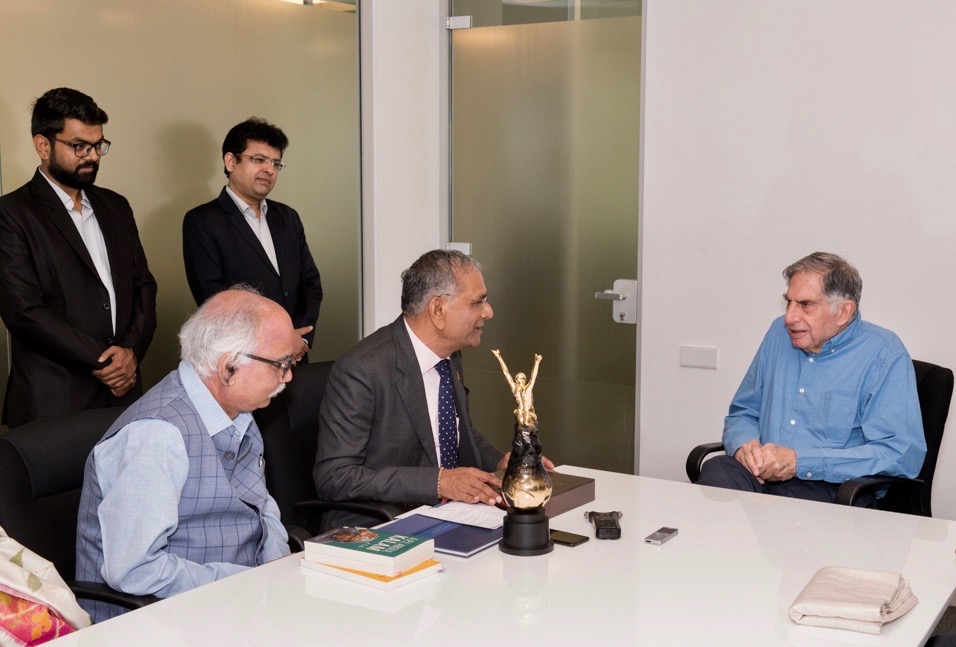
In 2016, the Award was conferred upon Ratan Tata. As he was unable to come to Surat at that time (he visited later), Govindbhai took me to Mumbai to personally give him the award (statuette seen on the table) and a cheque of Rupees 1 crore. For me, meeting Ratan Tata was like a dream come true. When I presented my book, ‘APJ Abdul Kalam: A Life’ to him, Ratan Tata said after a long pause, “After JRD, it was Dr Kalam who understood India correctly.”

November 21, 2016

November 21, 2016

November 21, 2016

Accompanied by my wife, Anjana, the young Kenyan-Indian, Dil Patel, and our Swiss host, Stefan Müller, I visited the Einsteinhaus (Einstein House), a former residence of Albert Einstein in Bern, Switzerland, which has been converted into a museum. Bearing No. 49, it is a small house built over a shop in a long shopping lane called Kramgasse (Grocers’ Alley) in the Old City of Bern, very much like Chandani Chowk in Delhi or Pathargatti in Hyderabad.

Einstein lived here with his wife Mileva from 1903 to 1905 and wrote the four articles that created the foundation of modern physics and changed views on space, time, mass and energy. He was only 26 then. Working for the Swiss Patent Office while pursuing his Ph.D, as he could not find a teaching post at the University of Zurich to support himself, Einstein could not have afforded a better place to live in. Einstein was fond of writing while standing, or perhaps, there was not much room for a table and chair. The stand in the picture is the one actually used by him.

Einstein was awarded the Nobel Prize for Physics in 1921, but history would soon intervene. The Nazis were on the rise in his native Germany, and Einstein, a Jew, was persecuted. More for his personal safety, Einstein moved to the United States in 1933, and worked at the Princeton University for the rest of his days. In 1999, the Time magazine named Albert Einstein the Person of the Century. Einstein famously said, “Few are those who see with their own eyes and feel with their own hearts. Imagination is more important than knowledge. Knowledge is limited. Imagination encircles the world.” Standing where Einstein once stood, I had goosebumps on my arms. Even today, the memory of it sends a thrill up my spine.