Books are precious in the sense that they capture the authors’ thoughts and retain them even after their lives, and in changed times. Those books that remain popular even after decades are called classics…
Hydrogen Romantics
Hydrogen Romantics

The lockdown period showed how much human activity has been polluting the environment. The air got cleared and rivers turned blue, something of a first time for the teenage generation. It was proved beyond doubt that with the fast pace of life, mankind, on a consumerism binge, is out to inflict injury upon itself. But as soon as life returned to normal, the pollution levels also returned, demonstrating an uncanny stubbornness.
But the good news is that the science and technology of sustainability are now mainstream and there is an understanding of the needs for water, clean air, food, mobility, and health besides energy which is intertwined with the environment. The return of hydrogen as fuel is one such development as the exhaust of hydrogen fuel is nothing but clean air and water.
I vividly remember Prof AK Dhol candidly telling us in the class, at GB Pant University where I studied, that mechanical engineers are typically involved with the generation, distribution, and use of energy. The rest of their activities like, the processing of materials; the control and automation of manufacturing systems; the design and development of machines; and the solutions to environmental problems have evolved from this core function of handling energy.
During my missile days at the DRDO, although I worked in making air bottles and airframes, I watched closely my propulsion colleagues who made rocket motors – the solid propellants, the liquid propulsion engines and finally, the amazing technology of Ram Rockets. I developed camaraderie with propulsion scientists Dr Ramprasad Ramakrishna (RR) Panyam and Dr B Subhash Chandran at the apogee of my engineering career while working on the Akash missile system.
I also watched from the periphery, the conceptual design of the hyperplane, a single-stage-to-orbit launch vehicle in the late 1980s led by Air Commodore R Gopalaswami. It was to be a hydrogen fueled, horizontal take-off, fully reusable single-stage hypersonic vehicle. The project never really took off for the want of budget. Cryogenic GSLV (Geosynchronous Satellite Launch Vehicle) rocket engines developed by ISRO (Indian Space Research Organization) use hydrogen.
At the Indian Institute of Chemical Technology (IICT), where Dr S Chandrasekhar, Director and J C Bose National Fellow, invited me to work as a Platinum Jubilee Mentor, I had the good fortune of meeting Prof CNR Rao, the third Bharat Ratna scientist after Dr CV Raman and Dr APJ Abdul Kalam and the “Hydrogen Man of India” as he is reverentially called.
I was fascinated by the process of synthesizing hydrogen fuel through the artificial photosynthesis process, on which Rao has been working at the Jawaharlal Nehru Centre for Advanced Scientific Research (JNCASR) in Bengaluru. Mankind can generate enough fuel from the atmospheric water vapour and sunlight to meet its transportation fuel requirements and industrial energy needs, he believes.
Prof CNR Rao has received the International Eni Award 2020, also called the Energy Frontier award, for research in renewable energy sources and energy storage. This award is considered to be the Nobel Prize in Energy Research. Italian President, Sergio Mattarella, gave him the award. Prof Rao laments, “Unfortunately, we in India have been used to working on problems that are somewhat repetitive. If we want to be at the cutting edge, we have to be innovators and originators.”
And then recently, I had an online meeting with Dan Bates who lives in Los Angeles and works in the Renewable Energy space. He discussed with me the idea of Aqua Hydrogen, which he placed between the blue hydrogen that is derived from fossil fuels and green hydrogen that is created by splitting water by electricity from a renewable source. He had the technology to create electricity from plastic waste and split water with it to get hydrogen. “Can we do a scale-up and ruggedization in India?” he asked.
I discussed this with Dr Chandrasekhar and his team at the IICT and they envisaged a completely “closed-loop” to create electricity by pyrolysis of plastic waste, use a part of it for electrolysis of water to generate hydrogen, and use it in a hydrogen cell. Hydrogen fuel cells combine hydrogen and oxygen.
Hydrogen cells are the fanciest item of our times. They have already revolutionized drones, which were significantly limited by the power and range provided by traditional batteries. Recently, Microsoft made headlines for running one of their data center’s servers on nothing but hydrogen for two days. Nine of the major auto manufacturers are developing hydrogen fuel cell electric vehicles (HFCEVs) for personal cars.
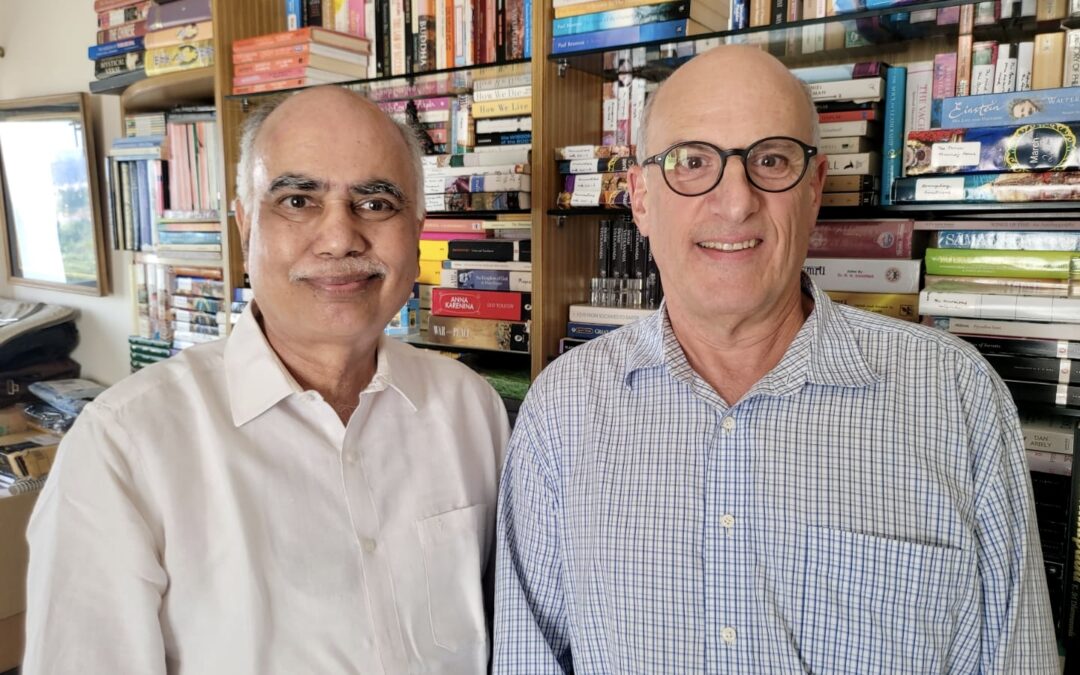
So, we nodded, and Dan Bates flew to India without wasting any time. Dan had suffered a brain stroke earlier this year, which affected his right side and yet he travelled alone from the other side of the planet. This speaks of his indomitable spirit. The enthusiasm his visit generated amongst us was palpable. We learnt from Dan Bates about #CleanSeas, a societal mission of The United Nations Environment Programme (UNEP), a global movement to tackle the excessive use of single-use plastics and get rid of dangerous microplastics in our toiletries and cosmetics.
Dan is CEO and President of Clean Vision Corporation, which is a holding company that acquires and operates sustainable clean technology and green energy businesses, and he would be starting with an investment of 100 million USD in setting up two integrated pyrolysis-electrolysis plants with plastic waste as feed and hydrogen fuel as output in India.
Going by the assertion of the Chief of India’s biggest energy company, Reliance, by 2030, India will be producing hydrogen at a dollar for a kilogram that will beat Rs 1000/- worth of petrol. But this technology does not come neat and packaged. It must be nurtured, refined and perfected. From now to Hydrogen Fuel Cells will be a journey of a few years but India will be at par with the best in the world.
May be not my generation, but the next ones would live in smog-free cities and see no plastics in their surroundings. I would be writing a book soon on the Hydrogen saga starting with a quote from British cosmologist and astrophysicist, Martin Rees, “All the atoms we are made of are forged from hydrogen in stars that died and exploded before our solar system formed. So, if you are romantic, you can say we are literally stardust. If you are less romantic, you can say we’re the nuclear waste from fuel that makes stars shine.” I believe, I am stardust!
MORE FROM THE BLOG

Unto this last

Aspects of Wealth
Much before Adam Smith wrote The Wealth of Nations in 1976 and Karl Marx wrote Das Capital, Kautilya – also identified as Vishnugupta and Chanakya – wrote अर्थशास्त्र, Science of Wealth, in around 300 BCE. Ancient India was a land of plenty…

Children of the Earth and the Sky
A The Indian diaspora has excelled in the modern world. Indian-origin engineers are heading three top technology companies of the world – Microsoft, Google, and IBM – and many more. There is hardly any company or university where Indians are not present…