Four Nos and Four Yeses

Four Nos and Four Yeses

Four Nos and Four Yeses

Had India and China been friends, the 21st century would already have been Asian. With peace within itself, being vastly more developed, and flourishing regional trade, what is not there on this planet that is not here? Food, energy, technology, market! The Asians, who comprise more than half of humanity, could have created a better world of abundance and peace. But Asia is full of conflicts, and the neighbouring countries are neither peaceful nor likely to become so soon.

For centuries, China had been a distant, enigmatic neighbour to India. However, this relationship changed dramatically in 1950 when China’s incursion into Tibet altered the regional dynamics. The situation escalated further in 1962 when the Chinese army penetrated deep into Indian territory, an event that continues to cast a long shadow over the relations between the two countries.

I visited China in October 2002. Dr Kalam had just become the President of India, and I was invited as co-author of his autobiography ‘Wings of Fire’, later translated into Chinese. I returned there in 2004 to explore if we could work out a medical exchange programme and visited the grand memorial of the Indian doctor Dwarakanath Shantaram Kotnis (1910-1942), who sacrificed his life treating Chinese revolutionaries in the 1930s as a volunteer. In 2006, Chinese President Hu Jintao came to India, and I had the honour of meeting him at Rashtrapati Bhavan. I can still feel the warm and firm grasp of his handshake.

President Jintao was a sagacious charmer. Everyone felt comfortable in his presence, and an impression was created that China and India could finally become friends and formidable powers. Dr Kalam especially liked President Jintao’s doctrine of ‘Four nos and four yeses’. The four nos were – no to hegemony, no to force, no to blocs and no to arms. The four yeses were – confidence building, reducing difficulties, developing cooperation and avoiding confrontation. India remained a cauldron of anxiety. Dr Kalam asked me, “Why can’t our leaders think and talk so straightforwardly? Why do we love rhetoric, long speeches and endless arguments?”

I made my fourth China visit in 2007, more or less a repeat of the 2004 visit, but this time in the company of cardiologist Dr B Soma Raju to explore if what was not possible at the government level could be achieved through private channels. The Chinese translation of my second book with Dr Kalam, ‘Guiding Souls’, was released during this visit. Our mission failed. I made three more visits to China in 2010 and twice in 2011 to explore Chinese medical equipment, replacing European and US brands in India to lower costs, but I realised in the end that it would never happen.

In 2012, President Xi Jinping succeeded Hu Jintao. When Narendra Modi became Prime Minister, he came to India and sat with him on a swing on the Sabarmati Riverfront in Ahmedabad. Chinese investment in India steadily rose, and then COVID-19 happened. While the Western world accused China of spreading the pandemic, India maintained a cautious silence. But in June 2020, Chinese troops clandestinely entered Indian territory. Indian soldiers dispelled them in a face-off that had many casualties on both sides. Tensions continued through 2021 and until the end of 2022.

During the closing ceremony of China’s 20th Party Congress at the Great Hall of the People in Beijing on October 22, 2022, which marked a violation of the tradition of a Chinese President serving a maximum term of 10 years, seated to President Xi’s left, his predecessor Hu Jintao, now 79 years old, chose the moment to disagree with his successor concentrating power by breaking tradition. In full public view, Mr Jintao was hustled from his chair and led out of the hall.

So, where will ‘Xi Jinping Forever China’ go from here? Is India forever locked in an impasse with its hostile neighbours, and will a peaceful Asia never become the new centre of the world? Righty called the Amrit Kaal, in the period from now to 2047, when India would complete a century of independence, how can India accomplish its peaceful ascent in the world? Would it adjust and accommodate the rise of China? Or contain China by joining hands with Japan, Australia and the United States? American poet Robert Frost (1874-1963), became immortal for his poem, The Road Not Taken:

Two roads diverged in a yellow wood,

And sorry I could not travel both

And be one traveler, long I stood

And looked down one as far as I could

To where it bent in the undergrowth.

What could be the ‘Four nos and four yeses’ for India? I hardly have the competence to handle such matters, so I discussed it with my knowledgeable friends and imagined what Dr Kalam would have answered. Interestingly, I found the answer not in innovation but in tradition. Our ancients laid out our ‘Four nos and four yeses’ for whoever was willing to follow them

Our ancient literature is full of guidance. For example, the Shrimad Bhagavad Gita perscribed temperance in both eating and conduct (युक्ताहारविहारस्य युक्तचेष्टस्य कर्मसु, 6.17) acquring skills in work (योग: कर्मसु कौशलम्, 2.50), and enterprise that is good for all (लोकसंग्रहमेवापि संपश्यन्कर्तुमर्हसि, 3.20). So, without any ‘ifs and buts’, our ‘Four nos’ can be: no to consumeristic lifestyles and living by temperance instead; no to the loss of jobs by automation by encouraging local industries; no to the corporate takeover of public utilities and revamping cooperatives; and no to all such consumer goods that are not manufactured indigenously.

Our ancients gave us a universal vision. Sayings like, the world is a large family (वसुधैव कुटुम्बकम्), let all be free from diseases (सर्वे सन्तु निरामयाः), an uneducated human being is no better than an animal (येषां विद्या . . . मनुष्यरूपेण मृगाश्चरन्ति), and protection of people’s property and provision to the ‘have nots’ are declared as the duty of the government (योगक्षेमं वहाम्यहम्) are popularly used as mottos by our organisations and businesses. Why can they not be followed also? This makes our ‘Four yeses’, global positioning, a sound public health system, education to create human resources for the world economy, and robust security and defence systems.

The commercialisation of education is the biggest tragedy in modern India. I say so because its effects are far-reaching and long-lasting. When inadequately and improperly educated children grow up and occupy positions, their poor performance produces immense misery for everyone, and economic loss and danger to the nation’s sovereignty. The entire future gets compromised. In the 8th century, Narayana, in his collection of short stories, Hitopadesha, defined education subtly but most aptly.

विद्यां ददाति विनयं विनयाद् याति पात्रताम्।

पात्रत्वात् धनमाप्नोति धनात् धर्म ततः सुखम्॥

Education creates humility, and from humility, one attains deservingness. From deservingness, one obtains wealth; from wealth comes righteousness, and from that, happiness.

Is it complicated? Can’t we understand it? The interests of a billion-and-a-half people can’t be hijacked to fight egoistic battles and serve vested interests, which, unfortunately, our political leaders are cherishing. There is hardly any consensus on anything. How can it be?

The Indian civilisation is among the oldest in the world, though I consider it original and eternal. It has survived all sorts of assaults, implosions, degradation and degeneration. This means that the Indian civilisation will not end by whoever and whatever. Having survived and outlived most other civilisations, it will overcome even the current logjam and only flourish.

AI will sweep away the petty games of deception and falsehood. Those who prepare themselves to embrace the new world will flourish; those who ignore or oppose will wither away. Please ponder upon the four yeses and four nos in your life and work; the nation will take care of itself. Dr Kalam was fond of reciting an analect of the ancient Chinese philosopher Confucius in his lectures:

If there is righteousness in the heart,

there will be beauty in the character.

If there is beauty in the character,

there will be harmony in the home.

If there is harmony in the home,

there will be order in the nation.

If there will be order in the nation,

there will be peace in the world.

Have peace in your heart and mind, and create order within your four walls. The rest will be taken care of.

MORE FROM THE BLOG

The Fabric of the Universe 

The Fabric of the Universe 

Nestled in a family and career, it may appear a little unsettling to consider oneself part of a cosmos, primarily unknown. But when this realisation dawns that not only one but everyone else around, and indeed everything, are a mere part of a larger drama that is rolling out…

Eternal, Ephemeral and I

Eternal, Ephemeral and I

I have always believed in the mystery surrounding this world. As a child, I believed in mythological stories, the stories in my textbooks, and the ones I heard on the radio (Television was not avaiable in homes until the 1970s). Then, when I entered the realm of books, I related to the stories there. Only after enrolling in GB Pant University and living surrounded by scientific institutions did rationality dawn on my consciousness…

Is Life a Game?

Is Life a Game?

Two people played a crucial role in my professional life—Dr APJ Abdul Kalam, under whom I worked first from 1982 at the Defence Research and Development Organization (DRDO) and later as his pupil till he departed in 2015, and Dr B Soma Raju, Cardiologist…

Our Success Must Not Fail

Our Success Must Not Fail

Our Success Must Not Fail

Who does not like success? Human beings are driven to succeed from early childhood. Parents celebrate when their toddler learns to stand up, speak its first words and go to school. Then, in school, from studies to sports, children compete, and by the time they become adolescents, their personalities are formed around it. They are winners or losers in the early games of life. The bright ones attend professional schools, while the rest join local colleges where they study science, commerce, or arts with few plans or prospects.

The Civil Services Exam has become a fixation with some bright students. More than a million take the nationwide preliminary exams. Some 10,000 to 20,000 clear it and join the fray for 1000 positions. Another few thousand get into the police and forest service through this exam. The film, ‘12th Fail’, brings out this saga, which repeats itself yearly, in an engaging manner. Despite the daunting odds, the candidates show remarkable perseverance, making multiple attempts to secure a position. A candidate can make six attempts till 32 years of age. For socially disadvantaged people, the age is 37. In a new trend that started a decade ago, engineering and medical graduates are also competing for civil service and coming out winners. About 2/3rd of the candidates selected are from among them, a testament to their unwavering determination that should inspire us all.

However, I am not talking about those who succeed but those who fail. How do they fare in their lives? What do the millions of youth without the label of a doctor or an engineer do? Many of them are yet to graduate. Which livelihoods do they seek, and what does the system offer them? Government jobs have lost their lustre long ago, and most youth depend on private jobs. Is the Indian economy able to generate enough jobs for its extensive and expanding young population? This failure of the system to create livelihoods gives an individual who failed in early life a double whammy. So, when we celebrate economic growth – the GDP rising, the SENSEX climbing, India poised to become the world’s third-biggest economy at 5 trillion dollars where and of what type are the livelihoods for the multitudes? Is this a jobless growth built on cuts-commissions-profits? We must shift our focus to a more inclusive and sustainable economic growth model that ensures opportunities for all.

My generation was taught in school that India is an agricultural economy. Despite the hype and hoopla of the IT revolution, agriculture remains the backbone of India’s economy, even though its GDP share is decreasing. In rural areas, six of 10 people are peasants. The last census held in 2011 found 120 million farmers in the country, a quarter of the halfabillion working Indians. There are also equal or more people raising livestock, fishery, forestry and agricultural supply chains. India is making enough food to feed its people for a long time. Getting economic power into the hands of the vast rural poor is now the problem, not making sure there is enough food. The challenge is how millions of people stuck with their small holdings can get more gainful vocations. Their holdings can be consolidated into more extensive ones to create more productive farms,replicating the Milk Revolution.

There is a sordid paradox. On the one hand, the government machinery controls food prices to satisfy the urban population, who eventually elect the ruling class. If a farmer has to buy a motorcycle, he pays globally comparative prices; why should he make food available to the modern and industrial sectors at the world’s lowest prices? On the other hand, global commodity trading firms have taken control of the cost of agricultural produce. While enough wheat and rice is produced, India has a steady supply deficit in pulses of a million metric tons annually. Edible oils also fall short of the demand. This shortage is bridged by imports. Why are Indian farmers not encouraged and supported to grow pulses and oilseeds in a mission mode, banning all imports? Who imports? How much and at what price? At whose behest?

Education and healthcare come next after food. The Indian education system can’t be called a failure because we started with very little. However, things appear out of control. A heavy emphasis on rote memorisation and test-taking, rather than critical thinking and problem-solving skills, has created a real mess out of which no solution seems to emerge. The coaching centre industry rules the roost, and everyone seems to live in denial mode.

The Indian education system has often failed to impart practical skills. No wonder a recent concern is the need for skill improvement among plumbers, carpenters, electricians, engineers and, most dangerously, hospital staff. It is claimed that the Skill India Mission has taught 14 million people, including 5.4 million who have learnt new skills or improved their old ones. But more is needed. The urgency for more practical skills is evident, and it’s a gap that needs to be filled immediately to ensure the future success of our workforce.

I am not a cynic who rules out foreign investors and commodity trading businesses. We can’t live isolated from the world. But we can’t allow the world to enter our homes, too. Companies are now structured differently; the ownership is more complicated and is constantly changing. India’s future can’t be left to this financial system where we don’t know who owns what. The masses can’t be simplified down to biological machines that only eat and work because they need more to meet their needs than what they get. It is humane to aspire. Life’s success is not merely about surviving but flourishingand evolving into a better future.

The failure of success is the biggest tragedy of any human enterprise, much more terrifying than the failure to succeed. Let us not allow the Indian success of independence, democracy and food sufficiency to become a failure. Kalidas declared long ago:

पुराणमित्येव न साधु सर्वं, नवीनमित्येव न चाप्यवद्यम् सन्तः परीक्ष्यान्यतरद् भजन्ते मूढः परप्रत्ययेनबुद्धिः (मालविकाग्निमित्रम् 1. 2)

All new is not necessarily good, and all that is old becomes wrong. Whether ancient or modern, humanity must test what is good and what is not as humanity progresses.

India has ruled over the world by Niti – a profound word whose exact equivalent is absent in other languages, but the nearest best is ‘Value orientation. Learn to value things: your work, your time, the people around you, how they feel, and above all, yourself. To be born as a human being is a blessing; to be helpful to others is a double blessing. Living for selfish gains is not the way. One must live by the Niti of happiness of all (सर्वे भवन्तु सुखिन:), and that will make all the difference.

MORE FROM THE BLOG

The Fabric of the Universe 
The Fabric of the Universe 

Nestled in a family and career, it may appear a little unsettling to consider oneself part of a cosmos, primarily unknown. But when this realisation dawns that not only one but everyone else around, and indeed everything, are a mere part of a larger drama that is rolling out…

Eternal, Ephemeral and I

Eternal, Ephemeral and I

I have always believed in the mystery surrounding this world. As a child, I believed in mythological stories, the stories in my textbooks, and the ones I heard on the radio (Television was not avaiable in homes until the 1970s). Then, when I entered the realm of books, I related to the stories there. Only after enrolling in GB Pant University and living surrounded by scientific institutions did rationality dawn on my consciousness…
Is Life a Game?

Is Life a Game?

Two people played a crucial role in my professional life—Dr APJ Abdul Kalam, under whom I worked first from 1982 at the Defence Research and Development Organization (DRDO) and later as his pupil till he departed in 2015, and Dr B Soma Raju, Cardiologist…

Altermodern

Altermodern

Altermodern

Over the past several months, I have been deeply immersed in the profound trilogy penned by esteemed philosophers Michael Hardt (b. 1960) and Antonio Negri (19332023)about how the modern world works and is likely to change. Their seminal works – Empire, Multitude, and Commonwealth, published respectively in 2000, 2004 and 2009 are treasure troves of profound thinking. My journey to these books was paved by the influential works of French authors Gilles Deleuze (19251995) and Félix Guattari (19301992), Anti-Oedipus and A Thousand Plateaus, published respectively in 1972 and 1980. Like a vast, invisible network, books allow anyone to enter and navigate the ocean of knowledge according to their taste and temperament.

As a child in the 1960s, I witnessed the transformative power of modernity. Growing hair beyond a bi-monthly visit to a barber shop was considered rebellious. Then, film heroes started appearing with long hair, and parents stopped hassling.Elvis Presley, the Beatles, and the hippies introduced a countercultural movement in the West. Wearing jeans arrived next, more as a culture than merely a dress – not to be washedbut worn as long as one wished, whatever the occasion or place. Shoes gave way to sneakers – no boot polish was required. Fountain pens vanished in the era of disposables. By the time the new Millennium arrived, the world had changedconsiderably.

Through the trilogy’s final volume by Hardt and Negri –Commonwealth I learned modernity as individualism, capitalism, urbanisation and a belief in the possibilities of technical and political progress that have all grown over time.Antimodernism is all that opposes these trends. Post-modernism is against all organisations and traditions. The authors describe these concepts as the root of a perpetual conflict. Understanding these concepts is crucial for anyone interested in social and cultural change.

Antimodernity . . . is not an effort to preserve the premodern or unmodern from the expanding forces of modernity but rather a struggle for freedom within the power relation of modernity. . .  it does not simply come after the exertion of modern power as a reaction . . . a diagonal line that escapes the confining play of opposites . . . and shifts the emphasis from resistance to alternative . . . not by opposition but by rupture and transformation. (p. 101-104)

Change is a natural phenomenon. Whatever situation or condition one is in, change is inevitable, and people have no option but to accept it. The acceptance could be a response or a reaction. Reacting is an emotional response that comes from our gut. It happens quickly and can be affected by things wehave been through or our feelings. Responding, on the other hand, is something that you do after giving it some thought.Most of the time, we all react instead of respond because responses demand effort. However, responding is always better because it helps us make better decisions and helps us benefit from our actions.

 The new money that entered Indian society in the 1990s, mainly through the IT industry, led to the dismantling of joint families. This was inevitable because the extra income creatednew desires, habits and the acquisition of status symbols promoted by global machines. Young couples liberated themselves, moving out to live as nuclear families. Butnothing exists without consequences, and there are always collaterals. So the children of these families were raised in creches and grew up with babysitters more than their own families. Without continuous mediation by other family members, spouse antagonism became a new trend.

 At the societal level, the new wealth created gated communities, shopping malls, expressways, multiplex theatres and various other ways where ‘wealthy people could ‘enjoy’ life without ‘crowds’ bothering them. But how could the poor be wished away? Maids are required in houses; drivers are required; help is needed for ironing clothes and in the form of milkmen, watchmen, delivery boys, and so on. All these people, though poor, know they are not indispensable. They are also well-informed about the Internet on their smartphones. Hardt and Negri call these internet-connected new poor the ‘multitude’.

The ‘new poor’ know their rights. They are antagonised by the income inequality in society. And they know that politiciansneed them for their votes. Thousands of YouTubers-turned-revolutionaries are igniting their minds, stoking their fears and fanning their aspirations. The challenge is how to engage the multitude in building a better society rather than keep onresisting it, keeping them at arm’s length, creating more bubbles and feeling safe living within them, which will end up in futility sooner rather than later.

According to Hardt and Negri, modernity began with the European colonisation of America, Africa and Asia. It was created by capitalism, industrialism, and military power but was dressed up as democracy with liberty, and equality. No wonder in the modern world that was made, there is no real democracy, liberty is very restrictive, and inequality is ubiquitous. There is an equilibrium that may be latent and below the critical mass, but a change is inevitable. This change will not be achieved through tokenism, such as more representation, social inclusion, or doles, but by the participation of the poor in economic activity.

The capitalist totality is not, as it seemed to many, the point of arrival or end of history where all antagonisms can be absorbed, but rather the limit on which resistances proliferatethroughout the sphere of production and all the realms of social life. . . the intellectual is charged with the task not only to denounce error and unmask illusions, and not only to incarnate the mechanisms of new practices of knowledge but also . . . to produce a new truth.. . rather than descending from above, this truth is constructed from below. (p. 118 -121)

There are no easy answers because the powers that rule the modern world seem answerable to none. They have already acquired control over the world’s affairs through technology and wealth. Even governments have become mediators between global corporations and their people. It is futile to fight modernity. Instead, one must adopt it to alter it for the better.

Hardt and Negri call for an alter-modernity. The multitude must participate in creating a new society and a more equitable economy. People must earn their daily bread truthfully and not through lies and thuggery, however sophisticated. Artificial Intelligence has already arrived, destroying the barriers to knowledge and pulling down veils hiding lies. Soon, technologies like blockchain will make fraud impossible. Calls and texts will turn into living testimonies against every wrongdoing. Being good will no longer be an option but an obligation.

 As said in the Commonwealth, We have to stop focusing on the haystack and find the needle. The purpose of life cannot be selfish, as life is forever interdependent. I am what I am because people have always been around me making me – my school teachers, neighbours, community, and colleagues. What do I do for the faceless others – farmers, workers, helpers, vendors before my part ends in the drama of the world and I must bow out of the stage?

Alter-modernity hinges on finding an alternative to the futility of human life by leaving behind a little surplus good, however small it may be. Alter the world for the better by taking individual action – however small it may be or how little it appears. As American tennis champion Arthur Ashe (1943-1993) said, “Start where you are. Use what you have. Do what you can.” Don’t give up, and never get carried away.

MORE FROM THE BLOG

The Fabric of the Universe 

The Fabric of the Universe 

Nestled in a family and career, it may appear a little unsettling to consider oneself part of a cosmos, primarily unknown. But when this realisation dawns that not only one but everyone else around, and indeed everything, are a mere part of a larger drama that is rolling out…

Eternal, Ephemeral and I

Eternal, Ephemeral and I

I have always believed in the mystery surrounding this world. As a child, I believed in mythological stories, the stories in my textbooks, and the ones I heard on the radio (Television was not avaiable in homes until the 1970s). Then, when I entered the realm of books, I related to the stories there. Only after enrolling in GB Pant University and living surrounded by scientific institutions did rationality dawn on my consciousness…

Is Life a Game?

Is Life a Game?

Two people played a crucial role in my professional life—Dr APJ Abdul Kalam, under whom I worked first from 1982 at the Defence Research and Development Organization (DRDO) and later as his pupil till he departed in 2015, and Dr B Soma Raju, Cardiologist…
Just Another Gear in the Desire Machine

Just Another Gear in the Desire Machine

Just Another Gear in the Desire Machine

In the winter of 1989, I visited Pune for the first time. I worked in the Defence Research & Development Laboratory, Hyderabad, as Project Manager for Airframe and System Integration in the Akash missile project. I was sent to interact with engineers at the Research & Development Establishment (Engineers) in Dighi, in the northern suburbs of Pune. I spent a few days there, and one evening, walking through the crowded Budhwar Peth, I bought a book, Self and Others, by R.D. Laing. I had no idea about the book or the author. The title and the three overlapping circles on the cover attracted me, and I bought it. A Scottish psychiatrist, Laing,died that very year, which I would later know.  

This book gave me insights into how we are all created by the people around us. As a child grows, he is ‘told’ how to behave. Interestingly, this does not happen smoothly. The child ‘reacts’, and the people around respond differently to these reactions. Some children are cajoled and pampered, and others are scolded and punished. Many others are just ignored. By the time one becomes an adult, a thousand swings have happened from the one extreme I never asked to be born, leave me in peace to I am all that exists, get out of my waysettling mainly on the middle ground of live and let live.

Later, I learned that German-American psychologist Karen Horney was the first to define the three-fold attitudes of human beings – moving toward, away from, and against others. Within this, three forces are hidden in various human behaviours and relationships, including parents and children,interactions between married couples, at the workplace, and even on the streets. Everyone is attracted to, averse to and hostile towards another individual. It is alright until these three responses are spontaneous and change according to the situation. Still, when they become conditioned into habits, the behaviours become problematic, which psychologists call neuroticism.

I have seen how TV changed lives in the 1980s. The definition of others expanded to include those we saw on TV. People were exposed to ideas, styles and fashions, which was earlier impossible. Then, the Internet came into the picture, and after it became available on mobile phones, social media created a new definition of society. In the past, contact was one-on-one primarily or one-to-many, and news spread through traditional media like TV and newspapers.Now, anyone worldwide can share their ideas and experiences in realtime and get feedback immediately. Thoughtful people could see how a few corporations made it happen, investing billions of dollars. But why have they provided us with all this?

 There are two books, Anti-Oedipus and A Thousand Plateaus. Written by French authors Gilles Deleuze and Félix Guattari and published respectively in 1972 and 1980, both books have a similar subtitle: Capitalism and Schizophrenia, which provides the answer. The flow of capital and interest and the flow of desire are entwined. Behind every investment of time, interest and capital is an investment of desire, and vice versa. Why do we purchase anything? Out of necessity or out of desire? Is there an invisible hand circulating money by making people earn and spend and creating profits for the capitalists in every act of their lives?

The three terms necessity, desire and wants, motivatepeople. Wise people know the difference between them; fools do not. Necessities are the essential requirements for survival and basic well-being. Everybody needs food, water, shelter and clothing. All must have protection from harm, a stable environment and health care. Some level of social interaction and support is necessary for mental health. Universal necessities are generally the same for everyone. Without these, survival and basic functioning are at risk. They are fundamental for life.

Desires are feelings of wanting something not necessary for basic survival but which is strongly yearned for. They are emotions, and they vary significantly among individuals. Desires drive people to set and pursue personal or professional goals and are a powerful motivating force for action and achievement. Wants are whimsical. They are primarily non-essential items or experiences that add comfort, pleasure or pride but are never necessary. People spend a lot on beverages, entertainment, cosmetics, jewellery, fashionable footwear and clothing, and touring for fun. Everyone must know how to distinguish what is crucial for survival from what is motivated by personal preferences and aspirations.This was called Viveka by ancient Indians, and Adi Shakaracharya wrote the copious Vivekachudamani’ on this subject.

The American philosophical writer and translator of Anti-Oedipus and A Thousand Plateaus, Mark Seem, writes in the introduction of Anti-Oedipus:

If one wants to do an analysis of the flows of money and capital that circulate in society, nothing is more useful than Marx and the Marxist theory of money. But if one wishes also to analyze the flows of desire, the fears and the anxieties, the loves and the despairs that traverse the social field as intensive notes from the underground . . . one must look elsewhere. . . the history of mankind is the history of a becoming-reactive.

I was surprised when I dived deep into these two books andfound the ego at the centre of this game of capitalism in the modern world. The Internet and broadband have been invested to stoke billions of people’s desires so that they buy what is unnecessary. In the name of fashion and trends, people must discard what they already have and hoard enough clothes, shoes and watches for the rest of their lives.

We are taught to see only ourselves behind every social event. Even God is waiting for us, listening to our prayers and pleas and doing us favours. This information gives us a picture of reality, but it doesn’t show us reality itself. We are presented with shapes, symbols and signs that hide flows and forces. They keep us from seeing other truths, especially the truth about how power controls us. They are meant to tame, and they make people obedient and docile.

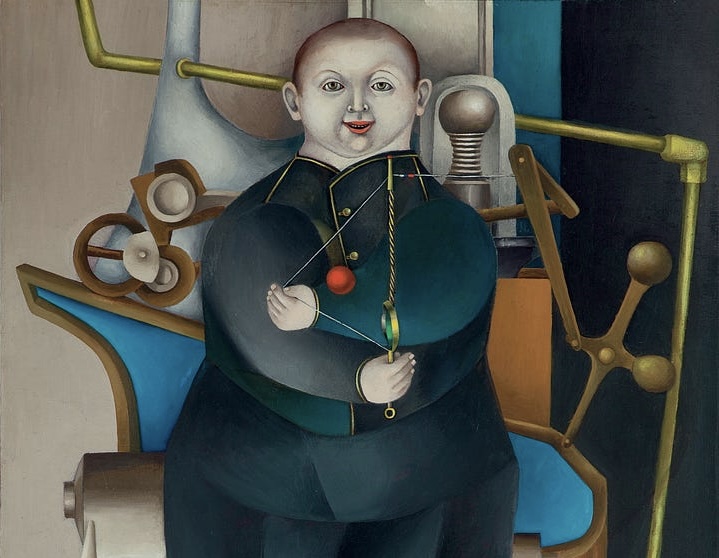
Things seem to be going well so far. Now comes the challenging part. While all this is good for leaders and corporations, it creates internal suffering and a depressive tone of life for countless people. An increasing number of people are neuroticised at home, at school and work. Those who survive the conversion become psychotic. These people escape their situations and run away, hiding their failure behind their false heroism. They turn into orphans no family, atheists, and nomads without territories. German-American painter Richard Lindner drew the ‘Boy with Machine’ picture in 1954. So he saw it coming, so it came. 

This is the disease of our times, and humanity suffers from it. To improve, we must live by doing what is necessary rather than becoming desire machines and Excel sheet numbers of corporations and in the mailing list of interest groups. By connecting to the machine of the universe – inside your body and outside in the sky you live better in the flow of life, not by the media. You can’t change the world, but you can save yourself for good by floating on water like a lotus. The life inside you will show itself in growth, a never-ending process. Life clasps ego-less people in its powerfully productive embrace – and their desire-free work – Nishkam Karma – turns them into greats.

MORE FROM THE BLOG

The Fabric of the Universe 

The Fabric of the Universe 

Nestled in a family and career, it may appear a little unsettling to consider oneself part of a cosmos, primarily unknown. But when this realisation dawns that not only one but everyone else around, and indeed everything, are a mere part of a larger drama that is rolling out…

Eternal, Ephemeral and I

Eternal, Ephemeral and I

I have always believed in the mystery surrounding this world. As a child, I believed in mythological stories, the stories in my textbooks, and the ones I heard on the radio (Television was not avaiable in homes until the 1970s). Then, when I entered the realm of books, I related to the stories there. Only after enrolling in GB Pant University and living surrounded by scientific institutions did rationality dawn on my consciousness…

Is Life a Game?

Is Life a Game?

Two people played a crucial role in my professional life—Dr APJ Abdul Kalam, under whom I worked first from 1982 at the Defence Research and Development Organization (DRDO) and later as his pupil till he departed in 2015, and Dr B Soma Raju, Cardiologist…

A Life of Service is a Life Lived Well

A Life of Service is a Life Lived Well

A Life of Service is a Life Lived Well

Life is a journey, and like in other journeys, we encounter numerous co-travellers — family, friends, mentors, colleagues, and even strangers — who share parts of the path with us. Each co-traveller brings unique experiences, perspectives, and support, enriching our journey in various ways. Some play a distinct role, and the relationships we build with them add depth and meaning to our lives. They help us learn, grow, and evolve, enriching and fulfilling our journey. Embracing these connections and cherishing the moments shared with each co-traveller can transform our journey into a more meaningful and enjoyable experience.

My first encounter with Venkat Changavalli was a memorable one. In 2007, during a visit to Orissa, he and Mr Ramalinga Raju, Chairman of Satyam Computers, planned to launch a nationwide Emergency Response system starting with the United Andhra Pradesh. They had invited Dr APJ Abdul Kalam to be its Chairman after he completed his Presidential term. Changavalli, a man of action, took over as the CEO of the new organisation, EMRI (Emergency Management and Research Institute), and transformed it into the iconic ‘108 Ambulance Service’. The name “108” came from invoking cosmic energy and divine connection. I had the privilege of accompanying Dr Kalam and Changavalli on their visit to Stanford University. We also visited Cisco and had the first telepresence meeting with Cisco’s office in Bengaluru, with John Chambers, CEO of Cisco, by our side.

Later, Changavalli was invited by the Government of Uttar Pradesh to set up a Police Emergency Response System with a budget of Rs. 2200 Cr. Changavalli took me to meet Chief Minister Akhilesh Yadav, who called him the best Advisor ever to work with him. My son Aseem became Changavalli’s neighbour in Hill County in Hyderabad for a few years, and we met there a few times. I visited his home and took the blessings of his mother. Changavalli now works as CEO of the Insurance Information Bureau of India, and he recently visited me to present a book, BL2BM: Benchless to Benchmark, about his distinguished career, which is indeed the uncommon journey of an ordinary man.   

Changavalli’s journey began in September 1953 in a Brahmin family in a quaint village, Audipudi, in Bapatla District, coastal Andhra Pradesh. His academic pursuits led him to Andhra Loyola College in Vijayawada, where he laid the foundation for his future in chemical engineering. He further honed his skills at the Regional Engineering College, Warangal, now known as the National Institute of Technology (NIT). Then, he was selected for the prestigious Indian Institute of Management, Ahmedabad, in 1975. His career began with Lupin and turned significantly in 1982 when he joined CIBA-GEIGY, a merged entity of Swiss giants in India, which would later become Novartis.

In 1994, Changavalli joined Dragoco India, which would later become Symrise, after a brief stint at Roffe Construction Chemicals. As CEO of Symrise, Changavalli expanded his work experience by visiting the Dragoco facilities in Singapore, Jakarta, Sydney, Holzminden, New Jersey, and Shanghai. He had attended executive courses at Harvard, Wharton, Columbia, LBS, and IMD and was even featured in the TIME magazine. So, with this experience and expertise, Changavalli crafted the ‘108’ system. Post EMRI, Changavalli served as an advisor to six state governments. After Uttar Pradesh, he went to Haryana, Meghalaya, Assam, Andhra Pradesh and Telangana.

Where is new India heading to? I asked Changalii, a veteran of both the private and public sectors, this question. Like a good teacher, he explained that India’s trajectory encompasses broad economic, geopolitical, and social dimensions. Undoubtedly, India is on the path of robust economic growth. It is projected to become the third-largest economy in the world by the mid-21st century, driven by a large and young population, increasing urbanisation, and a burgeoning middle class. Key sectors such as technology, manufacturing, and services are expanding rapidly, supported by government initiatives like ‘Make in India’ and ‘Digital India’.

India is becoming a global hub for technology and innovation. The country is home to a thriving startup ecosystem and significant advancements in information technology, pharmaceuticals, and space technology. Initiatives like the National AI Strategy and increased investment in research and development are propelling India towards becoming a leader in the global tech landscape.

Rising and increasingly assertive, India is an active member of international organisations like the United Nations, G20, and BRICS, strengthening ties with major powers like the United States, the European Union, and Japan. India’s strategic positioning and its role in regional groupings like the Quad (with the US, Japan, and Australia) reflect its growing geopolitical clout. And yet, as the country with the largest population in the world, it is a work in progress, navigating significant changes and challenges.

Efforts to address issues like poverty, education, healthcare, and gender equality are ongoing. While progress has been made, particularly in reducing poverty and improving access to education and healthcare, disparities and social tensions persist. Government policies and grassroots movements continue to push for social reforms and inclusive growth. Rapid urbanisation is transforming India’s cities. Significant investments are being made in infrastructure development, including smart cities, transportation networks, and urban planning. These developments aim to improve living standards, boost economic productivity, and make cities more resilient and sustainable.

Changavalli calls for investment in education and skill development to harness India’s demographic dividend. Initiatives like the New Education Policy 2020, aimed at revamping the education system, promoting research and innovation, and equipping the workforce with skills required for the 21st century, are a silver lining. Political stability and policy reforms to boost economic growth and improve governance are equally essential to shaping the country’s future.

Changavalli sees the most significant challenge in New India as balancing economic growth with social and environmental sustainability. While technology presents growth opportunities, it poses challenges, such as job displacement due to automation and the need for cybersecurity. Preparing the workforce for technological changes and ensuring data privacy and security are essential. Addressing this requires comprehensive and coordinated efforts across multiple sectors, including economic policies that promote inclusive growth, social reforms to reduce inequalities, and environmental regulations that ensure sustainable development.

So, what motivates Changavalli to come to work in his seventies? He looks back at his humble beginning in poverty and says that though he has been lucky to emerge from it, a billion people in India must be helped. Helping young people think right, instilling self-confidence, and helping them learn to celebrate the glass half-full is no less holy and deserving than any other worship. Work is worship, duty is God, and a life well lived is life lived well. Here, a person who works without any reason, not for money, fame, or anything else, is the most productive. Such people have the power to change the world. In terms of Karma-Yoga, this man is the very best example.   

MORE FROM THE BLOG

The Fabric of the Universe 

The Fabric of the Universe 

Nestled in a family and career, it may appear a little unsettling to consider oneself part of a cosmos, primarily unknown. But when this realisation dawns that not only one but everyone else around, and indeed everything, are a mere part of a larger drama that is rolling out…

Eternal, Ephemeral and I

Eternal, Ephemeral and I

I have always believed in the mystery surrounding this world. As a child, I believed in mythological stories, the stories in my textbooks, and the ones I heard on the radio (Television was not avaiable in homes until the 1970s). Then, when I entered the realm of books, I related to the stories there. Only after enrolling in GB Pant University and living surrounded by scientific institutions did rationality dawn on my consciousness…

Is Life a Game?

Is Life a Game?

Two people played a crucial role in my professional life—Dr APJ Abdul Kalam, under whom I worked first from 1982 at the Defence Research and Development Organization (DRDO) and later as his pupil till he departed in 2015, and Dr B Soma Raju, Cardiologist…