
Beyond the Molecule
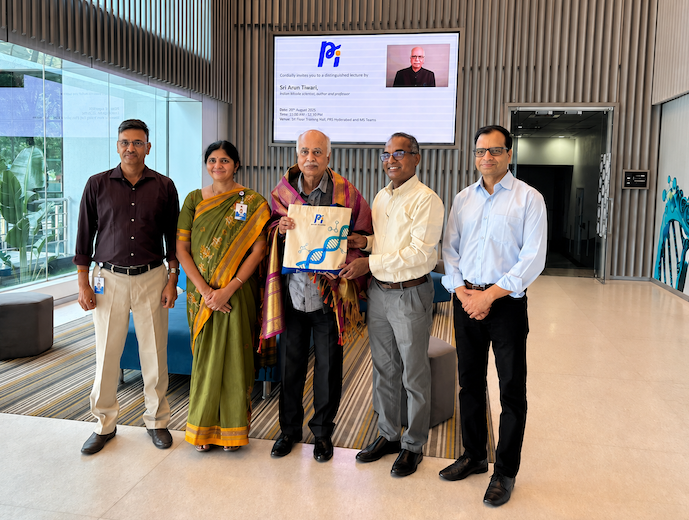
I recently visited PI Health Sciences Ltd. at Genome Valley, Hyderabad, at the invitation of my long-standing friend, Dr. S. Chandrasekhar, who joined the organisation as Chief Scientific Advisor after his superannuation as Secretary, Department of Science and Technology, Government of India. Given the freedom to choose my subject, I decided to speak on From Molecules to Missions, and, building upon my continuing engagement with artificial intelligence, made Science Beyond Silos in the AI Era my theme.
The conference room, with a capacity of about a hundred, was filled to capacity. Scientists from PI Health Sciences facilities at Panoli, Jaipur, Ankleshwar and Udaipur joined online. For a non-chemist to stand before such a formidable gathering of chemists was initially a little awkward for an engineer like me.
I therefore began with engineering.
Chemistry, I said, cannot remain in the flask. For a chemical reaction conceived by a scientist to become an industrial reality, engineering must create and control the required temperature, pressure, flow, mixing, separation and containment—precisely, repeatedly and safely. That simple acknowledgement produced an instant bonhomie. I could then change tracks and make the larger point: in the modern world, chemistry cannot remain separated from engineering, biology, environmental science, medicine—and increasingly, AI.
The hour then passed like a breeze.
Using AI-generated slides, I began with a proposition that sounds almost philosophical but is fundamentally scientific: molecules have an afterlife. What we create does not simply vanish after its intended use is over. Molecules may degrade, transform, bind to other substances, migrate, accumulate or persist. Their journey can continue long after the product they were designed for has been discarded.
Consider the chemicals entering soil through fertilisers, herbicides and pesticides; industrial chemicals discharged onto land and water; or pharmaceuticals and their metabolites leaving the human body and entering sewage systems. Some are removed or broken down, but others can survive treatment, move through water and soil, interact with organisms and reappear in unexpected places.
What goes down does not simply go away.
Groundwater makes this particularly clear. Landfill leachate, industrial effluents and agricultural chemicals can migrate through soil and rock and, under the wrong conditions, reach aquifers. Once there, the problem is no longer one of chemistry alone. Hydrology must tell us where the water moves. Geology determines the pathways. Agriculture must examine uptake by crops. Toxicology and medicine must assess exposure and consequences. Public policy must decide acceptable risk levels and how best to prevent or mitigate the associated harms.
The food web carries the story further. Certain persistent pollutants can accumulate in organisms and, in some cases, become increasingly concentrated at higher trophic levels. What begins invisibly in water may pass into plankton, fish, larger predators and ultimately human beings. The food web remembers what our production and disposal systems may forget.
Then there is plastic.
Plastic is one of modern chemistry’s great achievements precisely because it is durable, versatile and inexpensive. Yet the durability that created its enormous utility has also created its environmental persistence. Larger plastic objects fragment into microplastics and still smaller particles; fragmentation is not disappearance. Such particles are now found across marine and terrestrial environments and have been detected in human tissues as well. The precise health consequences are still being investigated, and science should resist premature claims. But the ubiquity of exposure itself gives us sufficient reason to take prevention, materials design and waste management far more seriously than we presently do.
This led me to a more uncomfortable question. Have we built parts of modern civilisation in which we first create exposures and lifestyles that favour chronic disease and then build increasingly sophisticated systems to treat their consequences?
The diabetes epidemic, for example, cannot be attributed simply to sugar—humans have consumed sugars for millennia. But it certainly cannot be separated from the modern ability to refine, concentrate, manufacture and distribute calorie-dense foods on an unprecedented scale, combined with sedentary living and other metabolic risks. Similarly, rising concern about environmental exposures and cancers in younger populations deserves rigorous investigation, not sensational attribution to a single culprit. The scientific responsibility is to ask the question early enough, collect the right evidence and act when the evidence becomes persuasive.
The same principle applies to climate change. Carbon capture is scientifically feasible and has already been demonstrated in several settings. But capturing carbon dioxide is only one part of the problem. It must then be compressed, transported and stored securely for very long periods. Economics, infrastructure, geology, monitoring, regulation and public confidence immediately enter the picture. Once again, no discipline owns the problem.
This was the central message of my lecture.
Plastic pollution is not merely polymer chemistry. Groundwater contamination is not merely hydrology. Food safety is not merely biology. Climate change is not merely atmospheric science. The problems have already crossed the boundaries between our departments. Our science must now do the same.
And this is where AI offers an extraordinary opportunity.
AI’s greatest contribution to science may not ultimately be faster calculation. It may be its ability to connect what science has separated—datasets residing in different institutions, models built by different disciplines, research literature too vast for one individual to master, and relationships visible only when information is examined across scales.
Chemistry can speak to biology. Environmental measurements can connect with health outcomes. Molecular properties can be combined with hydrology and land-use data to predict environmental fate. AI-enabled surveillance can identify emerging contamination hotspots, detect weak signals and help us move from discovering damage after it has occurred to anticipating pathways before harm becomes widespread.
In other words, from prediction to prevention.
That requires a change in the scientist’s question. We must continue asking, Does this molecule work? But we should add: Where will it eventually go? What will it become? What will it encounter? And what might it do there?
We must begin to design for fate, not merely for function.
After the lecture and an engaging Q&A, we continued the conversation over an excellent working lunch. It gave me an opportunity to interact more closely with Dr. Dinesh Chaurasiya, Dr. Prathama Mainkar and Dr. Abhishek Sud, among other outstanding scientists who have helped build PI into a leading Contract Research, Development and Manufacturing Organisation, particularly in the agrochemical domain. Their depth of scientific experience and the range of the discussion reinforced the very point I had tried to make in my lecture: important problems are increasingly solved not within disciplinary compartments, but through conversations across them.
Dr. Chandrasekhar, with his trademark wit, provided the perfect closing line. “Karl Ziegler and Giulio Natta received the 1963 Nobel Prize in Chemistry for their discoveries in the chemistry and technology of high polymers”, he said. “Now depolymerisation is waiting for one. Whoever really gets rid of plastics may take it home.”
Behind the humour lies a serious mission.
The scientist’s responsibility does not end when the molecule succeeds. It extends to what that molecule eventually does in the world.
Our molecules. Our missions. Our world. Our responsibility.
I returned home with a quiet sense of fulfilment—almost like a pilgrim returning from a place of learning and purpose. PI Health Sciences had seemed to me not merely a laboratory or an enterprise, but a portal of scientific excellence, where knowledge is being transformed into possibilities for a better world.
MORE FROM THE BLOG
The Resilient Doctor
Dr. Prithvi Raj Jampana is a distinguished radiation oncologist with extensive experience in radiotherapy and systemic treatments for a wide range of cancers. He trained in clinical oncology at Oxford University Hospitals and worked in the UK for over two decades...

AI, Stories and the Mind
I have been reading an English translation of the Kathasaritsagara—The Ocean of the Streams of Stories—composed in Sanskrit by Somadeva, a Kashmiri writer of the eleventh century. Organised into eighteen books, it is less a conventional book than an immense...
The Wellness Dividend
One teaching of Dr. A.P.J. Abdul Kalam that I have always tried to follow is to ‘stay in circulation’, as he put it. By this, he did not merely mean travelling, attending meetings or remaining publicly visible. He meant keeping the mind in motion—meeting people,...
Thank you, Sir. ‘What goes down does not simply go away’ is a line I won’t forget. It was a lovely way to bring engineering, chemistry and AI into one conversation.
A deeply thoughtful and timely reflection. The phrase “molecules have an afterlife” captures a scientific truth that society can no longer afford to overlook. A molecule’s story does not end when a product has served its intended purpose; it continues through soil, water, living organisms and, ultimately, human health.
The most powerful message here is the need to “design for fate, not merely for function.” Chemistry, engineering, biology, medicine, environmental science and public policy must work together, with AI helping to connect knowledge that institutional silos have separated. Scientific success should therefore be measured not only by whether an invention works, but also by where it travels, what it becomes and what consequences it leaves behind.
Innovation gives science its power; responsibility gives it its purpose.
As a young engineer, I found the idea that “molecules have an afterlife” both illuminating and unsettling. Engineering has enabled us to create computer hardware that is almost immortal in material terms, yet becomes commercially obsolete within a few years. Circuit boards, processors, batteries, displays and cables contain plastics, glass, silicon and valuable metals that do not disappear when a device is discarded. They persist in landfills, release hazardous substances, or travel through complex and often unsafe recycling chains.
We celebrate faster processors and smarter devices, but seldom ask what happened to yesterday’s machines. The true engineering challenge is therefore not merely to design hardware that performs better, but to create products that can be repaired, upgraded, disassembled, recovered and safely returned to the material cycle.
This article gives my generation a powerful principle: design for fate, not merely for function. The future engineer must take responsibility not only for what a technology can do, but also for what remains after its useful life has ended.