
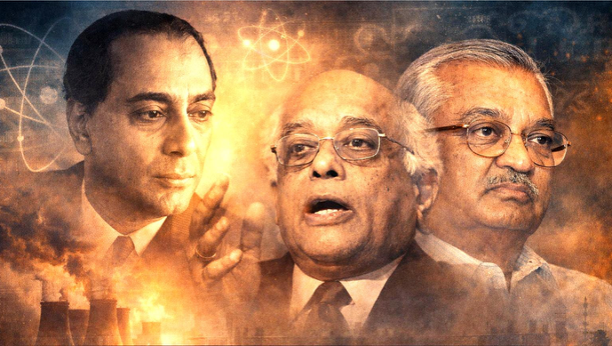
Awakening the Atom: India’s Quiet Energy Revolution
It is one of history’s great ironies that nuclear energy—arguably among humanity’s most profound technological achievements—remains burdened with the shadow of destruction. The association is not without reason; it was forged in the searing memory of the Hiroshima bombing on 6 August 1945, during the final stages of World War II, when the atom first revealed its terrifying power. And yet, in the decades since, that same force has quietly transformed into one of the cleanest and most sustainable sources of electricity we know. When India’s Fast Breeder Reactor at Kalpakkam recently went critical, it stirred in me a cascade of memories—most vividly, my visit in 2007 to the reactor ‘Bhavani’ as part of President A. P. J. Abdul Kalam’s entourage.
I remember standing before a structure of such immense scale and complexity—its vast volumes of reinforced concrete and steel descending deep underground, layers engineered, cooled and shielded to contain a force that, once critical, cannot simply be switched off—that it redefined my sense of what human endeavour can achieve. Today, when public celebrations often gather around bridges and skyscrapers, I am struck by how little we recognise these deeper infrastructures that sustain civilisation. We have grown accustomed to admiring the visible and the ornate, while remaining largely unaware of the invisible forces—and the monumental systems, buried beneath our feet—that quietly hold our world together.
At the foundation of this journey stands Homi J. Bhabha—a visionary who not only imagined India’s atomic future but also built the institutions to realise it. With the support of the Tata Trusts and the visionary backing of J. R. D. Tata, he established the Tata Institute of Fundamental Research in 1945, laying the foundation for India’s advanced scientific research ecosystem. In 1954, he articulated the three-stage nuclear programme, a uniquely Indian strategy designed to convert limited uranium and abundant thorium into long-term energy security. His untimely death on 24 January 1966, in the crash of Air India Flight 101, bound for London and lost over Mont Blanc in the Alps, did not extinguish this vision. It endured—quietly, persistently—through generations of scientists, and through a political leadership that grasped the long arc of national interest. That the first stage now stands effectively realised in April 2026 is not merely a technical milestone; it is a civilisational marker of patience, continuity and resolve.
The elegance of Homi J. Bhabha’s vision lies in its alignment with India’s natural endowment. With modest uranium reserves but vast thorium deposits, the programme unfolds in three deliberate stages: heavy-water reactors using natural uranium; fast breeder reactors that multiply fissile material, a material that can split and release energy to sustain a nuclear chain reaction; and, finally, thorium-based systems capable of sustaining energy production for centuries. For a country of over a billion people, the demand for energy at scale is not a choice but a necessity—one that cannot be met without harnessing the power of the atom. This is not just an energy strategy; it is a blueprint for sovereignty—transforming scarcity into abundance through science.
Yet, within this design lies a deeper strategic insight. The world remains fundamentally dependent on uranium—a resource India possesses only in limited measure—while thorium, abundant along India’s coasts, remains largely untapped globally. Bhabha’s pathway recognised that thorium cannot release energy on its own; it must first be ‘awakened’. During the fast breeder stage, plutonium is produced, which in turn serves as the trigger, converting thorium into uranium-233—a fissile material capable of sustaining a nuclear chain reaction. In this elegant act of scientific alchemy, India turns its constraint into strength: using what is scarce to unlock what is abundant, and thereby securing an energy future that is not only self-reliant but potentially inexhaustible.
Yet such a vision was never destined for haste. The programme’s long gestation arises from its very architecture. Each stage depends on the successful completion of the one before it; the second cannot proceed without the first, nor the third without the second. The technologies involved are among the most complex humanity has attempted. Fast breeder reactors operate under high neutron flux and demanding engineering conditions, while thorium must first be converted into uranium-233 through a multi-step fuel cycle before it becomes usable as nuclear fuel. Every step demands precision, validation and time.
To this intrinsic difficulty was added the weight of history. After the Smiling Buddha, India faced decades of technological isolation under regimes such as the Nuclear Suppliers Group. What many nations could access through global collaboration, India had to build painstakingly from first principles. This constraint undoubtedly slowed progress, but it also forged a rare kind of resilience. The programme that emerged is not derivative; it is deeply indigenous—shaped by necessity, refined through persistence, and strengthened by self-reliance. If anywhere in the world there exists a nuclear programme that can truly claim to be homegrown in spirit and substance, it is India’s.
History reminds us that science has often advanced through the movement of minds across borders. Albert Einstein, an immigrant to the United States, reshaped modern physics; Enrico Fermi, Leo Szilard and Edward Teller were among those who carried Europe’s intellectual legacy into America’s nuclear enterprise. India’s journey, by contrast, unfolded largely without such external inflows—its strength arising from within. In that sense, its achievement is not only technological but civilisational: a demonstration that sustained vision, even under constraint, can build capabilities as profound as any assembled through the advantages of global mobility.
Hereafter, the future moves forward with quiet certainty. With the breeder stage going critical at Kalpakkam, India begins to multiply its fissile resources, preparing the ground for the thorium era. In the coming decades, thorium-based reactor technologies are expected to progress from experimental stages to potential deployment, positioning India among the leading nations in industrialising this fuel cycle. In parallel, nuclear energy is likely to integrate with renewables, helping anchor a stable, clean energy grid. Beyond its borders, India may emerge as a provider of nuclear technologies and frameworks for the Global South—offering not just systems, but a philosophy of building under constraint.
In reflecting on the journey so far, I consider myself deeply fortunate to have met R. Chidambaram and Anil Kakodkar on several occasions and to have experienced their warmth and affection. As a mechanical engineer, I was struck when Kakodkar Sahib shared that he, too, came from the same discipline. Verghese Kurien, himself a mechanical engineer, embodied the same truth—that excellence is not confined by formal training. Perhaps that is the quiet law of great endeavour: those who surrender to the work before them often transcend their own boundaries, as if carried forward by a larger current of energy.
I have also been privileged to share a long-standing association with Sudhakar Potluri, who devoted a lifetime to atomic energy and later served as Chairman of the Electronics Corporation of India Limited. From him, I gained an appreciation of the extraordinary electronic engineering that underlies nuclear power—the seamless conversion of heat into steam, the precise running of turbines, and the generation of electricity in systems where ‘never a fault’ is not merely an ideal but an uncompromising necessity. As for me, my journey has been modest; I remain a small fry in the presence of such towering individuals, grateful simply to have been a fellow traveller in a boat steered by Dr. Kalam—much like an isotope held in careful balance.
MORE FROM THE BLOG
Tea, Coffee, or Me?
Though I have been a tea person all my life, coffee has always intrigued me. During my travels in the United States, it seemed to be everywhere: at breakfast tables, in offices, beside hotel reception desks and in paper cups carried through the streets. In Ethiopia, I...
The Agony and the Ecstasy of Life
Since I met Dr Chinnababu Sunkavalli, the robotic surgical oncologist, in 2022 through an introduction by the Tangirala brothers, Venkat and Ravi, he has become part of my life. His enthusiasm, his commitment to connecting with people, and his extraordinary zeal to...
The Resilient Doctor
Dr. Prithvi Raj Jampana is a distinguished radiation oncologist with extensive experience in radiotherapy and systemic treatments for a wide range of cancers. He trained in clinical oncology at Oxford University Hospitals and worked in the UK for over two decades...
Incredible achievement. But what lies ahead is equally important. The real promise of the fast breeder programme is unlocked only when it transitions into the third stage—thorium-based reactors. If realised at scale, this would place India in a uniquely advantageous global position: energy-independent, low-carbon, and technologically distinctive.
In quiet contrast to the spectacle that often surrounds technological announcements, this achievement stands dignified, complex, understated, and profoundly consequential. It signals that India is not merely participating in the future of energy, but is helping to define it. Thank you for giving us so many important facts Sir.
Reading Professor Arun Tiwari’s reflection on India’s nuclear journey feels like standing at the confluence of engineering, history, and civilisational purpose. As a civil engineer who has spent years working at the intersection of built infrastructure and sustainability, I found myself deeply moved by the way you reframe nuclear energy—not as a relic of destruction, but as a quiet, disciplined triumph of human ingenuity.
In sustainability research, we often debate the trade‑offs between energy, environment, and equity. The three‑stage nuclear programme is one of the few strategies that simultaneously strengthens all three pillars.
Professor Tiwari’s writing rekindles a sense of pride in the engineering fraternity—those who build quietly, persistently, often without public applause, yet leave behind structures and systems that outlive them.
In celebrating India’s nuclear journey, Professor Tiwari also celebrates the deeper truth of engineering: that progress is built not only on innovation, but on patience, continuity, and the courage to think in centuries.
The journey, as you described, to our generation has been long and exacting. From the early foundations laid at Bhabha Atomic Research Centre to the engineering rigour of BHAVINI, and the intellectual stewardship of leaders like Anil Kakodkar, this moment represents decades of disciplined continuity—rare in a world driven by short-term returns.
Yet, beyond the science and strategy, there is a deeper narrative. Nuclear energy, especially in its advanced forms, demands a culture of precision where failure is not an option. It is a domain where engineering becomes almost ethical in nature—systems must work, not most of the time, but all the time. In that sense, the fast breeder reactor is also a testament to India’s maturation as a nation capable of sustaining “never-a-fault” infrastructures.
India’s fast breeder reactor going critical is not merely a technical milestone—it is a civilisational moment in the country’s long pursuit of energy sovereignty. As you nicely brought out, at the heart of this achievement lies the vision first articulated by Homi J. Bhabha: that a nation with modest uranium reserves but vast thorium potential must think beyond conventional reactors. The fast breeder reactor embodies that foresight. It does not just consume fuel—it creates more than it uses, converting fertile material into fissile fuel, effectively turning scarcity into abundance. In a world anxious about energy security, climate change, and geopolitical dependence, India has quietly advanced a technology that addresses all three. The breeder reactor is not an incremental upgrade; it is a strategic pivot—from a linear to a regenerative nuclear fuel cycle
Prof Tiwari, keep walking. Necessity has always been the bedrock of all solutions to challenges.
I deeply appreciate Arun Tiwari ji for this thoughtful and insightful piece. He brings out India’s nuclear journey with remarkable clarity and quiet conviction, highlighting a dimension of nation-building that often goes unnoticed. I admire how he simplifies complex ideas while preserving their depth.
Respected Sir, Thank you for posting a need-based article focused on the nuclear programme. India aims to increase nuclear power capacity to 22,480 MWe by 2031 and hopes we will achieve it.
Dear Prof., India is a great example of self-sustenance in many areas. Thank you for sharing your journey in Nuclear energy development.
Rwanda will host the second edition of the Nuclear Energy Innovation Summit for Africa (NEISA 2026), bringing together Heads of State, policymakers, capital providers, regulators, technology providers, and industry leaders to advance strategic dialogue on Africa’s nuclear energy future.
It will take place from 18 – 21 May 2026 at the Kigali Convention Centre, Kigali, Republic of Rwanda. NEISA 2026 is organised in collaboration with leading international and regional partners, including the International Atomic Energy Agency, the United Nations Economic Commission for Africa, the Nuclear Energy Agency, the World Nuclear Association, and regional financial institutions
institutions.
It would be great to have participation from the Indian nuclear scientific community. Their experience and journey would hugely benefit Africa.
History reminds us that science has often advanced through the movement of minds across borders. Albert Einstein, an immigrant to the United States, reshaped modern physics; Enrico Fermi, Leo Szilard and Edward Teller were among those who carried Europe’s intellectual legacy into America’s nuclear enterprise. India’s journey, by contrast, unfolded largely without such external inflows—its strength arising from within. In that sense, its achievement is not only technological but civilisational. India’s journey is civilizational. This marks the pride of being Indian.
Thank you, Professor Arun Tiwari jee, for taking us on the journey from it’s beginning to the day our nuclear program and vision went critical,
I was awaiting this blog from you on this extraordinary achievement of our scientists. We are proud of our scientists, scientific fraternity and civilisation. I hope many more blogs like this will feature in the catalogue, keeping us aware of our greatest scientific achievements.