

7. The Divine Comedy: Book Review

7. The Divine Comedy: Book Review

7. The Divine Comedy: Book Review

I visited Italy as part of a family trip through Western Europe, which included cities in Germany, Belgium, France, Switzerland, and Austria. In Italy, we visited Milan, Rome and Venice. Italy stands out for its architecture, but also its people with a distinct attitude. The most intriguing city was Venice, a grand city built on the water, with no roads—only boats navigating waterways.

Later, I learned that Italy was not always a unified country. The survivors of the Trojan War arrived at Florence, and there were constant fights between them and the locals. Even the Roman Empire did not last for 500 years. As for Venice, a city built on 118 islands, it was founded in the 5th century AD by refugees fleeing the Roman Empire and Germanic invasions. Over time, it developed into a significant maritime and trading power, becoming a key player in European and Mediterranean commerce. Of the countries I visited, Italy remained with me as a land of brilliance and arrogance.

The Divine Comedy, written by Dante Alighieri, a 13th-century Florentine, is an epic poem comprising 14,233 lines. It is divided into three equal parts: Inferno (Hell), Purgatorio (Purgatory), and Paradiso (Paradise). The poem narrates Dante’s journey through the three realms of the dead, lasting from the night before Good Friday to the Wednesday after Easter in the spring of 1300. It begins saying:

Midway along the journey of our life
I woke to find myself in a dark wood,
For I had strayed from the straight path. (Inferno, Canto I, lines 1-3)

The Roman poet Virgil guides him through Hell and Purgatory; Beatrice, Dante’s ideal woman, guides him through Heaven.

When you read Dante, you feel like you are watching a film. He creates scenes using metaphors and explains complex insights through dialogues between the characters. It is a wholesome teaching on Christian theology, with Hell, Purgatory and Heaven as allegorical representations of sin, penance and divine grace, respectively.

There are multiple circular steps, like stepped rings, for rising through repentance or falling into sin. The punishments in each circle are not arbitrary; they are designed to reflect the nature of the sin. For example, those who indulged in lust are tormented by a storm, as their passions were uncontrolled. Similarly, those who committed violence against others are punished with violence. Dante also depicts Pope Boniface VIII and Pope Nicholas III in Hell.

I am in love with this book for its craftsmanship. How can anyone create an entire imaginary realm and then put it into words so that the reader also reaches there? The scene I loved most is when Dante finds a crowd outside the first circle of Hell. These people are not allowed inside as they were neither good nor bad, but lacked the faith to be saved. Called Limbo, this is not a place of punishment; it’s also not a place of eternal joy. It’s a state of perpetual longing for what they cannot have. He meets Socrates, Aristotle and Julius Caesar here.

My favourite lines are:

“The only answer that I give to you is doing it,” he said.
“A just request is to be met in silence, by the act.” (Inferno, canto XXIV, lines 77-78)

Taking practical actions makes your life relevant. Mere words are not enough when responding to a just request. When a request is undeniably fair, the most effective way to respond is to take the necessary steps to meet the request. Not doing this will take you to hell, make no mistake about it.

6. Miguel Street: Book Review

6. Miguel Street: Book Review

6. Miguel Street: Book Review

Winner of the Nobel Prize for Literature in 2001, Sir Vidiadhar Surajprasad ‘VS’ Naipaul visited President APJ Kalam with his wife in 2003. He was born into a lineage of landless brahmins from eastern Uttar Pradesh, who were taken to Trinidad by the British as indentured labour to grow sugarcane there. I was not there when he met Dr. Kalam, but I had the chance to meet him two years later.

In 2005, Guiding Souls: Dialogues on the Purpose of Life, co-authored by Dr. Kalam and me, was published. Sir Naipaul was in Delhi for a short visit, staying at the Taj Mansingh Hotel. My publisher, Piyush Kumar, took me to meet him. I was stunned by his persona—tall, handsome and erudite. His voice was heavy, as if coming from a depth. It was the first time I had met a Nobel laureate, and I was overwhelmed.

He wrote a message for the book: “This book demonstrates a wise and much-loved President, two attributes which do not always go together.” He said that what is good for you is usually not what you like. This is the biggest problem with people— they dislike being told about their faults. Sir Naipaul affectionately held my hand and said, “Keep writing, young man. Like music, writing comes with practice.” I took his advice to heart.

When asked which book he felt was closest to his heart, Si Naipaul said, “I write all books from the heart.” However, he added that he considered his first book, The Milguel Street, as his best writing. I bought it on my way back to Hyderabad from the airport and finished reading this 190-page book before landing in Hyderabad. It was the best English prose I have ever read—flowing like a breeze. An excerpt from the book reads:

“A stranger could drive through Miguel Street and just say ‘Sum!’ because he could see no more. But we who lived there saw our street as a world, where everybody was quite different from everybody else. Man-man was mad; George was stupid; Big Foot was a bully; Hat was an adventurer; Popo was a philosopher; and Morgan was our comedian.” (Chapter 8, p. 59)

A collection of interconnected stories set in a poor, working-class neighbourhood in Port of Spain, Trinidad, Miguel Street is narrated from the perspective of a teenage onlooker. Each chapter focuses on a particular character, but with characters from previous chapters reappearing as minor characters in subsequent ones. These are the people the child grows up watching. They are all stuck in their small, limited lives. However, the narrator has a real opportunity to alter his life, and he does so by leaving the community and pursuing higher education.

Twenty years have passed, but I have not forgotten the characters: Bogart, Popo, B. Wordsworth, Big Foot, Man-man and Hat. They appear when I discuss life with others. If I had to gift one book to a teenager without hesitation, this would be the book. 

The themes of ambition, failure and adaptation, explored in classic books, are universal and relevant. I read this book to relax and enjoy my time alone. I have it by heart, remember who said what, and revisit it depending on my mood. Writing simple, flowing prose about ordinary people and their little problems is difficult—something only Sir Naipaul could do. He is peerless. 

5. Faust: Book Review

5. Faust: Book Review

5. Faust: Book Review

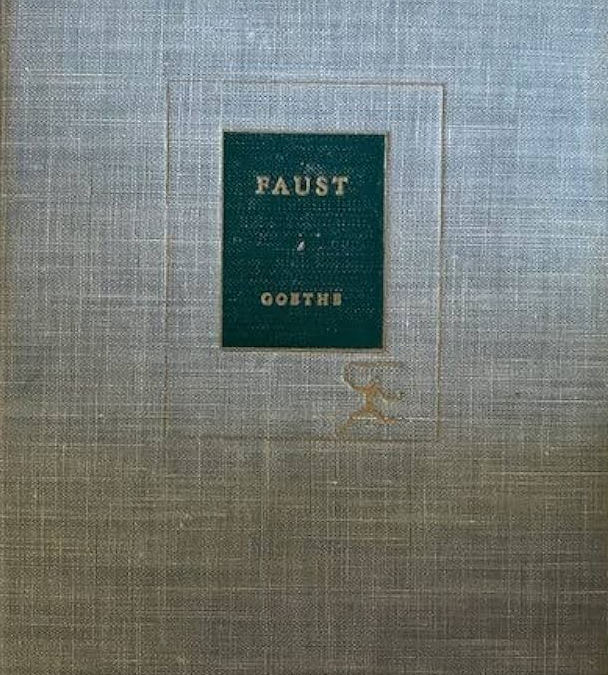
The German Chancellor, Gerhard Schröeder, visited New Delhi from October 6 to 7, 2004. He gifted President Kalam an English translation of Faust by Johann Wolfgang von Goethe, translated by Bayard Taylor. Goethe is regarded as one of the greatest writers in the German language.

Like many other books, Dr. Kalam passed on this deluxe edition to me. While browsing through it, I could not relate to it. The book remained on my shelf, unread. It was during the COVID-19 lockdown that I read it, only to realise how stupid I had been not to do so previously.

The story is about Faust, who, unsatisfied with his life as a scholar, attempts suicide. Mephistopheles, the Devil’s representative, intervenes and makes a bargain with Faust. He will serve Faust using his magic powers for a fixed number of years, but at the end of the term, the Devil will claim Faust’s soul, and Faust will be eternally enslaved. Faust makes use of Mephistopheles in various ways, including seducing an innocent young woman whose life is ultimately destroyed when she gives birth to Faust’s illegitimate son. She drowns the child and is sentenced to death for murder. God ultimately saves Faust because of his constant striving and pleading with God for redemption, through the intercession of the wronged woman. 

Faust is indeed a universal story. Each one of us, like Faust, makes a bargain to succeed. These defence mechanisms are rooted in childhood as sacrificed elements of the self in favour of psychological survival. For the neurotic, abandoning one’s genuine feelings in favour of a false self may be more amenable to caretakers. It may offer a viable life form at the expense of one’s genuine emotions and affects. For the psychotic, a Faustian bargain with an omnipotent self can offer the imaginary refuge of a psychic retreat at the price of living in unreality.

A brilliant poem with dazzling imagery, each stanza of Faust is a gem. My favourite verse is:

“What I possess seems far away from me, / And what is gone becomes reality.”  (Lines 31–32)

Not only is Mephistopheles everywhere in the world, but he is also ruthless and unrepentant.

“You’ll get no word of suns and worlds from me. / How men torment themselves is all I see.” (Lines 279–280)

“Grey, dear friend, is all theory, / And green the golden tree of life.” (Lines 2038-2039)

Eventually, the Devil is defeated, and the book concludes on a positive note.

“Let the sun be lost from heaven, / So it’s daylight in the soul, / We’ll discover in the heart, then, / What the Earth fails to hold.” (Lines 9691-9694)

Gaze towards that saving gaze, / All you, the penitent and tender, /To all those blissful ways, / Give thanks, and follow after. (Lines 12096-12099)

The central takeaway is the tragic quest for fulfilment and understanding, highlighting that endless ambition and a desire to transcend human limitations can lead to both extraordinary achievements and moral downfall. The work emphasises the importance of humility, ethical integrity, and acknowledging human limitations, while also celebrating the potential for redemption and the pursuit of higher ideals.

4. Self and Others: Book Review

4. Self and Others: Book Review

4. Self and Others: Book Review

I first visited Pune in the winter of 1989 and worked as part of the Project Akash team, which was involved in developing a surface-to-air missile system. I visited our sister organisation, Research & Development Establishment (Engineers), to discuss the missile launcher interface. In the evening, while browsing in a bookstore in the Budhwar Peth area, the book Self and Others caught my attention. The cover features three circles that partially overlap each other, and the title makes little sense. I had not heard of the author, R.D. (Ronald David) Laing. However, a mysterious force compelled me to buy this book. A Scottish psychiatrist, Laing died that very year, which I later came to know. 

The book is not big—only 192 pages—but what intrigued me the most was the idea that self-awareness is not merely about introspection but also about acknowledging the interplay between the self and surrounding social interactions. Understanding this dynamic allows individuals to navigate their relationships with increased mindfulness and intentionality. What we consider ‘normal’ behaviour is often a game played by people hiding from themselves.

According to Laing, the individual is not isolated from the environment. The individual continuously modifies the environment, and the environment simultaneously constructs and reconstructs the individual. To be normal is the guarantee of being unsuccessful in life. The art of living is all about recognising and validating the experiences and perspectives of others while staying true to one’s values and beliefs. This dual emphasis on the self and others can lead to more meaningful and fulfilling connections – moving toward, away from, and against others and is foundational to a peaceful and purposeful life.

The opposing forces of alienation and connection drive our lives. These forces are not permanent but mutually emergent between two people or groups. One response is to cut oneself off from others, leading to alienation. The other response is to connect. Develop a sense of belonging, relatedness, and mutual understanding with others and the world around us. Then there is self-estrangement. A sense of alienation from oneself can develop when internal values clash with societal norms. Having a more compassionate and understanding relationship with oneself is of utmost importance. Acknowledge and confront negative self-beliefs.

“True guilt is guilt at the obligation one owes to oneself to be oneself. False guilt is guilt felt at not being what other people feel one ought to be or assume that one is.” (Part Two, chapter X, p. 133)

The book emphasises the importance of genuine communication. Miscommunication or superficial interactions can distort self-perception and contribute to mental health issues. Laing examines how language and nonverbal cues impact our understanding of ourselves and others.

If you’re feeling disconnected from yourself and your passions, trying out new hobbies or pastimes may help you reconnect with them. When life is not going as you want it to, do what you liked most as a child. It can be flying a kite, reading a book, playing with pebbles or cards, or simply loitering around, going for a long walk, or sitting in a park or on a bench in a mall and just watching people. A well-wisher gave me the book on Gestalt Therapy. But this book came to me through an invisible hand that took me there and purchased it. It has proved to be an eye-opener for me.

3. Gestalt Therapy: Book Review

3. Gestalt Therapy: Book Review

3. Gestalt Therapy: Book Review

I arrived in Hyderabad in February 1982, having been selected as a Scientist in the Defence Research and Development Organisation (DRDO) and posted to the Defence Research and Development Laboratory (DRDL). I had got there purely on merit and grit, and was reverberating with excitement and growth. However, there were financial difficulties. The Central Government paid me a monthly salary of Rs. 1500, of which Rs. 400 was spent on house rent.

Inspired by Dr. Kalam, who became Laboratory Director around the same time, I spent long hours at the office, and my wife, with two children to raise, lamented it all. Soon, I succumbed to work pressure and ended up getting migraines. At times, they were disabling. They would come on just before an important meeting, and I found it extremely challenging to perform. A gentleman named M. Ravi Kumar gave me the book, “Gestalt Therapy: Excitement and Growth in the Human Personality,” saying that, based on his experience, it could be of help to me.

The book taught me how to interpret dreams and connect with ignored feelings and suppressed thoughts. I learnt that you could heal inside when you sit alone and talk aloud to the characters in your dream. Fritz Perls, one of the authors, developed the Empty Chair Technique, described below.

Sit on a chair and keep an empty chair before you, representing either an absent person or a part of yourself. Now, speak to the empty chair, expressing your thoughts, feelings, and emotions as if the other person or part were present. Then, swap chairs and speak from the perspective of the imagined ‘other’.

The empty chair can represent a part of oneself, such as a critical inner voice or a vulnerable aspect of oneself. You articulate your feelings, thoughts, and perceptions while speaking to the empty chair occupied by your ‘imaginary part’, bridge gaps in understanding and emotional well-being, and confront unresolved issues, fostering a profound sense of clarity and reconciliation. This releases tensions such as anger, tears, and shivering, and you feel better after a few minutes. This is not magic, but a brilliant scientific technique. I experienced healing using this techniquemy headaches disappeared within a few months.

We are indeed a bundle of multiple selves. There is a biological self, a social self, an intellectual self, and, finally, an immortal Self. Like waves in an ocean, these selves rise and fall in different situations and at various times. The problem starts when one dominates the others. For example, many knowledgeable people lack social grace. The example of an American President having a sexual encounter with his intern in his office is a glaring example of how the biological self can override all others.

Sleep, a regular break of about eight hours from waking life, is meant for mental repair. Dreams reveal the repressed, alienated, and ignored aspects of awareness, which, if correctly understood, can have a profoundly positive effect.

After reading this book, I began looking inward to understand my problems with the outside world, realising that many of them have built-in solutions and can be resolved from within. In this process, what happens to you inside becomes the most serious —and transformative—business. In the words of Fritz Perls,

“Awareness is like the glow of a coal which comes from its combustion… In awareness, a process is taking place in the coal (the total organism) . . . . Our emphasis is on self-awareness . . . this is where most of us are handicapped.” (Part 1, chapter III, p. 75-76)

That’s what the Gestalt therapy challenges us to do: stay present, face ourselves, and let awareness do what it does best—transform.