Still in her twenties, Rebecca F. Kuang has emerged as one of the most incisive literary voices examining empire’s afterlives. Born in China, raised in the United States, and educated at Cambridge and Oxford, she broke through with The Poppy War, a novel rooted in...

The Bhagavad Gita OS
The Bhagavad Gita OS
In an era where our minds scroll faster than our hearts can feel, where information pours in like a relentless monsoon yet wisdom dries up like parched earth—the Bhagavad Gita stands not as an ancient relic, but as a future-ready operating system for the human spirit.
Today, we wrestle with dilemmas Krishna did not name, but fully understood:
overstimulation, over-choice, over-thinking, under-feeling and under-resting. We live in a world of: Cognitive surplus—more knowledge than insight; Consumption deluge—more possession than satisfaction; and Speed addiction—more acceleration than arrival. Our tools advance, yet our inner software lags.
We download apps but do not decipher meaning. We upgrade devices but not desires. We collect data yet lose direction. At this crossroads, Shri Krishna’s voice returns—not from a battlefield of chariots, but from the battlefield of attention and identity. It whispers:
You are not the noise but the awareness behind it.
You are not the device but the operative Intelligence.
Five thousand years ago, Arjuna stood paralysed on the Kurukshetra battlefield. Today, we stand frozen on the battlefield of endless tabs and perpetual notifications. Our crisis is not Kurukshetra—it is Cortex-kshetra, the battlefield of the overwhelmed mind. Arjuna feared external war. We fear internal noise.
The Gita wasn’t spoken in the serenity of an ashram. It emerged amid chaos, confusion, and conflict on a battlefield. So must its wisdom return—not to monks alone but to multitaskers, distracted professionals, restless teenagers, burnt-out entrepreneurs and dreamers fighting invisible battles.
Never in human history have we possessed so much information and yet understood so little of ourselves. We accumulate facts but lose wonder. We collect opinions but lose silence. We chase everywhere yet arrive nowhere.
The Gita pierces this paradox: knowledge without clarity becomes confusion. Confusion without action to dispel it becomes stagnation. Action without purpose becomes entropy—a futile waste of life.
We consume food beyond hunger, hold opinions beyond curiosity, stare at screens past sanity and carry emotions beyond capacity. The world tells us, “Get more.” The Gita guides us to ‘Be more.’ Minimalism isn’t modern—it is eternal Vedanta. Real abundance isn’t owning everything—it is needing little and loving deeply.
Modern life worships speed: fast food, fast news, fast progress, fast entertainment, fast outrage. But speed without direction is anxiety. The Gita teaches us to “see action in inaction and inaction in action” (4.18). The wise move is to move fastest by standing still. Stillness is not inactivity—it is frictionless movement of the mind.
Some imagine the Gita belongs to a distant past—but to me it belongs most to a distracted future. Its message is not religious—it is self-engineering: Sort out your consciousness. Update your emotional intelligence. Perform from purpose, not panic. Act without attachment—and rest without guilt.
We do not fear death anymore—we fear irrelevance, Fear of Missing Out (FOMO), emptiness and stillness. But the Gita smiles gently and asks: If you lose YOURSELF, what will you do with the whole world? The world has changed. Human nature has not. The Gita remains the bridge between motion and meaning, between speed and stillness, between updates and awakening.
We don’t need more GB of storage—we need more self-knowledge. We don’t need 6G downloads—we need deeper uploads to the soul. And in that surrender, in that clarity, we earn our true upgrade—the final freedom from all reboots, called Paramam Gatim in the Gita (8.21).
My personal favourite in the Gita is the eighth shloka of the fifteenth chapter: “Just as the wind carries fragrances from their source, the embodied soul, leaving one body and entering another, carries the mind and senses (and subtle impressions) with it.” Let a modern rendering of this shloka inspire a generation wired to the world but disconnected within:
Think of the body
As a phone you borrow for a while –
Shiny, temporary,
Bound to scratch, slow and shut down.
When its time is up,
The SIM card – the subtle body –
Slides out quietly,
Carrying contacts of memory,
Messages of experiences,
Photos of impressions,
Apps of habit,
And the unclosed tabs of desire.
It finds another device
To reboot the unfinished journey.
The number changes, the casing changes,
But the data – tendencies, fears, loves and impulses –
Migrates with the SIM.
So, update wisely.
Clear junk.
Upload compassion.
Backup peace.
Delete grudges.
Life is never lost- it just transforms.
You are neither the device,
Nor the apps –
You are the core intelligence
Running beneath the screen of life.
When this system reaches shutdown,
You do not perish –
You simply boot into another OS.
An upgraded one –
From survival to creativity,
From instinct to insight,
From confusion to clarity.
Not a repeat version,
Still looping through old bugs.
The wisest users know:
The ultimate upgrade
Is merging back into the Infinite Source code
Where no reboot is ever needed again.
Paramam Gatim – the Supreme destination.
Understand your body as a temporary device—a sophisticated instrument you inhabit for a brief moment—while your true Self is like a SIM card silently carrying the stored memories, tendencies, desires and experiences that define your journey across lifetimes. Remember that death is not an end but a transfer, a reboot into another operating system shaped by the karma and consciousness you cultivate today. Clear inner clutter, install virtues, and evolve beyond repeating patterns toward the ultimate upgrade—a return to the Infinite Source, where consciousness rests free from cycles of birth and reboot, attaining the Supreme state the Gita calls Paramam Gatim and Buddha called Nirvana.
MORE FROM THE BLOG
Empire Without Flags
A Child and a Name in the Lila of Becoming
My younger brother Salil Tiwari’s son, Sudhanshu, and his wife, Stuti, have been blessed with a son. They live in Meerut, my hometown, and visited me recently. Like all visits involving a newborn, it carried a quiet gravity—soft footsteps, hushed voices, time slowing...
Life Goes On—Imperfect and Unresolved
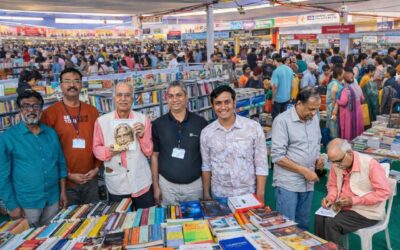
The readers have lapped up the silver jubilee edition of Wings of Fire. Within a month of its release on October 15, 2025, the 94th birth anniversary of Dr APJ Abdul Kalam, the first print was sold out. At the 38th Hyderabad Book Fair, on December 20th, 2025, I saw...