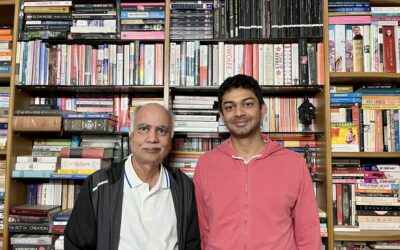
A Child and a Name in the Lila of Becoming

A Child and a Name in the Lila of Becoming

A Child and a Name in the Lila of Becoming

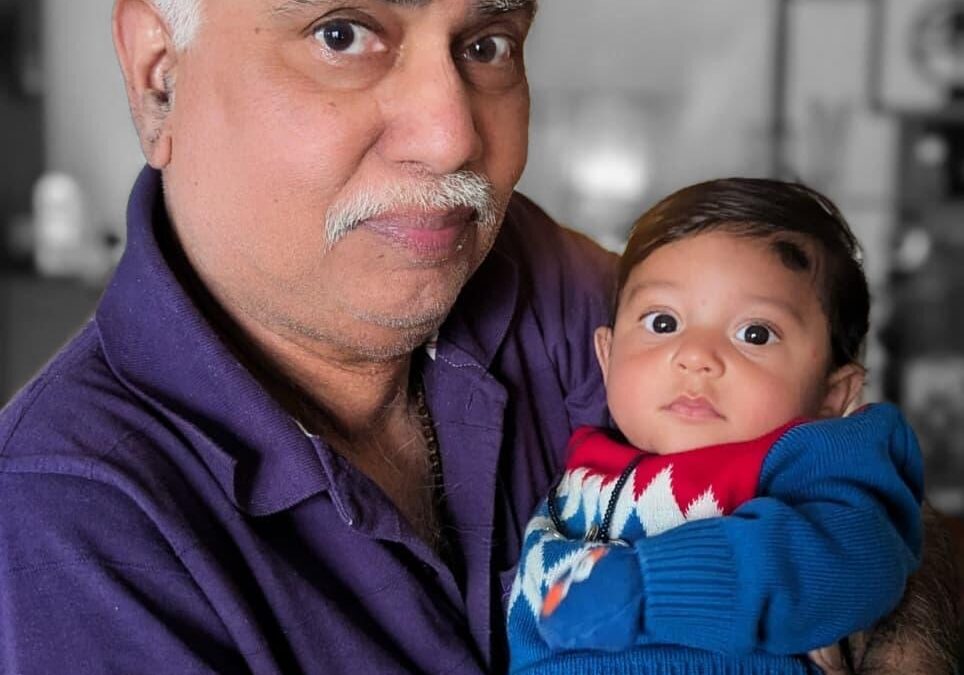
 My younger brother Salil Tiwari’s son, Sudhanshu, and his wife, Stuti, have been blessed with a son. They live in Meerut, my hometown, and visited me recently. Like all visits involving a newborn, it carried a quiet gravity—soft footsteps, hushed voices, time slowing itself to the rhythm of breath. They have named the child Pranav, a name that is bothintimate and cosmic, tender and vast.

In Indian cosmology, Pranav is Omkara—the primordial sound from which creation unfolds. It is not merely a syllable, but a principle: the first vibration that disturbs perfect stillness and allows the universe to appear. To hold such a name in one’s arms is to be reminded that every birth is not only biological but also metaphysical.

Before sound, before form, before the long procession of time, tradition tells us there was equilibrium—a flawless balance of primordial energies. What modern language might call potential energy, kinetic energy and inertial mass, ancient thought named sattva, rajas and tamas. In that original state, none dominated. There was no motion because there was no imbalance. It was not emptiness, but fullness without expression—a silence pregnant with worlds.

Then came Pranav. Shri Krishna declares:

प्रणवःसर्ववेदेषुशब्दःखेपौरुषंनृषु

पुण्योगन्धःपृथिव्यांतेजश्चास्मिविभावसौ(Bhagavad Gita Chapter 7, Verses 8-9)

I am the sacred syllable Om in all the Vedas;I am sound in space and ability in human beings.

I am the pure fragrance in the earthand the brilliance in fire.

The Mandukya Upanishad opens with a declaration as simple as it is total:

इतिएतदअक्षरंइदंसर्वम्

Om is this entire universe.

Creation does not begin with an object, but with a vibration. Om unfolds as A–U–M: waking, dreaming and deep sleep. Itfinally dissolves into silence—Turiya, the witnessing consciousness beyond all states. Sound emerges from silence, and silence remains beneath sound.

 The Bhagavad Gita presents a parallel perspective, rooted not in abstraction but in real life. Shri Krishna explains that all actions stem from the interaction of the three gunas—sattva (clarity and harmony), rajas (movement and desire) and tamas (inertia and physicality). These gunas belong to Prakriti, nature itself. The Self—the witnessing consciousness—remains unaffected, taking on bodies like an actor assumes roles, entering the stage without being changed by the costume.

Seen this way, the world is a stage, but not in the trivial sense of illusion. It is a theatre of becoming, where consciousness repeatedly steps into form to experience, learn, struggle, forget, remember and evolve. Each birth is a new entry, not of something entirely new, but of something ancient continuing its journey.

A child, then, does not arrive as a blank slate alone. He arrives carrying impressions—samskaras—not as fixed destinies, but as tendencies, textures, unfinished melodies seeking expression. The Gita speaks of this continuity with startling clarity: the embodied self leaves off worn-out bodies and takes on new ones, just as a person discards old garments and dons new clothes (Chapter 2, Verse 22). The journey is uninterrupted, though the forms change.

In this sense, Pranav is not merely beginning life; he is resuming it. Consciousness has chosen a new arrangement of matter, a new family, a new historical moment, to continue its exploration of itself. The stage has shifted, the script has evolved, yet the play goes on.

What is this play? No one knows fully. Every civilisation has attempted an answer—myth, science, theology, philosophy. Today, we speak of evolution, genetics, neural networks and cosmology. Yesterday, we spoke of gods, avatars and cycles of creation and dissolution. Tomorrow, we may speak in entirely different metaphors. But beneath all explanations remains the same intuition: there is intelligence unfolding through form, and we are participants within it.

Children remind us of this truth because they arrive without explanations. They do not justify existence; they embody it. In their stillness and sudden cries, in their unfocused gaze and grasping hands, one sees the gunas awakening—rajas in movement, tamas as grounding in the physical body and its needs, sattva in the quiet clarity of presence. And behind them all, one senses the silent witness the Gita calls the Akarta—the non-doer, the one who watches the play without being bound by it

To name a child Pranav is, therefore, an act of recognition. It acknowledges that this small life is aligned with the oldest rhythm we know: vibration emerging from silence, form arising from balance, experience unfolding from stillness. It is to say that the birth of the child is not a coincidence, but an expression of family, of history, of consciousness itself.

As Sudhanshu and Stuti cradle their son, the vastness of scripture finds its most intimate proof. The MandukyaUpanishad is no longer a text; it breathes. The Gita is no longer a discourse; it lives. The cosmic sound has taken a human name.

And perhaps this is the deepest comfort these traditions offer: that life, for all its uncertainty, is not random chaos. It is Lila—a play, a game, a divine experiment whose rules are not fully known, yet whose coherence we intuit. We stumble through it, misunderstand it, suffer within it, and occasionally glimpse its beauty. That glimpse is enough to keep us playing.

Welcome, Pranav.

You enter a world that Shakespeare once saw as a stage, where men and women make their entrances and exits, each playing many parts, and you enter the same world that the Bhagavad Gita understands as a field of action, where consciousness takes form, performs its work and moves on. On this vast stage, roles change, but the witness endures. You will wear many costumes in the course of your life—child, learner, worker, giver, observer—and each role will require something different of you.

Perform each role fully and sincerely, without holding onto any mask longer than needed. Forget when forgetting is necessary, so each act can start unburdened; remember when remembrance arises so that wisdom can temper desire. Act with intention, yet be free from attachment to results, offering your work for a greater good, so your presence brings steadiness, happiness and light to those sharing the stage with you.

 This world is an ongoing play—in medias res, as the Latin has it. By taking birth, we enter a story already in motion. Yesterday’s son becomes today’s father. Scenes continue to unfold, much as the same sun rises and we name it a new day. And at some moment—sooner or later—we realise that,though our role in the play was earnest and exacting, the play does not begin or end with us; that the stage, the actor and the audience all arise within a single, unbroken field of consciousness.

MORE FROM THE BLOG

From Disease to Wellness: Time for a Paradigm Shift

From Disease to Wellness: Time for a Paradigm Shift

Modern medicine is magnificent at one thing: it rushes heroically to the battlefield after the war has already been lost. When the coronary artery is blocked, a stent is inserted. When the pancreas fails, insulin is administered. When cancer erupts, it deploys...
A Hero’s Journey of Taking Cognition Beyond Mortal Neurons

A Hero’s Journey of Taking Cognition Beyond Mortal Neurons

In an age mesmerised by rankings, metrics, and loud declarations of success, the most consequential journeys often unfold quietly. They are not propelled by brilliance alone, but by curiosity, humility, and an unyielding fidelity to truth. The exploration of...

Science, Service, and the Long Goodbye to Leprosy

Science, Service, and the Long Goodbye to Leprosy

It was already evening when they arrived, and I sensed a good feeling. The light had softened, retreating gently from the edges of objects, as though the day itself wished to listen to what came next. Dr. Gangadhar Sunkara came with Dr. Chinnababu Sunkavalli—both...

Life Goes On—Imperfect and Unresolved

Life Goes On—Imperfect and Unresolved

Life Goes On—Imperfect and Unresolved

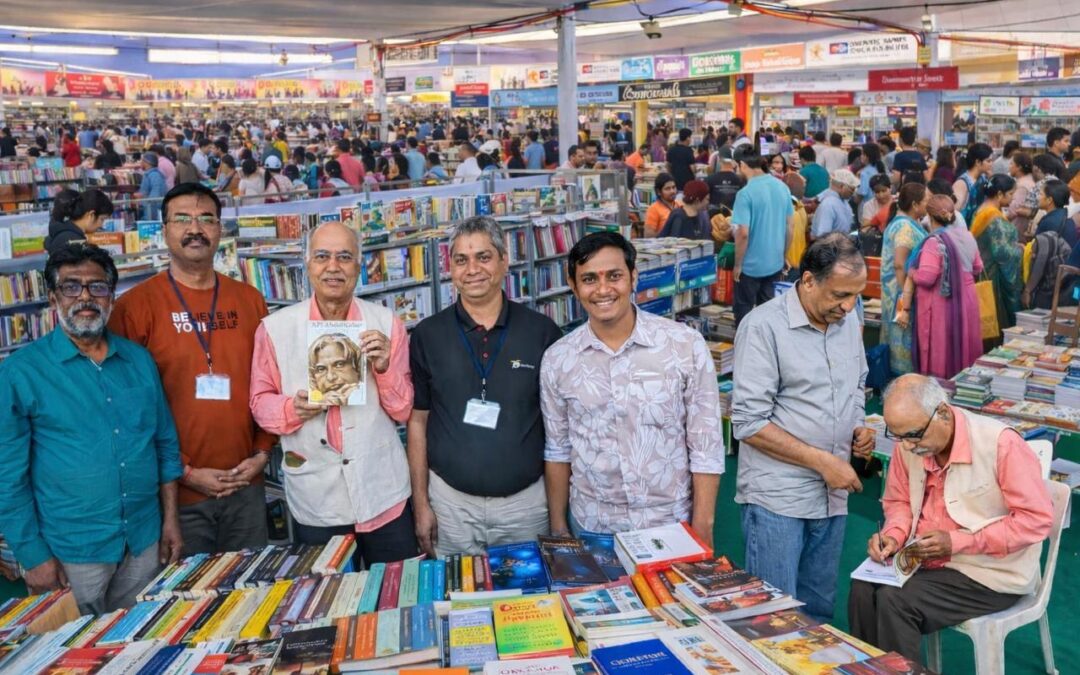
The readers have lapped up the silver jubilee edition of Wings of Fire. Within a month of its release on October 15, 2025, the 94th birth anniversary of Dr APJ Abdul Kalam, the first print was sold out. At the 38th Hyderabad Book Fair, on December 20th, 2025, I saw people buying  this book, and was pleasantly surprised when one of them approached me for an autograph after recognising me. He asked me what the best passage I would like him to read was, and I unhesitatingly pointed out a poem on page 130 that Dr Kalam had quoted. 

God hath not promised

Skies always blue,

Flower-strewn pathways

All our lives through…

These lines are from a well-known hymn composed by Annie Johnson Flint (1866-1932), who lost both parents in her early childhood and endured a severe form of arthritis all her life.Dr Kalam’s ascent in life, too, was neither easy nor accidental; it was earned through struggle and steadfast perseverance. This hymn serves as a gentle reminder against modern impatience. The lines quietly but firmly remind us that struggle is not an interruption to life; it is part of its design. 

We live in an age that constantly promises the opposite. Technology assures us of solutions. Markets promise prosperity. Politics promises justice. Social media promises happiness, visibility and belonging. Yet beneath these assurances run a deepening and widening disquiet: inequality grows, money consolidates power, violence seeps into homes and public spaces, consumerism replaces meaning, and the elderly—once custodians of wisdom—are increasingly treated as surplus.

Life never fully resolves itself, yet it goes on. This tension—between the desire for neat endings and the reality of unresolved living—centralises Shakespeare’s troubling comedy, All’s Well That Ends Well. Despite its optimistic title, the play provides no easy consolation. It gestures toward closure while quietly denying it, leaving the audience unsettled rather than reassured. People adjust, endure, rationalise and hope—often without complete resolution.Shakespeare seems to suggest that the real triumph is not the arrival at a perfect ending. The stubborn persistence of life itself makes people carry on.

The play, written around 1604–1605, recounts the story of Helena, a poor yet intelligent young woman who loves the nobleman Bertram. After curing the King of France with her medical skill, Helena is rewarded with the right to choose a husband and selects Bertram. But high-headed Bertram rejects her and imposes seemingly impossible conditions for accepting her as his wife. Through perseverance, disguise and clever strategy, Helena fulfils these conditions. The play examines love, merit versus birth, female agency and moral ambiguity. Helena wins her right over Bertram, but without his repentance and reconciliation. It is a conditional ending—legally complete and socially acceptable, yet emotionally and morally unsettled.

Shakespeare gave the English language nearly 2,000 enduring words and phrases that are still actively used in the modern worldfor example, the ubiquitous word manager, used in A Midsummer Night’s Dream, Act V, Scene I

         Come now; what masques, what dances, shall we have,

         To wear away this long age of three hours

         Between our after-supper and bedtime?

         Where is our usual manager of mirth?

This anxiety, boredom, and discomfort mirror our own age, marked by managing situations without resolving issues.Inequality is managed, not resolved. Injustice is addressed,not dismantled. Violence is condemned, yet normalised. Alcohol and smoking are denounced,yet promoted for profit. We are told that things are improving even as lived experience contradicts the narrative—like Shakespeare’s ending of All’s Well That Ends Well, modern life functions, but uneasily.

One of the play’s central conflicts is between merit and birth. The daughter of a low-ranked doctor, Helena rises through intelligence, service and bravery. Bertram resists her not because she lacks virtue, but because she lacks pedigree. The King orders the marriage to proceed. Social order is preserved through power rather than consent. Shakespeare does not disguise the discomfort this creates.

Four centuries later, the names have changed, but the structure remains. The modern world praises meritocracy while quietly safeguarding inherited privilege. Education, capital, influence and networks continue to centralise power, even as the rhetoric of equal opportunity grows louder. Success does not guarantee dignity. Competence does not ensure acceptance. The hymn does not promise smooth roads and wide, and Shakespeare does not promise justice without resistance.

In the present-day world, there are no longer kings, but money and power increasingly shape outcomes. Markets reward scale, not fairness. Politics values influence over integrity. Institutions function—but often at the cost of human trust.This produces a subtle moral displacement. What works begins to matter more than what is right. What ends well becomes justification enough, even if the means bruise human dignity along the way. Even the hymn does not promise triumph beyond ’strength for the day, rest for the labour. In other words, moral life is sustained not by victory, but by endurance.

The play, All’s Well That Ends Well, contains no spectacular bloodshed. Still, it is woven with subtler forms of violence: coercion, humiliation, abandonment, and emotional neglect—Bertram’s cruelty wounds without drawing blood. Helena’s suffering is noble, yet genuine. The modern world remains largely unchanged. There is widespread domestic aggression, emotional abuse, public outbursts, and digital harassment. A world fixated on dominance grapples with vulnerability. A culture that values power tends to forget care.

In All’s Well That Ends Well, Parolles embodies this emptiness—language without substance, performance without courage. He consumes attention but produces nothing of value. His eventual exposure is both comic and instructive. Modern consumer culture produces Parolles at scale. Noise replaces depth. Speed replaces reflection. The hymn quietly resists this frenzy by slowing time—by reminding us that life is not meant to be flower-strewn at every step.

          God hath not promised.

          Sun without rain,

          Joy without sorrow,

          Peace without pain…

No wonder the world is imperfect and unresolved. Inequality persists. Power distorts. Violence scars. Consumerism distracts. Elders are forgotten. Life continues—not because it is just or orderly, but because people persist in choosing to endure. Within narrow limits and imperfect conditions, they keep caring, keep hoping, and keep shaping meaning where none is guaranteed. It is this quiet, stubborn human resolve—more than fairness or reward—that allows existence to move forward, one deliberate act of attention and compassion at a time.

All’s well,’ not because all is healed, but because life, in its broken continuity, still invites responsibility. Perhaps that is the quiet lesson shared by Shakespeare and the hymn alike: not that the world will become just, gentle or equal overnight—but that even without such promises, we are still called to live wisely, compassionately and faithfully, one unresolved day at a time.

Life, much like the greatest works of literature, seldom reaches neat conclusions. It moves forward with loose ends, half-healed wounds and questions that defy final answers—and yet it continues anyway. To despair because life is imperfect is to misunderstand its deepest rhythm. Meaning is not found in perfect resolution, but in perseverance, compassion and the quiet courage to carry on despite uncertainty.

As All’s Well That Ends Well gently suggests, survival itself can be a form of grace. In moments when clarity fails and outcomes remain unresolved, hope does not disappear; it simply takes on a different form. As the hymn quietly assures us

But God hath promised strength for the day,

Rest for the labor, light for the way,

Grace for the trials, help from above,

Unfailing sympathy, undying love.

And so, life—imperfect and unresolved—continues, not by erasing uncertainty but by bearing it with quiet dignity. At a book fair, a stranger steps forward, book in hand, asking for an autograph—not for possession, but for connection. In that silent exchange lies continuity: ideas passing gently from one life to another. Dr Kalam left this world a decade ago, yet his presence endures in the minds he awakened and the futures he shaped. That is how life transcends its own limits. We live on through what we inspire in others. In that sense, I hope that I,too, will live beyond my life.

MORE FROM THE BLOG

From Disease to Wellness: Time for a Paradigm Shift
From Disease to Wellness: Time for a Paradigm Shift

Modern medicine is magnificent at one thing: it rushes heroically to the battlefield after the war has already been lost. When the coronary artery is blocked, a stent is inserted. When the pancreas fails, insulin is administered. When cancer erupts, it deploys...

A Hero’s Journey of Taking Cognition Beyond Mortal Neurons

A Hero’s Journey of Taking Cognition Beyond Mortal Neurons

In an age mesmerised by rankings, metrics, and loud declarations of success, the most consequential journeys often unfold quietly. They are not propelled by brilliance alone, but by curiosity, humility, and an unyielding fidelity to truth. The exploration of...
Science, Service, and the Long Goodbye to Leprosy

Science, Service, and the Long Goodbye to Leprosy

It was already evening when they arrived, and I sensed a good feeling. The light had softened, retreating gently from the edges of objects, as though the day itself wished to listen to what came next. Dr. Gangadhar Sunkara came with Dr. Chinnababu Sunkavalli—both...

The Lost Wisdom of Our Kitchens

The Lost Wisdom of Our Kitchens

The Lost Wisdom of Our Kitchens

There is a peculiar magic in the things we eat—an intimacy so daily, so habitual, that it becomes almost invisible. Food enters our bodies the way air enters our lungs: without ceremony, without question. We assume its shapes, its colours, its textures, as though they were born complete, needing no history, no explanation. But if we slow ourselves down, if we choose for a moment to observe, not with the hurried mind of our age but with a gentler, lingering gaze, then even the simplest ingredient begins to shimmer with hidden worlds. The kitchen, then, reveals itself as a quiet laboratory; each jar, each seed, each crystal becomes a phenomenon; and even a humble sweet—say, a shard of rock sugar—turns into a secret waiting to be understood.

The other evening, after finishing dinner at a small neighbourhood eatery, I was offered the familiar combination of saunf (fennel seeds) and mishri (rock sugar)—that tiny ritual that so many Indian meals conclude with. On a whim, I turned to my host, a software engineer, and asked whether he knew what mishri really was: how those transparent little crystals form, what process gives them their clarity and crunch. He looked at me with a strange mixture of amusement and discomfort. His gaze seemed to say, “What a ridiculous question!”, yet beneath it flickered the soft embarrassment of ignorance. It struck me then how rare it is, in our modern lives, to pause and wonder about the simplest things we consume.

The next morning, as I stood waiting for my tea water to boil, the memory of his expression returned. I watched the bubbles form at the bottom of the steel vessel, the tea leaves bloom in the rolling water, and suddenly the place seemed transformed. A kitchen is, in fact, a laboratory—not merely a site of cooking, but of transformations. Ingredients are never inert; they swell, dissolve, brown, align, pop and crystallise. They obey laws as ancient as the earth itself, yet sit quietly in jars and tins, asking nothing more than a moment’s attention.

My eyes drifted to the row of boxes on the rack, filled with the materials used to cook a meal. There was also a container of mishri. How strange, I thought, that something so unassuming, so crystal clear, should contain within it such a profound lesson in science. A piece of rock sugar is not a mere sweet; it is a slow story of molecules organising themselves into an ordered lattice, a three-dimensional poem written in the language of thermodynamics. How many marvels, then, have we swallowed unthinkingly? How many stories have dissolved on our tongues without ever being heard?

Crystallisation is at the very heart of material science, and what could be a simpler example than rock sugar? When hot sugar syrup cools, it enters a fragile state of supersaturation. In that suspended moment, a few sucrose molecules—almost shyly—align themselves, forming tiny nuclei. Around these seeds, the crystal grows, layer by layer, face by face, each plane a response to molecular geometry and thermal history. Slow cooling yields larger, clearer crystals; rapid cooling yields scattered grains and opacity. The same principles shape salt in the desert, snowflakes in winter, and even the flawless silicon crystals that carry the weight of modern computing. Yet, here they are, forming quietly in a pan in our kitchens.

This curiosity, once awakened, drifts effortlessly toward other ingredients. Sabudana (tapioca pearls), for example, is not merely a fasting food but a living demonstration of starch science. Starch granules are tiny, semi-crystalline bodies. When heated with water, they swell, burst, and transform into a gel—a process called gelatinisation. This gel is rolled into pearls, dried, and polished into the soft white orbs we soak before cooking. A sabudana pearl, so innocent in appearance, is really a tiny globe of polymer behaviour, viscoelasticity and phase transition.

Then there is makhana, the fox nut, born from the lotus seed and reborn in the pan. Inside its hard shell lies a matrix of starches and proteins. As the seed is roasted, moisture trapped in its heart expands into steam; at the precise moment when internal pressure overcomes rigidity, the entire structure bursts open. The seed becomes a puff—light, airy, delicately porous. This is not mere cooking; it is a controlled explosion, a marvel of thermal expansion, pressure thresholds and structural transformation.

And yet, I thought, our inquiry could not end with individual ingredients alone. It must extend to the collective wisdom that once guided our festive foods. Just then—like a fragrance drifting in from an old courtyard—the memory of my grandmother surfaced. I could see her, hands steady and sure, making sweets that changed with the seasons. In winter, she stirred ghee-laden laddoos with edible gum and dried ginger for warmth; in summer, she shaped cooling khus-khus (poppy seeds)  and coconut preparations; during festivals, she crafted confections with herbs, nuts, lotus seeds and spices, each one carrying a purpose beyond taste. These sweets were not indulgences alone; they were nutritional equations, cultural stories and seasonal prescriptions. A whole science lived in her hands, though she never named it so.

Traditional Indian sweets were once astonishing compositions of edible gums, herbs, spices, nuts, seeds and grains—each chosen not only for taste but also for their physiological effects. Gond (edible gum) for strength, dried ginger powder for warmth, nutmeg for calm, cardamom for digestion, khus-khus for cooling, and til (sesame seeds) for vitality. A laddoo (a ball-shaped confection) was a miniature medicinal ecosystem; a barfi (fudge candy) was as much a work of biology as of cuisine. These were not random mixtures but carefully balanced systems shaped by generations of observation, trial, memory and intuition.

Today, much of this quiet intelligence has been swept aside by the tide of convenience. Industrial sweets dominate our markets—gleaming, colourful, symmetrical, long-lasting. But this kind of perfection carries a quiet cost beneath its sheen. Artificial colours impersonate saffron; synthetic flavours mimic rose and pistachio; stabilisers, emulsifiers and preservatives grant unnatural shelf life; glucose syrups replace slow-cooked jaggery; hydrogenated oils masquerade as ghee. These sweets are as much chemical engineering as they are food—attractive but nutritionally hollow, convenient but quietly harmful. In the quest for texture and durability, we have lost nourishment and knowledge.

This is why curiosity matters. To ask, “What is this? How is it made? Why was it once done differently?” is to reclaim not only our health but also our heritage. When we ask such questions, mishri becomes a lesson in crystallisation; sabudana, one in polymer science; makhana, one in thermal mechanics; and traditional sweets, one in cultural engineering.

Walk into a kitchen with this awareness, and it transforms. The jars become textbooks; the spices, experiments; the utensils, instruments. One begins to see that the everyday act of cooking is a dialogue between the natural world and human wisdom. In this quiet, reflective state, the kitchen becomes both laboratory and temple—a place where matter transforms and meaning emerges.

And perhaps that is the real sweetness behind all these sweet things: not just in their taste, but in their story. When we choose to look closely, we discover that even the smallest crystal of mishri contains a universe—one that is ours to explore. After all, is not the highest endowment of humankind the twin power of imagination and curiosity? If we forsake them, what a royal squandering of our finest inheritance it would be! For life is meant to be observed, examined and questioned—not sleepwalked through in the dim hallway of habit.

MORE FROM THE BLOG

From Disease to Wellness: Time for a Paradigm Shift

From Disease to Wellness: Time for a Paradigm Shift

Modern medicine is magnificent at one thing: it rushes heroically to the battlefield after the war has already been lost. When the coronary artery is blocked, a stent is inserted. When the pancreas fails, insulin is administered. When cancer erupts, it deploys...

A Hero’s Journey of Taking Cognition Beyond Mortal Neurons

A Hero’s Journey of Taking Cognition Beyond Mortal Neurons

In an age mesmerised by rankings, metrics, and loud declarations of success, the most consequential journeys often unfold quietly. They are not propelled by brilliance alone, but by curiosity, humility, and an unyielding fidelity to truth. The exploration of...

Science, Service, and the Long Goodbye to Leprosy

Science, Service, and the Long Goodbye to Leprosy

It was already evening when they arrived, and I sensed a good feeling. The light had softened, retreating gently from the edges of objects, as though the day itself wished to listen to what came next. Dr. Gangadhar Sunkara came with Dr. Chinnababu Sunkavalli—both...
The Extra Mile

The Extra Mile

The Extra Mile

Shakespeare once reminded us that life is but a stage; listen closely, and beneath those familiar words, you can hear the soft hum of entrances and exits. Each of us arrives in medias res, as the Latins say—dropped into the middle of a vast, unfolding drama whose beginning we never witnessed and whose ending we shall not see. The world continues before us and after us; we hold only our scene, our cue, our momentary patch of light. And yet, this “stage” is also a journey. Marcel Proust, with his gentle, probing wisdom, told us that the true voyage is not in discovering new lands, but in discovering new eyes.

It was with such reflections swirling about me that Dr Krishna Yedula approached with a request: would I help shape into words the story of the Society for Cyberabad Security Council (SCSC) and its work during the pandemic—a story he had lived breath by breath as Secretary-General in those turmoiled COVID months? I agreed without hesitation. How could one refuse? For nothing in our lifetime has equalled that invisible storm that brought the machinery of the world to a standstill, stripped us of illusions, and forced us to confront the fragility of breath itself. To revisit those days was to revisit the human spirit under trial.

The SCSC is a rare and admirable institution—an alliance between the Police and the corporations of Hyderabad’s newest technological nerve centre, called Cyberabad, created to address the shared but often neglected domains of safety, responsiveness, and civic well-being. Its Chairman during the pandemic, Mr V. C. Sajjanar—later entrusted with leading the vast Telangana Road Transport Corporation—was a leader both steady and gracious, the kind of presence that turns anxiety into resolve.

When I asked Mr Sajjanar what the theme of such a book should be, he replied without the slightest pause: “The Extra Mile.” The clarity of his answer carried the weight of something larger, as though Lord Brahma Himself had leaned in to whisper a reminder—that calamities are not punishments but awakenings, moments when the human spirit is summoned to evolve. And so the book began to take shape.

It took time, for memory is a fragile archive, easily smudged by pain, haste and the passing of days. We wanted the story to hold every essential detail: the abandoned bodies given last rites by enlightened souls; the starving street dogs fed during the lockdown by hands that refused to look away; the migrant workers trudging out of a city that had forgotten how deeply it relied on them, who were offered food, dignity, and care; and the orphaned children whose education was quietly ensured by strangers who became guardians. Each thread deserved its place in the light.

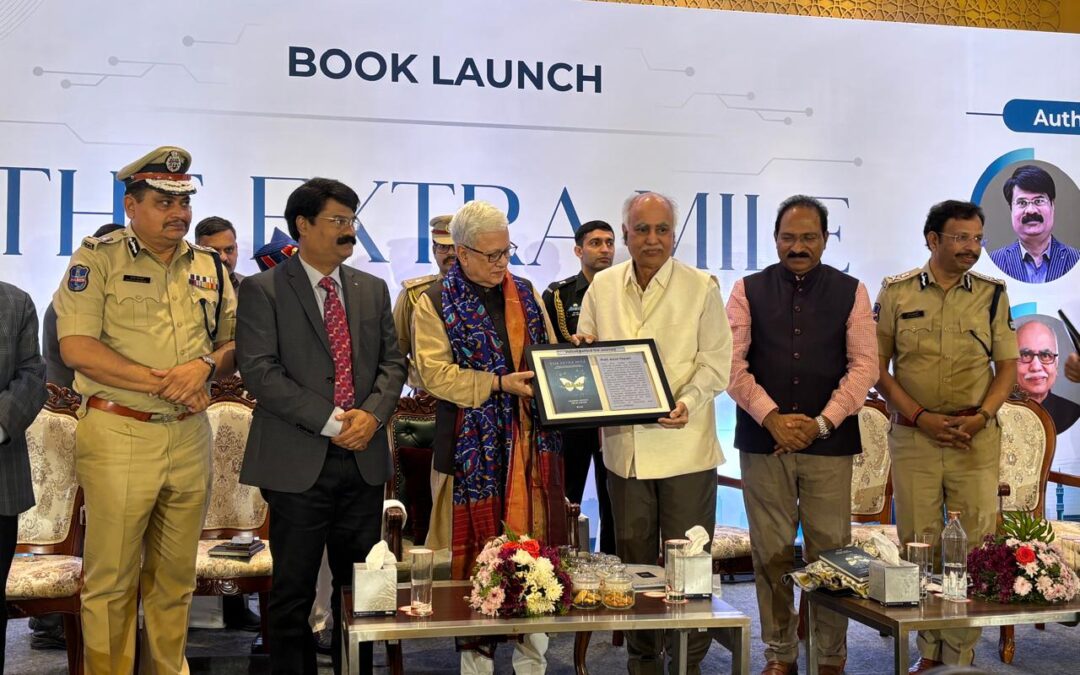
Finally, on a luminous December evening in 2025, Friday the 5th, the book was launched by the Honourable Governor of Telangana, Shri Jishnu Dev Varma—a prince of the old Tripura lineage—alongside senior officers, SCSC’s founding leaders, technologists, volunteers, and countless citizens who had experienced both sorrow and solidarity during those months. The Convention Hall at Hotel Daspalla—named after the ancient coastal kingdom of hills, forests, and rivers, now modern-day Vishakhapatnam—radiated a sense of purpose fulfilled. We chose Dr A. P. J. Abdul Kalam’s line as the epigraph: “Extraordinary people are those ordinary people who do extra work.” It was the perfect gateway into what I wished to share when my moment at the podium arrived.

The extra mile is not about an outward sprint; it is an inward gesture—a quiet vow: I will give a little more than what is asked, not for applause, but for the integrity of the act. This vow reveals itself in the smallest details of everyday life. The young engineer who notices the server room overheating does not walk past, murmuring, “Not my department”; he alerts the right people and prevents a failure no one else imagined. The professor who senses confusion clouding her students’ minds prepares a simple, clarifying handout, even though no syllabus demands it. The doctor finishing a weary shift sits with an anxious patient for a few unhurried minutes, knowing that reassurance can heal where medicine cannot.

In offices, the extra mile often appears as initiative: the colleague who gathers data and proposes solutions rather than rehearsing complaints. At home, it is the person who stays back after the party laughter has faded and quietly restores order—washes dishes, clears garbage, and rearranges furniture and coverings. For the farmer, it is sharpening tools late at night so that the next day’s labour is more productive. For the shopkeeper, it is letting a customer leave with twenty rupees pending because humanity weighs more than arithmetic. For a teacher, it is being ever ready to help the slowest student.

The extra mile has little to do with working longer or seeking recognition. It is about arriving at the right moment when needed, noticing what others overlook, and repairing what was not broken by you. It involves choosing quality even when no one will ever know. Here, the Bhagavad Gita enters like dawn light and gives the shloka— Karmanyeva adhikaras te ma phaleshu kadachana (2.47), which explains the concept of Nishkama Karma—action without attachment to reward.. Our authority rests in the action alone; the fruit is never ours to claim. To walk the extra mile is simply to embody this truth. It is the Gita quietly breathing through our everyday lives—devotion not in grand gestures, but in small, steadfast, selfless acts that gently refine the world from within.

For in the end, it is not the magnitude of a deed but the purity of intention that shapes character. And character, slowly built through unnoticed choices, earns trust and affection without ever demanding them. Those who walk the extra mile never walk it alone; their sincerity gathers companions, lightens burdens, knits communities, and makes the long road gentler for all.

And perhaps that is why one eventually realises: the extra mile is never crowded—because it is walked not by the strong, but by the sincere.

May the brave volunteers, the selfless leaders, and all the souls who risked their own safety and comfort to lift another out of fear or darkness be blessed with lives of abundance! May their courage ripple outward, inspiring others to step forward when the world trembles. And may their tribe increase—steadily, silently, like lamps lighting other lamps—until compassion becomes our civilisation’s most natural instinct. For it is in precisely such moments, when ordinary people choose to give more than is asked, that the extra mile reveals itself—not as the heroic road of a select few, but as the true path on which humanity moves forward together.

MORE FROM THE BLOG

From Disease to Wellness: Time for a Paradigm Shift

From Disease to Wellness: Time for a Paradigm Shift

Modern medicine is magnificent at one thing: it rushes heroically to the battlefield after the war has already been lost. When the coronary artery is blocked, a stent is inserted. When the pancreas fails, insulin is administered. When cancer erupts, it deploys...

A Hero’s Journey of Taking Cognition Beyond Mortal Neurons

A Hero’s Journey of Taking Cognition Beyond Mortal Neurons

In an age mesmerised by rankings, metrics, and loud declarations of success, the most consequential journeys often unfold quietly. They are not propelled by brilliance alone, but by curiosity, humility, and an unyielding fidelity to truth. The exploration of...

Science, Service, and the Long Goodbye to Leprosy

Science, Service, and the Long Goodbye to Leprosy

It was already evening when they arrived, and I sensed a good feeling. The light had softened, retreating gently from the edges of objects, as though the day itself wished to listen to what came next. Dr. Gangadhar Sunkara came with Dr. Chinnababu Sunkavalli—both...
The Theatre Within

The Theatre Within

The Theatre Within

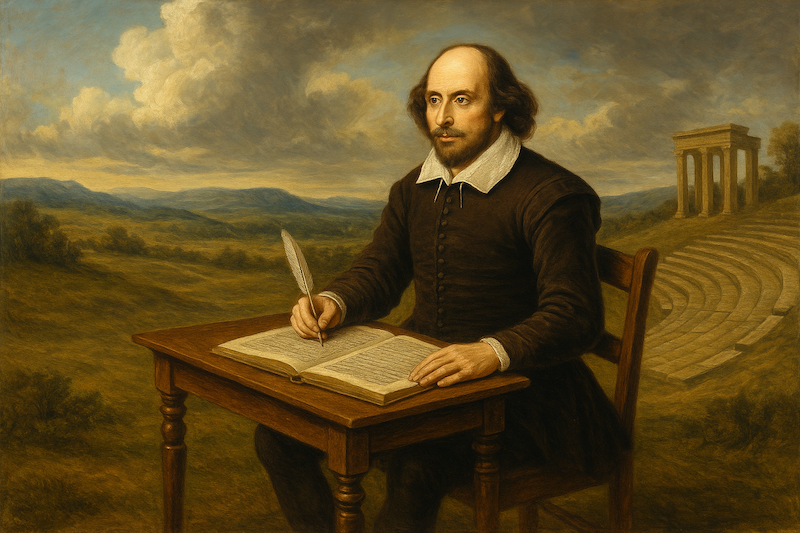
I have been fascinated by Shakespeare, as most of those fancy English phrases and words that enchanted me were created by this one man who lived in England during 1564–1616. I was always intrigued by how one individual could produce such a great body of work that continues to charm billions of English-speaking people over centuries. Then, a biography of Shakespeare, written by Peter Ackroyd (b. 1949), landed in my hands. It was such a wonderfully written book that for nearly a month, I remained under its spell, and this blog is my way of sharing that wonderful feeling.

What bewilders me about Shakespeare is not just the scale of his creativity—38 plays, 154 sonnets and two long narrative poems—but the breadth of human experience he was able to hold in his words. Peter Ackroyd’s biography reveals a man shaped by ordinary circumstances: born to a glove-maker, married young, father to three children, losing his only son at eleven, living through plagues, fires, political tension and religious unrest. Yet, from such turbulence, emerged a voice that could articulate joy and jealousy, ambition and doubt, love and rage, and grief and transcendence.

Ackroyd portrays not a divine genius floating above life, but an actor, businessman and working dramatist who navigated the vibrant, noisy streets of London. He walked among butchers and beggars, ship captains and silk merchants, lovers and lawbreakers. What he saw, he wrote. What he heard, he transformed. His theatre, The Globe, was literally circular—a metaphor for the human experience he shaped into drama.

Shakespeare is said to have created more than 1,700 new words, enriching the English language. These include popular words like majestic, lonely, eventful, radiance, and amazement, and phrases like break the ice, own flesh and blood, forever and a day, love is blind, wear my heart upon my sleeve, and the world is my oyster. To think that everyday speech today is sprinkled with the words he coined is almost haunting. It reminds us that behind every word is a mind that dared to express the unspeakable. The words Shakespeare teaches are not just tools; they are carriers of unexpressed feelings and emotions.

Ackroyd beautifully draws out how Shakespeare understood that ‘Drama is the language of the soul.’ His plays were not mere stories but cathartic journeys. The Greeks called it catharsis—the purging of emotions to restore inner balance. Shakespeare perfected it. Hamlet gives words to grief and existential despair. Othello shows how jealousy can consume dignity. King Lear explores old age, betrayal, and the tragedy of dignity stripped away. Macbeth is ambition turned into horror. The Tempest becomes forgiveness from the depths of pain. Even his comedies—As You Like It, A Midsummer Night’s Dream, and Twelfth Night—are not frivolous. Beneath the laughter lie longing, mistaken identity, the search for love and the desire for belonging. Every laugh comes with a tear. Every tragedy offers a glimpse of redemption.

We often imagine Shakespeare writing in solitude. But he was as much an actor as a playwright; his words were meant to be lived on stage. Shakespeare wrote not just to be read, but to be performed. He crafted his lines to suit the natural rhythms of spoken language and the physical movements of actors, aiming to elicit strong emotional reactions from the audience.

When we read King Henry V saying, “We few, we happy few, we band of brothers”, we hear a call to courage spoken before battle. When we read Venus saying to Adonis, “Bid me discourse, I will enchant thine ear”, we feel the seduction of language itself. When we encounter Queen Margaret telling Richard, the defeated Duke of York, “Lord, how art thou changed”, we face the fall of pride and the fragility of power. His drama becomes the mirror in which we now recognise ourselves.

It is not without reason that Shakespeare is studied today not just by literature students but also by psychologists, business leaders, spiritual thinkers and actors. He did not merely reflect life—he reframed it so we could see ourselves better. In a world moving fast, where emotional suppression equals strength, Shakespeare writes:

Give sorrow words; the grief that does not speak
Whispers the o’er-fraught heart and bids it break.

    (Macbeth, Act IV, Scene 3)

Peter Ackroyd reminds us that Shakespeare lived through multiple waves of plague. Theatres would close, silence would fall, and people would turn inward. Yet, when the stage reopened, crowds gathered in the thousands. Why? Because theatre allowed them to feel again, to release their silently carried sorrow. The greatest gift an artist, author, or dramatist offers is emotional ventilation—a safe space to cry without trauma, to laugh without danger, to confront fear without consequence. When people stop feeling, they stop healing.

In our age of artificial intelligence, virtual reality and drowning distractions, we still gather to watch a play, read a book, or recite a poem. Why? Because deep within, we are Shakespearean—we want to feel, to relate, to recognise our inner tensions reflected back to us. Ackroyd shows that Shakespeare did not escape life; he entered it more fully. Each character, each soliloquy, was his way of untangling human conflict.

“To be, or not to be (Hamlet, Act III, Scene 1) is not a philosophical line. It is a cry from someone on the edge of despair. Who does not feel so at some stage of one’s life? No wonder actors feel possessed when performing Shakespeare’s roles. No wonder audiences don’t just watch—they internalise. The evil of Langda Tyagi, in the film Omkara, the Hindi version of Iago in Othello, is felt.

At a time when content is instant, and attention is fleeting, Shakespeare reminds us that depth matters more than speed. He teaches that the most fragile experiences, like love, guilt, longing, beauty, and sorrow, are the most powerful forces shaping human life. AI may simulate dialogue, but cannot yet simulate the tremor of Hamlet’s voice before he speaks. Technology may scale emotion, but only theatre cultivates the courage to face it.

Ackroyd concludes that around 1611, Shakespeare quietly returned to Stratford, retiring from the thunder of applause into domestic silence. He died five years later, not in glory but in stillness. Yet the world continues to speak his words even today. There is something profoundly humbling about this. Greatness does not always end in celebration; sometimes it ends in contemplation. Just as actors exit the stage while the world goes on, Shakespeare left life, having already entered eternity. He writes in his last play:

We are such stuff as dreams are made on…

(The Tempest, Act IV, Scene 1)

As I enter my seventies, I spend much of my time at home due to health reasons and find myself increasingly in the quiet company of books and thoughts. In this stillness, reading and writing—like this very blog—have become my companions and pathways to inner journeys. Shakespeare, in particular, has emerged not merely as an author from a distant era but as a fellow traveller of consciousness, a timeless soul who speaks to me across centuries. In moments of solitude, his words make me smile, stir my wonder, and gently remind me that consciousness is one—unbroken, interconnected and eternal. Though my physical world may have narrowed, my inner world expands endlessly through these conversations with his works. In these moments, I realise that not only does Shakespeare live on through his writing—he also lives quietly within me, keeping alive the joy, the curiosity and the eternal internal theatre of the human spirit.

MORE FROM THE BLOG

From Disease to Wellness: Time for a Paradigm Shift

From Disease to Wellness: Time for a Paradigm Shift

Modern medicine is magnificent at one thing: it rushes heroically to the battlefield after the war has already been lost. When the coronary artery is blocked, a stent is inserted. When the pancreas fails, insulin is administered. When cancer erupts, it deploys...

A Hero’s Journey of Taking Cognition Beyond Mortal Neurons

A Hero’s Journey of Taking Cognition Beyond Mortal Neurons

In an age mesmerised by rankings, metrics, and loud declarations of success, the most consequential journeys often unfold quietly. They are not propelled by brilliance alone, but by curiosity, humility, and an unyielding fidelity to truth. The exploration of...

Science, Service, and the Long Goodbye to Leprosy

Science, Service, and the Long Goodbye to Leprosy

It was already evening when they arrived, and I sensed a good feeling. The light had softened, retreating gently from the edges of objects, as though the day itself wished to listen to what came next. Dr. Gangadhar Sunkara came with Dr. Chinnababu Sunkavalli—both...