
Technology, Post-Truth, and the Art of Storytelling
I count it among the quiet privileges of my life that I live in Cyberabad, that curious frontier of Hyderabad where glass and code rise together, and where the pulse of the contemporary world beats with an almost inaudible insistence. Yet, even here, amid the measured rhythm of machines and meetings, there comes a moment when the mind turns restless in its own enclosure—when the walls of one’s study, however familiar, begin to feel like a narrowing horizon.
It is then that I step out, not so much in search of diversion as in search of renewal, and find myself drawn, almost instinctively, to institutions—those living spaces where thought gathers, where ideas are not merely spoken but shaped, contested, and, in their quieter moments, allowed to become the future. These visits unfold as small, inward journeys—intellectual pilgrimages, if one may call them so—where the act of arriving is itself a kind of reflection.
Of all such places, the International Institute of Information Technology Hyderabad has, over time, become a point of gentle return. There is, upon entering its campus, a peculiar stillness—not an absence of activity, but a presence of thought. The corridors seem to hold a subdued resonance, as though they remember conversations not yet concluded, and discoveries not yet made. One walks through them with a certain attentiveness, sensing that beneath the visible order of classrooms and laboratories there moves an undercurrent of inquiry, of possibility, of futures quietly assembling themselves out of the discipline of the present.
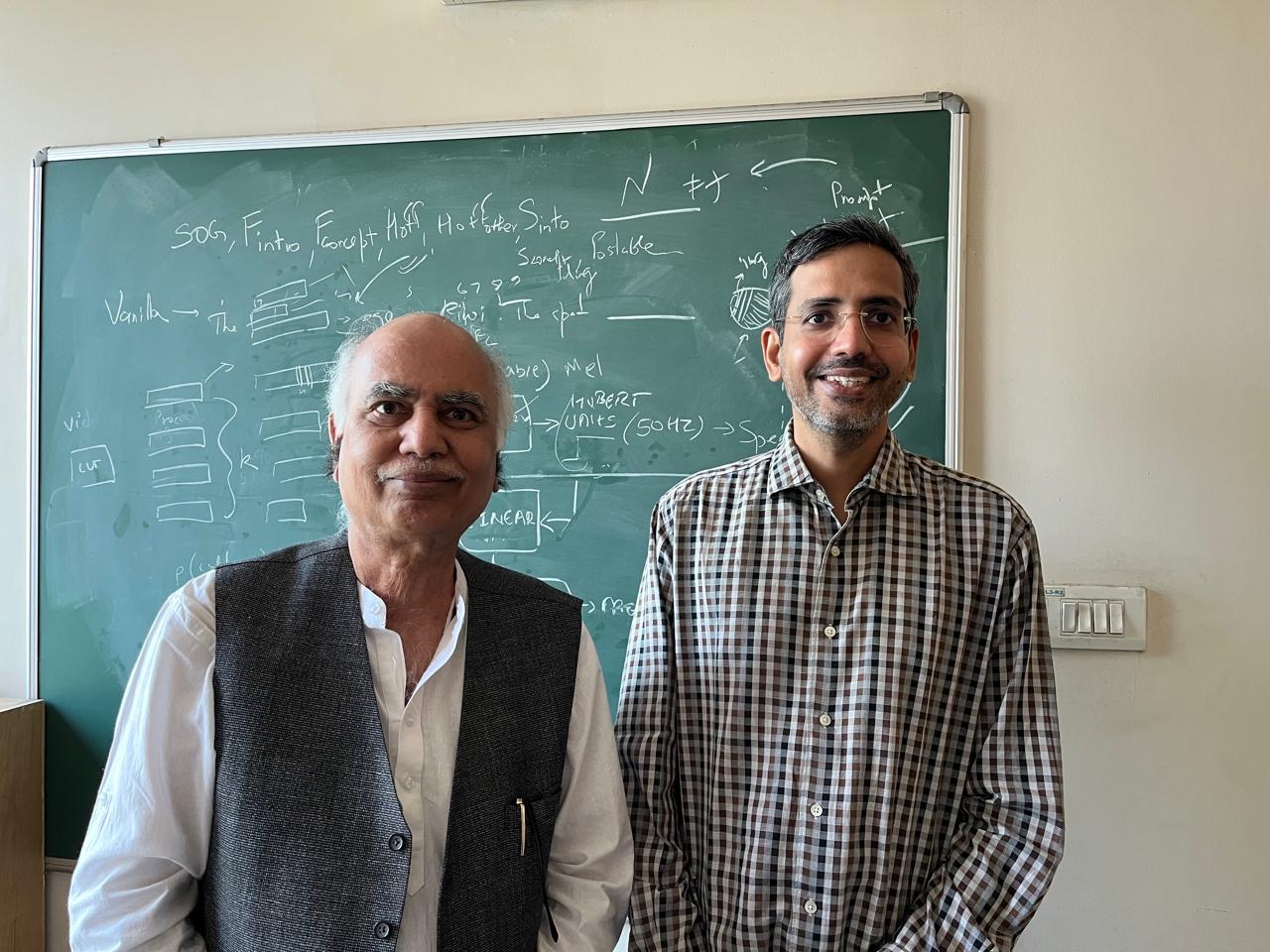
During a recent visit, I found myself lingering through an entire forenoon with Vineet Gandhi, who leads the Centre for Visual Information Technology. Conversations with researchers have a cadence of their own—they seldom declare their destination at the outset. The meeting, arranged at the behest of Deepti Gaddam, Managing Director of Ozone Hospitals and a successful technology curator, began almost ceremonially with introductions. Then, as if yielding to a deeper current, it unfolded through stories of journeys and ideas. What is termed ‘incubation’ in computer science revealed itself, in that room, as something more intimate—a quiet humanisation of technology.
Vineet’s own journey seems to trace the quiet arc of a new generation of global Indian scientists. Born in Pipar City (पीपाड़), a small town in Jodhpur district, and schooled in Ajmer, he carries within him that early geography of modest beginnings, which so often widens, rather than limits, one’s horizon. From there, he moved to the Indian Institute of Information Technology, Design and Manufacturing, Jabalpur, graduating in 2009, and soon after, as if answering a larger summons, left for Europe on the prestigious Erasmus Mundus programme.
Within the CIMET consortium—Colour in Informatics and Media Technology—Vineet’s education unfolded across intellectual and geographical landscapes, weaving together disciplines and cultures into a single, evolving inquiry. His master’s programme unfolded as a passage across borders—one semester in Spain, another in Norway—each landscape offering not merely a change of place but a shift in intellectual temperament. By the time he arrived at the National Institute for Research in Digital Science and Technology in France to complete his thesis, the journey had already begun to assume the quality of a quiet synthesis. It was there that he remained to pursue his doctoral work in applied mathematics and computer science under Rémi Ronfard, a pioneer in the intriguing field of Computer Theatre—where storytelling does not merely borrow from computation, but is reshaped by it, finding new grammars of expression at their intersection.
In 2015, Vineet returned to India, as though completing a wide arc, and joined the International Institute of Information Technology – Hyderabad as a Senior Research Scientist. Over the years, he has grown into a steady and thoughtful presence within its research community, and today, as an Associate Professor, he contributes to its vibrant ecosystem in visual computing and artificial intelligence. Alongside his academic work, he serves as Chief Scientific Advisor at Animaker Inc., where his insights flow outwards—translating the abstractions of computer vision into tools creators across the world use, often without pausing to consider the science that enables them.
This dual inhabitation—one foot anchored in the reflective quiet of academia, the other stepping into the restless terrain of real-world innovation—suggests a new form of scholarship. The researcher is no longer confined to the slow, solitary afterlife of published papers; knowledge now seeks embodiment, moving outwards into platforms and products that subtly reshape how the world sees, tells, and remembers its stories.
Listening to Vineet in person, whom I had previously knownonly through the media, I became aware—almost with a certain humility—of how little I truly understand of media technology. My relationship with cinema has largely been that of a spectator, one who receives images as they appear, without perceiving the intricate and invisible machinery that gives them form. And yet, in that moment, it seemed that behind every frame there lay not only technique, but an entire architecture of thought—patient, precise, and quietly transformative.
For me, digital media long remained a distant, almost mythical realm beyond engineering. Steve Jobs changed that perception—building Pixar into a pioneer of digital storytelling, and later reshaping not only music, but also how it was produced, distributed, and valued through the iPod and iTunes. In doing so, he showed how computation, creativity and narrative could converge to redefine entire creative industries.
Today, as we watch television or scroll through digital media, certainty itself seems to waver: is what we see real or fabricated, truth or simulation, human-made or machine-generated? These questions have stayed with me as I work on The Mirror and the Maze, my new book about a post-truth world—an environment in which objective facts recede, and perception is shaped more by emotion, belief and repeated narratives than by verifiable reality. Technology has given us the power to simulate reality—but with it comes a deeper philosophical unease about what reality now means.
Yet this uncertainty did not arrive overnight. The modern world has already lived through a quiet cognitive revolution—brought about not by books, but by cinema. While books, for centuries, remained the preserve of the literate and even within that, a reflective minority, films crossed those boundaries with ease. They spoke in images, emotions, and archetypes, reaching millions simultaneously, imprinting ideas with a force that text alone rarely achieves. Cinema did not merely entertain; it reshaped perception itself, training societies to see, feel and believe through narrative.
At the heart of every memorable film lies a story—an emotional thread that binds image to meaning and moment to memory. Films like Mayabazar and Mother India have shaped a civilisation’s sense of heroism and duty, while The Godfather and The Wolf of Wall Street expose the darker undercurrents of power. Even the recent Dhurandhar reflects the anxieties of nationhood, where visible narratives meet unseen forces.
And yet, beneath these varied expressions, something remains unchanged. Technology may refine the instruments of storytelling, but the human hunger for stories is insatiable, for we continue to seek the meaning of our own existence. What gives a film its life is not the apparatus, but the story it carries—a quiet bridge between what we see and what we feel. A great film is one in which the audience finds something of themselves.
My conversation with Vineet Gandhi unfolded in his modest chamber, suffused with the unmistakable stillness of a scholar’s workspace. On one wall stood a large, old-fashioned green board rather than the whiteboards in vogue today. He uses dust-free chalk sticks imported from Japan. “A couple of sticks last an entire semester”, he said, almost as an aside, with a gentle smile.
Before I left, he placed a few of those chalk sticks in my hand as a parting gift, thanking me for coming—small objects, yet curiously weighty in their suggestion. They seemed to remind me that, for all the sophistication of artificial intelligence and digital media, learning still begins in simplicity: a teacher, a board, and an idea slowly taking shape through the movement of a hand.
MORE FROM THE BLOG
The Resilient Doctor
Dr. Prithvi Raj Jampana is a distinguished radiation oncologist with extensive experience in radiotherapy and systemic treatments for a wide range of cancers. He trained in clinical oncology at Oxford University Hospitals and worked in the UK for over two decades...
AI, Stories and the Mind
I have been reading an English translation of the Kathasaritsagara—The Ocean of the Streams of Stories—composed in Sanskrit by Somadeva, a Kashmiri writer of the eleventh century. Organised into eighteen books, it is less a conventional book than an immense...
The Wellness Dividend
One teaching of Dr. A.P.J. Abdul Kalam that I have always tried to follow is to ‘stay in circulation’, as he put it. By this, he did not merely mean travelling, attending meetings or remaining publicly visible. He meant keeping the mind in motion—meeting people,...
Dear Sir, This brilliant piece masterfully connects the cutting edge of visual AI with the timeless, essential human need for narrative in an increasingly complex digital landscape.It serves as a powerful reminder that while technology can endlessly simulate and alter reality, true meaning must still be responsibly earned and deeply felt through the stories we tell.
What a contemplative and beautiful essay! Your trip to IIIT Hyderabad and your meeting with Vineet Gandhi seem to be an authentic academic pilgrimage.
Your depiction of the calm grace of academics, the fusion of humble origins with exceptionalism, and the fundamental philosophical queries about technology, mythology, and reality is profoundly moving.
It’s fascinating to witness how Vineet’s life story, from Pipar City to the cutting edge of visual computing and artificial intelligence, and how he always relies on his Japanese chalk sticks to write on a greenboard, illustrates genuine excellence. The act of leaving behind a set of chalk sticks as a farewell gesture is incredibly touching.
Thanks for bringing us on this internal trip. Your prose remains one of a kind. We look forward to reading your next book, The Mirror and the Maze.
It’s truly fascinating to think of how you have blended academia and real-world applications of AI and visual computing and the way you have weaved in the broader themes of storytelling, media technology, and the post-truth era is seriously thought-provoking. It’s a reminder that, at the heart of all this technology, the core human need for connection and understanding through stories often remains unchanged. It’s quite clear that simplicity still holds weight in an increasingly complex world.
What a thought-provoking piece this blog is! If the future is shaped not just by those who build technologies but by those who frame them, then storytelling itself must mature. It must move beyond seduction toward stewardship. The storyteller is no longer just an artist of imagination, but a custodian of collective sense-making. “Peculiar stillness—not an absence of activity, but a presence of thought” is beautifully written, sir.
Because in the end, reality can indeed be contested—debated, reframed, even obscured. But meaning cannot be manufactured indefinitely without consequence. It either deepens through engagement with truth, or it erodes into noise. And when the noise clears, what remains—quietly, persistently—is meaning that has been earned. Thank you, Sir, for making us reflect.
Respected Sir, your blog brings together three forces that increasingly define our age—technology, post-truth, and storytelling—and reads more like a diagnosis than an observation. What stands out is the quiet recognition that the crisis we face is not merely one of misinformation, but of meaning. Technology has not just amplified voices; it has altered the very architecture through which reality is perceived. In such a landscape, storytelling is no longer a cultural artefact—it becomes an epistemic tool. Thank you for bringing gems like Prof Vineet into the public eye.
Sir, your framing raises an uncomfortable but necessary question: if stories can construct reality, who then curates the storytellers? Algorithms today are not neutral conduits; they are invisible editors shaping which stories gain visibility and which fade into silence. In that sense, technology is not just the medium—it is an active participant in storytelling.
What lingers after reading your piece is a subtle but powerful proposition: that the antidote to post-truth is not the abandonment of storytelling, but its elevation. We need stories that are not only compelling but also coherent with reality; not only persuasive but also responsible. The art of storytelling must now rediscover its ethical core.
Hon’ble Arun Sir, thank you very much for writing and sharing such a nice visit to IIIT and journey of Dr Vineet Ghandhi. I salute to your interest in various subjects and meeting many people pioneers in different fields. Indeed Dr Vineet from Pipad, Rajasthan my own state (me from Rajlia, Kuchaman city) is very hardworking scientist having lot of experience in the technology. Technology including digital media and cinema transforming the world and making life easy and fast, a real service to common human being.
A technology does not arrive with a fixed meaning. It arrives as potential—ambiguous, open-ended, even morally neutral. Artificial intelligence can be framed as augmentation or replacement, as empowerment or surveillance. Social media can be seen as a connection or a fragmentation. Biotechnology can be narrated as healing or as transgression. The same underlying system can lead to radically different societal responses depending on the narrative that surrounds it.
This is where storytellers—writers, media, institutions, cultural voices—quietly assume a role as consequential as the technologist. They do not merely describe reality; they interpret it. And interpretation shapes adoption, resistance, regulation, and aspiration. A society does not respond to technology as it is, but as it understands it. That understanding is narrative. For example, the blog of Dr Ashok Tiwari (aighat.net) is providing such a lucid narrative about complex ideas.
The most compelling insight is the shift from truth as verification to truth as experience. In a post-truth environment, facts alone rarely persuade; narratives do. Repetition, emotional resonance, and identity alignment often outweigh empirical rigour. This does not diminish truth—it complicates its transmission. The storyteller, therefore, carries a new responsibility: not just to inform, but to anchor. To create narratives that do not merely engage but also endure scrutiny. Hats off to Prof. Vineet Gandhi.
Thank you Arun ji for sharing. Very simple statement that Learning still begins in simplicity
Prof Tiwari, your essay is a reflective piece that weaves together three strands. One, Technology & Institutions – Your visits to places like the International Institute of Information Technology Hyderabad show how ideas are quietly shaped through people like Vineet Gandhi. Two, Media and Perception – From cinema to AI, you highlight how storytelling (films like Mother India) has evolved into a force that can blur reality itself in today’s post-truth world.
How seamlessly you move between technology, storytelling, and civilisational vision…linking something as immediate as a campus visit to something as vast as India’s nuclear journey. The conversation with Prof. Vineet Gandhi adds a human dimension to what often feels like an abstract technological world. I was also struck by the way you connect storytelling….from cinema to digital media….to the emerging uncertainties of a post-truth world. Truly enriching read.
Prof Tiwari, what a journey this has been and continues to be! Indeed, the South stands to gain from the journey India has taken to come this far. What is clean and useful should be effective as an antidote to climate change, whose effects we currently experience. I am humbled by the modesty in referring to yourself as a small fry…
Dear Arun bhai, another masterpiece article with a lot of input on the technical side as well. You always cover a very wide range, from a farm and farmers’ requirements in a village to the nuclear programme and Uranium. The landscape of your writings and the scope of the subjects vary widely, providing a lot of knowledge and making it a valuable input for readers. Best Wishes.
Dear Prof., A very inspiring and powerful story of learning, technology and innovation! Thanks for sharing.
Respected Sir, Nice post with living example.
Dear Arunji, Inspiring jouney where science, storytelling, and real-world impact converge to quietly redefine how we create, perceive, and question reality. Nice to know about Vineet and his indepth knowledge in media tech.