
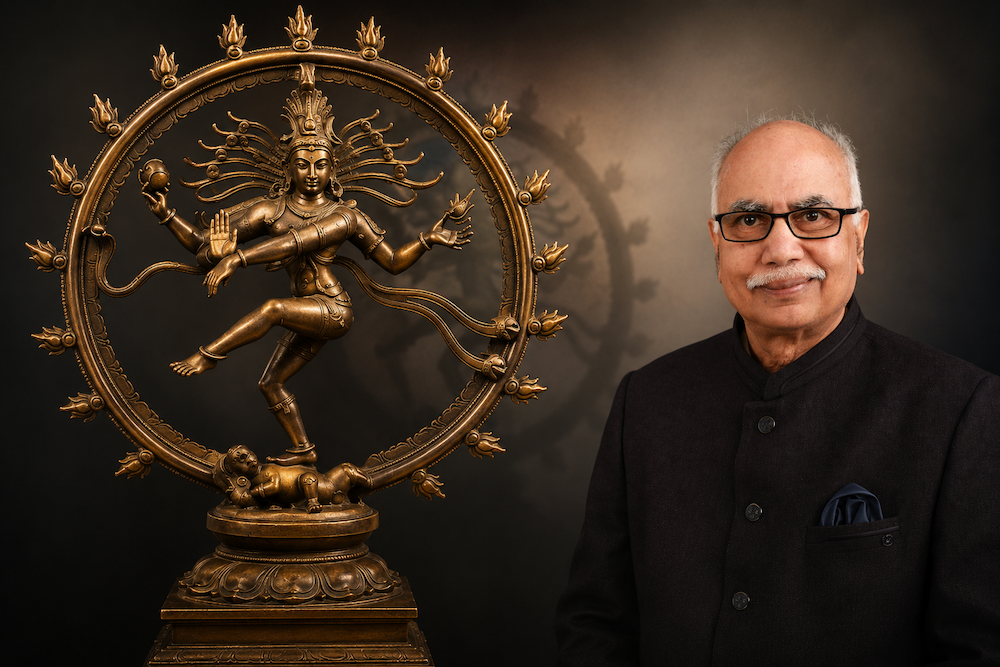
Nataraja: Metallurgy in Motion
Among the great images created by Indian civilisation, few possess the visual authority of the Chola Nataraja. Shiva dances within a circle of flame, one foot planted upon ignorance and the other lifted in liberating grace. His hair flies outward, his arms extend in several directions, yet his face remains serenely composed. Motion and stillness, destruction and renewal are held together in one form. It is not merely a god dancing, but a philosophical account of a universe continuously becoming, dissolving and beginning again.
The Chola Nataraja is also remarkable as a product of metal engineering. The sculptor had to transform an extraordinarily complex wax model—with extended arms, slender fingers, flying locks, flames, ornaments and an asymmetrically positioned body—into a durable copper-alloy image. Molten metal had to flow into every extremity before solidifying; the mould had to preserve minute details while containing the molten alloy; and the finished sculpture had to remain stable despite appearing to balance on a single dancing foot.
The precise construction method varied with the idol’s size and design. In some monumental examples, Shiva, the dwarf Apasmara, an icon of spiritual ignorance, ego, and forgetfulness of one’s true divine nature, and the flaming aureole were solid-cast together, while the lotus pedestal and rectangular plinth were cast separately and mechanically attached. What appears to the observer as a single, effortless composition could therefore be a carefully planned assembly of cast and joined components.
The engineering began long before the furnace was lit. The figure was constructed according to a canonical system of proportion in which the body was divided into modules that regulated the dimensions of the head, torso, limbs, hands, and overall stature. These proportions were not merely aesthetic conventions. They also controlled the length, position and mass of projecting components.
The raised leg extends across the body, four arms spread into the surrounding space, and locks of hair radiate from the head. If these elements were disproportionately long or heavy, they would increase the bending moments acting at the ankles, shoulders, wrists and hair junctions. Proportional geometry therefore helped the sculptor reconcile visual dynamism with physical stability.
In the living bronze-casting tradition of Swamimalai, the wax mixture has commonly been prepared from approximately equal proportions of beeswax and powdered dammar resin, softened with a small quantity of groundnut or sesame oil. Beeswax provides plasticity; the resin increases firmness and helps the model retain sharp edges; and the oil modifies its workability. The result is a modelling material that can be shaped by hand while remaining sufficiently stable to hold intricate detail.
Wax channels were then attached to the model. Some became pouring passages, or sprues, while others formed runners that distributed molten metal towards distant or delicate regions. Traditional prescriptions and surviving workshop practices often place these channels at the back, shoulders, neck and head, where the marks left after their removal would be least disruptive.
Their position was critical. Insufficient feeding could leave a hand, finger or flame incomplete. Poorly arranged passages could create excessive turbulence, trap gases or cause separate streams of metal to meet only after they had cooled too far to fuse properly. The channels therefore had to deliver metal rapidly and evenly while allowing displaced air and gases to escape.
The clay mould had to perform several apparently conflicting functions. Its inner surface needed to be fine enough to reproduce delicate facial modelling and ornament. At the same time, it had to be porous enough to release gases, refractory enough to withstand contact with molten copper alloy and mechanically strong enough to resist cracking or bursting during the pour.
The principal constituent of most early South Indian bronze images was copper, often forming around four-fifths or more of the alloy. Tin and lead were present in varying proportions, while zinc, silver, gold and other metals might occur in smaller or even trace quantities. The ritual term pancha-loha, meaning ‘five metals’, should therefore not be understood as a single, universally fixed metallurgical formula.
Tin increases copper’s hardness and strength, although excessive tin can make the alloy brittle. Lead has only limited solubility in copper and tends to remain dispersed as small globules, but it can improve the apparent fluidity and castability of the molten alloy. It may therefore help the metal enter narrow passages and reproduce fine details.
Yet some outstanding bronzes contain relatively modest quantities of both tin and lead. Their successful casting depended not merely upon a highly fluid alloy, but upon the entire foundry system: careful mould preparation, accurate temperature control, intelligent gating and rapid, well-directed pouring.
A Nataraja is especially difficult to cast because its sections vary greatly in thickness. The massive torso retains heat and remains molten longer than the slender fingers, flying hair and individual flames. If these thin regions solidify before they have filled completely, the result is a misrun—an incomplete casting. If two partly cooled streams meet, they may produce a cold shut, a weak seam where the metal fronts fail to fuse fully.
Thicker sections created additional challenges because metal contracts as it cools. Without continued feeding from reservoirs of molten alloy, shrinkage cavities, gas porosity, residual stresses, cracking and distortion could develop. The mould and gating system therefore had to ensure rapid filling of delicate features followed by progressive solidification, keeping heavier regions supplied with liquid metal long enough to compensate for contraction. The sculptor-founder was controlling not only the bronze’s form, but also the sequence in which it became solid.
The structural achievement is equally impressive. Visually, Shiva appears to float upon one leg. Mechanically, however, the load is distributed through a more complex system. The principal gravitational force passes through the supporting leg, the figure of Apasmara, the footplate and the pedestal. The entire geometry of the dancing Shiva is composed around this gravitational axis: although the limbs, hair and surrounding aureole extend dramatically into space, their masses counterbalance one another so precisely that the sculpture’s combined centre of gravity is brought into alignment with the single supporting leg. What appears to be movement at the edge of instability is, in fact, a remarkable achievement of static balance.
The Nataraja is therefore not a statue precariously balanced upon a single point of support. It is a carefully integrated structural system that conceals its engineering within its iconography. Apasmara becomes a compression-bearing element; the lotus pedestal becomes a load-distributing foundation; hair and ornamental links act as braces; and the aureole helps unite the composition mechanically as well as visually.
Chola craftsmen did not possess modern phase diagrams, finite-element models or computational fluid-dynamics software. Their knowledge was embodied in measurements, materials, proportions, workshop sequences and accumulated experience. A failed finger indicated inadequate feeding. A cracked investment revealed unsuitable clay, excessive moisture or insufficient drying. Porosity could indicate trapped gases, turbulence or inadequate control of the melt.
Over generations, success and failure produced a systematic body of empirical knowledge, transmitted through apprenticeship and grounded in close observation, disciplined practice and an intimate understanding of materials. This tradition remains alive in Swamimalai, where master sculptors and bronze casters from hereditary craft families continue to create sacred images through the lost-wax process, preserving historic proportions, materials and foundry techniques.
The continuing capacity of this tradition was dramatically demonstrated by the Nataraja installed at Bharat Mandapam for the 2023 G20 Summit in New Delhi. Standing 27 feet high including the pedestal and weighing approximately 18 tonnes, it was produced by traditional master craftsmen from Swamimalai using lost-wax casting and canonical proportions. Its scale was modern, but the fundamental sequence—proportional design, wax modelling, refractory investment, dewaxing, alloy melting, pouring and hand finishing—continued the historic South Indian foundry tradition.
The Chola Nataraja is thus not simply bronze shaped into a beautiful deity. It is geometry translated into wax, wax transformed into a refractory void, and that void filled through the controlled movement of fire and molten metal. Its deepest engineering triumph lies in making immense technical difficulty disappear.
The observer sees neither sprues nor solidification fronts, neither shrinkage cavities nor hidden load paths. One sees only Shiva dancing—bronze transformed into rhythm, mass into apparent weightlessness, and metallurgical knowledge into spiritual form.
MORE FROM THE BLOG
The Wellness Dividend
One teaching of Dr. A.P.J. Abdul Kalam that I have always tried to follow is to ‘stay in circulation’, as he put it. By this, he did not merely mean travelling, attending meetings or remaining publicly visible. He meant keeping the mind in motion—meeting people,...
A Teacher’s Legacy
Every year on September 5, India celebrates Teachers’ Day in memory of Dr. Sarvepalli Radhakrishnan (1888–1975), one of modern India’s most distinguished philosophers, teachers and statesmen. His life demonstrated that scholarship need not remain confined to the...
Beyond the Molecule
I recently visited PI Health Sciences Ltd. at Genome Valley, Hyderabad, at the invitation of my long-standing friend, Dr. S. Chandrasekhar, who joined the organisation as Chief Scientific Advisor after his superannuation as Secretary, Department of Science and...
A fascinating read, Sir. It’s striking how the sculptor had to think about molten metal reaching every fingertip and flame while the finished image still had to look balanced on a single foot. I wonder whether the canonical proportion system was as much an engineering aid as an aesthetic or religious one, since fixed ratios would also make casting and stability more predictable. Is that a fair way to see it?
This article beautifully reveals that the grandeur of Nataraja lies not only in its spiritual meaning but also in its extraordinary engineering. The apparent weightlessness of the dancing form conceals a profound mastery of proportion, balance, alloy composition, mould-making, molten-metal flow and controlled solidification. What appears to be divine movement is also metallurgy in motion.
Leaders, alliances and the distribution of global power will continually change. Nataraja reminds them that creation, preservation, dissolution and renewal belong to a larger cosmic rhythm. Standing before this magnificent image, the BRICS leaders seem not to command history but to participate briefly in its unending dance.
I was watching BRICS summit news on TV when I noticed the giant Nataraja idol you mentioned. Although some of the world’s most powerful political figures occupy the foreground, Nataraja dominates the picture—towering above them as a symbol of a civilisation far older than modern nations and political arrangements. Bhole Nath Ji ki Jai!