
A Teacher’s Legacy
Every year on September 5, India celebrates Teachers’ Day in memory of Dr. Sarvepalli Radhakrishnan (1888–1975), one of modern India’s most distinguished philosophers, teachers and statesmen. His life demonstrated that scholarship need not remain confined to the classroom; at its best, it can illuminate public life and guide a nation.
Dr. Radhakrishnan taught at several eminent institutions, including the University of Oxford, and was knighted in 1931. He served as Vice-Chancellor of Andhra University from 1931 to 1936 and of Banaras Hindu University from 1939 to 1948. After India attained independence, he became the country’s ambassador to the Soviet Union from 1949 to 1952, Vice-President of India from 1952 to 1962, and President from 1962 to 1967. Yet, through all these distinctions, he remained fundamentally a teacher. It is only fitting that his birthday became an occasion not merely to remember an illustrious life, but to honour the countless men and women who quietly shape the nation’s intellectual and moral character.
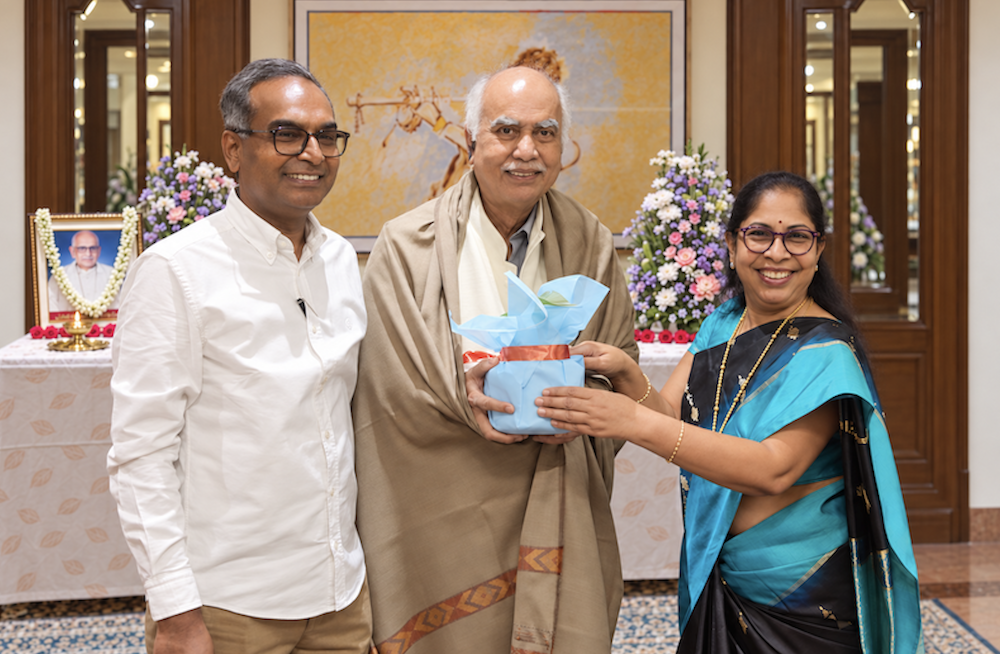
This year, Dr. Srivari Chandrasekhar, my long-standing friend and an eminent synthetic organic chemist, hosted a Teachers’ Day dinner at Dakshin, the iconic restaurant at ITC Kakatiya in Hyderabad. A large gathering of teachers attended, many from local schools and colleges, where they teach with financial support from Dr. Chandrasekhar and his wife, Bharathi. It was one of those rare evenings whose warmth remains long after the lights have dimmed and the tables have been cleared.
There was something deeply moving about the simplicity of the teachers gathered there. They carried no outward signs of power or privilege. Yet they possessed an unmistakable dignity—the quiet aura of people who have made useful work their livelihood and the growth of others their reward. Their lives may seldom receive public attention, but their influence travels through generations. A teacher may spend decades in the same classroom, yet through the students who pass through it, that classroom reaches laboratories, hospitals, industries, universities, public institutions and distant countries.
It is a sad truth that teachers in India are often underpaid. Their compensation rarely reflects the weight of the responsibility placed upon them. But a good teacher receives another kind of wealth: the affection of students, the respect of families and the knowledge that something of his or her mind and spirit will continue to live in the minds of others. This, of course, does not excuse society from paying teachers fairly. Respect cannot settle household expenses, nor can gratitude substitute for institutional support. Yet the love accorded to a good teacher remains one of the purest forms of recognition available in human life.
Dr. Chandrasekhar and Bharathi honoured me that evening as a teacher. It was indeed a humbling moment. I have never considered myself an academician in the formal sense. Except for a decade-long association as an adjunct faculty member at the School of Management Studies, University of Hyderabad, I possess few academic credentials that might justify such recognition. Most of my learning and work took place in laboratories, technology missions, public projects, books and conversations with remarkable people.
But perhaps teaching is larger than an academic appointment. A teacher is anyone who helps another person see more clearly, think more rigorously or act with greater confidence. A scientist explaining a failure to a young colleague is teaching. A physician listening carefully to a patient is teaching a young intern. A senior engineer who allows a junior colleague to attempt a difficult task is teaching. An author who places a hard-earned insight before an unknown reader is also, in some measure, teaching. Seen in this way, teaching is not merely a profession. It is a way in which knowledge accepts responsibility for the future.
Another satisfying part of the evening was meeting some of Dr. Chandrasekhar’s former students, now accomplished scientists in their own right. Over his three-decade academic career, he guided 97 scholars to complete their PhDs—an extraordinary achievement. Each doctorate represents far more than a thesis, a viva voce examination and a degree. It embodies years of experiments, failed chemical reactions, uncertain results, revised hypotheses, rejected manuscripts and the slow cultivation of scientific judgement.
Dr. Chandrasekhar also remembered, with equal warmth, another 13 students who had registered under his supervision but could not complete their doctoral work. For different personal, professional or academic reasons, they had to leave midway through the several years of demanding work typically required to complete a PhD. His remembrance of them was important. A teacher’s responsibility is not limited to those whose names appear successfully on a list. Those who could not complete the journey are also part of the teacher’s story. Education must retain compassion for unfinished journeys, for life does not always cooperate with ambition.
Of the 97 students who earned their doctorates under him, only about half pursued academic careers. The others entered industry, carrying their scientific training into the practical world of products, processes and manufacturing. More than 30 now work abroad, many in major chemical companies. Their paths remind us that the value of a doctoral education cannot be measured only by the number of professorships it produces. A scientist trained to observe accurately, question assumptions, endure uncertainty and learn from failure carries those capacities wherever he or she goes.
After retiring from the distinguished position of Secretary of the Department of Science and Technology, Government of India, Dr. Chandrasekhar did not retire from science. Through his association with GITAM University and PI Health Sciences, he continues to teach, mentor and participate in research. He hosted me at both places, and the vibrancy of the people around him struck me. Young researchers approached him freely. Questions moved easily across age and hierarchy. Ideas were discussed without ceremony. That atmosphere revealed something essential: a true teacher does not create dependence on himself; he creates confidence in others.
The continuity of this tradition became even more visible when Dr. Chandrasekhar spoke of his own teacher, the legendary Dr. A. V. Rama Rao, who guided 108 PhD scholars, including Dr. Chandrasekhar himself. His students once presented him with a unique Periodic Table containing 108 elements, each represented by the photograph of one of his doctoral scholars. It was a beautiful scientific metaphor. Just as the elements combine to create the material world, those students had carried their teacher’s influence into numerous institutions, disciplines and industries.
On the morning of Teachers’ Day, Dr. Chandrasekhar visited his guru. In speaking of Dr. Rama Rao’s achievement, he made his own remarkable record of 97 PhDs appear almost modest. But this is precisely how a great lineage of learning sustains itself. The accomplished student does not outgrow gratitude. He honours the teacher by extending the tradition, improving upon what he received and passing it forward. In Indian civilisation, the guru–shishya relationship has never been understood merely as a transaction of information. It is a living chain of trust, discipline, example and intellectual inheritance.
India’s chemical and pharmaceutical achievements offer visible evidence of this chain. The country has developed formidable capabilities in active pharmaceutical ingredients, generic medicines, agrochemicals and process chemistry. Its chemical industry is among the world’s most capable and competitive. Behind every successful molecule manufactured at scale stands an often-invisible community of teachers and students: professors who established laboratories with limited resources, research scholars who repeated experiments late into the night, technicians who refined processes, and industrial scientists who converted laboratory insight into reliable production.
The Indian scientific system has its share of shortcomings. Laboratories may face shortages of equipment and resources. Universities may struggle with bureaucracy. Research scholars may endure uncertain fellowships, inadequate infrastructure and long periods without encouraging results. Yet the system continues to produce scientists of international standing. This is not a reason to ignore its deficiencies. It is a reason to recognise the extraordinary human qualities that keep it alive despite them
During dinner, I asked Dr. Chandrasekhar what makes science—and especially the teaching of science at the highest level—truly great. His answer was concise: teacher commitment and student resilience.
The teacher’s commitment is not fulfilled merely by delivering lectures or signing progress reports. It means standing by a student through periods of confusion; protecting intellectual freedom while insisting on rigour; recognising potential before achievement makes it visible; and knowing when to guide, when to challenge, and when to step aside. A committed teacher does not provide easy answers to every question. He helps the student acquire the courage and discipline to pursue the answer independently.
The student’s resilience is the answering virtue. Research repeatedly confronts the young mind with failure. Experiments refuse to behave. Instruments malfunction. Papers are rejected. Promising ideas collapse under evidence. Resilience is not stubborn repetition; it is the capacity to absorb disappointment, learn from it and return to the problem with a better question. The student must remain teachable without becoming submissive, confident without becoming arrogant, and ambitious without losing integrity.
Commitment without resilience can produce frustration; resilience without commitment can become lonely endurance. But when the two meet, education becomes transformative. The teacher holds the lamp steady, while the student develops the strength to continue walking. One offers faith before success; the other justifies that faith through perseverance.
That Teachers’ Day dinner therefore became more than a celebration. It became a reminder of how civilisation renews itself. Nations are not built only in parliaments, factories or markets. They are built wherever one generation accepts responsibility for the next—where a teacher refuses to give up on a student and where a student rises once more after failure.
Blessed are such teachers. Blessed, too, are the resilient students who honour them not merely with flowers and words, but by carrying their learning into the world and making it fruitful.
MORE FROM THE BLOG
The Wellness Dividend
One teaching of Dr. A.P.J. Abdul Kalam that I have always tried to follow is to ‘stay in circulation’, as he put it. By this, he did not merely mean travelling, attending meetings or remaining publicly visible. He meant keeping the mind in motion—meeting people,...
Nataraja: Metallurgy in Motion
Among the great images created by Indian civilisation, few possess the visual authority of the Chola Nataraja. Shiva dances within a circle of flame, one foot planted upon ignorance and the other lifted in liberating grace. His hair flies outward, his arms extend in...
Beyond the Molecule
I recently visited PI Health Sciences Ltd. at Genome Valley, Hyderabad, at the invitation of my long-standing friend, Dr. S. Chandrasekhar, who joined the organisation as Chief Scientific Advisor after his superannuation as Secretary, Department of Science and...
A very moving reflection on the true meaning of teaching and mentorship. The thought that a teacher’s influence travels through generations, often far beyond the classroom, is beautifully expressed. A wonderful tribute to teachers, mentors and the enduring chain of learning. When I reflect back whatever I achieved is sumtotal of my mentors and teachers who supported me along the way.
Arunji,
A beautiful tribute to the teaching profession and to the teachers who quietly shape generations. The thought that a teacher’s influence travels far beyond the classroom is especially moving.
A timely reminder that teaching is not merely a profession, but a lasting legacy.
Arun Tiwari Sir, you beautifully show how true teachers carry no outward symbols of power, yet radiate a dignity born of commitment, compassion, and the courage to stand by students through confusion, failure, and growth.
Your reflections on Dr Chandrasekhar’s unwavering mentorship and the resilience of students who persist despite setbacks illuminate how civilisation renews itself—one steady lamp, one determined learner at a time.
Thank you, Arun Tiwari Sir, for offering a narrative that not only honours teachers but also rekindles faith in the quiet, transformative power of human guidance—something you have so generously given to scores of your mentees, including myself.
A deeply thoughtful and inspiring reflection on what truly makes a teacher’s legacy. A teacher’s greatest achievement is not merely the knowledge they impart, but the confidence, values and sense of purpose they awaken in their students. This beautifully reminds us that the influence of a true teacher continues far beyond the classroom, through the lives they shape.
Thank you for sharing such a meaningful piece.