
The Agony and the Ecstasy of Life
Since I met Dr Chinnababu Sunkavalli, the robotic surgical oncologist, in 2022 through an introduction by the Tangirala brothers, Venkat and Ravi, he has become part of my life. His enthusiasm, his commitment to connecting with people, and his extraordinary zeal to serve others have continually impressed me. When you see a younger person doing what you once wanted to do but could not, a special kind of bonding develops. There is neither envy nor regret, only the satisfaction of seeing an unfinished aspiration finding expression in another life. I wrote Live For A Legacy in 2023 about his work, and the book was warmly received, leading to a second edition earlier this year.
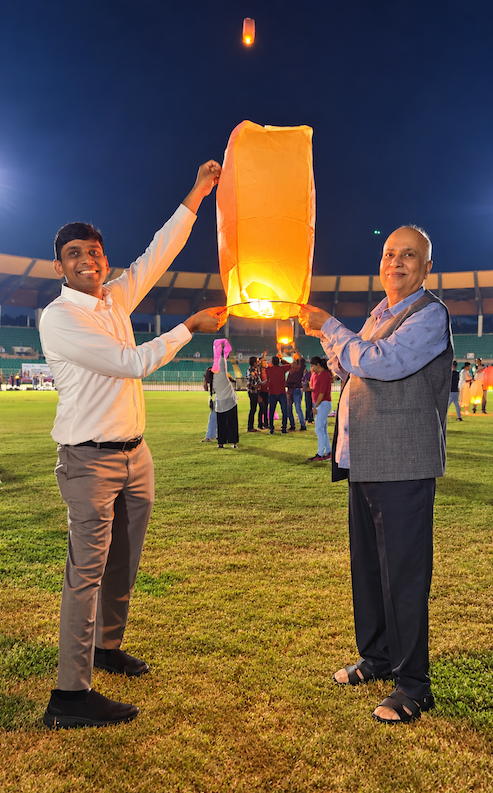
The evening before the Cancer Run on 11 October 2026, organised by the GRACE Cancer Foundation, which Dr. Sunkavalli co-founded, I attended a beautiful lantern-flying ceremony. The next day, the ninth edition of the Cancer Run drew more than 35,000 participants. By any standard, organising an event of this magnitude is an extraordinary achievement. Mobilising people, securing resources, coordinating with the city administration, and arranging hospitality for thousands require enormous dedication.
As I watched the lantern rise into the sky, a question came to mind. What purpose do such events really serve? How does public awareness of the agony endured by cancer patients actually reduce their suffering? Can a gathering of healthy people, however enthusiastic, make a meaningful difference to someone lying in a hospital bed, frightened by a diagnosis or exhausted by chemotherapy?
These questions stayed with me. These days, I often find myself revisiting my experiences, much like a cow chewing its cud, reflecting on events long past and gradually drawing meanings from them that weren’t apparent when I first lived through them. During this reflection, a novel I read long ago surfaced in my memory: Irving Stone’s The Agony and the Ecstasy, published in 1961. It tells the story of the great Renaissance artist Michelangelo Buonarroti, whose life was a seemingly endless contest between physical suffering and creative fulfilment.
Stone’s Michelangelo is not the serene genius whom posterity admires, but a restless, often tormented man driven by an inner vision that exceeds the limits of his body and circumstances. He cannot always control the people and forces shaping his life, but he remains fiercely determined to control his response to them, preserving his artistic integrity and remaining faithful to his creative vision.
He quarrels with patrons, struggles with poverty, endures loneliness, and subjects himself to punishing physical labour. Yet his mind remains absorbed in what might emerge from an unremarkable block of marble. Where others see stone, he imagines a living form waiting to be released.
His work on the Sistine Chapel ceiling becomes an especially powerful expression of this struggle. For years, painting in physically demanding conditions and under pressure from Pope Julius II, Michelangelo endured the exhaustion and frustration of creating something that had never existed before. I visited the Sistine Chapel in the Vatican in May 2013, and I still remember looking up at that magnificent ceiling, overwhelmed by the scale of his imagination and the extraordinary labour behind it.
Standing beneath those frescoes, I could almost sense the agony of the man who had created them more than 500 years ago, and the ecstasy he must have felt as his extraordinary vision came alive. The experience brought home to me a profound truth: Michelangelo’s extraordinary achievement was not that he escaped suffering, but that suffering could not extinguish his purpose. The beauty he created continues to move strangers who know little of his struggles but instinctively recognise the greatness of the human spirit behind his work.
Therein lies the central insight of Stone’s novel. The human mind is not simply a passive observer of life’s circumstances. It interprets experiences, assigns meanings, creates possibilities, and sometimes discovers reasons to continue when circumstances offer little encouragement. The same event can overwhelm one person and awaken extraordinary resolve in another. A person’s inner world is as real as the external world in which they must live.
Cancer is an unwelcome biological invasion. It asks no permission, respects no ambition, and distinguishes no one as virtuous or careless. There are several well-established risk factors, including tobacco consumption, alcohol use, certain infections, environmental exposures, and inherited genetic susceptibility. Yet people who live remarkably disciplined lives, eat sensibly, exercise regularly and avoid known hazards can still develop the disease. Some cancers arise through the accumulation of cellular changes that cannot be attributed to any personal failure.
Cancer is particularly unsettling because it challenges our comforting assumption that good conduct necessarily produces good outcomes. Even someone who has taken every precaution may suddenly find life split into two periods: before diagnosis and after. Familiar routines give way to investigations, pathology reports, treatment decisions, hospital visits and the unbearable uncertainty of tomorrow.
The mind becomes a second arena of suffering, where fear of death mingles with anxieties about disfigurement, loss of independence, financial difficulties, interrupted careers, and the future of children. Some patients suffer more from the thought of becoming a burden than from the physical discomfort of treatment, while others experience profound loneliness despite being surrounded by loving relatives.
The family, too, enters a prolonged ordeal. A cancer diagnosis can reorganise an entire household, deplete savings of decades, and turn spouses into caregivers, children into anxious witnesses, and elderly parents into helpless spectators of their children’s suffering. Although modern treatments can cure or control many cancers, advanced disease may bring prolonged suffering and a slow, devastating decline, exacting an enormous emotional, physical and financial toll on the entire family.
What, then, can the mind accomplish?
Hope, emotional support, spiritual strength and a sense of purpose can certainly improve how a person experiences illness. They may help patients tolerate treatment, communicate their needs, preserve relationships and find meaning in ordinary days. But it would be scientifically misleading and morally unfair to suggest that positive thinking can cure cancer, or that patients who deteriorate have somehow failed to summon sufficient willpower.
The mind is no substitute for surgery, radiotherapy, chemotherapy, immunotherapy, or effective pain relief, but it helps a person retain their humanity rather than being reduced to a disease. This is where society must step in, going beyond celebrating medical technology to ensure early diagnosis, affordable treatment, pain relief, counselling, practical support for caregivers, and compassionate end-of-life care. It must recognise the immense unpaid labour of families and refuse to leave patients suffering in isolation.
Seen in this light, the Cancer Run becomes much more than a physical activity. Thousands running together declare that cancer is not merely a family’s private misfortune but a shared human concern. Such events can encourage screening, challenge stigma, mobilise volunteers, raise resources, and awaken compassion, provided that one morning’s enthusiasm translates into sustained support throughout the year. I now see my association with Dr. Chinnababu in this larger perspective. Beyond his surgical expertise, his remarkable ability to bring people together represents another dimension of healing: building a community around those most vulnerable. The surgeon treats the disease; the community must help protect the person.
The lesson of The Agony and the Ecstasy is that agony and ecstasy are inseparable dimensions of human existence. We are all mortals, and death comes in myriad ways, cancer being only one of them. What ultimately matters is not how long we live or how we die, but what we make of the days given to us. Michelangelo left behind masterpieces in marble and fresco, but a life lived with kindness is no less of a creation. A burden shared, a helping hand extended in times of distress, or a gentle word remembered long after we are gone can be equally enduring masterpieces of the human spirit. We may never have our names engraved in stone, but we can leave the goodness of our hearts in the lives we touch. May Dr. Chinnababu’s tribe increase.
MORE FROM THE BLOG
Tea, Coffee, or Me?
Though I have been a tea person all my life, coffee has always intrigued me. During my travels in the United States, it seemed to be everywhere: at breakfast tables, in offices, beside hotel reception desks and in paper cups carried through the streets. In Ethiopia, I...
The Resilient Doctor
Dr. Prithvi Raj Jampana is a distinguished radiation oncologist with extensive experience in radiotherapy and systemic treatments for a wide range of cancers. He trained in clinical oncology at Oxford University Hospitals and worked in the UK for over two decades...
AI, Stories and the Mind
I have been reading an English translation of the Kathasaritsagara—The Ocean of the Streams of Stories—composed in Sanskrit by Somadeva, a Kashmiri writer of the eleventh century. Organised into eighteen books, it is less a conventional book than an immense...
0 Comments