
Layers of Becoming
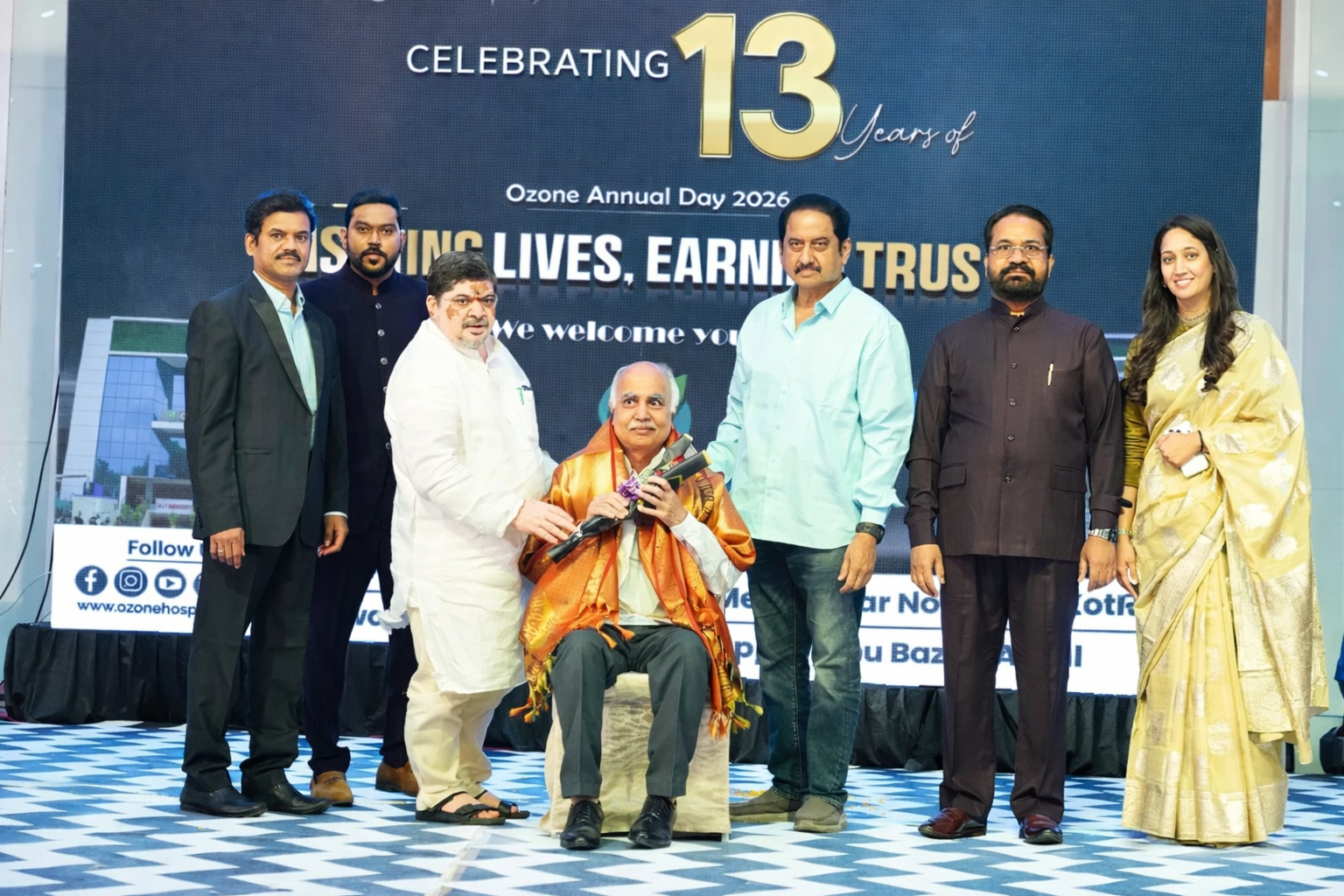
When I sat on the chair on stage to be felicitated on the 13th Foundation Day of the Ozone Hospital, on February 28, 2026, and Telangana Transport Minister Mr. Ponnam Prabhakar, Telugu film star of yesteryears Mr. Suman Talwar, and Chairman Mr. Satya Sai Prasad wrapped the ceremonial shawl around me, I wondered: Who am I? Am I the mechanical engineer who worked as a teaching associate? Or, the scientist who calculated the stress tolerances for missile structures? Am I the technologist who translated defence systems into life-saving medical devices and helped develop special steel for a coronary stent? Am I the mentee of Dr. A. P. J. Abdul Kalam, and the co-author of Wings of Fire? Or, am I someone who cannot be fitted into any system—a nobody who kept trying to be somebody?
After the glittering event, as I was driven back by my son Amol, rather than feeling elated, I felt quietly unsettled—drawn inward toward reflection. The next day, alone at home, I gazed at the photograph of my father on the bookshelf, overseeing the long, fulfilling hours I spent at my desk each day. Public perception tempts me to believe in a coherent arc—engineer to innovator, innovator to author, author to mentor. It suggests a seamless progression, as though my identity were a single, uninterrupted block carved with deliberate symmetry. Yet lived experience is rarely so orderly. What appears linear in retrospect is, in reality, shaped by pauses, detours and invisible reckonings.
The past is not one solid block. It is made up of many layers of time, built one on top of the other. Each layer was shaped by the needs and pressures of its own moment, and none of them replaces what came before. Everything remains within us—like layers of sediment in a rock, formed over time, pressed by circumstances, and quietly shaping who we are inside.
As a young mechanical engineer pursuing my master’s degree, I spent five formative years teaching engineering students. I taught kinematics—how mechanisms work, and how velocity and acceleration vectors rotate, forming instantaneous centres for the links in the mechanism. In the classroom, clarity mattered as much as correctness, and patience with young students’ queries demanded a maturity that I gained quite early in my trial by fire.
When I later joined the Defence Research & Development Organisation (DRDO) and began working on missile structures, I amazed my seniors with my clarity about the degrees of freedom in a missile’s flight path, which I acquired while teaching kinematics earlier. I effortlessly slid into the world of shear forces, bending moments, vibration modes and stress analysis. I felt as if I were walking a pre-laid-out path.
The work in the missile laboratory demanded competence and responsibility. It demanded discipline and required systems thinking. That phase trained me to respect engineering’s capacity to manufacture hardware and to account for material defects and other unforeseen factors, such as stress concentrations, which were quantified and accounted for as factors of safety. While the design must withstand the rigours of application, it must also be agile and ‘just sufficient’.
My mind felt like a fruit maturing on its tree—gathering sweetness from inquiry, firmness from responsibility, and readiness from the quiet certainty that the time to bear weight had arrived. That double urgency—pedagogical accountability while teaching in the university, and the engineering rigour of a missile laboratory—seasoned me. I learned that precision is not coldness—it is care. And it instilled a lifelong reverence for the structures, technical and intellectual, that quietly keep both machines and minds intact.
Working under Dr. A.P.J. Abdul Kalam added another layer of depth. He was not merely my Director; he became my mentor. When defence technologies began to yield civilian spinoffs, a new sense of urgency emerged—the urgency of translation. How could the rigour and materials developed for strategic purposes be redirected toward saving lives? My transition into medical innovation was not a break from my past but a reorientation of it. The moral horizon widened. Technology was no longer only about capability; it became about the urgency of compassion embedded in design. That, too, formed a layer.
Co-authoring Dr Kalam’s autobiography, Wings of Fire, introduced me to yet another urgency—the need to shape a life into a narrative so that it might continue to inspire. The book travelled into countless hands. It connected science with aspiration, discipline with dream. Being publicly known as Dr. Kalam’s pupil became part of how others saw me. But even that recognition was only sediment—one more layer formed under the pressure of responsibility and purpose.
On the stage, wrapped in an expensive silk shawl, flowers in hand, under glittering lights, all these layers converged inward. The engineer was still within me. The medical innovator stood beside him. The student of Kalam reflected quietly. The author observed. None cancelled the other. They coexisted. If someone had asked me, ‘Who are you?’ at different points in my life, the answer would have been different each time—and yet each answer would have been true in that moment. That is when the insight became clear: I am not a single, fixed identity—I am the layered imprint of all that once felt urgent.
In that reflective pause, I remembered my father. He passed away at forty-nine, before I was even employed. His absence was one of the earliest urgencies in my life—an unspoken pressure to stand firm, to honour what he had embodied, and to become steady sooner than perhaps I might otherwise have. Loss leaves a deep sediment; it quietly shapes resilience. I realised that whatever recognition I received that evening rested also on foundations he had laid long before I understood their value. All I missed that evening was seeing my father sitting in the front row, so that I might have handed him the shawl when I came down.
Now, staying mostly at home for medical reasons, I find another kind of season unfolding. Constraint has become opportunity. The hours that once belonged to travel and public engagements—entropy disguised as work—are now given instead to reading and writing, quiet acts of continuation. Even now, sedimentation continues. New urgencies arise: preserving health without surrendering purpose, mentoring without imposing, and distilling experience into wisdom rather than nostalgia. Identity remains a living formation. It is not a finished rock, but a landscape still being shaped by time, reflection and the gentle pressure of becoming.
Who am I? I am the history of my urgencies—moments that demanded action and shaped the course of my life. I am the discipline of engineering, tempered and compressed by responsibility. I am the moral expansion born of the mentorship of a great man, and the effort to translate technology into healing. In many ways, I am a narrative that tries to connect aspiration with compassion.
And yet, this story does not belong to me alone. It is a narrative of a son whose father’s life was cut short, but who drew inspiration from the elders who crossed his path. Prof. Ashok Kumar Dhol and Prof. Sharat Chandra Malviya shaped my value system. Prof. Ajay Dron and Prof. Arun Prakash moulded my emotional heart. They have all left this world, yet I can still hear their words and follow their counsel.
And then there are my students—more than two hundred of them—who pursued an MBA in Healthcare and Hospital Management at the University of Hyderabad, where I had the privilege of teaching as an adjunct professor between 2008 and 2017. Today, they are spread across the global healthcare landscape, carrying their own journeys forward—Raman in Australia, and Sama in the United States.
And how can I not think of the readers of my blogs, who pause, reflect, respond and carry my words into their own circles? In them, I sense that my life does not end with me—it extends quietly in many directions, like layers in a rock, settling, enduring, and becoming part of something larger than myself.
MORE FROM THE BLOG
Tea, Coffee, or Me?
Though I have been a tea person all my life, coffee has always intrigued me. During my travels in the United States, it seemed to be everywhere: at breakfast tables, in offices, beside hotel reception desks and in paper cups carried through the streets. In Ethiopia, I...
The Agony and the Ecstasy of Life
Since I met Dr Chinnababu Sunkavalli, the robotic surgical oncologist, in 2022 through an introduction by the Tangirala brothers, Venkat and Ravi, he has become part of my life. His enthusiasm, his commitment to connecting with people, and his extraordinary zeal to...
The Resilient Doctor
Dr. Prithvi Raj Jampana is a distinguished radiation oncologist with extensive experience in radiotherapy and systemic treatments for a wide range of cancers. He trained in clinical oncology at Oxford University Hospitals and worked in the UK for over two decades...
To place this Lifetime Achievement Award in your hands, Prof. Arun Tiwari Sir, for Ozone Family , it is our privilege, our pride, and our deepest gesture of gratitude.
From founding the Care Foundation, collaborating with Dr. APJ Abdul Kalam on the Kalam Stent and the inception of telemedicine, to co-authoring the beloved Wings of Fire — your contributions have shaped the very fabric of Indian healthcare.
And then there is Layers of Becoming — what an extraordinarily apt title, Sir. Because that is precisely what your life reflects — layer upon layer of purpose, wisdom, and grace, each one richer than the last.
From 2007 to today, you remain untouched by time, unchanged in spirit. The same conviction. The same generosity. The same heart that puts people before everything else.
There are very few with the intellect to lead and the heart to serve. You are, and will always remain, one of them.
The piece resonates with a scientific elegance—it mirrors how complex systems evolve: through iteration, feedback, and adaptive correction. Human consciousness, in this sense, behaves like a living system—learning, reorganising, and stabilising at higher levels of coherence. The blog captures this beautifully, without resorting to abstraction, grounding the idea of becoming in lived awareness.
What lingers is its quiet assertion: that the journey is not towards becoming something else, but towards becoming more aligned with what one inherently is. In that sense, every layer is not a departure, but a return—an approach towards an inner symmetry where thought, action, and being begin to converge. A fitting essence might be captured in the phrase: “स्वरूपे प्रतिष्ठा” — to be established in one’s true nature.
Nice one, Arunji. You have so beautifully articulated that “becoming” happens in layers, quietly and over time.
In a world where we all seek quick change, this is a gentle reminder that real growth is slow and inward. What we call achievements perhaps are only small reflections of a much deeper journey.
Grateful for such insights — they give direction as much as they give understanding.
Dear Sir, I’m pleased to congratulate you on the recognition of your work & who you are. Someone who has given so much to those around him and yet has been so kind, humble and self-effacing.
Beautifully said, everything remains within us – like layers of sediment in a rock, formed over time, pressed by circumstances, quietly shaping who we are inside. What one gives to others is also a major part of who we are/ our thoughts & experiences.
Being your student has been a true privilege sir. You were never teaching just concepts – you were shaping how we think, how we carry responsibility, how we connect knowledge with purpose. You have shown us that identity isn’t a title but a continuous process of becoming. Thank you for being a teacher whose lessons go far beyond the classroom. I am truly grateful sir.
Prof Tiwari, I thank God for the many layers He has graciously laid on you, keep living for Him as long as life lasts….
Respected Sir, Greetings! Reading “Layers of Becoming” felt like witnessing the quiet architecture of a life built with purpose, discipline, and compassion. Your reflection that identity is not a fixed form but a layered imprint of lived urgencies deeply resonated with me. I feel truly humbled to be remembered among your students and to carry forward even a small part of your teachings here in Australia. Your journey continues to guide us—not just in what we do, but in how we think and become. Gratitude always, Sir. Warm Regards.
Congratulations Prof on a well-deserved recognition. This piece offers a deeply introspective exploration of identity as a layered, evolving construct shaped by purpose, mentorship, and lived experience. It powerfully yet humanely conveys how life’s phases accumulate rather than replace one another. It is humbling that you acknowledge that the layering process is not a perfect straight line but a journey shaped by both the good and difficult times. This is a universal lense for any reader to examine their own journey and the quiet forces shaping who they become.
Dear Prof., Thank you for sharing your life’s story – becoming in layers. This is one of the reasons your blogs are good. They are a source of inspiration beyond your current home life.
I remember the positive impact of your visits to Africa. You opened the door to healthcare cooperation among many African countries and India. These relationships are enduring
Your life has had a global impact. May God continue to use your life’s story for more inspirations
Beautifully out: “The engineer was still within me. The medical innovator stood beside him. The student of Kalam reflected quietly. The author observed. None cancelled the other. They coexisted. If someone had asked me, ‘Who are you?”
Arun Tiwari Sir, thank you for sharing such a moving and finely layered meditation on identity and becoming. Your ability to look inward with honesty and outward with compassion is a rare gift. The way you trace each phase of your life—as sediment shaped by urgency, responsibility and grace—offers a clarity that steadies everyone who learns from you.
What touched me most is how effortlessly you transform personal reflection into collective insight. You remind us that growth is not a single arc but a quiet accumulation of experiences, mentors, losses and responsibilities that continue to shape us long after the moment has passed.
Your writing, like your mentorship, remains compassionate, undemanding and deeply human. Thank you for continuing to guide so many of us with such gentleness and depth. Your words don’t just inform—they illuminate.
Perhaps the most compelling idea is that “becoming” has no final endpoint. It is an open process—less like constructing a building and more like tuning an instrument. The self, then, is not something we achieve once and for all, but something we continuously align. And in that alignment, one senses a quiet convergence: the individual story gradually resonating with a larger, universal order. I loved most of the time I spent attending your classes at HCU, and when I teach my students now, I find myself talking like you at times. Will one of the students carry forward? I have no doubt it will happen.
There is a strong ethical undertone in your narrative, Tauji. Becoming is not merely accumulation, but refinement. Just as biological systems evolve by eliminating noise and amplifying signals, the human journey demands discernment—what to carry forward and what to dissolve. In that sense, the blog moves beyond introspection into responsibility; it suggests that maturity lies not in adding more layers, but in making them more transparent to truth.
Congratulations on the award, Sir. A poignant memory of your father shows that even absence can serve as a foundational layer of resilience.
You beautifully illustrate that we are not just one thing, but we are a narrative of everyone we have taught, loved or lost.
So, true! “Layers of Becoming” describes human growth as a gradual accumulation and refinement of experiences, insights, and identities over time. Rather than a fixed self, the individual is seen as a dynamic process, shaped by memory, learning, and awareness. Each layer—biological, psychological, social, and reflective—adds depth, but true maturity lies in integrating them coherently. Some layers must be shed, others transformed, to reduce noise and reveal clarity. The process is continuous, not goal-bound. In this view, becoming is less about acquiring more and more and more about aligning the self with truth, allowing deeper intelligence and purpose to emerge through conscious evolution.
Layers of Becoming” reads like a quiet excavation of the self—where identity is not presented as a fixed monument, but as a living sediment shaped by time, experience, and awareness. What stands out is its implicit alignment with both modern science and ancient insight: that human consciousness is not static, but plastic—continuously reorganising itself through perception, memory, and meaning-making. The blog subtly captures this dynamic layering, where each phase of life is neither discarded nor absolute, but integrated into a deeper coherence. I can still remember your visits to us at NRDC, what a lively time we had!
Arun ji, Thank you for sharing the blog. Congratulations for the felicitation. The reflection post felicitation was an act of humility and gratitude. Hats off to you.
Congratulations for the facilitations. Your sense of gratitude for your teachers-your father (1st teacher is mother), professors, seniors, juniors—in fact everybody around you is really commendable….a learned person learns from everybody…persons, nature, anything.
Dear sir, your words, so beautifully written, share wisdom that comes with a lifetime of thoughtful reflection. Your words are truly a lifeline for me as I lay down my layers of sediment with urgency and purpose. Warm regards.
Dear Tiwari Sir, Beautifully spelt out your journey in “Layers of Becoming”! I have taken away so many key lessons from your story. I am truly happy to have been part of your journey, listening and growing alongside you. You’ve taught me invaluable lessons, and I’m always grateful for the chance to learn from you.
Very well deserved recognition Professor Tiwari, though not exactly befitting your contributions to the various facets of growth and development. The books co-authored by you will serve to remind the coming generations about your multi-faceted excellence. People like me get reflected glory when you receive such recognition. CONGRATULATIONS
Hearty congratulations, Shri Arun Tiwari Sir, on the felicitation. Truly deserving for all your service to the nation and the excellent books you have authored, which inspire Millions. Wish you many more recognitions and felicitations.
Hon’ble Arun sir, Many congratulations on the Lifetime Achievement Award conferred on the occasion of the Foundation Day of Ozone Hospital on 28.02.2026. Certainly, your achievements are enormous, like layers of a large rock, reflecting the experience from the different sectors you worked in. You are a great seasoned personality, helping and mentoring many people, including me. The knowledge and wisdom you have now are spreading to others. You are well-deserved of lifetime achievement awards like this. Your positive thoughts have been depicted in your 50 Books, many articles, and blogs. All are reflected in society worldwide. With kind regards.
Arunji, your journey beautifully shows how engineering rigour, mentorship under A. P. J. Abdul Kalam and the compassion behind medical innovation can coexist and enrich one another. The idea that identity is formed through layered urgencies, responsibilities, purposes, and losses is profoundly insightful. Your tribute to your father adds a touching reminder that the foundations of our achievements are often laid quietly by those who shaped us. I am very thankful, we both co-authored our book The Extra Mile, which reflects with this blog.
The moment where you describe standing on stage, being felicitated, yet feeling inwardly unsettled and questioning “Who am I?” is especially powerful. It captures the essence of the entire piece. The idea of identity as layered sediment, shaped by different phases yet coexisting, is beautifully expressed. Your remembrance of your father and the quiet acknowledgment of those unseen foundations adds a touching depth that makes the reflection truly resonate.