
In an era where our minds scroll faster than our hearts can feel, where information pours in like a relentless monsoon yet wisdom dries up like parched earth—the Bhagavad Gita stands not as an ancient relic, but as a future-ready operating system for the human spirit....
Origami and the Science of Protein Folding
Origami and the Science of Protein Folding
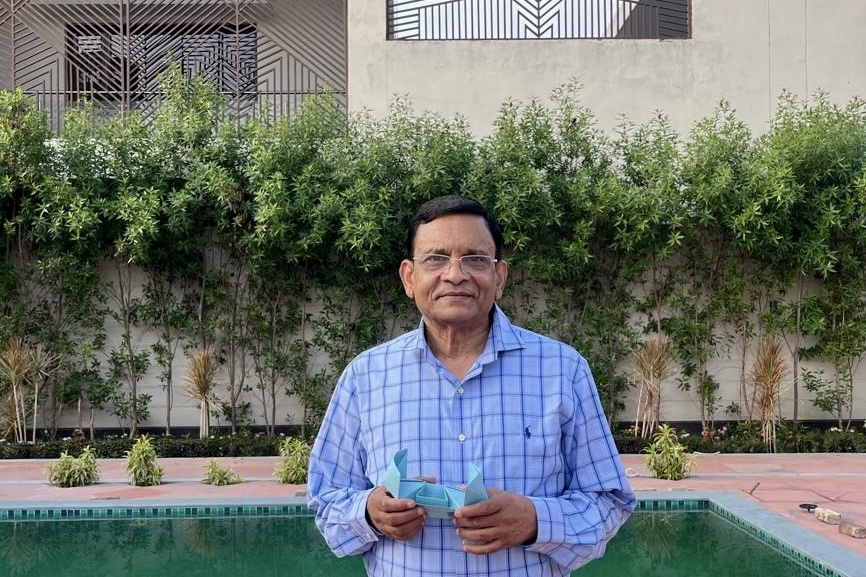
I have been blessed with the friendship of Manher Sameer. We met at GB Pant University in 1974, where I was pursuing my graduation in Mechanical Engineering, and where Sameer joined the Mechanical Engineering program after completing his graduation in Sciences from the adjacent College of Basic Sciences and Humanities. So technically, he was a year junior to me, but senior to me in all other respects – intelligence, skills and, above all, compassion.
I stayed back to teach after my graduation and completed my master’s in the process. Meanwhile, Sameer set up an ice factory in Moradabad as part of his family business and later established his enterprise in corrugated boards, an innovation at the time. Together, we named the new company ‘Paperphants’. It flourished and expanded over time. After I moved to Hyderabad in 1982, we became engrossed in our respective careers and families and lost in our busy schedules.
Sameer is gifted with excellent body-mind coordination, which usually manifests in sports. He is ambidextrous, playing with his left hand and writing with his right hand. He played cricket, badminton and table tennis at the University level. I loved watching him play table tennis – the way he would produce topspin, making the ball drop near the opposite side of the net and spin back, leaving his opponent no chance of reaching it. But more than that, I was intrigued by his skill in Origami.
Origami, derived from the Japanese words ‘oru’ (to fold) and ‘kami’ (paper), has evolved over centuries into both a hobby and an intricate art form. While traditional origami focuses on creating animals, flowers and geometric patterns, modern origami incorporates mathematical principles and engineering designs, pushing its boundaries beyond mere aesthetics.
Origami relies on a series of folds and unfolds, governed by simple rules that shape the paper into complex three-dimensional structures. The key lies in the crease patterns – mathematical blueprints that guide the transformation of a flat, usually square sheet of paper into an elegant figure. There is never a cut made and regardless of the complex shape you create, the paper can always be unfolded back to its original form. These folds require precision and adherence to geometric principles, often utilising angles, symmetry and proportion and demanding a very high degree of patience. There was nothing in the origami book that Sameer could not make.
In 2008, I met Dr. Arshad Quadri, MD, an Indian-origin cardiothoracic surgeon working in West Hartford, Connecticut, in the United States. He was married to the sister of my friend, radiologist Dr. Naiyer Imam, and they hosted me at their homes for a few days. I cherished this wonderful time with truly good people. Dr. Quadri took us to his lab and demonstrated his trials of folding a heart valve from bovine tissue using the origami technique.
The issue in paediatric cardiac care is that the valve needs to change as the child grows, which inspired him to come up with a prosthetic that could grow with the child. His origami-inspired heart valve prosthetic, made from live tissue, would address these challenges by expanding from paediatric to adult sizes while maintaining structural integrity and function. I had goosebumps seeing his work. I invited him to India for a collaboration, but he was already so deeply immersed in the US system that it was too late to turn back. The valve was never made.
Then, when my friend, Dr Girish Sahni (1956 – 2024), hosted me at his laboratory, the Institute of Microbial Technology (IMTECH) in Chandigarh, we stood in front of a giant haemoglobin mural at the G.N. Ramachandran Protein Centre. Trying his best to explain medical science to an engineer, Dr Sahni told me that all proteins are like long ribbons, and how they fold gives rise to different molecules. He also described the remarkable work of physicist Dr Ramachandran (1922 – 2001), who paved the way for the field of structural biology with his discovery of the dynamics of protein folding.
Correctly folded proteins perform a myriad of functions, such as catalysing enzymatic reactions, enabling cell signalling and providing structural support. For example, the precise folding of haemoglobin allows it to transport oxygen throughout the body, while the structure of collagen provides strength and elasticity to tissues. Misfolding can lead to various diseases, making protein folding one of the most critical processes in life sciences. Dr. Sahni praised G.N. Ramchandran’s work, stating that had he lived in the West, he would have been awarded a Nobel prize.
Origami and protein folding, though seemingly unrelated, share profound commonalities in their reliance on structure, precision and transformative processes. Origami, the ancient Japanese art of paper folding, embodies beauty through meticulous craftsmanship. In contrast, protein folding, a critical aspect of molecular biology, governs the functionality of life itself through the precise arrangement of amino acids.
Origami has transcended its artistic roots and found applications in science, technology and medicine. Engineers use origami-inspired designs to develop compact and deployable structures such as solar panels for spacecraft. In medicine, researchers have drawn inspiration from origami to create stents and other medical devices that can unfold in the body to minimise surgical invasiveness.
Computational models inspired by origami are helping scientists predict protein folding pathways. These tools use algorithms to simulate the folding process, enhancing our ability to design drugs and understand diseases. Origami-based designs are being integrated into nanotechnology and synthetic biology. Scientists are exploring ways to fold DNA and proteins into programmable structures, paving the way for breakthroughs in drug delivery, tissue engineering and the development of molecular machines.
Sameer, Dr Quadri, Dr Sahni… an engineer, a cardiac surgeon, a biologist… in hindsight, these people look like co-passengers in the journey of my life. Each participated in expanding my consciousness. Transcending mere acquaintance and delving into the realm of shared experiences, mutual respect, and emotional connection gives life its true meaning. A frog in the well may be a cruel metaphor, but if one has no friends beyond their family members and colleagues, they have not lived any better.
As life unfolds, revealing its complexities and joys, the definition of a friend evolves, shaped by both the richness of human interaction and the trials that test the strength of such bonds. A friend is not merely someone with whom we share time or interests; they are a mirror reflecting our aspirations, a confidant in our vulnerabilities and often a beacon guiding us through the labyrinth of existence.
Friendship is a living, breathing entity – one that adapts, evolves and grows as life unfolds. It is defined not by grand gestures but by the quiet moments of understanding, the shared experiences and the steadfast presence of someone who truly cares. As we journey through life, we come to realise that friends are the architects of our joy, companions in our sorrow and co-authors of our most cherished memories.
A friend, ultimately, reflects love–not platonic but functional, not transactional but unconditional; not fleeting but enduring. Thank you, Sameer, for being there for me and ensuring that I did not falter in my formative steps and wither away without blossoming. It was during my university days that I underwent a transformation, which allowed me to develop an open-minded attitude and a creative zeal. The wings I flew with to reach Dr Kalam were grown there – no wonder he could fold my career like a beautiful origami or a wholesome protein.
MORE FROM THE BLOG

The Bhagavad Gita OS

Yoga Vasishtha Walks into Nolan’s Dream
I watched Christopher Nolan’s Inception when it was released in 2010, back when going to the theatre still felt like an event. The film is centred around the idea of entering and manipulating dreams, slipping into layers of the mind as easily as walking through doors....
When Glass Begins to Think
When Hari Atkuri visited me with his niece, Krishna, I felt an immediate shift in the air—as if a gentle breeze had entered the room carrying the fragrance of an unseen, far-off garden. Warm, curious, and quietly luminous, their presence brought a rare ease, the kind...


