
Who Builds for the Billion?
There are moments when knowledge does not come from books or structured lectures, but from the quiet authority of lived experience. I have increasingly come to believe that the most important knowledge comes from listening—listening to people as they recount what they have built, what they have struggled against, and what they have learnt in the process. These narratives are never entirely free from bias; no human telling ever is. Yet, when spoken openly before an audience, they carry a certain irreducible truth. One cannot sustain a falsehood in full public view for long.
Perhaps that is why platforms like TED have become so relevant in our times. They are not merely stages for ideas; they are spaces where experience is distilled into insight. I have had the privilege of standing on such a stage myself—speaking on ‘Innovation is All about New Vision’ in 2019 at MVR College of Engineering & Technology, Hyderabad, and later on ‘Connecting Human and Artificial Intelligence’ in 2024 at BITS Pilani, Hyderabad Campus. Each time, I came away with the same realisation: innovation is not an abstract construct. It is deeply human, shaped as much by intent as by intellect.
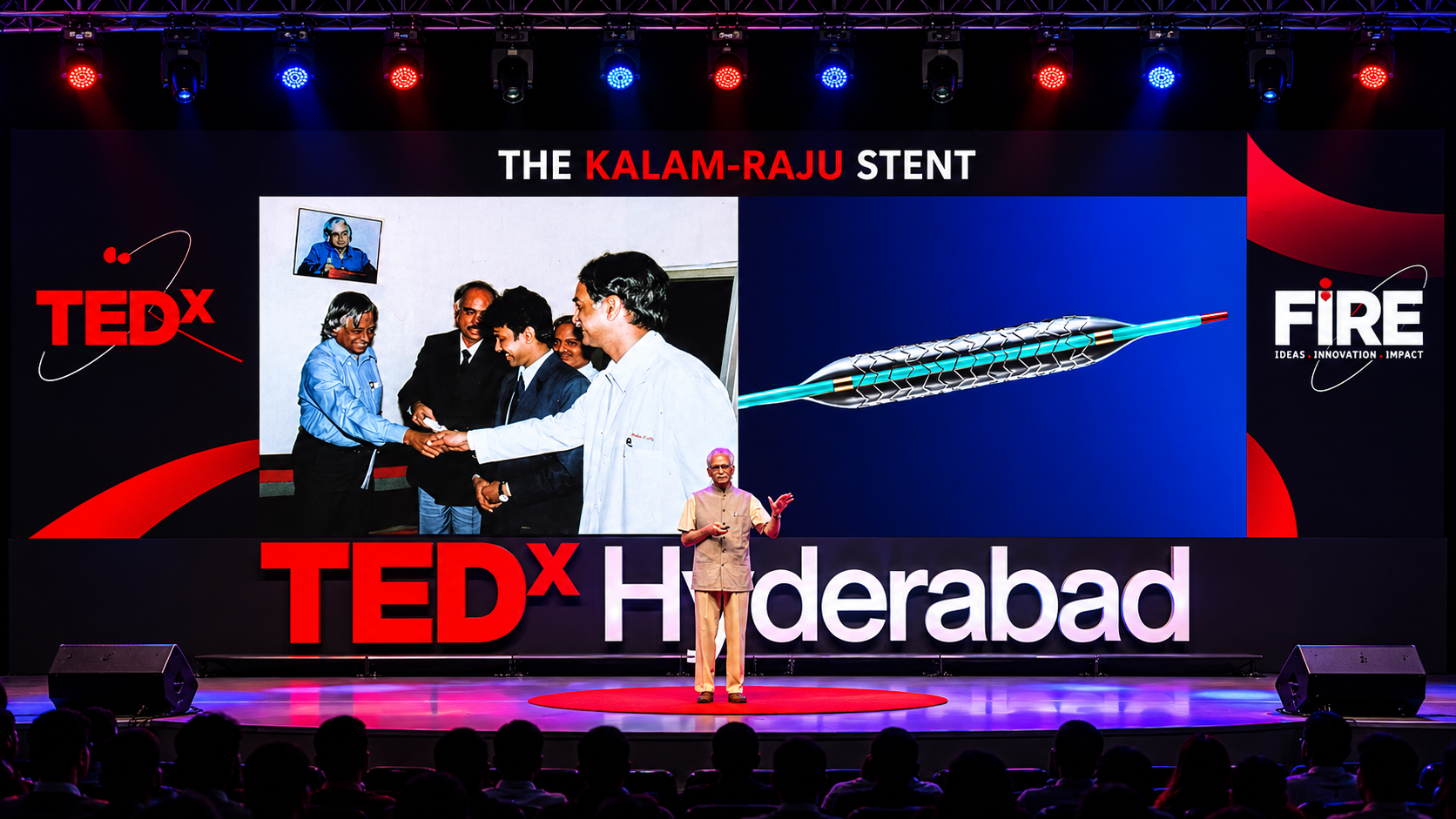
It was in this frame of mind that I attended a talk by Dr. B. Soma Raju on innovation in medicine. What unfolded was not merely a recounting of achievements but a journey into the very anatomy of innovation.
He spoke of a time in the mid-1990s when the idea of developing an indigenous coronary stent first took root—not as a technological ambition, but as a response to an ethical unease. The imported stents available at the time were prohibitively expensive, often costing more than the angioplasty procedure itself. For a vast majority of patients, the choice was stark: health or affordability, survival or surrender.
The challenge was immense. A coronary stent is not just a device; it is a silent companion to the human heart, required to endure its relentless rhythm within an oxygen-rich environment—without corroding, without failing. It demands a material that is both resilient and biocompatible—a rare balance.
At that time, I found myself drawn to this mission, entrusted with developing the required steel. Working alongside a metallurgical scientist and my seniors at Defence Metallurgical Research Laboratory (DMRL)—Dr. A. Venugopal Reddy and Dr. Koneru Bose. We navigated a path that was as much about science as it was about purpose. It was also a moment of personal transition. I chose to step away from DRDO, moving into the private sector with the conviction that innovation aimed at public good needed a different kind of ecosystem.
Three decades later, listening to Dr. Soma Raju narrate that journey with clarity and authenticity felt like returning to a story that time had paused, but never truly ended. He spoke of the stent, of the then-emerging balloon valvuloplasty procedure, of the courage to challenge the status quo, and of the subtle yet decisive role of political will. Beneath his words, one could sense the deeper currents of innovation—the interplay of dominant forces and quiet rebellions, the constant churning of the human mind striving to do better. The hall rose in unison, not merely in applause, but in acknowledgement of a journey that had touched something deeper in the collective conscience.
And yet, as I stepped out of the hall, my thoughts turned away from history towards the dilemmas of the present. What happens when innovation itself is captured?
Not captured in any dramatic sense, but gradually absorbed—by corporate priorities, by regulatory frameworks, by distribution systems, and ultimately by markets that determine what is worth building. When science aligns itself primarily with profitability, a subtle shift occurs. The question is no longer what is needed, but what will sell. Then who builds for the needy billion?
There was a time when Dr. A. P. J. Abdul Kalam articulated a vision that sought to bridge this gap—precisely, the idea of civilian spinoffs from defence technology. It was a powerful model: technologies developed in the pursuit of national strength could be redirected towards societal well-being. It was not merely a transfer of technology; it was a transfer of intent. That bridge, today, seems washed off.
In its place stands a new ferry service—incubation centres, start-ups, venture capital, valuation cycles. It is energetic, ambitious, and, in many ways, necessary. But it is also shaped by a different logic. Innovation is nurtured, but within the boundaries of market viability. Success is celebrated when a start-up is acquired, scales, or exits. Failure, which is intrinsic to innovation, is quietly borne by individuals—often at the cost of their most creative years.
Those who align themselves with what may be called the ‘Big Machine’ are often seamlessly accommodated within its architecture—rewarded, amplified, and carried upward by its momentum. Those who remain outside it, however capable or accomplished, frequently find themselves navigating a quieter and more constrained terrain. This is rarely a reflection of individual inadequacy. It arises from a deeper structural asymmetry embedded within the ecosystem itself. And for a country like India, with its immense reservoir of talent and aspiration, such asymmetry cannot be viewed merely through the lens of economics or career mobility. It ultimately raises a larger ethical question about fairness, access and the nation’s responsibility towards its own innovators.
A billion people cannot be served by an innovation that is designed only for those who can pay. Nor can we afford to romanticise a past that cannot be recreated. The question, therefore, is not whether we choose between enterprise and public good. It is whether we can integrate the two.
We need pathways to ensure that public-funded research once again aligns with essential healthcare needs, with affordability not an afterthought but a design principle. We need to value innovations not merely for their market success, but for their societal impact. A low-cost device that reaches millions carries a significance that no valuation can fully capture.
We must also recognise that innovation does not end with invention. It must travel through manufacturing, through distribution, through systems that ensure it reaches those who need it most. Affordability is not an accident; it is engineered through intent, policy and persistence.
As we step further into an era shaped by artificial intelligence, another dimension emerges. Technology now has the capacity to learn not just from structured data, but from human experience itself. The narratives we share—the stories of patients, of doctors, of innovators—can become part of a larger intelligence system. In that sense, every lived experience is no longer just a memory; it is a data point in the making of future solutions.
As I reflect on that evening, on the journey from a metallurgical challenge in a laboratory to a larger question about the future of innovation, I am left with a simple, persistent thought. Innovation is not merely about changing the status quo. It is about choosing whose status quo we seek to change. And in that choice lies the answer to a question that will define our times: Who builds for the needy billion?
In that answer lives the spirit of Dr. Kalam, who saw beyond laboratories and launch pads into the lives of ordinary people, and reminded us that technology finds its highest purpose when it serves humanity. In that answer resonates the work of Dr. B. Soma Raju, who chose not the convenience of imports, but the courage of creation, and in doing so, expanded the reach of healing.
And in that answer rests a quiet blessing for the countless innovators who continue despite adversity; who persist without certainty, build without applause, who fail and rise again—not for valuation, but for value. May more such minds emerge, for it is they who will ultimately build not merely for markets, but for the aspirations of a billion people.
MORE FROM THE BLOG
The Resilient Doctor
Dr. Prithvi Raj Jampana is a distinguished radiation oncologist with extensive experience in radiotherapy and systemic treatments for a wide range of cancers. He trained in clinical oncology at Oxford University Hospitals and worked in the UK for over two decades...

AI, Stories and the Mind
I have been reading an English translation of the Kathasaritsagara—The Ocean of the Streams of Stories—composed in Sanskrit by Somadeva, a Kashmiri writer of the eleventh century. Organised into eighteen books, it is less a conventional book than an immense...
The Wellness Dividend
One teaching of Dr. A.P.J. Abdul Kalam that I have always tried to follow is to ‘stay in circulation’, as he put it. By this, he did not merely mean travelling, attending meetings or remaining publicly visible. He meant keeping the mind in motion—meeting people,...
Arunji, nice one. The idea that the most important knowledge comes not from books, but from listening to people who have built, struggled, and learnt through experience, resonated deeply with me. In a world obsessed with scale and technology, your reminder that meaningful innovation begins with understanding people is both important and relevant today.
Respected Sir, Thanks for the informative blog on an innovative biomedical device. The original Kalam-Raju bare-metal stent is now largely phased out and has been replaced by drug-eluting stents. But it proved three things: 1. India can make world-class medical devices; 2. Price can drop 80-90% with indigenous technology, and 3. Scientist-doctor partnerships work for a better Life
.
Essentially, the purpose of innovation is not to amaze people but to enable them. The most successful innovations are often those that become so integrated into daily life that society forgets they were once innovations at all. When a new idea reduces suffering, expands opportunity, saves time, improves health, or enhances dignity, it fulfils its highest purpose.
The future belongs not merely to those who invent, but to those who ensure that invention serves humanity. Innovation achieves its noblest form when its benefits are felt not by a select few, but by the many whose lives become healthier, safer, more productive, and more hopeful because of it.
Dr A.P.J. Abdul Kalam often emphasised that science must ultimately reach the common citizen. During my own association with him, I witnessed how defence technologies were adapted for civilian use. The Kalam–Raju Stent is one such example. The objective was not merely technological achievement; it was to reduce the cost of cardiac treatment and make life-saving healthcare accessible to ordinary Indians. That spirit captures the essence of meaningful innovation.
Arun Ji, this is a beautifully argued and deeply humane piece, elevating the discussion of innovation beyond markets and metrics and grounding it in moral purpose, public responsibility, and human dignity. Particularly admirable is the way you connect affordability, systems design, and technological progress to a larger civic vision—one that asks not merely what we can build, but for whom we choose to build it. May we always ask not how technology can enrich a few, but how it can empower the many; not how rapidly we can innovate, but how wisely we can apply innovation in service of a more just, compassionate, and flourishing society.
Very well written, Sir. I felt like attending your class in 2008. An innovation that benefits society usually possesses three qualities. First, it addresses a genuine need rather than creating an artificial demand. Second, it is affordable and accessible. Third, it can be adopted at scale without requiring extraordinary expertise. A technology that reaches only a few hundred people may be impressive; a technology that reaches millions becomes transformative.
India’s development journey provides many inspiring examples. The widespread availability of affordable generic medicines, digital payments through UPI, low-cost vaccines, rural electrification, and mobile connectivity have improved lives more profoundly than many celebrated technological breakthroughs. A vegetable vendor accepting digital payments, a farmer receiving weather information on a mobile phone, or a patient obtaining affordable medical treatment represents innovation in its highest form—technology serving humanity.
The blog traverses the delicate terrain between aspiration and accessibility, reminding us that innovation divorced from inclusivity risks becoming an elegant irrelevance. The “billion” is not a market segment to be captured, but a lived reality to be understood….layered, unequal, and often inconvenient for neat technological solutions. Overall, your writing does not merely pose a question…it invites a reorientation of thought. And that, perhaps, is its most enduring contribution.
Today, artificial intelligence offers unprecedented opportunities. Yet its value will not be measured by the number of algorithms created or the size of data centres built. It will be measured by whether it helps a teacher educate children better, enables a doctor to diagnose disease earlier, assists a farmer in increasing productivity, or empowers a small entrepreneur to compete effectively in the marketplace.
Innovation must also be evaluated through the lens of inclusion. Technologies that widen the gap between the privileged and the disadvantaged may generate wealth, but they do not necessarily generate progress. True progress occurs when innovation reduces inequality of opportunity and expands human capability. It should make knowledge more accessible, healthcare more affordable, agriculture more productive, governance more transparent, and livelihoods more secure.
The next great innovation may not emerge from a glamorous laboratory or a highly funded corporation. It may arise from a village entrepreneur solving a local problem, a teacher developing a new learning method, a doctor creating a low-cost diagnostic tool, or a farmer discovering a more sustainable cultivation practice. Innovation is not confined to technology; it is the application of human creativity to improve the human condition.
Respected Sir, really an excellent write up. Who in India doesn’t know about the Kalam-Raju stent? When people hear the word innovation, they often imagine rockets, artificial intelligence, quantum computers, or billion-dollar startups. These achievements are undoubtedly important, but the true measure of innovation is not its sophistication; it is its usefulness. The finest innovations are those that quietly improve the daily lives of ordinary people.
History offers countless examples. The bicycle gave mobility to millions long before automobiles became common. The sewing machine increased productivity for households and small businesses. Vaccines transformed public health. The Green Revolution raised food production and prevented widespread hunger. None of these innovations became important because they were fashionable. They became important because they solved real human problems.
Some learned people say in commencement addresses to some top universities that we have to destroy AI. Maybe because they don’t want to be booed. How naive can they be? AI was here all along, and it’s here to stay. When the internet came, people thought it would destroy jobs. Indian bank unions did not want computers to be introduced in banks. But you can not stop a technology whose time has come. In India, we want to conduct all research in the public sector, and the private sector is viewed with suspicion. This mindset has to change.
Arun Tiwari Sir’s Style of writing – Beautifully crafted as usual, in your style. A powerful reminder that lived experience, when shared openly, transforms knowledge into action. Thank you for highlighting how purpose-driven innovation — like Dr Soma Raju’s and Dr Kalam’s — turns technology into real value for the needy billion. This reminds me of the Purpose of establishing CARE Hospital – to provide care that people trust
Sir, this article also took me down memory lane to the time I joined CARE Foundation in 1997 after returning from the United States. My intention was always to work in the field of technology and explore how it could best be utilized in healthcare. Dr. Soma Raju’s remarks reminded me of the days when you were working on the design and development of the stent and, later, when I joined the organization, how we were involved in its clinical validation. It gave immense satisfaction to see a medical device become affordable and accessible to larger sections of society. We continued working in other areas of technology, which led to the development of a telemedicine system in 2001 under a public-private partnership initiative. This effort helped ensure that specialist consultations and expert medical advice became available to people living in remote locations. Broadband internet was not even widely available at that time, yet the technology served its purpose effectively. Today, there is considerable excitement around the use of emerging technologies. This reminds me of what Dr. Kalam often said, that the latest technology is not necessarily the best technology. He emphasized the importance of appropriate technology for specific applications. I believe this principle is important in every domain, and even more so in healthcare. It took the COVID-19 pandemic in 2020 for telemedicine to become fully integrated into clinical workflows, and today teleconsultations have, in many situations, become a preferred option for patients. While technological innovation will continue to evolve, it is important that these advances make healthcare more accessible and affordable for larger sections of society, rather than benefiting only a few. This has been the spirit guiding our work over the last two and a half decades. As your article rightly highlights, the true impact of innovation lies not merely in its creation, but in making it available to those who need it most.
Respected Arun sir, thanks a lot for writing such a nice blog. Really experience plays a pivotal role like your great experience in many fields. Coronary stent developed by your hardworking team under the leadership of Dr Kalam sir, was a great affordable innovation which provided easy life to many people, the real service to the society. Indeed innovations should be nurtured and scaled up for the service of community.
Dear Prof, What a nice way to celebrate innovation motivated by responsiveness to people and their needs! Not just for the money! Your story and the inspiration of Dr Kalam serve a greater purpose.
This is a thoughtful piece showing how purpose and persistence can deliver affordable healthcare. You rightly trace how market logic and institutional shifts risk capturing innovation, narrowing who benefits. The reminder of Dr. Kalam’s vision is especially resonant: technologies born from public intent should circle back to public good. As we build AI and new platforms, your call to center lived experiences of patients, clinicians, innovators deserves policy attention. May more innovators pursue value over valuation and rebuild bridges to serve the needy billion.
The one who works as a professional, finishes the job. The one who takes it just as a work, completes the task. But those who live the domain, become the ones who build for the billion.
Bhai Sahib, I agree with you that a true invention leads to the empowerment of people, whether in medicine or any other field. The more lives it touches upon, the better the invention.
“We must also recognise that innovation does not end with invention. It must travel through manufacturing, through distribution, through systems that ensure it reaches those who need it most. Affordability is not an accident; it is engineered through intent, policy and persistence”.
The above sentence has to be engraved in all public institutions at the entrance and also as a screen saver on all computers of Scientists to remind of their responsibility as a researcher in a public funded laboratory.
Great innovation to remember and get inspired,
Arunji, An inspiring reflection on innovation, purpose, and societal impact. The story of indigenous medical innovation highlights how true progress begins with empathy and a commitment to accessibility. Your question “Who builds for the needy billion?” is both timely and profound. Innovation achieves its highest value when it serves humanity beyond markets and reaches those who need it most.
Innovations leading to practical solutions today have umpteen available pathways and means to realise them to be made available to address the issues. These channels and platforms further build the markets and economy. However R&D Organizations in India need to address systemic flaws to become real harbingers for this cause. Building leadership in institutions will flower innovations into building blocks of prosperous markets and economies. Institutional systemic reforms are the need of the hour.
A powerful and inspiring piece. I was especially moved by the idea that innovation is not only about creating something new, but about choosing whose lives we want to improve through it. A timely and important reflection for all innovators.
Arun Ji, your article beautifully captures a truth I have witnessed throughout my journey as a cancer surgeon and social entrepreneur. Real transformation happens when innovation reaches those who are often invisible to the system—the rural poor, the underserved, and those living far from the benefits of modern healthcare. Through our cancer screening and prevention initiatives, I have learned that building for the billion is not merely about scale; it is about inclusion, dignity, and ensuring that the fruits of science and technology touch every life. Thank you for reminding us that the true test of progress is how well we serve the last person in the queue.