

Kafka in the Age of the Gig Economy
In my youth, when I first read Franz Kafka’s Metamorphosis, published in 1915, it seemed to belong to a distant, shadowed landscape of European modernism—strange, unsettling, intellectually luminous, yet safely contained within literature. One reads differently at twenty, differently again at forty. Now, in my seventies, I find that the story has quietly crossed the boundary between page and world. Gregor Samsa no longer lies only in a narrow room of fiction; he appears, flickeringly, in the restless movement of our cities, in the blue glow of handheld screens, in the hurried footsteps of the young who labour without certainty, protection, or even the assurance of being remembered. Time, which softens many impressions, has sharpened this one. I do not merely recall Kafka now—I return to him as one returns to an unfinished question.
What troubles me is not hardship alone. India has known poverty and endurance, yet it has also sustained neighbourhoods of care, invisible threads of reciprocity, and a moral vocabulary that ensured no one disappeared entirely from the circle of recognition. The disquiet I feel today is subtler, almost soundless: the thinning of identity itself. In the expanding gig economy, I watch young men and women in perpetual motion—delivering meals, steering strangers through traffic, coding unseen architectures of the night, moderating conversations they will never join. They are everywhere visible yet nowhere known. Their labour is measured to the second; their lives remain immeasurable. Ratings rise and fall like small, indifferent tides. A missed day, a moment’s illness, an algorithm’s quiet judgment—and the fragile thread of belonging begins to loosen. Looking at them, I feel the faint, persistent echo of Kafka’s insect—not grotesque in body, but diminished in social presence, reduced to function without story.
Age brings with it an altered scale of perception. One begins to notice not only what is built, but what quietly recedes. I have lived through decades that promised continuity: institutions that offered lifelong work, professions that carried an inner dignity, and social contracts—imperfect, contested, yet real—that linked effort with security. The young inherit astonishing technologies, velocities of connection we could scarcely imagine; yet the ground beneath their feet feels less stable than ever before. They improvise brilliantly, adapt with courage, and move with a fluency that commands admiration. And yet, beneath this brilliance, I sense a civilisation learning to celebrate flexibility while gently withdrawing responsibility. Progress glitters; assurance fades.
Perhaps this is why Kafka returns with such quiet insistence. His question was never truly about transformation into an insect. It was about recognition—about what remains of the human when usefulness becomes the only language spoken. In the gig economy, usefulness is immediate and dissolvable. One is needed intensely for an hour, forgotten the next. Efficiency governs; covenant retreats. There is elegance in the system’s design, even a kind of technological poetry. Yet beneath that elegance lies an absence difficult to name: the promise that society fails to keep with its youth. Work exists, but work without protection becomes a delicate form of invisibility.
I find myself unexpectedly restless in the face of this reality. Old age is often imagined as a season of detachment, of philosophical acceptance. Instead, I discover a heightened tenderness towards vulnerability—perhaps because dependence no longer appears theoretical. To see millions begin their adult lives already exposed to such precarity evokes not anger, nor nostalgia alone, but a quiet sorrow that settles like evening light—gentle, persistent, impossible to ignore. One wonders whether speed has outrun wisdom, whether innovation has moved faster than compassion can follow.
And yet despair feels too simple, almost a failure of imagination. I have witnessed too much resilience in our people, too much unrecorded generosity, to believe that invisibility is destiny. History reminds us that systems forgetting humanity eventually confront their own incompleteness. The gig economy, still young, need not remain a landscape without shelter. It could grow toward something more humane—where flexibility walks beside security, where technology enlarges dignity rather than thinning it, where society renews its quiet promise to those who carry its future in their uncelebrated labour.
Reflecting on Kafka now, I am struck by another tenderness in his fate. He did not live to see the reach of his own words; recognition came largely after his death. Such is the mysterious endurance of the written thought: it travels beyond the writer’s breath, waits patiently in time, and awakens when the world becomes ready to hear. Ideas, like seeds, choose their own season. That a solitary imagination from a century ago can illuminate the anxieties of our digital present is itself a form of hope—the assurance that meaning outlives circumstance.
Age, then, becomes not withdrawal but witness. To grow old is to watch patterns gather across decades, to recognise when metaphor hardens into reality, and to feel—quietly, insistently—the responsibility to speak before silence turns into consent. My unease is, therefore, not complaint but care, a refusal to accept anonymity as the price the young must pay for opportunity. Care, in later life, often takes this form: a gentle persistence of attention.
Kafka, returning softly through the corridors of memory, offers not darkness alone but warning—and also invitation. Even in one’s seventies, the heart still hopes that stories might end differently than before; that recognition may arrive in time; that dignity may prove more durable than efficiency. I am reminded of this in the smallest of encounters: the brief moment at my doorway when a young gig worker places a packet into my hands, his eyes already divided between the present and the next demand waiting inside the earplug-connected mobile through which another customer’s voice is calling. He carries several packets at once, time folded tightly around him, and from me he seeks nothing more than a good rating—an invisible gesture that may shape his remaining day. Our exchange lasts only seconds, yet something in it lingers: the quiet asymmetry between a life measured in hurried deliveries and a life pausing long enough to notice. And so, the question returns, tenderly but insistently: whether somewhere, within the swift machinery of the modern world, space may still be made for the simple, irreducible presence of the human being—seen, named, and held in quiet regard.
When I pause at a traffic signal and see helmeted riders waiting in the dust-filled air, or glimpse tired eyes illuminated by midnight screens, I do not see insects. I see nascent citizens of a future still searching for its moral language. Their anonymity is not natural; it is constructed—and what is constructed may yet be reimagined.
If my generation holds any remaining task, perhaps it is simply this: to insist, without bitterness and without noise, that progress must encompass compassion within it, or remain incomplete. For in the end, the truest metamorphosis is not Gregor’s, nor the world’s machinery of work, but the awakening of recognition within us. And if that awakening comes—even quietly, even late—then perhaps the story is still being written toward the light.
MORE FROM THE BLOG

Stay Awake, Stay Connected
There are certain timeless truths that can be ignored only by the most callous among us. One such truth is the Buddhist concept of Triple Refuge: Buddham saranam gacchami—I take refuge in the Buddha (the Enlightened One or Teacher); Dhammam saranam gacchami—I take...
Layers of Becoming
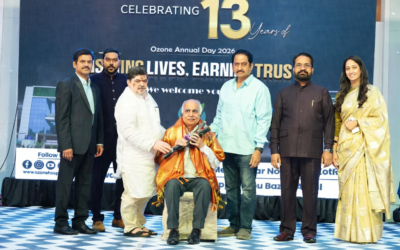
When I sat on the chair on stage to be felicitated on the 13th Foundation Day of the Ozone Hospital, on February 28, 2026, and Telangana Transport Minister Mr. Ponnam Prabhakar, Telugu film star of yesteryears Mr. Suman Talwar, and Chairman Mr. Satya Sai Prasad...

The Unfulfilled Promise of Healthcare
Recently, I had the opportunity to spend nearly three hours in conversation at the Care Foundation, graciously hosted by its CEO, Mr. S. G. Prasad, whose quiet commitment to accessible healthcare has sustained many meaningful initiatives over the years. The meeting...

Fascinating perception of Gig Economy reflecting the theme of Franz Kafka’s landmark work of fiction, Prof Tiwariji !
Your words of wisdom on humanity are very apt in the realm of digital identity !!
Respected Sir, Pranaam,
Well-structured and needs-based information.
Dear Sir, Greetings! A deeply insightful reflection, sir. The idea that “usefulness has become the only language spoken” captures the quiet erosion of identity in today’s gig economy so powerfully.
What resonates most is your emphasis on recognition—in a world driven by ratings and algorithms, the human story often fades into the background. As we build more tech-driven systems, your piece is a timely reminder that progress must also preserve dignity and compassion.
Thank you for this thought-provoking perspective. Warm Regards.
The gig economy must not be allowed to drift into a system where convenience for many is built upon the quiet precarity of a few. It must be guided, regulated, and humanised—so that innovation remains aligned with dignity and justice. If left unchecked, the long-term social cost will be significant. A large segment of the working population could become permanently trapped in precarious livelihoods, with limited upward mobility and no safety net. This is not merely a labour issue; it is a societal one—affecting public health, family stability, and the broader fabric of economic equity.
Thank you, Sir, for sharing this wonderful blog!
This really made me pause and reflect. I love how it connects Kafka’s story to the reality of the gig economy, people always on the move, working hard, yet often invisible. The writing captures that quiet sense of being needed but unnoticed, which feels so true today. The moment with the delivery worker at the end really brings the whole idea home.
Also, your line “One reads differently at twenty, differently again at forty” really resonated with me. The way I interpreted books at 18 versus now has been completely different. It’s a reminder of how much perspective shapes the way we see the world, and ourselves.
The endless availability of gig workers and the negative effect of gig economy is visible everywhere. Delivery boys can be seen snaking thru traffic at any time of the day. There was huge hue and cry few years back about ecommerce killing mon and pop shops….it didnt. Its the gig economy which contributed to marked decline in the number of such shops. But these gig workers will always be just scraping through…not earning more than bare minimum to keep them barely fed. Its a sorry state of affairs.
What is particularly concerning is the structural imbalance: these workers are called “partners” or “independent contractors,” yet they have little real autonomy. The platforms exercise significant control over pricing, work allocation, and performance metrics, creating a situation that resembles employment without responsibility. This asymmetry allows platforms to capture efficiency gains while externalising risks onto workers.
Most gig workers bear the full burden of risk—irregular income, lack of health coverage, absence of social security, and algorithm-driven performance pressures—while the platforms retain disproportionate control without corresponding accountability. The asymmetry is stark: workers are treated as independent contractors in law, but managed like employees in practice. Over time, this creates not just economic vulnerability, but psychological stress, social insecurity, and a gradual erosion of labour dignity.
If left unchecked, the long-term social cost will be significant. A large segment of the working population could become permanently trapped in precarious livelihoods, with limited upward mobility and no safety net. This is not merely a labour issue; it is a societal one—affecting public health, family stability, and the broader fabric of economic equity.
The gig economy in India has made life easier for many people, but it has also created a difficult reality for the workers behind it. Delivery riders, drivers, and other platform workers often have no fixed income, no job security, and no benefits like health insurance or pensions. Their earnings depend on app algorithms that they cannot understand or control, and they carry all the risks—accidents, illness, or sudden loss of work
If this continues, it can lead to serious social problems, such as growing inequality and a lack of dignity in work. India needs to create simple, fair rules—like minimum income support, basic social security, and greater transparency—so that technology helps workers, not exploits them. We must be kind and nice to them in the meantime.
What is needed is a balanced framework that preserves the genuine advantages of the gig model—flexibility, scalability, and access—while embedding safeguards that prevent exploitation. This includes minimum earning standards, insurance and health benefits, transparent algorithmic governance, grievance redressal mechanisms, and pathways for skill development and progression. Platforms must evolve from mere intermediaries to responsible stakeholders in their workforce’s well-being.
The way you linked Kafka to what we see around us today felt very real….especially that idea of people being visible everywhere but not really known. I see these delivery boys and riders every day, but I don’t think I had paused to look at them the way you described. That part stayed with me. It didn’t feel heavy or preachy, just quietly unsettling in a true way.
This Blog also reminds us that no matter how fast the world is changing, every person deserves to be treated with some level of dignity and respect. The gig economy is a system where people use an app to do short-term work such as delivering food, driving a car, and doing online work. This gives many young people a job, but it is not a job that is secure or protected. Tiwati ji also reminds us how invisible some of these workers can be in society and how we might think that real progress also means having some level of compassion for them.
“I watch young men and women in perpetual motion—delivering meals, steering strangers through traffic, coding unseen architectures of the night, moderating conversations they will never join. They are everywhere visible yet nowhere known. Their labour is measured to the second; their lives remain immeasurable. Ratings rise and fall like small, indifferent tides. A missed day, a moment’s illness, an algorithm’s quiet judgment—and the fragile thread of belonging begins to loosen. Looking at them, I feel the faint, persistent echo of Kafka’s insect—not grotesque in body, but diminished in social presence, reduced to function without story.”
These lines are not mere sentences beautifully woven with words by Prof. Arun Tiwari jee’s intellectual mind, but the sensitive heart in him. Let’s pause, think, and find ways we can do something to support such development. Professor Tiwari, I know you have done so much even in this digital age for the people. You have ignited several minds. People follow you. I hope the days will see hope of rays. If not today, tomorrow, but certainly in the future.
Arunji, this blog, which captures the contrast between the expected serenity of age and the deepening sensitivity to vulnerability, is striking. That quiet sorrow you describe, less outrage, more attentive witnessing, feels like a form of wisdom in itself, reminding us that progress without compassion leaves a human deficit that technology alone cannot repair. Good one!
A very thought-provoking reflection. Kafka wrote about systems that appear impersonal, opaque, and strangely indifferent to the individual — and it is striking how those themes resonate even more in today’s gig-driven, algorithm-governed world.
What once appeared as literary exaggeration now feels almost documentary. The worker confronting invisible rules, faceless authority, and constantly shifting expectations seems like a modern echo of Kafka’s characters.
Reading this, one almost feels that Kafka was not only observing his age, but quietly foreseeing ours.
Thanks you very much Arun sir for writing such a wonderful blog. Your memories are excellent putting many examples in the blogs of your vast experience. Very well written about society and its changing behaviour with change of time. You have educated all of us through the examples of gig workers, their recognition, which must be there and one should own the contribution of each and every body in the society whatever may be the big or small worker. Every part of our body is important, similarly every human being or even every living being is important on the planet.
With regards.
Dear Prof
Age and wisdom are the gifts you bring to the young generation and posterity.
Thank you for the reflections …
Thank you for your very compassionate thoughts, Arun Tiwari Sir
Perhaps you have articulated the thoughts of a generation in their seventies or nearing that age.
Human dignity begins where perception deepens—where we resist the habit of reduction and choose, instead, to see one another as unfinished beings rather than expendable functions. In the faces blurred by speed, labor, and fatigue, there persists an irreducible claim: that no life is merely incidental to the systems it sustains. To affirm dignity is not to romanticise struggle, but to refuse the quiet violence of indifference that renders people interchangeable and unseen. It is an ethical stance that asks us to slow our judgments, to recognise that every anonymous figure carries a history, a hope, and a capacity for meaning not yet exhausted. When society honours this truth, progress ceases to be only mechanical or economic and becomes, at last, human—measured not by output alone, but by the breadth of care it extends to those who move within it.
Carry on, Sir. Keep writing what we can feel but can’t articulate.