
The Man Shaping Real-World AI
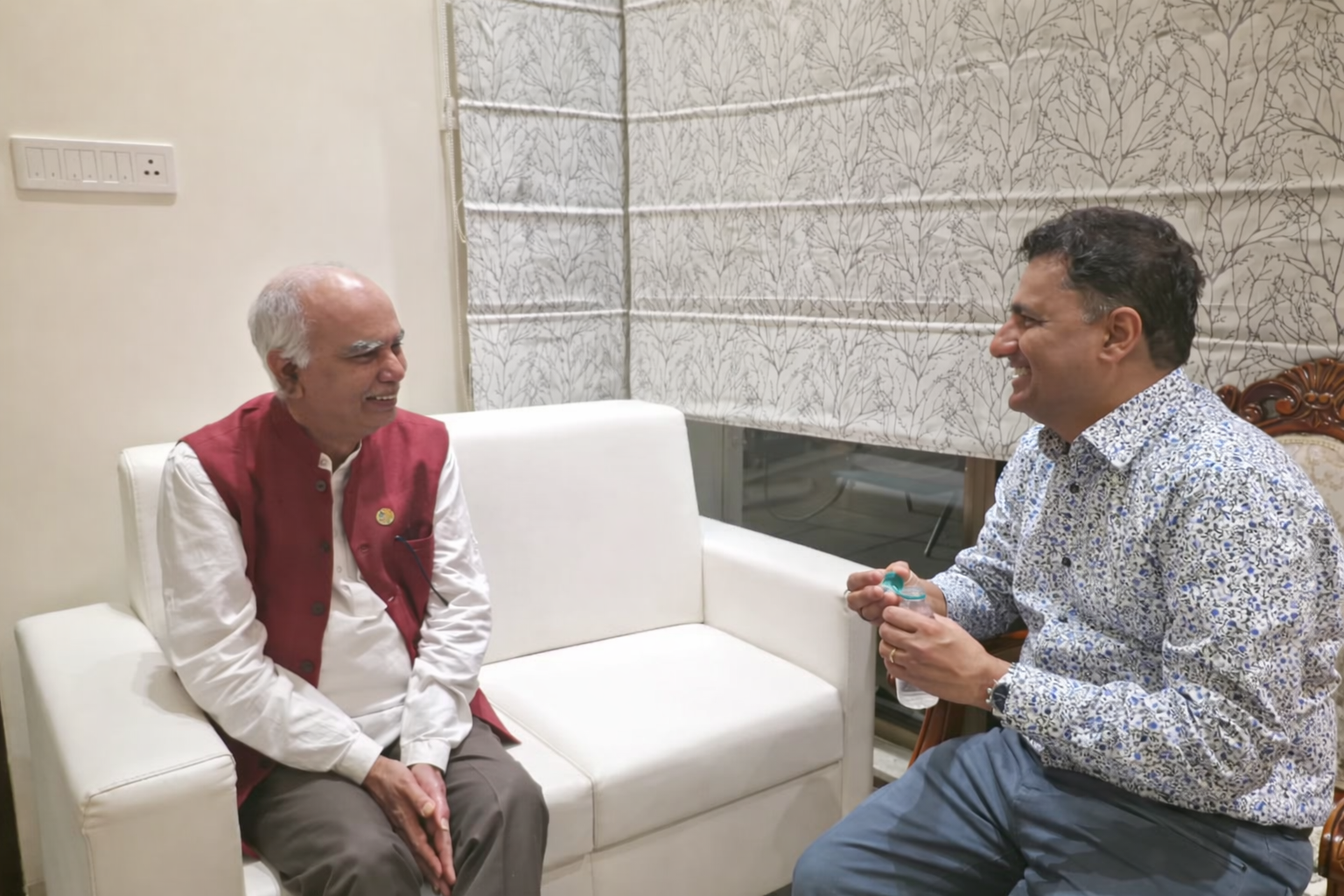
I stopped wondering about the world a long time ago. Even this waking life feels no different from a dream—strange, layered, quietly unfolding—especially if one watches carefully. Of late, I have neither been travelling a lot nor pursuing any agenda that would make me particularly relevant to the world. And yet, life continues to bring remarkable people into my orbit—many from distant continents, many who carry the unmistakable weight of achievement with an effortless grace. Meeting Srinivas Attili was one such moment.
Srini Attili, as he is called, is the Executive Vice President of the Civilian Business Group at Science Applications International Corporation (SAIC), a major American technology enterprise headquartered in Reston, Virginia. SAIC operates across multiple sectors, supporting federal agencies and state and local governments. Its portfolio is vast, its reach significant.
But what struck me about Srinivas Attili was not abstraction; it was clarity. In a world that often confuses innovation with progress, he speaks in terms of execution, trade-offs and outcomes. The approach is deceptively simple—build enterprise and mission IT capabilities that are reusable, replicable and resilient. Layer onto this the intelligent application of AI—not as a buzzword, but as a tool to enhance productivity and bend the cost curve.
Attili’s worldview is striking in its simplicity. “There are no mysteries,” he says. “What we call problems often arise because we are investing our time, money and effort in the wrong things.” Optimising the wrong thing, he suggests, is perhaps the most seductive trap of all.
His journey began far from the corridors of global technology leadership—in Narsipatnam in Anakapalle district, Andhra Pradesh. It was a landscape of quiet abundance and silent struggle. Frugality was not a choice but a way of being, practised even amidst nature’s bounty, where every resource was respected and nothing taken for granted, because abundance came only through relentless labour.
In such places, aspiration does not announce itself loudly; it germinates quietly, often waiting for a moment of ignition. For him, that moment arrived when a government-sponsored technology camp was conducted in his town. He enrolled. That single spark was enough. What followed was a trajectory shaped by curiosity and discipline: a bachelor’s degree in computer technology from Nagpur, a master’s in computer science, and an MBA in the United States. He went on to build a career across institutions such as PwC, IBM, Deloitte and McKinsey & Company—before stepping into leadership at SAIC.
Yet, for all this global exposure, his philosophy remains grounded.
“Understand the problem before fitting a solution,” he says. “That is how you earn trust, stay relevant and deliver outcomes that endure.” He follows the startup and venture ecosystem closely, but his interest lies less in the novelty of technology and more in its translation—how ideas move from promise to operational reality. This is where many innovations falter. Execution, not imagination, is the true differentiator.
For Attili, long-term impact is not measured in quarters or headlines, but in systems that endure. One such example dates back to 2003–2004, when he helped build a portal for the U.S. Army. It allowed deployed soldiers to access education from over 100 universities through a single interface—a simple yet profound act of enabling individuals to use a benefit they had earned.
Over the years, he has witnessed waves of technological change—eBusiness, on-demand services, microservices, APIs, blockchain, cloud computing, and cybersecurity. Some trends faded; others became foundational. His lens, however, remains consistent: Does it solve a real problem? And does it endure?
On artificial intelligence, he is equally clear-eyed. AI, in his view, is not about automating workflows solely for efficiency. At SAIC, they refer to ‘mission threads’—use cases that must function reliably at scale, over time. AI must not merely execute; it must learn, adapt and improve. It must become a living system.
But Attili’s sense of mission extends beyond the corporate sphere. His association with nonprofits like Global Grace Health—focused on cancer screening and outreach to the poor in their communities—reflects a deeper commitment to human well-being. It was this shared thread that led to our meeting.
He is also mentioned as a quiet force in Dr. Chinnababu Sunkavalli’s book, Live for a Legacy, which I had the privilege to co-author. His visit to Hyderabad, and the time we spent together at Dr. Chinnababu’s home, felt less like a formal meeting and more like a conversation that lingered—like a cup of tea whose warmth stays long after it is finished.
When I asked him for advice for Indian technology entrepreneurs, he articulated a framework of elegant simplicity—the ’three E’s’: Experience of the mission; Expertise in technology; and Ecosystem orchestration. This, he explained, is about integration—connecting partners, aligning platforms, and helping institutions extract value from what they already possess. “Blessed are the mission integrators”, he said. Those words stayed with me.
Integration, in his view, is not merely technical. It is deeply human. Imagination, compassion, interpretation, articulation—these are not soft skills; they are the very forces that enable integration. Without them, excellence remains elusive. Whether one is a homemaker preparing a meal, a farmer tending crops, a teacher shaping young minds, or a nurse caring for the ill, the difference lies in seeing the act not as an isolated task, but as service to a larger cause. In that shift, peace emerges.
AI, then, is not an end. It is an enabler. A compass. A vehicle. Used wisely, it sharpens our ability to serve. Used blindly, it amplifies our confusion.
There is, perhaps, a larger intelligence at play—a quiet evolutionary force that nudges reality towards purpose. We may not fully comprehend it, but we sense its direction. And in that unfolding, human beings remain uniquely placed—not as masters, but as participants.
As I listened to Srini speak of integration—of mission threads, ecosystems and enduring systems—I could not help but reflect on our own landscape in India. Ours is, in many ways, a fragmented system. Each Ministry often beats its own trumpet. Departments tend to become domains, and domains quietly harden into fiefdoms. For a vast nation of extraordinary capability, there is still no institutional equivalent of Science Applications International Corporation—an entity that exists to integrate, to harmonise, to make the whole greater than the sum of its parts.
In far too many places, “our way is the highway” remains the unspoken doctrine. And so, despite undeniable progress—new flyovers arching across cities, skyscrapers rising with confidence, shopping malls redefining consumption—the deeper questions persist. The poor are not only poor; they are often underserved, even unserved. Primary education struggles for attention. Primary healthcare access is uneven. People like farmers, agricultural labourers, fishermen, etc.—the invisible backbone of the nation—continue to live their own fate, as spectators to a narrative of development that unfolds around them but not always for them.
They watch speeches. They watch cricket matches. They witness the symbols of growth. But beneath their feet, the water table recedes. Yet even as they remain on the margins, global supply chains quietly enter their modest kitchens—bringing both opportunity and disruption. It is not intent that fails; it is, more often, the failure to integrate.
What we need today are not merely technologies—or policies drafted in isolation—but integrators: individuals and institutions with the capacity to see across silos, align incentives, connect disparate systems, and carry outcomes through time. Most organisations rarely fail because they lack ideas. They falter because they scale what should never have grown, sustain revenue that adds little value, and defer the hard choices that clear thinking compels. In the end, success does not belong to those who know more—it belongs to those who connect, choose and act in time.
We need Srinis. Not as exceptions, but as a growing tribe. Men and women who understand that true progress lies not in isolated excellence, but in orchestrated harmony; who recognise that the real power of AI—or any technology—emerges only when it is embedded within systems that serve a coherent purpose. Progress is not about building more systems. It is about making systems work together. That is the work that lies before us. May many more like him rise.
MORE FROM THE BLOG
Two Paths up the Human Mountain
I have read Sri Aurobindo for many years, and my spiritual framework has been deeply shaped by his intellectual spirituality. From The Secret of the Veda to Savitri and The Life Divine, he produced perhaps the most profound exposition of Indian philosophical thought...
From AI to Autonomous Care
The second edition of the International Conference on AI in Healthcare was held at Yashoda Hospital in Hyderabad on 13-14 June 2026. Robotic cancer surgeon Dr. Sunkavalli Chinnababu led the event, which attracted 2,000 delegates, 375+ speakers, policymakers,...

Solidified Air
I am enjoying re-reading Thus Spoke Zarathustra by the German philosopher Friedrich Nietzsche. In Part I, in the chapter Of the Tree on the Mountainside", he uses the image of a lonely tree growing high on a mountain to describe the fate of those who strive to rise...
Srini is a treasure for SAIC and the AI industry at large. We need more leaders and stewards of AI like Srini as we continue the amazing journey of AI impacting virtually every aspect of our lives. Wonderful story of your meeting with Mr. Attili! Thank you Prof. Tiwari.
Thank you Sir for sharing this wonderful blog! What I appreciated most about this piece was that it didn’t frame AI as some distant futuristic concept, but as something already quietly shaping the way people live, work, think, and make decisions every day. There’s a tendency in AI discussions to swing between hype and fear, but this felt much more grounded and human.
The line that stayed with me was the idea that the real challenge is not whether machines can think, but whether humans can continue to think deeply in a world optimised for speed and automation. Building systems that work in the real world requires much more than intelligence. It requires judgment, empathy, and clarity about what problems are actually worth solving.
Not a doubt Prof Tiwari, “What we need today are not merely technologies—or policies drafted in isolation—but integrators: individuals and institutions with the capacity to see across silos, align incentives, connect disparate systems, and carry outcomes through time.” May we all find it in our hearts to comply.
I am inspired with the insights of your conversation with Srini. His three Es and the power of integration are really down to earth concepts and must be pursued by many who would like to serve the majority of the people. It’s uplifting!
Dear Sir, Greetings! A deeply insightful and inspiring reflection, Sir. What stands out most in this article is the emphasis on integration — not just of technology, but of people, systems, purpose, and compassion. Shri Srinivas Attili’s journey beautifully demonstrates that true leadership in AI is not about chasing trends, but about solving real-world problems with clarity, humility, and long-term vision.
Your observation that India needs “integrators” more than isolated excellence is profoundly relevant today. Technology alone cannot transform society unless it is connected meaningfully to human needs and institutional collaboration. The concept of the “three E’s” — Experience, Expertise, and Ecosystem orchestration — is a powerful framework for entrepreneurs, policymakers, and technologists alike.
Thank you, Sir, for presenting AI not merely as a technological evolution, but as a human responsibility guided by wisdom, service, and purpose. Such writings inspire deeper thinking beyond innovation and towards meaningful impact. Warm Regards.
Prof, I’ve had some time to reflect on your piece, and I must say, it is rare to find a summary that captures the “signal” so clearly amidst the “noise” of the current AI hype. You’ve distilled Srini’s professional journey and the core ethos of SAIC’s work into something both accessible and deeply human.
Professionals like Mr Attili remind us that the future of AI and enterprise transformation will not be shaped solely by inventors, but by those who can bridge aspiration with implementation, ensuring that innovation serves real people through durable systems. In that sense, his work embodies a quiet but profound leadership—where relevance is sustained not by headlines, but by outcomes that endure.
Mr Srinivas Attili represents a rare and increasingly vital archetype in the age of AI: the builder who understands that trust is earned not through technological spectacle, but through disciplined execution anchored in human need. His principle—“Understand the problem before fitting a solution”—captures the enduring distinction between innovation that dazzles briefly and innovation that transforms systems meaningfully.
In a world often captivated by disruption for its own sake, Attili’s approach reflects deeper strategic wisdom: technology becomes meaningful only when it is put into practice. Many can imagine; far fewer can institutionalise. His career demonstrates that execution is where vision acquires legitimacy.
The U.S. Army education portal example is especially telling. It was not merely software—it was infrastructure for opportunity, converting an earned entitlement into accessible empowerment for deployed soldiers. That is the highest form of applied technology: not novelty, but meaningful enablement at scale.
Lovely narrative. Mr Srinivas Atilli’s “three E’s”—Experience, Expertise, and Ecosystem orchestration—may well serve as a strategic doctrine for the next generation of Indian entrepreneurs. Particularly profound is his emphasis on ecosystem orchestration: the recognition that lasting innovation often emerges not from isolated invention, but from integrating systems, institutions, and human purpose.
“Blessed are the mission integrators” is more than a memorable phrase—it is a philosophy for our times. Srinivas Attili exemplifies the quiet architect whose work does not merely follow technological change, but shapes its real-world meaning.
Found your reflections on India very honest and important. The gap is not always about lack of ideas, but about how everything remains fragmented. The need for people who can truly integrate and align systems comes through very strongly. Overall, this felt calm, insightful, and quietly powerful. It leaves you thinking….not just about AI or systems, but about how we choose to work and contribute.
Mr Srinivas Attili’s professional journey offers a powerful lesson in what truly separates enduring technological leadership from transient trend-chasing. Having navigated successive waves—from eBusiness and cloud architecture to cybersecurity and AI—his defining strength lies not in pursuing novelty, but in consistently asking the most consequential question: Does this solve a real problem, and will it endure? Equally compelling is his broader humanitarian commitment. His engagement with public health initiatives such as cancer outreach reflects a worldview in which technological competence and social responsibility are not separate pursuits, but complementary obligations.
In an era where innovation is often celebrated for speed rather than substance, Mr Attili’s perspective restores technology to its highest purpose: mission reliability. His understanding of AI as a “living system”—one that learns, adapts, and sustains mission-critical outcomes over time—moves the conversation beyond automation into institutional transformation. This is not technology as fashion; it is technology as infrastructure.
Sir, Excellent mention of “our way is the highway ” which aptly describes lack of human centric focus, and exclusion of the foundational contributors.Technology, particularly AI, serves as an enabler for human purpose rather than an end in itself.
It is a timely reminder that we need leaders and integrators who focus on solving real-world problems and creating lasting impact rather than simply chasing novel trends.
Prof Arun Tiwari Ji is blessed with positive energy and aura. He can inspire people who meet him, even for a while; he can awaken your consciousness, connect the contemporary opportunities with your abilities and your organisational capabilities to pursue them. Very enlightened soul and torchbearer. I am fortunate to have known him for the last 10 years and have immensely benefited from observing his humility, accessibility, thought process, mentoring, and patriotic commitment.
When we provide a topic or instructions to Yantra-Medha (AI), it analyses the available data and offers results, yet its limitations remain clear—which is precisely why the warning, ‘AI can make mistakes,’ is always attached.
However, when we sit in the presence of Professor Arun Tiwari (a manifestation of extraordinary consciousness), the experience is entirely different. He doesn’t just draw conclusions from our conversations; he scans us, recognises our inherent potential and positivity, and inspires us to engage in our work with joy and complete dedication.
This realisation is not limited to his physical presence; we experience the same when reading his blogs. His writings are not merely a collection of words; they touch the reader’s consciousness, understand it deeply, and provide meaningful direction. For me, this is not just a thought, but a lived truth that this flow of consciousness is far more effective and life-transforming than the mere informational capacity of a machine. This is exactly what happened to me when I was in his presence.
Arunji, what stands out in this blog is the quiet consistency of purpose across decades. From enabling soldiers’ access to shaping resilient AI systems, the thread is clear: technology in service of real human needs. Conversations like these don’t end; they continue to inform and inspire long after. Today’s interaction with you is an eye-opener, helping me think outside the box.
Thank you Arun ji for sharing this wonderful blog. Execution is the true differentiator which makes difference between winners and losers. One more highlight is true progress comes from Orchestrated harmony. Integrated efforts among siloed is the success factor. Fantastic insights.
As usual, Arun ji, a deeply reflective piece that captures not just the evolution of AI, but the spirit of those shaping it. Srini comes across as a rare blend of intellect and purpose—someone who understands that technology is not an end in itself, but a means to serve humanity. His journey reflects quiet conviction, clarity of thought, and a commitment to building solutions that matter in the real world. In many ways, this is the kind of leadership AI needs today—grounded, thoughtful, and guided by values beyond code.
A beautiful story of a man making a global impact through innovation and technology!
It’s men like Srini our world needs – persons of great humility and accomplishments.
Thanks for sharing this story with us all.
Awesome
What a beautiful reflection! Your discussion with Srinivas Attili comes across not as a casual talk but as an engaging master class on clarity, focus, and integration.
The life story of Srini, from his humble origins in Narsipatnam to being Executive Vice President at SAIC, is extremely motivating. But what makes him stand apart from others is the practical wisdom he has gained, focus on execution rather than on fancy words, and his profound knowledge about solving real problems.
His concepts of the ‘three E’s’ and being a “mission integrator” are very inspiring and necessary for every field, especially technology.
Thank you for such a wonderful reflection! Such reflections stick to one’s mind forever.