
The Quiet Force of Purpose
There are meetings that remain as events, and there are meetings that quietly become reflections. My recent interaction with Pavan Pidugu, graciously hosted by Dr. Chinnababu Sunkavalli at his home, belongs to the latter category. It was not a formal gathering of titles and achievements, though both were present in abundance—it was a meeting of journeys, of intent, and of that rare human quality which one recognises instinctively but struggles to name.
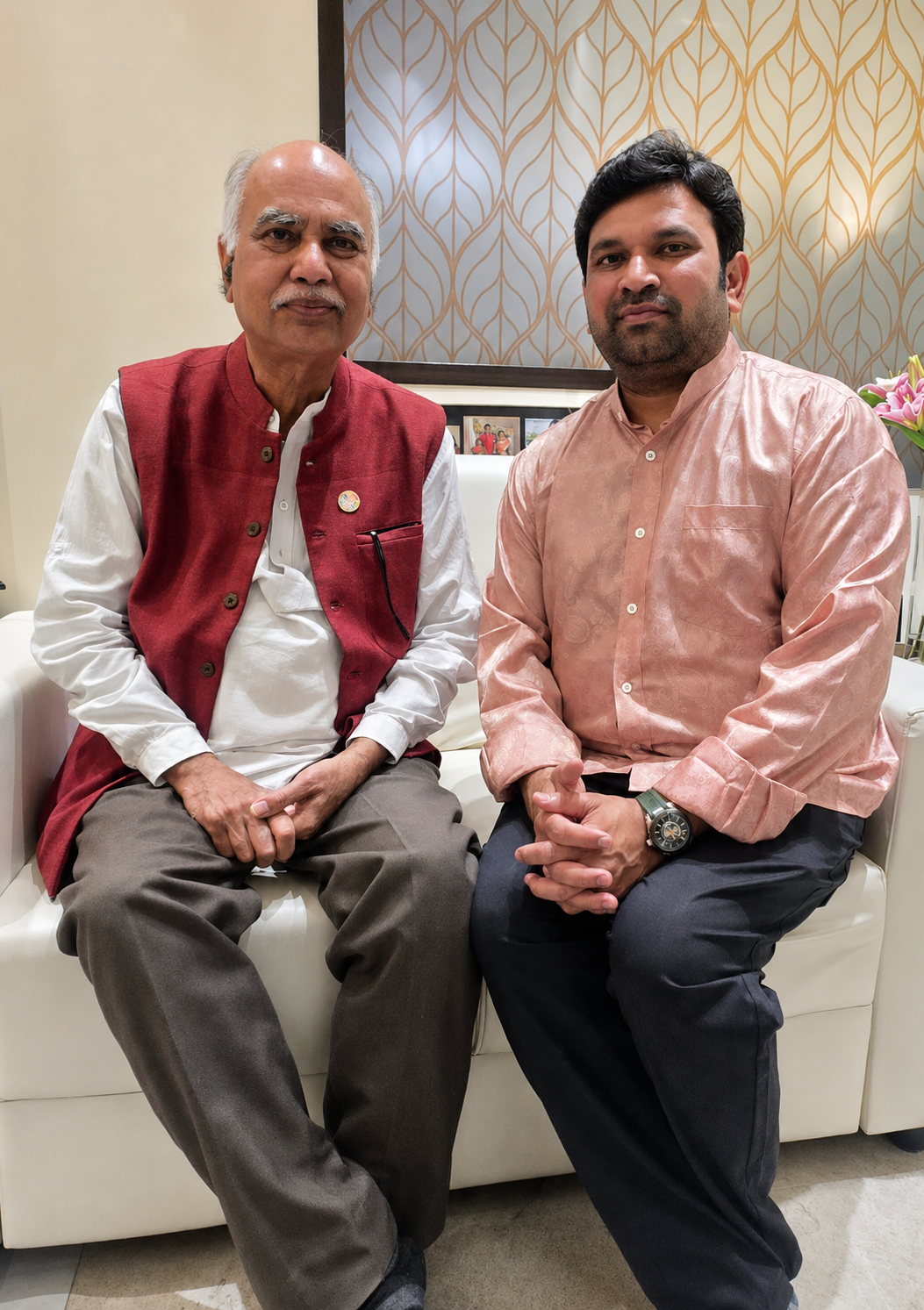
Pavan stood before me in a simple cotton shirt—unassuming, grounded. Yet here was a man who, since February 2025, has served as the Chief Digital & Information Officer at the U.S. Department of Transportation, reporting directly to Secretary Sean Duffy. In that moment, as he held my hand with warmth and respect, there was no hierarchy—only a quiet dignity that comes from being aligned with something larger than oneself. We sat on a sofa and spoke for an hour, and he also shuffled, talking to other guests.
Pavan’s story begins not in a metropolis, but in a village nestled in the foothills of the sacred Tirumala Hills in Tirupati. It is here that one begins to understand the first layer of his personality—the synthesis of tradition and aspiration.
His formative years were shaped within the Maharishi Mahesh Yogi Education System, an educational philosophy that integrates consciousness-based learning with modern knowledge systems. It is a system that does not merely aim to produce professionals, but individuals anchored in awareness, discipline and inner balance. In hindsight, one sees how such an education does not loudly announce itself but quietly informs every decision that follows.
Like thousands of Indian engineers of the late 1990s, Pavan arrived in the United States in 2002, carried forward by the rising tide of the global software revolution. But what distinguishes him is not the migration—it is the evolution.
He worked for Walmart at its headquarters, nestled in Bentonville, Arkansas—a place that blends the character of a Southern town, the intimacy of a small community, the dynamism of a global business centre, and the expanding energy of the Northwest Arkansas metropolitan region. Pavan entered a world where scale is not an abstract concept but a daily operational reality. Walmart is not merely a retail giant; it is a complex network where supply chains, customer behaviour and digital systems intersect on a planetary scale. Here, Pavan did not just participate—he transformed.
He led the evolution of Walmart’s global digital customer and omnichannel experience, redefining how millions of people interact with retail ecosystems. More importantly, he introduced a shift in ways of working—embedding design thinking and product management principles into the organisation’s technological backbone.
One of his defining contributions was taking charge of Walmart’s global point-of-sale systems through a rigorously fact-based decision-making framework. In a world often driven by intuition and urgency, he brought clarity, data discipline and architectural foresight. Recognition followed, as did material success—but these, one senses, were by-products rather than objectives.
Even at the height of his corporate journey, Pavan remained a student. He pursued a master’s in operations management from the University of Arkansas, and later another from Columbia University—one of the most storied institutions in the Ivy League.
He also briefly stepped into academia as an Adjunct Professor at the Rochester Institute of Technology. This movement—from industry to classroom—reveals an important trait: the desire not just to accumulate knowledge, but to share it.
Then came what Pavan himself describes as a ‘calling’.
In a decision that might appear ‘worldly-unwise’, he chose to leave a successful corporate trajectory and join the U.S. federal government, moving to Washington, D.C. It is here that the narrative deepens.
Governments around the world share certain characteristics—they are large, complex, often slow, and bound by layers of processes. Compensation rarely matches the corporate sector. Yet, they embody something that no private enterprise can fully claim: a mandate to serve.
At the Federal Motor Carrier Safety Administration (FMCSA), Pavan served as Chief Technology Officer and later rose to his current position. His work focused on transforming how technology is conceived, built and delivered within a federal institution—serving carriers, commercial vehicle drivers, and law enforcement agencies.
This is not merely about software. It is about safety, efficiency and trust across a vast national network. His recognition as one of the ‘World 100 Technology Leaders 2024’ stands as an affirmation—not just of competence, but of conviction.
My conversation with Pavan opened a deeper window into how transportation is conceptualised in the United States. In India, transport is often equated with trucks—the visible carriers of goods on highways. It is a perspective shaped by immediacy and familiarity.
But in the United States, transportation is far more expensive. It encompasses everything that moves—by road, rail, air, sea and inland waterways. It is an integrated network where logistics, infrastructure, policy and digital intelligence converge.
The U.S. Department of Transportation oversees this vast ecosystem—ensuring not just mobility, but safety, sustainability and interoperability. Agencies such as FMCSA are but one part of this larger architecture, focused on commercial motor vehicle safety, yet intricately woven into larger systems beyond themselves. This holistic approach transforms transportation from a sector into a living framework of national functionality. It is not merely about movement; it is about enabling life at scale.
India, in its rapid development, stands at an interesting juncture. The physical infrastructure is expanding impressively, but the conceptual framework—seeing transport as an integrated, multimodal system—still has room to evolve. The future will demand not just more roads, but smarter, interconnected mobility ecosystems.
Yet, beyond systems and strategies, what remains with me is the person. In Pavan, I see what Friedrich Nietzsche once described as the ‘Übermensch’—not in the misunderstood sense of dominance, but as an individual who transcends conventional limitations by aligning deeply with purpose; a person who acts not out of compulsion, but out of clarity.
And yet, Pavan remains grounded—rooted in family, in simple habits, in a life that does not seek spectacle. Such an equilibrium is uncommon. Ascending is one thing; to ascend while remaining anchored to one’s centre is another altogether. As I left that evening, I found myself thinking not just about Pavan, but about the ecosystem that produced him.
Indian civilisation, at its best, does not merely impart knowledge—it shapes character. When this foundation is paired with quality education, global exposure, and relentless hard work, it produces individuals who can navigate complexity without losing their inner coherence. Pavan Pidugu is one such individual.
He is not an exception to celebrate, but a possibility to recognise. A reminder that in a world increasingly driven by speed and scale, it is still possible to move with purpose—and to remain human while doing so. And perhaps, that is the quiet message he embodies: true greatness does not announce itself. It can be lived simply, steadily and with a sense of responsibility that extends far beyond oneself. In Pavan lives the ideal of a life divine—a son of Mother India who neither submits to nor blindly rejects systems, but elevates them from within with mindful intelligence and a compassionate heart. May his path remain guided by clarity and grace, may his work continue to serve with quiet strength, and may his journey inspire many more to rise with purpose, wisdom and compassion.
MORE FROM THE BLOG
Tea, Coffee, or Me?
Though I have been a tea person all my life, coffee has always intrigued me. During my travels in the United States, it seemed to be everywhere: at breakfast tables, in offices, beside hotel reception desks and in paper cups carried through the streets. In Ethiopia, I...

The Agony and the Ecstasy of Life
Since I met Dr Chinnababu Sunkavalli, the robotic surgical oncologist, in 2022 through an introduction by the Tangirala brothers, Venkat and Ravi, he has become part of my life. His enthusiasm, his commitment to connecting with people, and his extraordinary zeal to...
The Resilient Doctor
Dr. Prithvi Raj Jampana is a distinguished radiation oncologist with extensive experience in radiotherapy and systemic treatments for a wide range of cancers. He trained in clinical oncology at Oxford University Hospitals and worked in the UK for over two decades...
Interesting perspective on synthesis of consciousness-based learning and modern knowledge, Prof Tiwariji !
Your reflections on life journeys of contributors to society through technology are inspiring !!
Respected Sir, Thank you for sharing the life journey of Mr Pavan Pidugu, which inspires.
Thank you, Sir, for sharing this enriching blog! I really admired the way Pidugu Sir’s journey was portrayed here. There’s a rare combination of clarity, humility, and quiet determination in the way he seems to approach both life and work. The piece doesn’t just highlight achievement, but it reflects the depth of character and sense of responsibility behind it. So inspirational
“The Quiet Force of Purpose” illuminates one of the most underestimated engines of societal transformation: the supply chain. Often invisible to the public eye, supply chains are the circulatory systems of civilisation—moving food, medicine, technology, energy, and opportunity across vast geographies. When strengthened through intelligent design and technology, they do far more than deliver goods; they reshape economies, reduce inequality, and stabilise societies.
Modern supply chains are no longer mere logistical frameworks—they are strategic enablers of development. Efficient agricultural networks can reduce food loss and farmer distress; healthcare supply systems can bring life-saving medicines to remote populations; digital commerce ecosystems can connect small producers to global markets. In this way, supply chains become instruments of inclusion, resilience, and national progress.
Prof Tiwari, Thank you for the fitting reproduction of this humbling experience. I can’t agree more with you that ” in a world increasingly driven by speed and scale, it is still possible to move with purpose—and to remain human while doing so”. May we be found doing so!
The US is a land of opportunities, but it is not a forgiving land if you are not ready to work hard and prove yourself. There are millions of immigrants in the United States who survive easily, but only a few reach a level beyond mere survival. I see grit in Pavan’s story. Congratulations on the achievements and on making the place where he comes from and his parents proud.
By foregrounding mission over machinery, “The Quiet Force of Purpose” offers an inspiring vision for the future: one where engineers, innovators, and leaders become architects of social good. It affirms that when expertise is fused with ethical intent, technology can become one of civilisation’s most profound instruments of renewal. In this sense, the work is both a tribute and a call to build not just smarter systems, but a better society. Salute to Dr Pavan.
“The Quiet Force of Purpose” is a powerful reminder that true technological progress is not defined merely by innovation, speed, or disruption, but by its capacity to elevate society itself. It celebrates a rarer form of leadership—one where technology is guided by purpose, systems thinking, and human responsibility. In an era often dazzled by novelty, this narrative rightly honours those who build enduring frameworks that solve real problems, strengthen institutions, and expand human possibility. Hats off to Pavan Pidugi Sir!
What stands out most in Pidugu Sir’s work is its recognition that societal transformation through technology is often quiet, cumulative, and deeply structural. The greatest revolutions are not always loud; they occur when digital systems improve healthcare access, optimise governance, democratise knowledge, empower communities, and create resilience where fragility once existed. This is technology not as spectacle, but as service.
Blog of Shri Arun Tiwari exposes only a part of his persona like the proverbial tip of the iceberg. He has been specially gifted by Ma Saraswati. To come in contact with him, I consider it my good fortune.
Greetings! A truly inspiring and thought-provoking reflection, Sir. Your portrayal of Shri Pavan Pidugu beautifully highlights how humility, purpose, and service can coexist with global leadership and technological excellence. The message that true greatness is lived quietly, with clarity and responsibility, is deeply impactful. Thank you, Sir, for sharing such meaningful insights on leadership, purpose, and nation-building in the age of technology. Warm Regards.
Prof, an impressive narrative. Following my work on establishing the IRCTC ecommerce portal, I agree with your insight of viewing transportation as a cohesive, multimodal system. I have witnessed this firsthand as a builder of Airline Decision Support Systems and as a CRM service provider for the New South Wales Transportation system, where we contributed to enhancing the customer experience.
There’s no noise, no self-projection…just steady work, clarity, and purpose. The way you describe him, especially that moment of meeting him, makes it very real. This didn’t feel like a story about success. It felt like a reminder that you can grow, move across worlds, take on big responsibilities…and still stay rooted.
Thank you for sharing such an inspiring reflection, Sir. You excellently depict the essence of living with purpose rather than chasing mere external validation. It serves as a profound reminder that true greatness lies in quiet responsibility and remaining grounded in one’s humanity amid the speed of the modern world. This article truly resonates and encourages us to align our actions with our core values.
Respected Sir, this well-crafted blog resonates deeply, especially when one reflects on inspiring individuals like Pavan Pidugu, whose rise to a senior position in the U.S. government stands as a testament not merely to personal success but to the enduring global trust earned through Indian values of diligence, integrity, and perseverance. His journey symbolises something greater than financial achievement—it reflects how Indians, wherever they go, often distinguish themselves through quiet competence, intellectual rigour, and an unwavering work ethic. Across continents, Indians have increasingly become trusted contributors to institutions, governance, science, and innovation not simply because they seek prosperity, but because they consistently demonstrate reliability, commitment, and purpose. In many ways, this growing trust is a far more profound accomplishment than wealth alone. It is a reminder that true success lies not only in what one earns, but in the respect one commands, the responsibilities one shoulders, and the bridges of confidence one builds across nations.
Superb piece of writing Sir. Congratulations Pavan. This is people like him who have contributed to make USA leader in computer technology. As I am clicking on my key board, using software owned by some American corporation, some money is being paid to that corporation. But all this contribution from hard working Indians and people from other such countries is being viewed in a negative way.
Tiwari Ji elevates the context by giving equal weight to the person, the human aspects, accomplishments, and, more importantly, the arrival journey, while keeping himself in the background. Easy in his writing style, much like his demeanour.
Arunji, Pavan’s journey reflects a thoughtful shift from achievement to purpose. Choosing public service over corporate comfort and building systems that enhance safety and trust at scale speaks to a conviction that goes beyond career milestones. It was nice meeting him last week, along with you.
Thank you, Arun ji, for sharing this blog. You have given so many takeaways:
1. Do not accumulate knowledge, but share it
2. Align with your purpose deeply and act with clarity
3. Ascend and still anchor to your centre
4. Move with purpose and remain human.
A deeply resonant piece that reflects the strength of purpose lived, not proclaimed. It reminds us that the most meaningful journeys are often quiet, driven by inner conviction rather than external validation. As someone who has seen purpose unfold in the service of others, I find this a powerful affirmation that true impact is built steadily, with humility, clarity, and unwavering commitment to a larger cause.
This is not just another summary of an event; it is a picture perfect description of a beautiful life journey. The life journey of Mr. Pavan Pidugu, whose journey began in the hallowed hills of Tirupati and ended in an important position in the U.S. Government is one that inspires awe and respect in equal measure.