
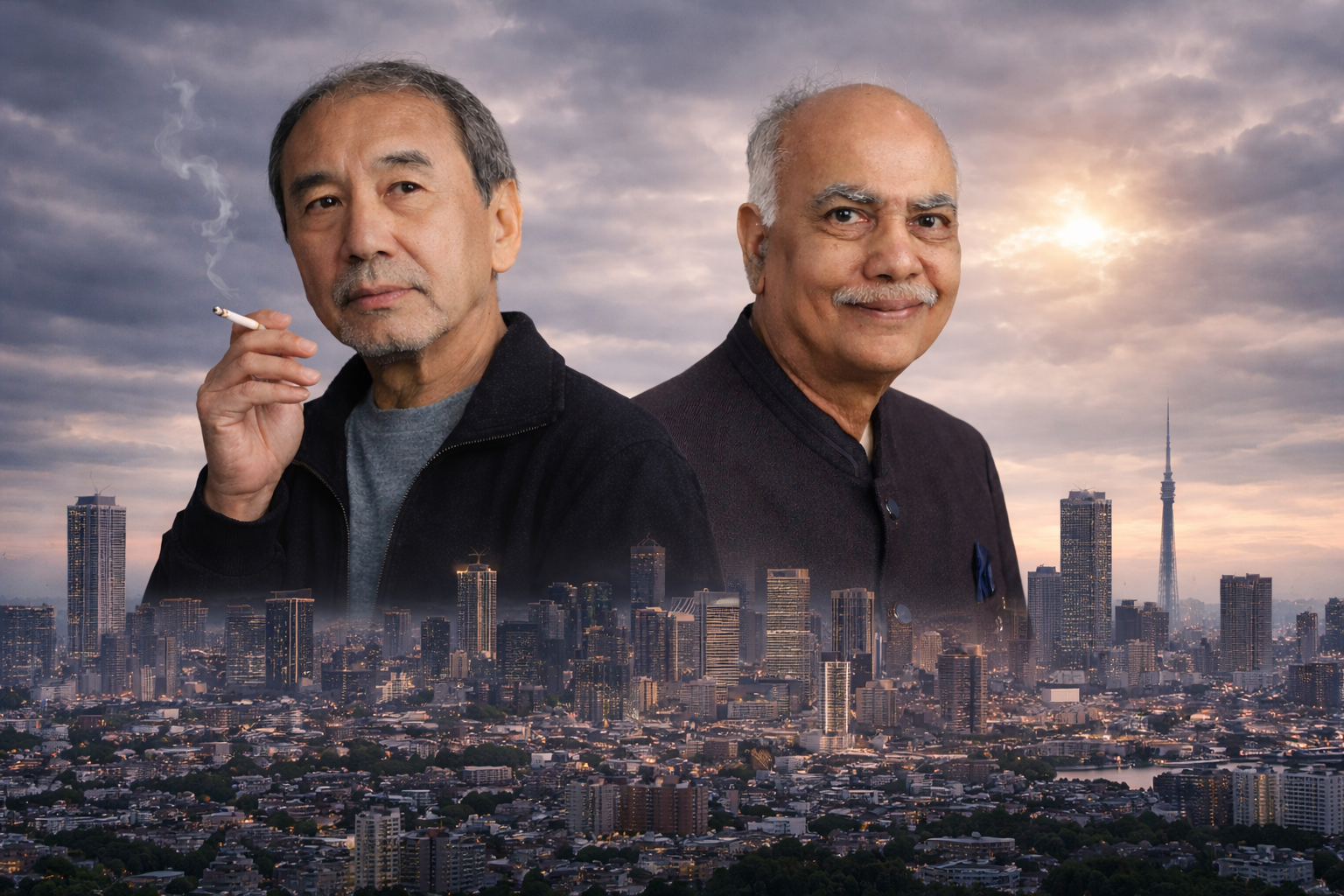
Stay Awake, Stay Connected
There are certain timeless truths that can be ignored only by the most callous among us. One such truth is the Buddhist concept of Triple Refuge: Buddham saranam gacchami—I take refuge in the Buddha (the Enlightened One or Teacher); Dhammam saranam gacchami—I take refuge in the Dhamma (the teachings or truth); and Sangham saranam gacchami—I take refuge in the Sangha (the community).
Confusion is the hallmark of modern times. Propaganda through electronic media and the creation of a consumer society have pushed the majority of people to live lives as cogs in the ‘machine of the world’. But there is also a minority who can see through this ‘game’ and refuse to succumb, albeit at a great cost. Their sensitivity draws them inward, and they live with the risk of becoming socially inept or losing their mental balance.
I just finished reading the novel 1Q84 by Japanese writer Haruki Murakami, which beautifully explores this problem in the contemporary world. A master writer, Murakami uses ‘The City of Cats’ as a metaphor for passive withdrawal from reality on a population level. In the novel, the protagonist misses his train, drifts into a town where cats live like humans, and slowly becomes trapped in a repetitive, silent existence. He, however, manages to escape by boarding the last train that passes through. Murakami’s warning is clear: If you disengage for too long, the world replaces you. After a point, there may not even be a train left to carry you away.
Murakami then discusses a ‘two-moon world’—a heightened perception experienced by certain individuals as a subtle shift in reality because of their superior cognitive ability. It is not consciously chosen. People sensitive to hidden layers of reality become aware of forces that others ignore and are pulled deeper into their inner world, a reality partly of their own making. In both cases, there is a withdrawal from the real world. One is an escape through dullness, the other is estrangement born of awareness.
Murakami maps two dangers of modern existence: the sleep of indifference—routine, unquestioned living and emotional withdrawal—which can eventually cause people to vanish quietly, as if permanently settled in the City of Cats. On the other hand, the perception of hidden truths creates its own burden. Feeling too deeply, such people risk losing their connection to shared reality and becoming isolated. What makes 1Q84 powerful is that its protagonists, Tengo and Aomame, neither fall into a City of Cats-like passivity nor dissolve into the madness of hyper-awareness. They hold onto each other. Love becomes the anchor to a shared, chosen reality.
If I extend this into the world of the Bhagavad Gita, the City of Cats represents tamasic drift (inertia, unconsciousness), the two-moon world reflects rajasic, overactive perception (restlessness, fragmentation), and the union of Tengo and Aomame points towards sattva (balance, clarity). Murakami, without naming it, is circling a very ancient truth: both dullness and hyper-sensitivity can disconnect us from reality. What restores us is meaningful connection. How do we remain truly alive in a world that either numbs us or overwhelms us?
What Sangham sharanam gacchami really implies is: ‘I take refuge in the Sangha (community).’ Here, the Sangha is not merely a social group. It is a field of shared awareness, a corrective mirror, and a stabilising force when perception becomes uncertain. Awakening (bodhi) is individual, but stabilising that awakening requires a community, because insight without grounding can drift. Enlightenment without relationship risks becoming delusion. The community protects truth from turning into isolation.
The Taittiriya Upanishad declares in its invocation:
सह नाववतु।
सह नौ भुनक्तु।
सह वीर्यं करवावहै।
तेजस्वि नावधीतमस्तु मा विद्विषावहै॥
May we be safeguarded together, and
Nourished in unity.
May we work with shared strength,
Learn to be luminous, and
Not fall into discord.
When we bring all this together, a deeper synthesis emerges: we do not merely need community for safety—we need it for illumination. Just as one mirror may warp, but many aligned mirrors reveal the truth more faithfully. Truth is not weakened by sharing—it is clarified by it, whereas isolation magnifies both illusion and emptiness.
The Taittiriya Upanishad does not say: ‘Let me be enlightened’; it says: ‘Let us be luminous together.’ And the Buddha does not say: ‘I am enough.’ He says: ‘Take refuge in the Sangha.’ When the path becomes subtle, and the inner sky grows vast, it is not solitude but shared presence that keeps the light from dissolving into darkness. All great teachers keep their bright students close to them. All great leaders are supported by capable and wise ministers. In good families, people have their dinner together, discussing how the day has passed.
With the world compressed into a mobile screen, it is possible to feel engaged yet remain untouched by real experience. One can drift into passive living—scrolling, consuming, becoming a cog in a larger machine—or, at the other extreme, become inwardly fragmented, overstimulated and socially withdrawn. Both, in different ways, distance us from truly living. What anchors me is the simple, enduring truth that life unfolds in relationships—in conversations with family, in unhurried moments with friends, and in small acknowledgements of the people who form the fabric of everyday society. These interactions are not incidental; they are what keep the mind steady and the heart awake.
So while I read a great deal, I also write by hand on paper, water the potted plants in my balcony, make my tea, and sit quietly to watch the sunrise. I never forward a WhatsApp ‘Good morning’ message; instead, I type it every day, addressing the recipient by name and the day—Monday, Tuesday, and so on. Despite my health condition, I make it a point to step out, visit institutions and speak to people—to engage with the living world, and to avoid becoming lost in my own mental world.
The bodily senses, I increasingly feel, are the true gift of being alive. Even gods are said not to possess bodies; only humans do. I have not yet fully understood the mind, but this much I am certain of: when it drifts too far from the body and its immediate surroundings, it tends to create its own difficulties, often leaving one in a waterless, deep well of despair. In this journey, I remain deeply connected to my friends from my university days—Sameer and Suresh Patel—and to my colleagues from DRDO—Adalat Ali, Sagar and Sheridon—and, above all, to my younger brother Salil. They are my anchors, my quiet points of return, my existential ‘earthing’.
At the same time, I remain mindful of how easily one can seek quick relief from stress or emptiness through harmful escapes, especially substance abuse, which only accelerates decline by weakening clarity, discipline and purpose. It does not resolve problems; it reduces our capacity to respond to them. In the end, I am reminded that life is not lost in a single dramatic moment, but gradually—through disconnection from people, from presence and from meaning. To remain truly alive is to stay connected to one’s surroundings, to be aware of others’ feelings, and thereby to remain grounded in a shared reality—not a prisoner of one’s own mental castle in a concrete jungle.
MORE FROM THE BLOG
The Resilient Doctor
Dr. Prithvi Raj Jampana is a distinguished radiation oncologist with extensive experience in radiotherapy and systemic treatments for a wide range of cancers. He trained in clinical oncology at Oxford University Hospitals and worked in the UK for over two decades...
AI, Stories and the Mind
I have been reading an English translation of the Kathasaritsagara—The Ocean of the Streams of Stories—composed in Sanskrit by Somadeva, a Kashmiri writer of the eleventh century. Organised into eighteen books, it is less a conventional book than an immense...
The Wellness Dividend
One teaching of Dr. A.P.J. Abdul Kalam that I have always tried to follow is to ‘stay in circulation’, as he put it. By this, he did not merely mean travelling, attending meetings or remaining publicly visible. He meant keeping the mind in motion—meeting people,...
You have very rightly noted that Murakami’s image of the two-moon world is not merely a surreal device—it is a precise metaphor for a heightened cognitive state, where perception begins to register layers of reality that are normally filtered out. The brain is not only a receiver of reality but also a generator of it. When internal narratives begin to dominate external signals, reality itself becomes negotiable. The “two moons” then are not in the sky, but in cognition—one anchored in the shared world, the other in a private constellation of meaning.
The challenge, therefore, is not to reject this heightened perception, but to integrate it. To see deeply without drifting away; to hold multiple layers of awareness without losing the thread of lived reality. The mature mind learns to move between worlds—touching the subtle without abandoning the tangible. In this integration lies creative power, not fragmentation.
A very insightful reflection, Arunji. That simple image — “water the potted plants in my balcony, make my tea, and sit quietly to watch the sunrise” — feels very close to my own mornings these days. It beautifully captures how awareness begins in stillness before it extends into action, and the essence of truly “staying awake.”
And “stay connected” resonates with the spirit of Sahana Vavatu — a reminder that growth and understanding are shared journeys. Your articulation that “it is not solitude but shared presence that keeps the light from dissolving into darkness” brings out this truth with great clarity.
My Friend, I am humbled by this reflection of your person. So while I read a great deal, I also write by hand on paper, water the potted plants in my balcony, make my tea, and sit quietly to watch the sunrise. I never forward a WhatsApp ‘Good morning’ message; instead, I type it every day, addressing the recipient by name and the day—Monday, Tuesday, and so on. Despite my health condition, I make it a point to step out, visit institutions and speak to people—to engage with the living world, and to avoid becoming lost in my own mental world. Praying with you.
“Stay Awake, Stay Connected” is the blog heading of my spiritual mentor and elder brother, Professor Arun Tiwari, who taught me awareness, consciousness and how to live a contented life after retirement from regular Government Service, speaks about everything one needs to live a life. He started quoting the Buddhist concept of Triple Refuge: Buddham saranam gacchami—I take refuge in the Buddha (the Enlightened One or Teacher); Dhammam saranam gacchami—I take refuge in the Dhamma (the teachings or truth); and Sangham saranam gacchami—I take refuge in the Sangha (the community). I am a student of biological sciences. What I understand here is that our body is an assembly of organs working together and for each other. Anyone’s failure or debility of working adversely affects the whole body. Their perfect working is truthfully synchronised, meticulously, and governed by the organ that deals with Buddhi, which makes one Buddha (The Brain, the enlightening organ as we understand). And that enlightenment of Buddhi comes from living a truthful life, the dharmic-spiritual way. With such alignment, Buddha and Damma, the Sangh gets synchronised, and life becomes easy sailing. I understand the same principle applies to our worldly life. It’s our life, enlightened people have been teaching. It is in our hands what life we choose to live.
Thank you for this profoundly illuminating piece, Arun Tiwari Sir. Your synthesis of Murakami, the Gita, the Triple Refuge, and lived experience is both rare and deeply resonant. You remind us that clarity is not found in withdrawal or overstimulation, but in meaningful connection—with people, with presence, with the simple rhythms of being alive.
Your reflections on Sangha as a field of shared awareness, and on the body as our anchor to reality, are especially moving. I’m grateful for the wisdom, gentleness and lived honesty you bring to every line. It’s writing that doesn’t just inform—it steadies. Thank you for offering such clarity in a world that often pulls us toward confusion. Your insights truly enrich the journey.
What is striking is how this apparently philosophical blog aligns with contemporary neuroscience, which no longer sees cognition as a single-threaded process. The brain operates through parallel networks—analytical, emotional, and default-mode systems—often working simultaneously. Murakami’s “extra-thinking” mind resembles this integrative field, where insights emerge not from deliberate effort but from a kind of relaxed vigilance. His protagonists often access truth not by solving problems, but by allowing meaning to surface—through dreams, music, silence, or seemingly trivial encounters.
I feel the finest use of the mind is knowing when not to use it. Insight, creativity, and even emotional balance often arise when the mind relaxes its grip. In these moments, awareness expands beyond deliberate thought, and one begins to perceive rather than construct reality. This is not anti-intellectual; it is a higher calibration of intelligence—where thinking becomes a servant of understanding, not its substitute. The art, then, is not in sharpening the mind endlessly, but in learning when to engage it, when to guide it, and when to let it fall silent.
Sir, very nicely mapped the three important perspectives and aptly concluded — true living lies in staying connected to the world around us.”The line that stayed with me: Enlightenment without relationship risks becoming delusion. So simple, yet so easy to forget in today’s world.
The discipline of attention is most important. The mind tends to follow the path of least resistance, drifting toward distraction, fear, or habit. But attention, when trained, becomes selective—it chooses what deserves energy. This is not suppression, but prioritisation. Just as a scientist filters noise to detect a signal, a well-trained mind filters impulses to preserve coherence. Over time, this creates an inner economy in which mental energy is conserved and directed toward what truly matters. Diffused attention is most harmful.
Respected Sir you are our Murakami. You have explained in your blogs that intelligence is not merely computation but receptivity. The “extra-thinking” mind is the space where the self loosens its grip, allowing reality to disclose itself. In that sense, his fiction becomes a guide—not to escape the world, but to perceive it more fully. The challenge is not to think harder, but to remain open enough for something beyond thought to enter. Excellent blog!
Very balanced and thought-provoking! Connectivity with people you know and with whom you have good wavelength must never be lost even if they may be at a distant place and
one may not have met personally for a long time Honoured and feeling privileged to see my name in the list. Best Wishes and Regards.
A calm and insightful piece sir, encouraging balance between solitude and community, perception and participation. Beautiful connection between 1Q84, the buddhist idea of the Sangha, and the wisdom of Gita into a single, clear insight, that both disengagement and over sensitivity can pull us away from reality.
‘Sangham sharnam gachchami’…..be part of a sangha…..which in my view is driving you towards a cult????
And all cults would want to control your thinking, actions and purse.
Sorry for little radical views of mine.
I fully endorse what you have concluded in your blog: To remain truly alive is to stay connected to one’s surroundings, to be aware of others’ feelings, and thereby to remain grounded in a shared reality—not a prisoner of one’s own mental castle in a concrete jungle.
This has been my main motive all through. Staying connected with my friends and relatives is a unique and most satisfying experience in my life. I shall continue doing so, knowing so well the value of it for longevity and a happy life.
Admire you for bringing this fact so beautifully to light.
Hon’ble Arun sir, Living together, working together, eating together is a great concept of togetherness, to keep people around for a good cause is indeed a Pathway for society to be followed. Lord Buddha showed the path of living and peace to the world community. Many people follow different paths to lead a peaceful, quiet life. With regards.
Arun ji, Your reminder that staying connected to people, to purpose, and to the present moment that keeps us grounded is very powerful. True strength often lies in these quiet anchors of friendship and awareness that keep us from drifting into isolation.
Murakami was my favorite author in the 2008-09 time frame — as I was mesmerized by his “Kafka on the Shore” — and then read all his novels and short stories published at that time point and later 1Q84 — but after 1Q84 — I did not read any after that. Regarding the community, the prayer to illuminate ‘us’ than ‘me’ — I believe that is something our next generations need to believe in.
Your emphasis on human connection as an anchor in today’s fragmented world is especially moving and relatable. It leaves us with a quiet sense of clarity and introspection.