
Wings of Duty
There is a small seabird that weighs scarcely more than a hundred grams, yet every year it performs the longest migration known in the animal kingdom. The Arctic tern (Sterna paradisaea) leaves its breeding grounds in the Arctic and flies to the Antarctic from August to November, where summer awaits, before returning north during March to May to welcome another Arctic summer. In a single year, it may travel over 70,000 kilometres. Over its lifetime, it can cover more than two million kilometres—equivalent to several journeys between the Earth and the Moon. No living creature spends more of its life in pursuit of light and warmth.
Its achievement is remarkable, not merely because of the distance it covers but because of its extraordinary precision. Without maps, satellites or navigational instruments, the Arctic tern reads the Earth’s magnetic field, the position of the Sun and stars, the direction of the winds and the rhythm of the oceans, returning almost unfailingly to the same breeding grounds year after year. Though tiny in stature, it is one of nature’s supreme navigators.
Naturalists often marvel at the tern’s endurance, but I find myself equally moved by its purpose. It does not migrate for adventure. It migrates because life itself demands movement. It follows an invisible compass refined over millions of years. It teaches us that constancy and movement are not opposites. One may travel endlessly and yet never lose one’s direction.
Until recently, I did not know that this extraordinary bird would find a place in my own life.
A few days ago, Squadron Leader Mradul Dixit and my niece, Sagarika, came to visit me before leaving Hyderabad for their next posting at Yelahanka in Bengaluru. They had arrived in Hyderabad three years earlier from Guwahati, where they had begun their married life. During those years, they were blessed with a daughter, Shambhavi, who has brought new joy to the family. Like every Air Force family, they now prepare to build another home in another city, carrying memories with them and creating new ones wherever duty calls.
My association with Mradul, however, began much earlier. I first met him when our families were exploring the possibility of his marriage to Sagarika. At the time, he was undergoing training at the Air Force Academy at Dundigal, near Hyderabad. For every aspiring military aviator, Dundigal is more than an institution. It is where young men and women are transformed into officers. Flying is taught there, certainly, but so too are discipline, responsibility, calm judgement and the quiet confidence that comes from mastering both oneself and one’s machine.
From the beginning, I found Mradul to possess that understated assurance which military training often imparts. There is little display, yet there is unmistakable strength.
Mradul hails from Shivpuri in Madhya Pradesh, once the summer capital of the illustrious Scindia rulers of Gwalior. When we travelled there for the wedding, I found myself drawn not merely to the ceremonies but also to the place’s history. The magnificent Chhatris of the Scindias stand amidst serene gardens, their marble domes reflecting the elegance of a bygone era. They are monuments not only to royalty but also to memory itself.
What intrigued me most was one particular detail. The Scindia royal insignia features two intertwined serpents. Indian civilisation rarely chooses symbols casually. The serpent has long represented vigilance, renewal, wisdom and continuity. A pair of serpents suggests balance and the perpetual regeneration of life. Standing before those marble memorials, I felt that the emblem carried a quiet lesson: institutions endure not because they resist change, but because they renew themselves while remaining faithful to their inner character.
That lesson seemed strangely appropriate for military life.
Mradul flies the Avro HS 748, an aircraft that has served the Indian Air Force with quiet distinction for decades. Designed in Britain and manufactured in India by Hindustan Aeronautics Limited, the Avro has seldom enjoyed the glamour associated with fighter aircraft. Yet it has carried troops, supplies, medicines, equipment and hope to remote corners of the nation, often operating from airfields where larger aircraft cannot land. Its contribution has been measured less by spectacle than by reliability. It reminds us that nations are sustained not only by heroic moments but also by dependable service carried out every day without fanfare.
Their next destination, Yelahanka, is itself part of India’s aviation heritage. One of the oldest Air Force stations in the country and the venue for Aero India, it has witnessed generations of pilots taking to the skies in the service of the nation. For an aviator, every posting becomes another point on an invisible map drawn not by geography alone but by duty.
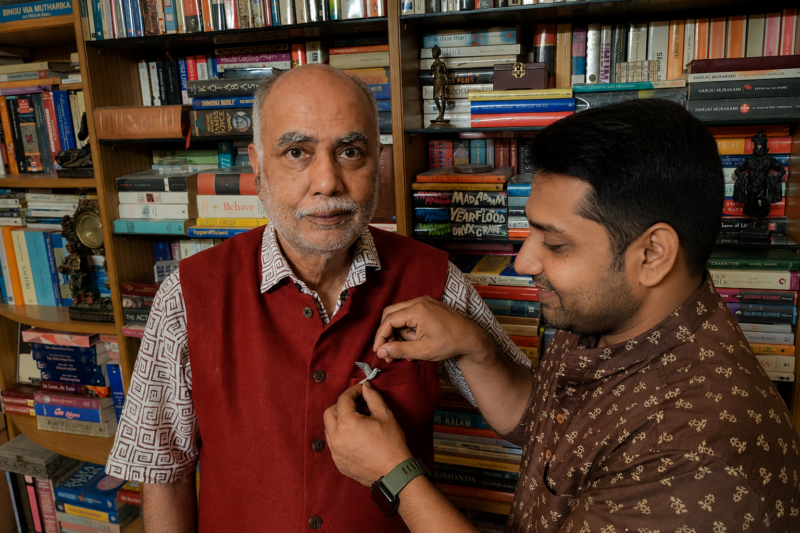
As they prepared to leave, Mradul did something unexpected. He did not simply hand me a small box. He opened it, took out a tiny silver brooch shaped like a bird, stepped closer and gently fastened it onto the pocket of my jacket. For a brief moment, I remained still while he carefully adjusted it until it sat perfectly in place.
It was such a simple gesture, yet it carried an unexpected tenderness. It reminded me of the old military tradition of pinning insignia upon a uniform—not as an ornament but as a mark of trust, affection and shared values. The brooch was no longer an object. It had become part of the occasion itself.
The bird was an Arctic tern. I could think of no bird more fitting to symbolise the life of an Air Force officer.
Like the Arctic tern, a pilot spends his life following invisible pathways across immense skies. He trusts training, instruments and judgement just as the bird trusts the Earth’s magnetic field and the heavens above it. He leaves home repeatedly, not because he wishes to wander, but because service demands movement. One posting follows another. Guwahati yields to Hyderabad. Hyderabad gives way to Yelahanka. Tomorrow, another city, another runway, another horizon will appear.
Yet through all these journeys, something remains unchanged.
The compass within.
The Arctic tern does not undertake its astonishing migration for conquest or adventure. Every flight serves the larger purpose of life itself. So too with military aviation. Every sortie serves something beyond the individual pilot—whether carrying supplies to distant frontiers, evacuating the injured, delivering relief after natural disasters or quietly sustaining the logistical lifelines upon which national security depends.
The bird and the pilot are united not by wings alone but by purpose. As I stood before my bookshelves while Mradul pinned the little tern to my jacket, I realised that the gift itself was secondary. What he had really given me was an idea.
The Arctic tern teaches that home is not always a place marked on a map. Sometimes, home is the direction in which one’s inner compass continues to point. Destinations may change—from Dundigal to Guwahati, from Hyderabad to Yelahanka, and onward to places yet unknown—but the journey remains coherent because duty gives it meaning.
When I look now at the little silver tern resting on my jacket, I no longer see merely a bird. I see a young Air Force officer setting out once again towards another horizon.
And I silently wish that, like the Arctic tern itself, he may always find favourable winds, clear skies and, wherever duty may take him, the certainty of finding his way home.
MORE FROM THE BLOG

The Resilient Doctor
Dr. Prithvi Raj Jampana is a distinguished radiation oncologist with extensive experience in radiotherapy and systemic treatments for a wide range of cancers. He trained in clinical oncology at Oxford University Hospitals and worked in the UK for over two decades...

AI, Stories and the Mind
I have been reading an English translation of the Kathasaritsagara—The Ocean of the Streams of Stories—composed in Sanskrit by Somadeva, a Kashmiri writer of the eleventh century. Organised into eighteen books, it is less a conventional book than an immense...
The Wellness Dividend
One teaching of Dr. A.P.J. Abdul Kalam that I have always tried to follow is to ‘stay in circulation’, as he put it. By this, he did not merely mean travelling, attending meetings or remaining publicly visible. He meant keeping the mind in motion—meeting people,...
Prof Tiwari, Great rendition of your experience yet again. I am touched by Mradul’s gesture to you and the symbolism. But more so of the Arctic Tern’s life of migration, and the fact alluded to the truth that life itself demands movement.
‘The Arctic tern teaches that home is not always a place marked on a map. Sometimes, home is the direction in which one’s inner compass continues to point. Destinations may change …. but the journey remains coherent because duty gives it meaning’ May we all obey the dictates of the inner compass
Wings of Duty is a beautifully synchronised write-up on the great abilities of a Nature-created bird and Human Air Force capabilities, with thoughts on common parameters. Best wishes to Mr Mradul and Ms Sagarika; God bless them. Jai Shri Krishna.
Thank you, Sir, for sharing this blog! This piece made me think about duty in a different way. We often associate it with sacrifice or obligation, but the comparison with the Arctic tern shows that purpose can give even constant movement a sense of belonging. The idea that home is not always a place, but something carried within through values and direction, stayed with me long after I finished reading. It’s a quiet reminder that what keeps us grounded isn’t where we are, but why we continue the journey.
Another captivating read, Arunji. It reminds us that true strength lies not in resisting change, but in renewing purpose while preserving character. The transition from royal symbolism to military ethos feels both natural and profound.
Respected Sir, what lingers is the gesture — Mradul not handing over the box, but opening it and pinning the little silver tern to your jacket, in the old tradition where insignia is a mark of trust rather than ornament.
And your quiet insight, that constancy and movement are not opposites. The tern travels endlessly yet never loses direction; the pilot leaves home again and again yet carries the compass within. Home, then, is not a place on a map but the direction one’s inner compass keeps pointing towards. Runways change — Guwahati, Hyderabad, Yelahanka — but the journey stays whole because duty gives it meaning.
Favourable winds and clear skies to Squadron Leader Mradul and his family. Thank you, Sir
Dear Sir, Greetings! An inspiring and beautifully crafted reflection, Sir. The parallel you draw between the Arctic tern’s extraordinary migration and the life of an Air Force officer is both profound and deeply moving. Your writing reminds us that true purpose lies not in the destinations we reach, but in the unwavering inner compass that guides us through life’s changing horizons. Thank you for another thought-provoking and uplifting piece. Warm Regards.
True, the life of an Air Force family is like that of a tern. Surprisingly, I found that they adapt themselves to the surroundings and what I admire is that when they introduce themselves, they DO NOT FORGET TO MENTION THEIR FAMILIES. The terns move as a community and share well. Their strength to adapt to the new surroundings is really praiseworthy. I pray and wish that the entire community (and also your niece and her family) be given strength to move on and experience the best in life.
Dear Sir, the Arctic tern’s innate navigation is a remarkable expression of biological intelligence. A little bird travels between the Arctic and Antarctic by integrating signals from Earth’s magnetic field, the Sun, stars, winds and coastlines. This intelligence is not learned in the human sense; it is embodied in the bird’s nervous system, sensory organs and inherited behavioural patterns. Evolution has encoded a living navigation system capable of sensing, interpreting, and responding to a changing planet. The Arctic tern therefore reminds us that intelligence is not confined to the human brain or to artificial machines—it can also exist as a deep, adaptive wisdom written into life itself. My best wishes to Sqdr Leader Mradul Dixit
What an eye-opener! The Arctic tern’s innate navigation is one of nature’s most astonishing biological achievements. Without maps, instruments or formal learning, it undertakes an immense annual migration between the Arctic and Antarctic regions. Scientists believe that it combines several inherited abilities: sensitivity to Earth’s magnetic field, awareness of the Sun’s position, recognition of stars, winds and coastlines, and an internal biological clock. Its navigation is therefore not based on a single compass but on an integrated sensory system refined through evolution. The Arctic tern reminds us that intelligence does not always appear as conscious calculation; sometimes it is written quietly into the body as an ancient and remarkably precise knowledge of the Earth. My best wishes to Sq Ldr Mradul Dixit.
As always learnt so much from this piece.
Contemplative and quietly profound. The way you weave the epic journey of the Arctic tern with the disciplined, almost poetic rhythm of an Air Force life is truly striking. There’s a certain elegance in how the narrative moves from the vastness of nature to the intimacy of a personal moment, without ever losing its sense of purpose. What lingers most is that beautiful idea of the “inner compass”… reminder that constancy is not about standing still, but about moving with meaning. It’s rare to come across writing that informs, reflects, and gently stirs something deeper all at once. Truly a delightful and enriching read.
Wings of Duty, the Arctic Tern is not merely a narrative to be read, but a profound testament to the deep, enduring sentiments held for family and the sacred sanctity of human relationships. Through the graceful presence of Mradul and Sagarika, we find a story beautifully and meticulously woven—a rare tapestry of emotional elegance seldom witnessed in our contemporary times. May divine blessings always guide and protect Mradul and Sagarika.
Sir, I am in the awe just thinking how beautifully you relate an Arctic tern travel to a lifes purpose and beyond. It is really an inspiring journey of Mradul. Thank you for the enlightenment on a rare and truly record winning bird for its precision and purpose.
What remained with me wasn’t just the astonishing journey of the Arctic tern, but the idea that purpose can make even constant movement feel like continuity. In a world that often equates success with arriving somewhere, this very nicely & gently suggests that what matters more is the compass we carry within. Destinations change, but Purpose is what keeps every journey coherent.
Another Blog from the master. The parallel between the Arctic tern and the life of an Air Force officer is a new dimension. Rightly articulated that the highest form of service is carried out silently, but guided by an inner compass. My best wishes to Squadron Leader Mradul Dixit and his family for safe journeys ahead.
The idea that purpose can make even constant movement feel like continuity truly stayed on my mind. In a world that often equates success with arriving somewhere, this essay nicely & gently suggests that what matters more is the compass we carry within. Destinations change, but character & purpose is what keeps every journey coherent.