
The Extra Mile
Shakespeare once reminded us that life is but a stage; listen closely, and beneath those familiar words, you can hear the soft hum of entrances and exits. Each of us arrives in medias res, as the Latins say—dropped into the middle of a vast, unfolding drama whose beginning we never witnessed and whose ending we shall not see. The world continues before us and after us; we hold only our scene, our cue, our momentary patch of light. And yet, this “stage” is also a journey. Marcel Proust, with his gentle, probing wisdom, told us that the true voyage is not in discovering new lands, but in discovering new eyes.
It was with such reflections swirling about me that Dr Krishna Yedula approached with a request: would I help shape into words the story of the Society for Cyberabad Security Council (SCSC) and its work during the pandemic—a story he had lived breath by breath as Secretary-General in those turmoiled COVID months? I agreed without hesitation. How could one refuse? For nothing in our lifetime has equalled that invisible storm that brought the machinery of the world to a standstill, stripped us of illusions, and forced us to confront the fragility of breath itself. To revisit those days was to revisit the human spirit under trial.
The SCSC is a rare and admirable institution—an alliance between the Police and the corporations of Hyderabad’s newest technological nerve centre, called Cyberabad, created to address the shared but often neglected domains of safety, responsiveness, and civic well-being. Its Chairman during the pandemic, Mr V. C. Sajjanar—later entrusted with leading the vast Telangana Road Transport Corporation—was a leader both steady and gracious, the kind of presence that turns anxiety into resolve.
When I asked Mr Sajjanar what the theme of such a book should be, he replied without the slightest pause: “The Extra Mile.” The clarity of his answer carried the weight of something larger, as though Lord Brahma Himself had leaned in to whisper a reminder—that calamities are not punishments but awakenings, moments when the human spirit is summoned to evolve. And so the book began to take shape.
It took time, for memory is a fragile archive, easily smudged by pain, haste and the passing of days. We wanted the story to hold every essential detail: the abandoned bodies given last rites by enlightened souls; the starving street dogs fed during the lockdown by hands that refused to look away; the migrant workers trudging out of a city that had forgotten how deeply it relied on them, who were offered food, dignity, and care; and the orphaned children whose education was quietly ensured by strangers who became guardians. Each thread deserved its place in the light.
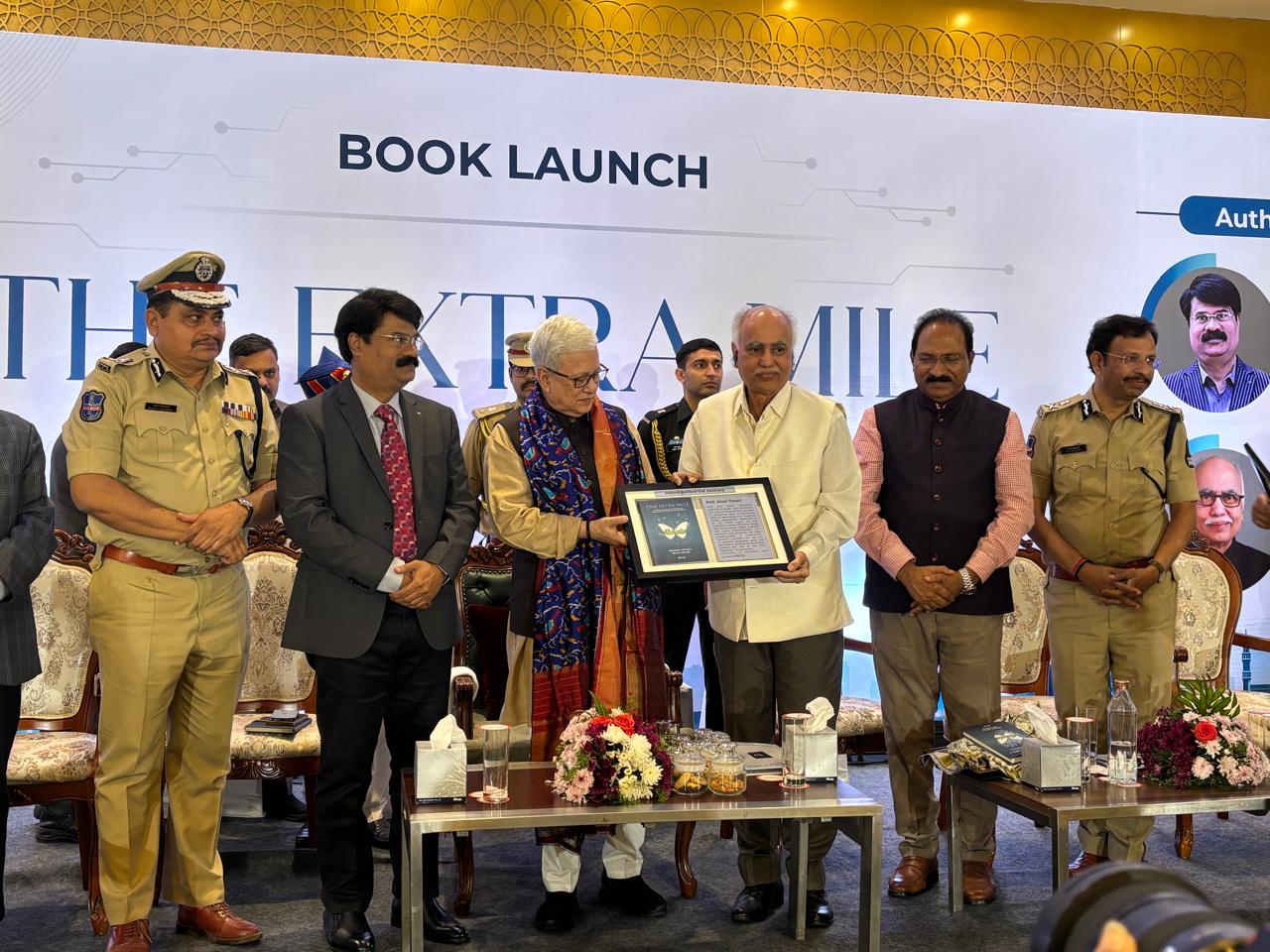
Finally, on a luminous December evening in 2025, Friday the 5th, the book was launched by the Honourable Governor of Telangana, Shri Jishnu Dev Varma—a prince of the old Tripura lineage—alongside senior officers, SCSC’s founding leaders, technologists, volunteers, and countless citizens who had experienced both sorrow and solidarity during those months. The Convention Hall at Hotel Daspalla—named after the ancient coastal kingdom of hills, forests, and rivers, now modern-day Vishakhapatnam—radiated a sense of purpose fulfilled. We chose Dr A. P. J. Abdul Kalam’s line as the epigraph: “Extraordinary people are those ordinary people who do extra work.” It was the perfect gateway into what I wished to share when my moment at the podium arrived.
The extra mile is not about an outward sprint; it is an inward gesture—a quiet vow: I will give a little more than what is asked, not for applause, but for the integrity of the act. This vow reveals itself in the smallest details of everyday life. The young engineer who notices the server room overheating does not walk past, murmuring, “Not my department”; he alerts the right people and prevents a failure no one else imagined. The professor who senses confusion clouding her students’ minds prepares a simple, clarifying handout, even though no syllabus demands it. The doctor finishing a weary shift sits with an anxious patient for a few unhurried minutes, knowing that reassurance can heal where medicine cannot.
In offices, the extra mile often appears as initiative: the colleague who gathers data and proposes solutions rather than rehearsing complaints. At home, it is the person who stays back after the party laughter has faded and quietly restores order—washes dishes, clears garbage, and rearranges furniture and coverings. For the farmer, it is sharpening tools late at night so that the next day’s labour is more productive. For the shopkeeper, it is letting a customer leave with twenty rupees pending because humanity weighs more than arithmetic. For a teacher, it is being ever ready to help the slowest student.
The extra mile has little to do with working longer or seeking recognition. It is about arriving at the right moment when needed, noticing what others overlook, and repairing what was not broken by you. It involves choosing quality even when no one will ever know. Here, the Bhagavad Gita enters like dawn light and gives the shloka— Karmanyeva adhikaras te ma phaleshu kadachana (2.47), which explains the concept of Nishkama Karma—action without attachment to reward.. Our authority rests in the action alone; the fruit is never ours to claim. To walk the extra mile is simply to embody this truth. It is the Gita quietly breathing through our everyday lives—devotion not in grand gestures, but in small, steadfast, selfless acts that gently refine the world from within.
For in the end, it is not the magnitude of a deed but the purity of intention that shapes character. And character, slowly built through unnoticed choices, earns trust and affection without ever demanding them. Those who walk the extra mile never walk it alone; their sincerity gathers companions, lightens burdens, knits communities, and makes the long road gentler for all.
And perhaps that is why one eventually realises: the extra mile is never crowded—because it is walked not by the strong, but by the sincere.
May the brave volunteers, the selfless leaders, and all the souls who risked their own safety and comfort to lift another out of fear or darkness be blessed with lives of abundance! May their courage ripple outward, inspiring others to step forward when the world trembles. And may their tribe increase—steadily, silently, like lamps lighting other lamps—until compassion becomes our civilisation’s most natural instinct. For it is in precisely such moments, when ordinary people choose to give more than is asked, that the extra mile reveals itself—not as the heroic road of a select few, but as the true path on which humanity moves forward together.
MORE FROM THE BLOG
Stay Awake, Stay Connected
There are certain timeless truths that can be ignored only by the most callous among us. One such truth is the Buddhist concept of Triple Refuge: Buddham saranam gacchami—I take refuge in the Buddha (the Enlightened One or Teacher); Dhammam saranam gacchami—I take...
Layers of Becoming
When I sat on the chair on stage to be felicitated on the 13th Foundation Day of the Ozone Hospital, on February 28, 2026, and Telangana Transport Minister Mr. Ponnam Prabhakar, Telugu film star of yesteryears Mr. Suman Talwar, and Chairman Mr. Satya Sai Prasad...

The Unfulfilled Promise of Healthcare
Recently, I had the opportunity to spend nearly three hours in conversation at the Care Foundation, graciously hosted by its CEO, Mr. S. G. Prasad, whose quiet commitment to accessible healthcare has sustained many meaningful initiatives over the years. The meeting...

Doing extra work beyond obligation quietly enlarges life. When effort is guided by service rather than reward, it sharpens empathy, resilience, and purpose. Supporting others—through time, attention, or skill—creates invisible bonds that strengthen both giver and receiver. Such work refines character, teaching patience and humility while expanding one’s capacity to endure and adapt. The benefits often return indirectly: trust deepens, communities flourish, and self-worth grows from contribution rather than applause. Extra effort becomes a discipline of generosity, transforming routine labour into meaningful action. In serving others without calculation, life gains depth, direction, and a lasting sense of fulfilment.
Everybody moves forward in life—driven by ambition, necessity, or circumstance. Progress, in some form, is almost unavoidable. But there is a deeper kind of movement that marks truly fulfilled lives: the ability to move forward while carrying others along.
Those who help others rise do not slow their own journey; they enrich it. By sharing knowledge, offering support, opening doors, or simply standing beside someone in difficulty, they multiply the meaning of their success. Their progress creates ripples—families strengthened, confidence restored, possibilities unlocked.
Such people are truly blessed, not because life is easier for them, but because their lives matter beyond themselves. They experience a rare abundance: the joy of seeing another grow because of their kindness. In the long run, achievements fade, but the lives we touch continue forward—often carrying our influence long after we have moved on.
Sir,
एक्स्ट्रा माइल का मतलब है ज़रूरत से ज़्यादा काम करना—इनाम या पहचान के लिए नहीं, बल्कि इसलिए कि किसी दूसरे इंसान को इसकी ज़रूरत हो सकती है। यह तब मदद करने का फ़ैसला है जब यह मुश्किल हो, तब सेवा करना जब कोई न देख रहा हो, और तब भी परवाह करना जब इससे कोई पर्सनल फ़ायदा न हो।
एक्स्ट्रा माइल चलने का मतलब है यह समझना कि ज़िंदगी सिर्फ़ कॉन्ट्रैक्ट, सैलरी या रोल के बारे में नहीं है, बल्कि एक-दूसरे के प्रति ज़िम्मेदारी के बारे में है। समाज में तरक्की कभी भी उन लोगों से नहीं हुई जो सिर्फ़ वही करते हैं जिसके लिए उन्हें पैसे मिलते हैं; यह उन लोगों से होती है जो थोड़ा और देते हैं—समय, ध्यान, सब्र या दया।
ऐसी दुनिया में जो तेज़ी से एफिशिएंसी और अपने फ़ायदे से चल रही है, एक्स्ट्रा माइल इंसानियत को वापस लाता है। यह हमें याद दिलाता है कि सेवा कमज़ोरी नहीं है, उदारता नुकसान नहीं है, और बिना किसी स्वार्थ के किया गया प्रयास अक्सर गहरे, अनदेखे तरीकों से वापस आता है। एक्स्ट्रा माइल चलने से ज़िंदगी भारी नहीं होती; यह उसे मतलब देती है।
Dear Sir, Greetings! Thank you for a profoundly moving and beautifully written reflection. “The Extra Mile” elevates everyday acts of service into a quiet philosophy, weaving history, leadership, and the timeless wisdom of the Gita into a narrative that honours humanity at its best. This piece reminds us that real heroism often unfolds without noise—through sincerity, compassion, and action without expectation—an inspiring tribute to those who chose conscience over comfort during our most testing times. Warm Regards.
Civilisations do not advance because everyone does their job description well. They advance because a few individuals consistently step beyond it—teachers who mentor after class, doctors who explain patiently to the anxious, scientists who share data openly, administrators who simplify systems for the weakest user. None of this is “required,” yet all of it is essential.
The extra mile is also a discipline against self-interest. It asks a demanding but straightforward question: If I have the capacity to reduce friction, ignorance, or suffering, why should I withhold it merely because it is not priced? By answering that question with action, work becomes service.
Ultimately, the extra mile is where private excellence becomes public good. It is where professionalism matures into stewardship. History remembers such acts not as favours, but as foundations—quiet contributions that made systems humane, knowledge accessible, and progress sustainable.
The idea of the Extra Mile is not about working longer hours or performing unpaid labour; it is about enlarging the horizon of responsibility. What we are paid for defines a role. What we choose to do beyond that establishes our character.
To walk the extra mile is to act where there is no contract, no applause, and often no immediate reward. It is the decision to apply one’s knowledge, time, or influence not merely for personal advancement, but for outcomes that quietly improve the lives of others. Such actions arise from an inner ethic rather than external compulsion.
The Extra Mile reminds us that civilisation survives not on systems alone, but on ordinary people choosing integrity when no one is watching. You show that the extra mile is not an act of heroism, but of attention to life lived attentively. In doing so, this piece restores dignity to everyday action. A moving tribute to how institutions matter only when animated by conscience. Not a story of doing more, but of being more. The extra mile, as you show, is where duty quietly turns into compassion. Nishkama Karma finds its most convincing expression here—not in scripture alone, but in food shared, lives protected, and dignity preserved during the darkest hours.
Sir, COVID is a watershed moment that this generation witnessed. Excellent compilation in depicting the works of sincere, unsung heroes. This reminds me of the word “Anagha”, which Tyagaraya uses in his work -Jagadananada Karaka -depicting features of a hero, one whose actions are transparent and without hidden motives. Aptly said, reassurance heals where medicine cannot. Your works are so noble that they naturally inspire others to improve themselves.
Arun ji, what an institution the SCSC is! Amazing book! Thank you for this. Your writing reminded me that the “extra mile” isn’t a distant place we reach just by effort alone — it’s a state of being that shows up in small acts of care, in showing up when others don’t, and in making a choice rooted in compassion rather than convenience. Truly inspiring.
Prof Tiwari, indeed, in this life we need to embrace the extra mile spirit as it is in so short a supply, ‘the extra mile has little to do with working longer or seeking recognition. It is about arriving at the right moment when needed, noticing what others overlook, and repairing what you did not break. It involves choosing quality even when no one will ever know.’ May we be found doing this, thank you for this insightful reflection, one other time, my friend!
You rightly said Sir…its the ‘extra mile’ which makes a difference between ordinary and extra ordinary worker. At an age of 67 I clearly remember those ‘extra mile’ teachers who taught us in school, in college. Colleagues whom I worked with. The latest was a security guard at Tughlakabad Fort in Delhi last week who ran extra mile to handover my water bottle to me deep inside the fort, which I had left at the ticket counter, as he knew there is no drinking water available inside the fort. He requested is colleague, who relieved him on duty, to stay little longer at the gate so that he can go find me. This is ‘extra mile’ which both security guards ran. They were not duty bound to do it.
Dear Prof, Congratulations on launching “The Extra Mile”! It inspires the reader’s magnanimity. It is a voice for the voiceless. It appreciates the kindness and generosity that each human being is endowed with in times of need. Thank you!
Hon’ble Arun Tivari Sir, Indeed, SCSC is a rare and admirable institution—really created to address the shared but often neglected domains of safety, responsiveness, and civic well-being. Its Chairman during the pandemic, Mr V. C. Sajjanar, gave that passionate work a valid name, and you have converted and designed it into Extra Miles, as narrated by Dr Krishna Yedula. I witnessed the Book Launching Ceremony, and tears rolled down my face as I listened to the story you described about the extra work the ‘Heroes’ performed during that challenging pandemic. The Doctors, Police officials, homemakers and the volunteers really did commendable work during that period, putting their own lives at risk. I salute all of them. Without a doubt, I can say it happens only in India, as our strong culture fosters us to go the extra mile. Being an agriculturist, I too firmly put my words here for extra miles performed by a Farmer’s spouse OR a Farm Woman daily from morning 05.0 AM to night 11.0 PM, she is very much busy in a multitasking job, we all know, developing family, children, house as a whole, animals, farm and ultimately the nation. I congratulate you and your co-author on writing such an important book, inspiring everyone to do more in life.
Tiwari sir, you’ve masterfully scripted SCSC’s real COVID heroics in The Extra Mile—marvellous work by Krishna Yedula’s team, brilliantly supported by Sajjanar sir’s dynamism. Hats off! I have worked closely with Arun Tiwari Sir, and am a family member of Krishna Yedula. They reflect real humanity.
A deeply reflective and humane piece that weaves philosophy, lived leadership, and quiet service into a single moral thread. Without glorifying heroism, it shows how civilisation advances through attentiveness, responsibility, and unadvertised effort…especially in moments of collective trial. The idea of “the extra mile” emerges here not as exertion, but as integrity in action, making this both a tribute to pandemic courage and a timeless guide to purposeful living.
Arunji, A profoundly moving reflection on leadership, service, and courage. With literary grace and moral clarity, this narrative captures how the “extra mile” is not heroism, but sincerity in action—lived out by ordinary people in extraordinary times.
It stands as both a tribute to collective compassion during the pandemic and a timeless reminder that actual progress is made through selfless, unseen acts. Being a co-author along with a celebrated author like you makes this so special to me, a lifetime achievement, and a sense of fulfilment.
I enjoyed writing this book with you and enjoyed every word of wisdom that comes out from a learned man like you. Truly honoured and blessed.