
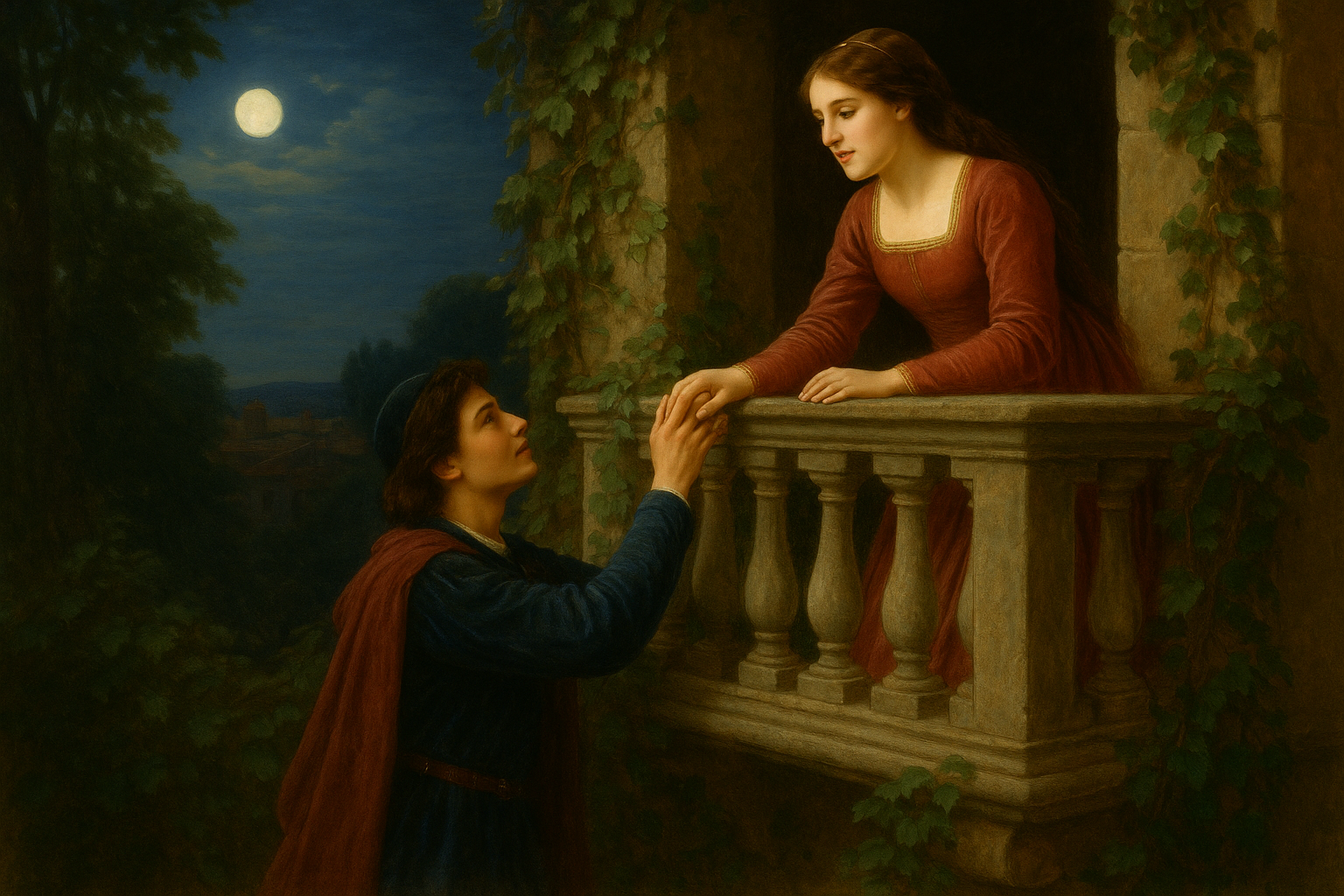
The Alchemy of the Balcony
I have been deeply engrossed in reading Shakespeare for a while. It remains one of the most astonishing paradoxes in literary history that Romeo and Juliet—a drama pulsing with murder, deception, impulsive rebellion and ethical transgression—has been remembered across continents and centuries, not for its violence but for a single, moonlit balcony. A recent film, O’Romeo, brought this truth to light by focusing on a passionate, high-stakes romance that mirrorsthe central, tumultuous love story of the classic play. Similar to the Montague/Capulet feud, O’Romeo roots in an intense rivalry within the modern-day Mumbai underworld, and though it does not replicate scenes, it clinically examines the perils of ‘forbidden love’.
Read plainly, the narrative is chaotic, almost startling in its speed and recklessness. A street brawl erupts within the first hundred lines. Romeo broods over a different girl altogether. Juliet, scarcely fourteen, is pressured into a marriage she does not want. Romeo trespasses into her home under the cover of night. Mercutio is slain in broad daylight, Tybalt falls in vengeance, Paris dies at the tomb, and Friar Lawrence—custodian of spiritual wisdom—concocts a dangerous sleep potion to fake Juliet’s death—so potent that he boasts it can borrow life from death.
“And in this borrowed likeness of shrunk death” (Act 4, Scene 1)
Immediately after Romeo kills Tybalt, he realises that his impulsive act of revenge has made him a plaything of fate. He must go into exile to save his life. He laments, in a moment of bitter clarity,
“O, I am fortune’s fool!” (Act 3, Scene 1)
Nothing about this world is calm or orderly; it is a society fermenting with feud, pride, honour and haste. Yet, despite this tumult, the moment that humanity has chosen to preserve, paint, film, dramatise and fall in love with is the quiet, tremulous exchange beneath Juliet’s window—the instant when Romeo whispers, breath held like a prayer, that it is the east, and that Juliet is the sun!
On that balcony, the world of Verona briefly dissolves (Act 2, Scene 2). No feud intrudes. No parent watches; no dagger glints. No banishment looms. No potion is brewed. Instead, the scene glows with the innocence of discovery, and the trembling honesty of two young souls speaking without armour. For those few minutes, we glimpse love unshadowed by consequence. It is the only time they are entirely themselves.
“But, soft! What light through yonder window breaks?
It is the east, and Juliet is the sun.”
Why does the world cling to this scene and not the events that shape the tragedy? Why is the balcony the emblem of the play, the cultural shorthand for love itself? The answer lies inselective human memory and irresistible human longing. We do not hold on to the full truth of an experience; we distil it. We are alchemists before we are historians. Juliet, aware of the danger, whispers fearfully,
“If they do see thee, they will murder thee.”
Yet her voice softens almost instantly as love overwhelms caution. She confesses in lines that have outlived kingdoms,
“My bounty is as boundless as the sea, my love as deep.”
Romeo, overwhelmed by her radiance, declares his own daring ascent,
“With love’s light wings did I o’erperch these walls”
In a way, Romeo and Juliet resembles the production of alcohol from coarse, sticky molasses. The raw materials of the play—the feud, the bloodshed, the rash decisions, and the priest’s deception—are thick, turbulent and unrefined. They bubble and ferment with heat, anxiety and danger. But when distilled, when separated from the heaviness of their origin, what rises is clear, fragrant and intoxicating: the pure vapour of yearning. The balcony scene is this vapour. It is the spirit extracted from the chaos—the moment when the residue falls away, and only emotion remains.
The balcony endures because it transforms private longing into a public symbol. Shakespeare, with remarkable psychological insight, understood that audiences crave a moment of sincerity amid chaos. The balcony becomes the boundary between childhood and adulthood, between safety and danger, between the earth and the sky. It is not just a window; it is a frontier where the ordinary world ends and a myth begins—and myths endure because they contain something we need. The fights, the murders, the terrible haste—these are the slow-moving elements. The gentle glow of the balcony is the concentrated spirit that the world chooses to drink.
But why did this particular play, among countless tragic romances, become the universal template? Part of its power lies in its treatment of love not as possession but as revelation. Romeo and Juliet’s passion is not engineered, planned, or socially advantageous; it erupts with the inevitability of a storm. This rawness makes it universally recognisable. Every culture has known the fever of first love—the sense that feelings define destiny and that the world cannot possibly understand the urgency burning within.
Another reason lies in how Shakespeare endows recklessnesswith rationality, transforming the volatility of young love into something that sounds almost inevitable. Adolescence is often dismissed as impulsive, emotional and irrational; yetShakespeare dignifies its wildness by offering a poetic logic to passion. When Juliet muses,
“What’s in a name? That which we call a rose
By any other name would smell as sweet.”
She is not merely defying her family’s feud; she is articulating the mind’s attempt to make sense of overwhelming feelings. In her reasoning, love itself becomes a force beyond labels, tribes, or inherited hatred—a self-justifying truth, like the rose’s fragrance.
Shakespeare thus allows recklessness to masquerade as clarity, giving young passion the philosophical defence it otherwise lacks. The audience, hearing such lines, accepts the lovers’ hurried devotion not as folly but as a kind of intuitive wisdom. We choose enchantment over caution because Shakespeare makes the illusion feel like the more profoundtruth.
This is why the story adapts so easily across cultures. In India, it becomes the tale of lovers divided by caste or community; in America, by race or class; in the Middle East, by tribe; in Japan, by tradition; in Europe, by politics or religion. The lovers become universal avatars of forbidden desire. Every society discovers its own feud within the Capulet–Montague hostility. Shakespeare’s poetry becomes the vessel into which each culture pours its own history, wounds and longings.
In the end, the world does not remember that they died; it remembers that they loved. And that is the alchemy of the balcony: the moment when two ordinary lives rose into myth, proving that even in a universe of chaos, a single instant of pure feeling can become eternal. Shakespeare’s play closes with the Prince’s grave, a chastening reminder—
“For never was a story of more woe
Than this of Juliet and her Romeo.” (Act 5, Scene 3)
Yet even in that sorrow, the world chooses the radiance that came before it, for tragedy is merely the residue, while love is the distilled spirit that rises. And thus the alchemy is complete: from the ferment of violence and folly emerges one pure, enduring vapour—the balcony’s eternal light.
MORE FROM THE BLOG

Stay Awake, Stay Connected
There are certain timeless truths that can be ignored only by the most callous among us. One such truth is the Buddhist concept of Triple Refuge: Buddham saranam gacchami—I take refuge in the Buddha (the Enlightened One or Teacher); Dhammam saranam gacchami—I take...

Layers of Becoming
When I sat on the chair on stage to be felicitated on the 13th Foundation Day of the Ozone Hospital, on February 28, 2026, and Telangana Transport Minister Mr. Ponnam Prabhakar, Telugu film star of yesteryears Mr. Suman Talwar, and Chairman Mr. Satya Sai Prasad...

The Unfulfilled Promise of Healthcare
Recently, I had the opportunity to spend nearly three hours in conversation at the Care Foundation, graciously hosted by its CEO, Mr. S. G. Prasad, whose quiet commitment to accessible healthcare has sustained many meaningful initiatives over the years. The meeting...

Romeo and Juliet by William Shakespeare is often celebrated as a story of passionate love, but at its core, it is a tragedy about inherited hatred. Two young people fall in love, yet the long-standing feud between their families destroys them. The play’s message is clear: when societies cling to divisions—whether of caste, religion, class, or ideology—love and humanity suffer. The tragedy warns that pride and prejudice passed from one generation to the next can ruin lives that had nothing to do with the original conflict.
A very thought-provocative blog Sir!
I especially loved the idea that we remember the “distilled spirit” of a story rather than its chaos. The analogy of fermentation and distillation captures perfectly how the violence and haste of Romeo and Juliet somehow leave us remembering only that luminous balcony moment. It captures something true about how we remember stories, perhaps our own lives too.
Loved the insight that the world remembers not the violence but the moment of unguarded tenderness beneath Juliet’s window. A thoughtful, evocative piece that shows how literature survives through the fragments the human heart chooses to keep.
Dear Sir, I saw this movie in 1977 when I was seventeen at Hospet. Having been a Kannada medium student up to my 10th standard, I could hardly understand the dialogue with that slang and accent. But the balcony scene is very vividly etched in my mind. The only thing that I remember about that movie is the balcony scene. This clearly tells us that the pure form of art or an act reaches your heart and leaves a lasting impression; you don’t need to understand the conversation. That particular scene was very intense. At that age, you always sympathise with the two, and everything else looks cruel against them.
I have no specific comment for or against. But the way you brought out the intensity of love between the two through the balcony alchemy is quite interesting and made me recall the scene and my understanding of that part of the movie. Sir, thank you once again for an interesting and thought-provoking blog.
The idea of a love story rising from the rubble of violence — compared to the making of alcohol — is something I could never have imagined. You truly have the rare ability to distill perspectives that are both unique and deeply engaging.
And those concluding lines are unforgettable:
“In the end, the world does not remember that they died; it remembers that they loved. And that is the alchemy of the balcony: the moment when two ordinary lives rose into myth, proving that even in a universe of chaos, a single instant of pure feeling can become eternal.”
They linger long after reading — almost like the very alchemy you describe.
Dear Sir, This is a profoundly illuminating reflection. What struck me most is your idea that we are “alchemists before historians.” The way you distil Romeo and Juliet into its emotional vapour rather than its narrative violence beautifully explains why the balcony outlives the bloodshed. It is not selective ignorance, but selective longing.
Your comparison to fermentation and distillation is especially powerful — the chaos as molasses, the balcony as spirit. It reframes tragedy not as the defining essence of the play, but as the residue from which something purer rises.
You also highlight something deeply human: we preserve moments that affirm hope, even when the story warns us otherwise. Perhaps the balcony endures because it reflects who we aspire to be — fearless in love, if only for an instant. Grateful for the way you make literature feel both timeless and urgently contemporary. Warm Regards.
Love exposes the absurdity of inherited hatred. The feud between the Montagues and Capulets is never explained. It is simply there—ancestral, unquestioned, corrosive. Against this irrational hostility, the lovers represent a new logic: connection over division. Their deaths reconcile the families. Love succeeds morally, even though it fails physically.
There is also something deeply adolescent in the play’s power. Romeo and Juliet love absolutely. There is no moderation. Modern readers may call it impulsive; Shakespeare presents it as total. Youth in the play is allied with authenticity; age is aligned with rigidity. The lovers’ refusal to calculate consequences becomes, paradoxically, their nobility.
And so the violence does not cancel the romance; it intensifies it. The fragility of their lives makes their declarations feel urgent. In a world where honour demands blood, they choose surrender. In a culture of pride, they choose vulnerability.
The play reminds us that, at its most iconic, romance is rarely about safety. It is about risk. It is about choosing another person despite the circumstances. It is about believing, however briefly, that love can outshine inherited darkness.
Shakespeare does not give us a happy ending. He gives us a luminous moment that costs everything. Perhaps that is why the play endures—not because it teaches us how to live in love, but because it captures the terrifying, radiant force of love when it first awakens, before compromise, before caution, before time.
It is one of literature’s great paradoxes that Romeo and Juliet—a play steeped in bloodshed, vendetta, secrecy, and impulsive death—has become the world’s supreme emblem of romance.
From its opening scene, the atmosphere is not tender but violent. The streets of Verona erupt in brawls. Masculine honour is fragile and combustible. Swords are drawn more quickly than words are considered. The lovers do not grow in a garden of peace; they bloom in a battlefield. Mercutio dies cursing both houses. Tybalt dies in revenge. Even the final act unfolds in a tomb. The play’s architecture is tragic, not sentimental. And yet, at its centre stands an intensity of feeling that feels pure, almost incandescent. Thank you for bringing out this excellent piece of literature.
The love of Romeo and Juliet is born in deception—a masked ball, concealed identities, secret vows. It survives only through concealment: a clandestine marriage, hidden messages, a feigned death. Every step forward requires a lie to someone else. In ordinary moral terms, this is not an ideal foundation. But Shakespeare transforms secrecy into intimacy. The very danger surrounding them sharpens their attachment. Love becomes not comfort, but defiance.
Why, then, does a story that ends in double suicide become synonymous with romance?
Partly because Shakespeare isolates love from time. Romeo and Juliet never grow disillusioned with one another. They never face domestic ordinariness, economic strain, ageing, or compromise. Their love remains suspended at its most lyrical moment. Juliet is “the sun.” Romeo is constant. Their language lifts them above the coarse world of feud and politics. In dying young, they escape erosion.
As usual, truly inspirational Arun ji, this reflection reminds us that life’s defining moments are not measured by duration, but by transformation. The balcony is not merely a place—it is a moment of awakening, where fear surrenders to purpose, and uncertainty gives way to clarity. In my journey as a cancer surgeon, I have seen how human beings rise above suffering, converting pain into courage and vulnerability into strength. We do not carry every detail of our struggles; we carry the meaning we derive from them. That meaning becomes our legacy. True alchemy lies not in changing circumstances, but in elevating the human spirit to see beyond them.
HaHa…Even Shakespeare must be turning and wondering in his grave that he never took balconies so seriously and something that can trigger such serious commentary.
The balcony holds a very special place in love stories across the Eastern world. Many love stories began on balconies and, for people of our age, most likely ended there.
The central idea is powerful: human beings are not faithful historians, but emotional alchemists. We selectively remember what uplifts us, extracting beauty from disorder. This is graceful, reflective piece that explains why certain moments in literature—and life—become timeless: they capture the essence of human longing, not the full complexity of human reality….
Hon’ble Sir, many thanks for describing the Alchemy of the Balcony, the Love and affection of Romeo and Juliet, the most famous story in your words. Certainly, we know about love, not the Sacrifice or their death. It also prevails in different forms in different parts of the world. With kind regards.
…….and in Africa by tribe/ethnicity too. And while the story of Romeo and Juliet was a well packaged play meant to teach a lesson while entertaining, we are living the script. A script sadly perpetuated by parents and community leaders in the name of preserving community norms/beliefs/traditions and keeping “clean” seed within the tribe or whatever else we want to call it. I would be surprised if none of us interacting with this piece by Prof Tiwari said we do not know someone practicing the same. …
Beautiful reflection and insights into the popular Shakespearean love story …