
Learning the Art of Writing by Reading
I enjoy reading quite a lot—sometimes as much as ten hours a day, though on average about eight. Reading has become my primary pastime—not as a leisure activity, but as a discipline. I read good books, chosen carefully, ordered online and added to a personal library built slowly and meticulously over the past fifty years. Every book is wrapped in a transparent plastic cover to protect it from dust and decay. I write in the margins, underline passages and affix slips of paper with tape. Books, for me, are not objects to be preserved in pristine condition; they are working instruments. I converse with them.
After publishing thirty-five books, I have decided not to write any more in that form. The inspiration came from Shakespeare, who wrote nothing in his last six years. However, I continue to write blogs—shorter, more flexible, and closer to thought in motion. Since May 2019, these blogs have been curated by Tanya Seth-Reddy. There are now more than 160 of them, each roughly a thousand words, recording observations, reflections, and, most importantly, stories of extraordinary people I have encountered. Sakal Publications published a book titled Spectrum, drawn from 150 of these blogs, that presents both my worldview and my writing style.
According to an AI analysis of my blogs, my writing falls within the stream-of-consciousness tradition pioneered by James Joyce and Virginia Woolf. I accept that description with some hesitation, because style is not something one consciously adopts. It emerges from long exposure, absorption and imitation—often unconsciously. On my website, I list ten books that shaped my thinking and explain how each influenced me at a particular stage of life. I neither inherited writing nor was educated in literature, nor learned to write through workshops or manuals. I learned to write by reading.
Among all writers, V. S. Naipaul has influenced me most—his moral seriousness, his clarity and his refusal to sentimentalise. Among living authors, Kazuo Ishiguro, who won the Nobel Prize in 2017, has been a profound teacher. Never Let Me Go, and Klara and the Sun confront the future not with spectacle, but with restraint, presenting a quiet humanity staring down an ethically diminished world. Margaret Atwood, especially through her MaddAddam trilogy, is another great teacher. She does not predict the future; she extrapolates from the present. These writers show what it means to think through fiction.
Here, I want to explain precisely what I mean by learning to write by reading, using Oryx and Crake—the first book I read in 2026—as an example.
In Oryx and Crake, Oryx is presented less as an animal than as a sound—a mantra severed from its original referent. The word survives, but its source, the antelope, has faded away. In this detachment lies Atwood’s quiet warning: meanings once rooted in lived reality are now abstracted, commodified, and hollowed out. Oryx’s own life mirrors this condition. She is shaped by forces she neither names nor controls, carried along by systems that preserve surface appearances while draining experience of depth.
Crake, by contrast, takes his name from a marshland bird that feeds in shallow waters, surviving on insects and molluscs. It is a creature adapted to liminal terrain—neither land nor water, neither depth nor stability. Atwood invokes this image deliberately. The world of Oryx and Crake resembles a vast marshland: ethically shallow, ecologically fragile and technologically saturated. In this landscape, technology does not cultivate or sustain; it forages. It feeds on natural resources, on bodies, on attention, and ultimately, on the human mind itself. Together, Oryx and Crake name a present in which words drift free of meaning and intelligence thrives in shallow ground—efficient, adaptive and extractive, yet incapable of reverence or restraint.
Atwood sets her novel around 2050, after a pandemic has wiped out most of humanity. The story is told through a man who survives and lives alone on an island with bioengineered humanoids. Atwood moves skilfully back and forth between the post-apocalyptic present—where the hero struggles to survive—and the pre-apocalyptic past of 2030, reconstructed through memory. This non-linear structure gradually reveals how the world fell apart, creating suspense while allowing the reader to learn inductively, rather than be told.
Atwood’s world-building is vivid and unsettling because it feels familiar. The sterile, high-tech corporate compounds are sharply contrasted with the chaotic and violent ‘pleeblands’, where the poor (plebeians) live. In the ‘Blood and Roses’ game, characters trade human achievements in art and music against histories of war and atrocity, reducing both to points. Civilisation itself becomes a scoreboard.
Memory, for Atwood, is not merely a narrative device but a central theme. The hero’s constant return to the past is both a coping mechanism and a burden. He is deeply flawed—an ‘intimate outsider’ who witnesses the disaster partly through his own complicity. This moral proximity is crucial. The reader identifies with him not because he is heroic, but because he is recognisably human.
Who is not like this helpless hero archetype of modern times? In our inability to effect change, embedded in our cowardice, we are later haunted by the guilt of a co-conspirator. But when was it ever different? Did not Bhishma watch in silence as Draupadi was subjected to an attempt at disrobing? Did he not lie upon a bed of arrows, delaying his death while reflecting and lamenting? Had he not awaited the auspicious phase of the Sun?
Is Atwood pointing out the same trajectory for the thoughtful people of the world? Atwood insists that she writes speculative fiction, not science fiction. Nothing in Oryx and Crake depends on impossible technology. The question she asks is not ‘can we do this?’, but ‘will we?’ What happens when scientific capability outruns ethical restraint? The novel is a warning, but it is also a compelling story—addictive, unsettling and meticulously constructed.
What I learned most from Oryx and Crake is the power of wordplay. Atwood’s stunning neologisms and puns expose the devaluation of language in a consumer-driven, high-tech world. Brand names do the work of philosophy. ‘NooSkin’ suggests renewal while concealing artificiality. ‘HelthWyzer’ masks corporate manipulation beneath the guise of managerial wisdom. The ‘BlyssPluss’ pill promises pleasure and enhancement while carrying a hidden plague. The secure facility where the new world is created is called ‘Paradice’—a play on paradise and dice—signalling that this supposedly perfect world is built on a reckless gamble.
Reading teaches that writing is not merely a vehicle for story, but a moral instrument. Language does not arrive empty; it carries histories, hierarchies, silences and choices. Ethics are embedded not only in what is said, but also in how patiently, honestly and sparingly it is said. A writer who reads learns that meaning is shaped as much by what comes first and what comes later as by the sentences in between.
Perhaps most powerfully, reading teaches the value of restraint. Consider, for example, Ernest Hemingway’s Hills Like White Elephants. The entire story deals with the dilemma of having an unwanted baby, but the word ’abortion’ is not used. The moral weight of the story lies entirely in the unsaid—in pauses, repetitions and evasions. The couple’s inability to name the problem mirrors their inability to face it honestly. Excess explanation would have weakened the story.
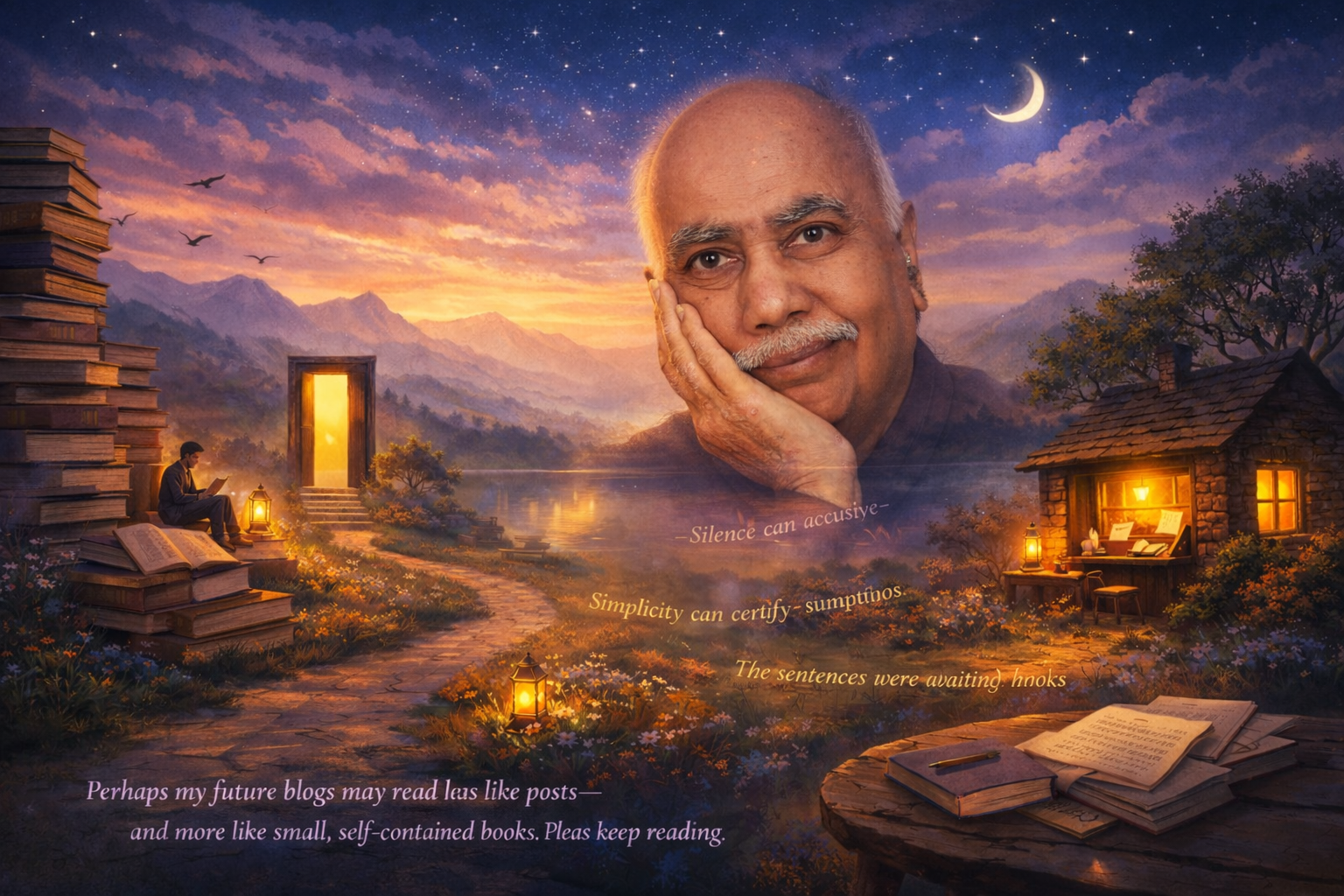
From such works, a writer learns that excess often betrays insecurity, while restraint signals trust—trust in language, in the reader, and in truth itself. Reading teaches that silence can accuse, simplicity can confer dignity, and structure can disclose what argument struggles to prove. When one reads deeply and attentively over many years, rhythms begin to seep in—along with moral posture, pauses, and an instinct for what must be left unsaid. This is not a shortcut but a discipline that demands time, patience and practice. And then, almost quietly, writing arrives with a revelation: the sentences were already there, waiting to be recognised. Perhaps that is why my future blogs may read less like posts and more like small, self-contained books.
Please keep reading—and do share your thoughts in the comments.
MORE FROM THE BLOG

The Unfulfilled Promise of Healthcare
Recently, I had the opportunity to spend nearly three hours in conversation at the Care Foundation, graciously hosted by its CEO, Mr. S. G. Prasad, whose quiet commitment to accessible healthcare has sustained many meaningful initiatives over the years. The meeting...

Kafka in the Age of the Gig Economy
In my youth, when I first read Franz Kafka’s Metamorphosis, published in 1915, it seemed to belong to a distant, shadowed landscape of European modernism—strange, unsettling, intellectually luminous, yet safely contained within literature. One reads differently at...
Those Who Transcend the Known
The best part of my career has been meeting eminent people and learning—often quietly—about the many facets of human excellence—something missed by those who pursue excellence in their own fields and live within their silos and echo chambers. Even now, when I travel...

Prof. Arun Tiwari, I will keep reading—because your reflections are not merely literary notes, but invitations to think more deeply, more ethically, and more patiently. Each blog feels less like a post and more like a quiet conversation with a disciplined mind that has read widely and lived thoughtfully.
What stands out most in this piece is your insistence that writing is a moral act shaped by years of attentive reading. In an era that rewards speed and noise, your commitment to restraint, structure, and ethical language is both rare and necessary. Your reading of Oryx and Crake especially demonstrates how literature can be examined not just for story, but for conscience.
Please continue to write. For many of us, your blogs are not simply essays—they are reminders that seriousness of thought and gentleness of spirit can coexist.
Enlightening insight into the anatomy of your writing, Prof Tiwariji!
Your creative writings left a lasting impression on readers!!
Reading and writing are not separate acts but two sides of the same coin. One cannot truly write without first learning to read deeply—absorbing the cadence of language, the discipline of thought, and the quiet honesty with which great minds shape words into meaning. Writing without reading is therefore impossible; it would be like trying to sing without ever having listened to music.
Yet the reverse is not necessary. A reader may choose never to write and still be fulfilled by the companionship of great books. But when such a reader finally dares to write, something remarkable happens. The words do not arrive as strangers; they seem already waiting within, formed slowly through years of attentive reading. What emerges on the page is not effort alone but a gentle flow—language remembering the paths it has long travelled in silence.
Thus, reading prepares the soil, and writing becomes the natural flowering. And when the flowering comes, it feels less like an achievement and more like a quiet inevitability.
Very interesting. I truly admire your sincere tapas of learning — an openness to receive wisdom from every direction and a quiet discipline in assimilating it into a harmonious whole. The confluence of literature, science, history, culture, and spirituality — moving freely across time and space — gives these reflections with a rare depth.
You had mentioned when we met in person as well, that like Shakespeare in his later life, you will be taking pause on authoring books. However, it is comforting that this continuing stream of fortnightly blogs will keep inspiring and nurturing thoughtful living for many of us.
Dear Sir, Greetings! This reflection beautifully affirms that writing is not manufactured—it is distilled from decades of disciplined reading. The way “Oryx and Crake” is examined here demonstrates how literature becomes not merely narrative, but moral inquiry and intellectual training. To learn to write by reading deeply is perhaps the most rigorous apprenticeship of all. Warm Regards.
I love how you describe reading not as a hobby, but almost as a daily practice that slowly shapes the way you think and write. The idea that style isn’t something you “choose” but something that seeps in over years of serious reading feels very true.
Your take on Atwood is especially engaging….the way names, structure, and even invented words carry moral weight. It’s a great reminder that writing isn’t just about telling a story, but about being careful and responsible with language.
A beautiful testament to reading as a lifelong discipline rather than a pastime. The reflection on learning to write through immersion captures how language, restraint, and moral clarity are cultivated over time. It reminds us that true writing is not constructed, but discovered through attentive reading, where meaning deepens as much in silence as in words.
Reading and writing belong to the same living continuum—two movements of a single creative breath. To write without reading is impossible, for writing draws its strength from the rhythms, meanings, and silences first encountered in the pages of others. Reading teaches the mind how language breathes, how thought finds form, and how truth becomes word.
Yet reading asks for nothing in return. A reader may remain only a listener all life and still be deeply enriched. But when such a reader finally turns toward writing, the act does not feel foreign. The sentences seem to rise from within, shaped quietly over years of attentive companionship with great books. What appears as creation is, in truth, remembrance—language flowing through a mind long prepared to receive it.
I agree with you Sir that writing is not separate from reading but its natural unfolding. When the moment arrives, it comes gently, like a river discovering its own course, carrying within it the echoes of every book that once lit the way.
Learning to write begins, paradoxically, with the humility to read. Great books do more than tell stories; they shape the rhythm of thought, refine the precision of language, and awaken the moral imagination. In their pages, we encounter clarity without arrogance, depth without obscurity, and beauty without excess. Slowly, almost invisibly, the mind absorbs cadence, structure, and truthfulness of expression. One learns that good writing is not ornament, but honesty made articulate. To read Shakespeare, Kafka, or the sages of any tradition is to sit in silent apprenticeship—watching how experience is distilled into words that endure. Thus, the path to writing well is not a hurried invention but patient companionship with greatness, until the borrowed light within us begins, quietly, to shine as our own.
Reading and writing are like inhaling and exhaling in the same breath of thought. One cannot write without first reading, because every sentence we compose is shaped—quietly and invisibly—by the sentences we have loved before. Reading teaches rhythm, patience, and truthfulness; it prepares the inner ear long before the hand begins to move.
Yet a reader is never obliged to become a writer. Many live richly in the company of books alone. But when a lifelong reader finally attempts to write, the words often arrive with surprising ease. It is like a musician who has listened to great music for years: the first note played is not entirely new, but a continuation of melodies already living within. Writing then feels less like invention and more like release—language flowing outward from a silence patiently filled by reading. In this way, reading and writing stay interconnected: one gathers the light, the other allows it to shine.
A very beautiful piece of writing, Sir. Learning to write begins not with the pen, but with attentive reading. Good books quietly train the mind—teaching rhythm without announcing it, revealing structure without displaying effort, and shaping thought through the company of great ideas. When we read deeply, we absorb clarity, humility, and precision; language becomes less a tool of display and more a bridge to truth. Over time, the voices of fine writers dissolve into our own inner voice, and writing emerges not as imitation, but as a natural flowering of understanding. Thus, to read well is to begin writing well, for every page of honest reading prepares a page of honest expression.
Arunji, This is a beautiful testament to reading as vocation rather than hobby. What stands out is not just the range of writers you engage with, but the seriousness with which you treat language as a moral force.
The idea that books are “working instruments” feels central. You do not consume them; you converse with them. And perhaps that is why your blogs continue to evolve—less like commentary, more like distilled thought.
If writing has arrived quietly, as you say, it is because it has been preceded by decades of disciplined listening.
It becomes quite a challenge to write a review when you can savor your favorite dessert, but the words fail to express that immense pleasure.
Beautifully written sir. In a world that rewards speed and constant explanation, choosing what not to say becomes an act of respect. The way you see silence, structure and trust in the reader feels calm and confident. It makes writing seem more about understanding it deeply.
Arun ji, Thank you for this blog on the art of writing by reading. Please let me know when the book on your blogs is published.
Arun ji, I have personally witnessed your deep discipline of reading and reflection, and how effortlessly you transform those thoughts into profound writing. Your ability to absorb wisdom through reading and express it with such clarity is truly inspiring. It reinforces the timeless truth that great writing is born from great reading, contemplation, and inner stillness. Your journey continues to motivate many of us to become better readers, thinkers, and contributors to society.
Supreme power (GOD) decides, and life (human) acts. As we have seen, you have whatever little experience you were born with to teach, preach, and light the path for future generations. And for that, you read, write and teach. How can Lord Ganesh put his pen down until Ved (Gyan)- Vyasa (Expander, Narrator) stops narrating the knowledge? And as Gyan never stops, so does the pen of Sri Ganesh. Jay ho Prabhu, Jay ho.
Very nice, sir. You are a very good, high-level, recognised writer; the skill comes from your regular and rigorous reading. We are all certainly inspired by your reading and writing skills, particularly I, blessed by your good self in the form of a book, ‘The Future of Food: Agriculture Leadership in a Tech-Driven World’. You have shaped this book in many ways, putting your visionary insights and thoughts into the small discussions at different points in time. I salute you, sir. Thanks and regards.
Prof Tiwari, not a doubt your thoughts find an exit through your pen for others to read and reflect on them, one approach cum style fitting all isn’t at all feasible, freedom is the way to go, readers will adapt in the process. I value the depth of your articles’ connection to life’s real challenges, which inspires the “oh, therefore I am not alone” response. As you correctly exposed, ‘Language does not arrive empty; it carries histories, hierarchies, silences and choices. Ethics are embedded not only in what is said, but also in how patiently, honestly and sparingly it is said.’
Keep walking your talk, my friend!
Sir, please don’t lay your pen down. Although your blogs are inspiring, we also need your books to clear our minds and provide a much-needed escape. Like how Dr Kalam lived his philosophy to the literal last second, the final, magnificent sprint of your book writing is much needed.
Pray, continue. We are all waiting.